How to Deploy Conversational AI for Insurance CX in 2026

Amir Prodensky
CEO
Mar 11, 2026
7 min read
A practical guide for insurance CX leaders deploying voice AI
Key takeaways:
Automating high-volume insurance service interactions such as policy inquiries, billing questions, and claims status checks can reduce contact center workload while improving service levels.
Deploying conversational AI for FNOL intake accelerates claims reporting, captures structured claim data, and provides policyholders with 24/7 support during loss events.
Integrating conversational AI with policy, billing, and claims systems enables automated interactions to complete real servicing tasks instead of only answering general questions.
Successful conversational AI deployments improve core CX metrics including containment rate, average handle time, and queue wait times without increasing agent headcount.
Customer experience leaders in insurance operate in a metrics-driven environment.
A VP of CX at a carrier like Nationwide or Plymouth Rock is responsible for service levels, average handle time, policyholder satisfaction, regulatory compliance, and the productivity of dozens or hundreds of service agents. Conversational AI has moved from experimental technology to operational infrastructure for these teams. The question is no longer whether to use it.
The real question is how to deploy conversational AI in a way that measurably improves policyholder service while reducing operational cost.
Why conversational AI is becoming core infrastructure for insurance CX
Customer experience leaders in insurance face structural pressure from three directions: increasing contact volumes, rising service expectations, and a limited supply of experienced agents. Conversational AI addresses these pressures not as a digital novelty, but as a capacity layer for customer-facing teams.
Strada’s platform is designed specifically for insurance service environments where interactions are tied to policy data, claims workflows, and regulatory requirements. Instead of replacing agents, the system absorbs repetitive interactions so agents can focus on complex policyholder needs.
For most carriers, inbound contact centers handle three primary interaction types:
Policy servicing requests
Claims-related inquiries
Billing or payment questions
These contacts often represent 60–80% of inbound volume, yet many follow structured workflows that can be automated without sacrificing experience quality.
What CX leaders are actually measured on
Customer experience leaders are rarely evaluated on technology adoption alone. They are measured on operational and policyholder outcomes such as:
CX metric | Why it matters in insurance |
Average handle time | Directly impacts staffing costs and queue times |
Call containment | Determines how many interactions require an agent |
Service level (e.g., 80/30) | Measures accessibility of customer support |
First contact resolution | Indicates whether issues are resolved without repeat calls |
Claims intake speed | Impacts customer satisfaction during loss events |
Cost per contact | Key operational efficiency metric |
CSAT or NPS | Signals policyholder loyalty and retention |
When conversational AI is deployed correctly, improvements across these metrics can compound.
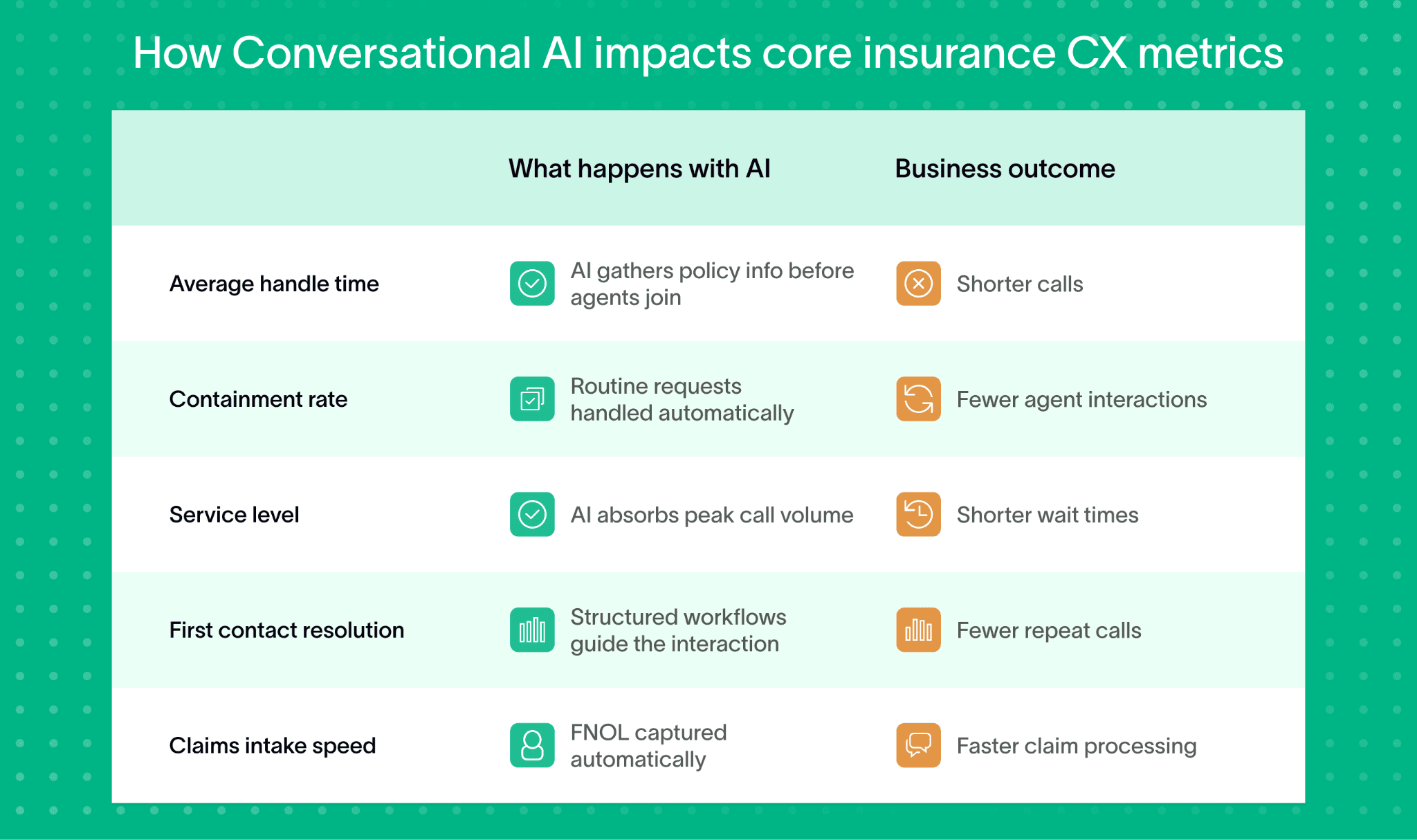
For example, many insurance deployments see:
50–70% automated containment for routine requests
30–55% reduction in handle time for assisted interactions
24/7 availability for FNOL intake and policy servicing
These improvements translate directly into reduced staffing pressure and improved service levels during peak demand.
The difference between generic AI and insurance-specific AI
Most conversational AI platforms are designed for general customer support. Insurance service operations require additional capabilities:
Integration with policy administration systems
Access to claims management platforms
Structured FNOL workflows
Secure identity verification
Complete audit trails for compliance
Strada is designed around these insurance realities. The platform connects directly to policy, billing, and claims systems so conversations are grounded in real policyholder data rather than static knowledge bases.
For CX leaders, that difference determines whether AI becomes a production system or remains a pilot project.
Where Strada creates the most immediate CX impact
The fastest way to improve contact center performance is to automate high-volume, low-complexity interactions. This is the operational starting point for most insurance conversational AI deployments.
Strada focuses first on the interactions that consume the largest share of agent capacity.
High-impact use cases for insurance conversational AI
Interaction type | Operational impact |
Policy status inquiries | Reduces simple account lookup calls |
Billing and payment questions | Handles repetitive payment reminders and updates |
Address or contact changes | Automates basic servicing requests |
Claims status checks | Eliminates frequent follow-up calls |
FNOL intake | Captures structured claim details before agent involvement |
Renewal inquiries | Provides policy renewal information automatically |
These interactions often represent thousands of contacts per week for mid-size carriers.
When conversational AI handles them autonomously, agents gain time to focus on higher-value tasks such as:
Complex claims discussions
coverage clarification
retention-sensitive policyholder conversations
The result is not only lower contact volume but also more productive agent time.
Why first notice of loss is often the first deployment
FNOL is one of the most strategically important use cases for insurance conversational AI.
A well-structured FNOL interaction captures key information needed to open a claim:
policyholder identity
incident description
location and timing
vehicle or property details
potential injuries or damages
Traditionally, this process requires a call center agent working through a scripted workflow.
Strada’s conversational AI can guide policyholders through the same process via voice, chat, or SMS while automatically recording the structured data required by claims systems.
For CX organizations, this has several operational benefits:
Benefit | CX outcome |
Faster claim intake | Reduces wait time during stressful events |
Structured data capture | Improves claim accuracy |
Lower agent workload | Frees adjusters and service reps |
24/7 FNOL availability | Improves customer trust and responsiveness |
During high-volume events such as storms or natural disasters, this capability becomes even more critical. Conversational AI allows carriers to absorb surge volumes without overwhelming service teams.
How to deploy conversational AI in insurance operations
Understanding how to deploy conversational AI is primarily about operational design rather than technology configuration. The most successful deployments align AI capabilities with CX performance metrics.
Strada approaches deployment with a CX outcomes framework rather than a technical rollout.
Step #1 Align automation with CX metrics
Conversational AI should target interactions that influence the metrics CX leaders manage daily.
CX metric | Automation strategy |
Reduce AHT | Automate repetitive account lookups |
Improve service levels | Absorb simple calls during peak periods |
Increase containment | Handle routine policy servicing autonomously |
Improve FNOL intake speed | Collect claim data automatically |
Reduce cost per contact | Shift simple interactions to AI channels |
This alignment ensures the AI deployment improves the metrics that leadership tracks.
Step #2 Integrate with core insurance systems
Insurance service interactions require access to operational systems such as:
Policy administration platforms
Claims management systems
Billing and payment services
CRM platforms used by service agents
Strada connects directly to these systems so the AI can perform real tasks such as retrieving policy data or updating contact information.
Without these integrations, conversational AI remains limited to answering general questions. With them, the system becomes an operational service channel.
Step #3 Preserve agent context during escalations
Even the best conversational AI will escalate some interactions to agents.
When escalation happens, the agent should receive full context:
policyholder identity
conversation history
actions already taken
claim or policy references
This prevents policyholders from repeating information and shortens agent handling time.
Strada automatically transfers this context during handoffs so the conversation continues seamlessly.
Step #4 Ensure compliance and data protection
Insurance interactions frequently involve sensitive personal data such as:
policy numbers
vehicle information
medical details
payment information
Conversational AI deployments must therefore meet strict security and governance standards.
Strada addresses these requirements through:
encrypted communication channels
data isolation controls
complete audit trails
compliance with SOC 2 and GDPR standards
For carriers operating in regulated environments, these safeguards are essential to deployment approval.
Measuring the CX impact of conversational AI
Once deployed, conversational AI must prove its value through measurable improvements in CX performance.
Strada provides analytics dashboards that allow CX leaders to track operational outcomes directly tied to AI interactions.
Core metrics for evaluating conversational AI
Metric | What it reveals |
Containment rate | Percentage of interactions resolved without agents |
Average handle time | Efficiency of agent-assisted interactions |
Interaction volume | Reduction in inbound calls |
FNOL completion rate | Effectiveness of automated claim intake |
Escalation rate | When human intervention is required |
CSAT impact | Policyholder satisfaction with automated interactions |
These metrics allow CX leaders to determine whether conversational AI is delivering operational improvements.
For many carriers, early deployments produce measurable results within the first few months:
Containment rates approaching 65% for routine interactions
AHT reductions of up to 55% for assisted contacts
Significant reductions in queue wait times during peak demand
These improvements translate into real staffing flexibility and improved policyholder service.
Continuous optimization
Conversational AI systems improve over time as more interaction data becomes available.
CX teams can use interaction logs to identify:
common escalation points
policyholder misunderstandings
new automation opportunities
Strada’s analytics tools allow teams to refine conversational flows and expand automation coverage as patterns emerge.
Over time, conversational AI evolves from a single automation project into a permanent capacity layer within the service organization.
How to launch a conversational AI tool easily across CX channels
Many CX leaders assume deploying AI will require major operational disruption. In reality, the fastest path is usually a focused pilot around one high-impact workflow.
This approach allows teams to validate results before expanding automation across the contact center.
A typical insurance deployment model
Phase | Objective |
Discovery | Identify high-volume service interactions |
Pilot | Deploy conversational AI for one workflow such as FNOL |
Measurement | Track containment, AHT, and policyholder satisfaction |
Expansion | Add additional servicing workflows |
Scaling | Extend automation across channels |
By beginning with a narrow use case, carriers can evaluate the impact quickly while minimizing operational risk.
Channels where conversational AI delivers value
Strada supports multiple interaction channels used by insurance policyholders:
Voice interactions through contact centers
SMS communication for quick updates
Web chat on policyholder portals
Email automation for service responses
Supporting multiple channels allows policyholders to engage through whichever medium is most convenient.
For CX leaders, this multi-channel capability reduces call center demand while improving accessibility.
Expanding beyond initial use cases
Once conversational AI proves effective in one workflow, carriers typically expand automation into additional service areas:
billing support
renewal reminders
claim status updates
document submission assistance
Each new workflow increases the system’s contribution to operational efficiency.
Eventually conversational AI becomes a permanent part of the service infrastructure, handling a large share of inbound policyholder interactions.
Conclusion
Insurance CX leaders face an ongoing challenge: delivering faster, more responsive service while controlling operational costs. Conversational AI provides a scalable way to expand service capacity without increasing headcount.
Strada approaches conversational AI from an insurance operations perspective. By integrating directly with policy, billing, and claims systems, the platform enables automated interactions that actually complete real service tasks.
When deployed strategically, conversational AI can improve containment, reduce handle times, accelerate FNOL intake, and strengthen the overall policyholder experience.
If you want to understand how to deploy conversational AI in your insurance contact center, request a Strada pilot review to evaluate the workflows with the highest CX impact.
Frequently Asked Questions
How can conversational AI help reduce pressure on our insurance contact center agents?
Conversational AI handles high-volume interactions such as policy inquiries, billing questions, and claims status checks. This frees agents to focus on complex policyholder situations while maintaining service levels during peak periods.
Why is FNOL often the first workflow carriers automate with conversational AI?
Framer is a design tool that allows you to design websites on a freeform canvas, and then publish them as websites with a single click.
How does conversational AI affect key CX metrics that leadership tracks?
Framer is a design tool that allows you to design websites on a freeform canvas, and then publish them as websites with a single click.
What should CX leaders prioritize when deciding where to deploy conversational AI first?
Framer is a design tool that allows you to design websites on a freeform canvas, and then publish them as websites with a single click.
How does insurance-specific conversational AI differ from general customer support AI?
Framer is a design tool that allows you to design websites on a freeform canvas, and then publish them as websites with a single click.
Table of Contents
Carriers, MGAs, and brokers scale revenue-driving phone calls with Strada's conversational AI platform.
Start scaling with voice AI agents today
Join innovative carriers and MGAs transforming their calls with Strada.
How to Deploy Conversational AI for Insurance CX in 2026

Amir Prodensky
CEO
Mar 11, 2026
7 min read
A practical guide for insurance CX leaders deploying voice AI
Key takeaways:
Automating high-volume insurance service interactions such as policy inquiries, billing questions, and claims status checks can reduce contact center workload while improving service levels.
Deploying conversational AI for FNOL intake accelerates claims reporting, captures structured claim data, and provides policyholders with 24/7 support during loss events.
Integrating conversational AI with policy, billing, and claims systems enables automated interactions to complete real servicing tasks instead of only answering general questions.
Successful conversational AI deployments improve core CX metrics including containment rate, average handle time, and queue wait times without increasing agent headcount.
Customer experience leaders in insurance operate in a metrics-driven environment.
A VP of CX at a carrier like Nationwide or Plymouth Rock is responsible for service levels, average handle time, policyholder satisfaction, regulatory compliance, and the productivity of dozens or hundreds of service agents. Conversational AI has moved from experimental technology to operational infrastructure for these teams. The question is no longer whether to use it.
The real question is how to deploy conversational AI in a way that measurably improves policyholder service while reducing operational cost.
Why conversational AI is becoming core infrastructure for insurance CX
Customer experience leaders in insurance face structural pressure from three directions: increasing contact volumes, rising service expectations, and a limited supply of experienced agents. Conversational AI addresses these pressures not as a digital novelty, but as a capacity layer for customer-facing teams.
Strada’s platform is designed specifically for insurance service environments where interactions are tied to policy data, claims workflows, and regulatory requirements. Instead of replacing agents, the system absorbs repetitive interactions so agents can focus on complex policyholder needs.
For most carriers, inbound contact centers handle three primary interaction types:
Policy servicing requests
Claims-related inquiries
Billing or payment questions
These contacts often represent 60–80% of inbound volume, yet many follow structured workflows that can be automated without sacrificing experience quality.
What CX leaders are actually measured on
Customer experience leaders are rarely evaluated on technology adoption alone. They are measured on operational and policyholder outcomes such as:
CX metric | Why it matters in insurance |
Average handle time | Directly impacts staffing costs and queue times |
Call containment | Determines how many interactions require an agent |
Service level (e.g., 80/30) | Measures accessibility of customer support |
First contact resolution | Indicates whether issues are resolved without repeat calls |
Claims intake speed | Impacts customer satisfaction during loss events |
Cost per contact | Key operational efficiency metric |
CSAT or NPS | Signals policyholder loyalty and retention |
When conversational AI is deployed correctly, improvements across these metrics can compound.

For example, many insurance deployments see:
50–70% automated containment for routine requests
30–55% reduction in handle time for assisted interactions
24/7 availability for FNOL intake and policy servicing
These improvements translate directly into reduced staffing pressure and improved service levels during peak demand.
The difference between generic AI and insurance-specific AI
Most conversational AI platforms are designed for general customer support. Insurance service operations require additional capabilities:
Integration with policy administration systems
Access to claims management platforms
Structured FNOL workflows
Secure identity verification
Complete audit trails for compliance
Strada is designed around these insurance realities. The platform connects directly to policy, billing, and claims systems so conversations are grounded in real policyholder data rather than static knowledge bases.
For CX leaders, that difference determines whether AI becomes a production system or remains a pilot project.
Where Strada creates the most immediate CX impact
The fastest way to improve contact center performance is to automate high-volume, low-complexity interactions. This is the operational starting point for most insurance conversational AI deployments.
Strada focuses first on the interactions that consume the largest share of agent capacity.
High-impact use cases for insurance conversational AI
Interaction type | Operational impact |
Policy status inquiries | Reduces simple account lookup calls |
Billing and payment questions | Handles repetitive payment reminders and updates |
Address or contact changes | Automates basic servicing requests |
Claims status checks | Eliminates frequent follow-up calls |
FNOL intake | Captures structured claim details before agent involvement |
Renewal inquiries | Provides policy renewal information automatically |
These interactions often represent thousands of contacts per week for mid-size carriers.
When conversational AI handles them autonomously, agents gain time to focus on higher-value tasks such as:
Complex claims discussions
coverage clarification
retention-sensitive policyholder conversations
The result is not only lower contact volume but also more productive agent time.
Why first notice of loss is often the first deployment
FNOL is one of the most strategically important use cases for insurance conversational AI.
A well-structured FNOL interaction captures key information needed to open a claim:
policyholder identity
incident description
location and timing
vehicle or property details
potential injuries or damages
Traditionally, this process requires a call center agent working through a scripted workflow.
Strada’s conversational AI can guide policyholders through the same process via voice, chat, or SMS while automatically recording the structured data required by claims systems.
For CX organizations, this has several operational benefits:
Benefit | CX outcome |
Faster claim intake | Reduces wait time during stressful events |
Structured data capture | Improves claim accuracy |
Lower agent workload | Frees adjusters and service reps |
24/7 FNOL availability | Improves customer trust and responsiveness |
During high-volume events such as storms or natural disasters, this capability becomes even more critical. Conversational AI allows carriers to absorb surge volumes without overwhelming service teams.
How to deploy conversational AI in insurance operations
Understanding how to deploy conversational AI is primarily about operational design rather than technology configuration. The most successful deployments align AI capabilities with CX performance metrics.
Strada approaches deployment with a CX outcomes framework rather than a technical rollout.
Step #1 Align automation with CX metrics
Conversational AI should target interactions that influence the metrics CX leaders manage daily.
CX metric | Automation strategy |
Reduce AHT | Automate repetitive account lookups |
Improve service levels | Absorb simple calls during peak periods |
Increase containment | Handle routine policy servicing autonomously |
Improve FNOL intake speed | Collect claim data automatically |
Reduce cost per contact | Shift simple interactions to AI channels |
This alignment ensures the AI deployment improves the metrics that leadership tracks.
Step #2 Integrate with core insurance systems
Insurance service interactions require access to operational systems such as:
Policy administration platforms
Claims management systems
Billing and payment services
CRM platforms used by service agents
Strada connects directly to these systems so the AI can perform real tasks such as retrieving policy data or updating contact information.
Without these integrations, conversational AI remains limited to answering general questions. With them, the system becomes an operational service channel.
Step #3 Preserve agent context during escalations
Even the best conversational AI will escalate some interactions to agents.
When escalation happens, the agent should receive full context:
policyholder identity
conversation history
actions already taken
claim or policy references
This prevents policyholders from repeating information and shortens agent handling time.
Strada automatically transfers this context during handoffs so the conversation continues seamlessly.
Step #4 Ensure compliance and data protection
Insurance interactions frequently involve sensitive personal data such as:
policy numbers
vehicle information
medical details
payment information
Conversational AI deployments must therefore meet strict security and governance standards.
Strada addresses these requirements through:
encrypted communication channels
data isolation controls
complete audit trails
compliance with SOC 2 and GDPR standards
For carriers operating in regulated environments, these safeguards are essential to deployment approval.
Measuring the CX impact of conversational AI
Once deployed, conversational AI must prove its value through measurable improvements in CX performance.
Strada provides analytics dashboards that allow CX leaders to track operational outcomes directly tied to AI interactions.
Core metrics for evaluating conversational AI
Metric | What it reveals |
Containment rate | Percentage of interactions resolved without agents |
Average handle time | Efficiency of agent-assisted interactions |
Interaction volume | Reduction in inbound calls |
FNOL completion rate | Effectiveness of automated claim intake |
Escalation rate | When human intervention is required |
CSAT impact | Policyholder satisfaction with automated interactions |
These metrics allow CX leaders to determine whether conversational AI is delivering operational improvements.
For many carriers, early deployments produce measurable results within the first few months:
Containment rates approaching 65% for routine interactions
AHT reductions of up to 55% for assisted contacts
Significant reductions in queue wait times during peak demand
These improvements translate into real staffing flexibility and improved policyholder service.
Continuous optimization
Conversational AI systems improve over time as more interaction data becomes available.
CX teams can use interaction logs to identify:
common escalation points
policyholder misunderstandings
new automation opportunities
Strada’s analytics tools allow teams to refine conversational flows and expand automation coverage as patterns emerge.
Over time, conversational AI evolves from a single automation project into a permanent capacity layer within the service organization.
How to launch a conversational AI tool easily across CX channels
Many CX leaders assume deploying AI will require major operational disruption. In reality, the fastest path is usually a focused pilot around one high-impact workflow.
This approach allows teams to validate results before expanding automation across the contact center.
A typical insurance deployment model
Phase | Objective |
Discovery | Identify high-volume service interactions |
Pilot | Deploy conversational AI for one workflow such as FNOL |
Measurement | Track containment, AHT, and policyholder satisfaction |
Expansion | Add additional servicing workflows |
Scaling | Extend automation across channels |
By beginning with a narrow use case, carriers can evaluate the impact quickly while minimizing operational risk.
Channels where conversational AI delivers value
Strada supports multiple interaction channels used by insurance policyholders:
Voice interactions through contact centers
SMS communication for quick updates
Web chat on policyholder portals
Email automation for service responses
Supporting multiple channels allows policyholders to engage through whichever medium is most convenient.
For CX leaders, this multi-channel capability reduces call center demand while improving accessibility.
Expanding beyond initial use cases
Once conversational AI proves effective in one workflow, carriers typically expand automation into additional service areas:
billing support
renewal reminders
claim status updates
document submission assistance
Each new workflow increases the system’s contribution to operational efficiency.
Eventually conversational AI becomes a permanent part of the service infrastructure, handling a large share of inbound policyholder interactions.
Conclusion
Insurance CX leaders face an ongoing challenge: delivering faster, more responsive service while controlling operational costs. Conversational AI provides a scalable way to expand service capacity without increasing headcount.
Strada approaches conversational AI from an insurance operations perspective. By integrating directly with policy, billing, and claims systems, the platform enables automated interactions that actually complete real service tasks.
When deployed strategically, conversational AI can improve containment, reduce handle times, accelerate FNOL intake, and strengthen the overall policyholder experience.
If you want to understand how to deploy conversational AI in your insurance contact center, request a Strada pilot review to evaluate the workflows with the highest CX impact.
Frequently Asked Questions
How can conversational AI help reduce pressure on our insurance contact center agents?
Conversational AI handles high-volume interactions such as policy inquiries, billing questions, and claims status checks. This frees agents to focus on complex policyholder situations while maintaining service levels during peak periods.
Why is FNOL often the first workflow carriers automate with conversational AI?
Framer is a design tool that allows you to design websites on a freeform canvas, and then publish them as websites with a single click.
How does conversational AI affect key CX metrics that leadership tracks?
Framer is a design tool that allows you to design websites on a freeform canvas, and then publish them as websites with a single click.
What should CX leaders prioritize when deciding where to deploy conversational AI first?
Framer is a design tool that allows you to design websites on a freeform canvas, and then publish them as websites with a single click.
How does insurance-specific conversational AI differ from general customer support AI?
Framer is a design tool that allows you to design websites on a freeform canvas, and then publish them as websites with a single click.
Table of Contents
Carriers, MGAs, and brokers scale revenue-driving phone calls with Strada's conversational AI platform.
Start scaling with voice AI agents today
Join innovative carriers and MGAs transforming their calls with Strada.
How to Deploy Conversational AI for Insurance CX in 2026

Amir Prodensky
CEO
Mar 11, 2026
7 min read
A practical guide for insurance CX leaders deploying voice AI
Key takeaways:
Automating high-volume insurance service interactions such as policy inquiries, billing questions, and claims status checks can reduce contact center workload while improving service levels.
Deploying conversational AI for FNOL intake accelerates claims reporting, captures structured claim data, and provides policyholders with 24/7 support during loss events.
Integrating conversational AI with policy, billing, and claims systems enables automated interactions to complete real servicing tasks instead of only answering general questions.
Successful conversational AI deployments improve core CX metrics including containment rate, average handle time, and queue wait times without increasing agent headcount.
Customer experience leaders in insurance operate in a metrics-driven environment.
A VP of CX at a carrier like Nationwide or Plymouth Rock is responsible for service levels, average handle time, policyholder satisfaction, regulatory compliance, and the productivity of dozens or hundreds of service agents. Conversational AI has moved from experimental technology to operational infrastructure for these teams. The question is no longer whether to use it.
The real question is how to deploy conversational AI in a way that measurably improves policyholder service while reducing operational cost.
Why conversational AI is becoming core infrastructure for insurance CX
Customer experience leaders in insurance face structural pressure from three directions: increasing contact volumes, rising service expectations, and a limited supply of experienced agents. Conversational AI addresses these pressures not as a digital novelty, but as a capacity layer for customer-facing teams.
Strada’s platform is designed specifically for insurance service environments where interactions are tied to policy data, claims workflows, and regulatory requirements. Instead of replacing agents, the system absorbs repetitive interactions so agents can focus on complex policyholder needs.
For most carriers, inbound contact centers handle three primary interaction types:
Policy servicing requests
Claims-related inquiries
Billing or payment questions
These contacts often represent 60–80% of inbound volume, yet many follow structured workflows that can be automated without sacrificing experience quality.
What CX leaders are actually measured on
Customer experience leaders are rarely evaluated on technology adoption alone. They are measured on operational and policyholder outcomes such as:
CX metric | Why it matters in insurance |
Average handle time | Directly impacts staffing costs and queue times |
Call containment | Determines how many interactions require an agent |
Service level (e.g., 80/30) | Measures accessibility of customer support |
First contact resolution | Indicates whether issues are resolved without repeat calls |
Claims intake speed | Impacts customer satisfaction during loss events |
Cost per contact | Key operational efficiency metric |
CSAT or NPS | Signals policyholder loyalty and retention |
When conversational AI is deployed correctly, improvements across these metrics can compound.

For example, many insurance deployments see:
50–70% automated containment for routine requests
30–55% reduction in handle time for assisted interactions
24/7 availability for FNOL intake and policy servicing
These improvements translate directly into reduced staffing pressure and improved service levels during peak demand.
The difference between generic AI and insurance-specific AI
Most conversational AI platforms are designed for general customer support. Insurance service operations require additional capabilities:
Integration with policy administration systems
Access to claims management platforms
Structured FNOL workflows
Secure identity verification
Complete audit trails for compliance
Strada is designed around these insurance realities. The platform connects directly to policy, billing, and claims systems so conversations are grounded in real policyholder data rather than static knowledge bases.
For CX leaders, that difference determines whether AI becomes a production system or remains a pilot project.
Where Strada creates the most immediate CX impact
The fastest way to improve contact center performance is to automate high-volume, low-complexity interactions. This is the operational starting point for most insurance conversational AI deployments.
Strada focuses first on the interactions that consume the largest share of agent capacity.
High-impact use cases for insurance conversational AI
Interaction type | Operational impact |
Policy status inquiries | Reduces simple account lookup calls |
Billing and payment questions | Handles repetitive payment reminders and updates |
Address or contact changes | Automates basic servicing requests |
Claims status checks | Eliminates frequent follow-up calls |
FNOL intake | Captures structured claim details before agent involvement |
Renewal inquiries | Provides policy renewal information automatically |
These interactions often represent thousands of contacts per week for mid-size carriers.
When conversational AI handles them autonomously, agents gain time to focus on higher-value tasks such as:
Complex claims discussions
coverage clarification
retention-sensitive policyholder conversations
The result is not only lower contact volume but also more productive agent time.
Why first notice of loss is often the first deployment
FNOL is one of the most strategically important use cases for insurance conversational AI.
A well-structured FNOL interaction captures key information needed to open a claim:
policyholder identity
incident description
location and timing
vehicle or property details
potential injuries or damages
Traditionally, this process requires a call center agent working through a scripted workflow.
Strada’s conversational AI can guide policyholders through the same process via voice, chat, or SMS while automatically recording the structured data required by claims systems.
For CX organizations, this has several operational benefits:
Benefit | CX outcome |
Faster claim intake | Reduces wait time during stressful events |
Structured data capture | Improves claim accuracy |
Lower agent workload | Frees adjusters and service reps |
24/7 FNOL availability | Improves customer trust and responsiveness |
During high-volume events such as storms or natural disasters, this capability becomes even more critical. Conversational AI allows carriers to absorb surge volumes without overwhelming service teams.
How to deploy conversational AI in insurance operations
Understanding how to deploy conversational AI is primarily about operational design rather than technology configuration. The most successful deployments align AI capabilities with CX performance metrics.
Strada approaches deployment with a CX outcomes framework rather than a technical rollout.
Step #1 Align automation with CX metrics
Conversational AI should target interactions that influence the metrics CX leaders manage daily.
CX metric | Automation strategy |
Reduce AHT | Automate repetitive account lookups |
Improve service levels | Absorb simple calls during peak periods |
Increase containment | Handle routine policy servicing autonomously |
Improve FNOL intake speed | Collect claim data automatically |
Reduce cost per contact | Shift simple interactions to AI channels |
This alignment ensures the AI deployment improves the metrics that leadership tracks.
Step #2 Integrate with core insurance systems
Insurance service interactions require access to operational systems such as:
Policy administration platforms
Claims management systems
Billing and payment services
CRM platforms used by service agents
Strada connects directly to these systems so the AI can perform real tasks such as retrieving policy data or updating contact information.
Without these integrations, conversational AI remains limited to answering general questions. With them, the system becomes an operational service channel.
Step #3 Preserve agent context during escalations
Even the best conversational AI will escalate some interactions to agents.
When escalation happens, the agent should receive full context:
policyholder identity
conversation history
actions already taken
claim or policy references
This prevents policyholders from repeating information and shortens agent handling time.
Strada automatically transfers this context during handoffs so the conversation continues seamlessly.
Step #4 Ensure compliance and data protection
Insurance interactions frequently involve sensitive personal data such as:
policy numbers
vehicle information
medical details
payment information
Conversational AI deployments must therefore meet strict security and governance standards.
Strada addresses these requirements through:
encrypted communication channels
data isolation controls
complete audit trails
compliance with SOC 2 and GDPR standards
For carriers operating in regulated environments, these safeguards are essential to deployment approval.
Measuring the CX impact of conversational AI
Once deployed, conversational AI must prove its value through measurable improvements in CX performance.
Strada provides analytics dashboards that allow CX leaders to track operational outcomes directly tied to AI interactions.
Core metrics for evaluating conversational AI
Metric | What it reveals |
Containment rate | Percentage of interactions resolved without agents |
Average handle time | Efficiency of agent-assisted interactions |
Interaction volume | Reduction in inbound calls |
FNOL completion rate | Effectiveness of automated claim intake |
Escalation rate | When human intervention is required |
CSAT impact | Policyholder satisfaction with automated interactions |
These metrics allow CX leaders to determine whether conversational AI is delivering operational improvements.
For many carriers, early deployments produce measurable results within the first few months:
Containment rates approaching 65% for routine interactions
AHT reductions of up to 55% for assisted contacts
Significant reductions in queue wait times during peak demand
These improvements translate into real staffing flexibility and improved policyholder service.
Continuous optimization
Conversational AI systems improve over time as more interaction data becomes available.
CX teams can use interaction logs to identify:
common escalation points
policyholder misunderstandings
new automation opportunities
Strada’s analytics tools allow teams to refine conversational flows and expand automation coverage as patterns emerge.
Over time, conversational AI evolves from a single automation project into a permanent capacity layer within the service organization.
How to launch a conversational AI tool easily across CX channels
Many CX leaders assume deploying AI will require major operational disruption. In reality, the fastest path is usually a focused pilot around one high-impact workflow.
This approach allows teams to validate results before expanding automation across the contact center.
A typical insurance deployment model
Phase | Objective |
Discovery | Identify high-volume service interactions |
Pilot | Deploy conversational AI for one workflow such as FNOL |
Measurement | Track containment, AHT, and policyholder satisfaction |
Expansion | Add additional servicing workflows |
Scaling | Extend automation across channels |
By beginning with a narrow use case, carriers can evaluate the impact quickly while minimizing operational risk.
Channels where conversational AI delivers value
Strada supports multiple interaction channels used by insurance policyholders:
Voice interactions through contact centers
SMS communication for quick updates
Web chat on policyholder portals
Email automation for service responses
Supporting multiple channels allows policyholders to engage through whichever medium is most convenient.
For CX leaders, this multi-channel capability reduces call center demand while improving accessibility.
Expanding beyond initial use cases
Once conversational AI proves effective in one workflow, carriers typically expand automation into additional service areas:
billing support
renewal reminders
claim status updates
document submission assistance
Each new workflow increases the system’s contribution to operational efficiency.
Eventually conversational AI becomes a permanent part of the service infrastructure, handling a large share of inbound policyholder interactions.
Conclusion
Insurance CX leaders face an ongoing challenge: delivering faster, more responsive service while controlling operational costs. Conversational AI provides a scalable way to expand service capacity without increasing headcount.
Strada approaches conversational AI from an insurance operations perspective. By integrating directly with policy, billing, and claims systems, the platform enables automated interactions that actually complete real service tasks.
When deployed strategically, conversational AI can improve containment, reduce handle times, accelerate FNOL intake, and strengthen the overall policyholder experience.
If you want to understand how to deploy conversational AI in your insurance contact center, request a Strada pilot review to evaluate the workflows with the highest CX impact.
Frequently Asked Questions
How can conversational AI help reduce pressure on our insurance contact center agents?
Conversational AI handles high-volume interactions such as policy inquiries, billing questions, and claims status checks. This frees agents to focus on complex policyholder situations while maintaining service levels during peak periods.
Why is FNOL often the first workflow carriers automate with conversational AI?
Framer is a design tool that allows you to design websites on a freeform canvas, and then publish them as websites with a single click.
How does conversational AI affect key CX metrics that leadership tracks?
Framer is a design tool that allows you to design websites on a freeform canvas, and then publish them as websites with a single click.
What should CX leaders prioritize when deciding where to deploy conversational AI first?
Framer is a design tool that allows you to design websites on a freeform canvas, and then publish them as websites with a single click.
How does insurance-specific conversational AI differ from general customer support AI?
Framer is a design tool that allows you to design websites on a freeform canvas, and then publish them as websites with a single click.
Table of Contents
Carriers, MGAs, and brokers scale revenue-driving phone calls with Strada's conversational AI platform.
Start scaling with voice AI agents today
Join innovative carriers and MGAs transforming their calls with Strada.
© 2026 Strada API, Inc.
