Blog

/

AI & Automation

How Voice AI Eliminates Manual Data Entry in Insurance in 2026

Amir Prodensky

CEO

Dec 25, 2025

17 min read

How insurers capture structured data without manual input

Manual data entry means typing information from calls, forms, or documents into systems by hand. Despite automation trends, it’s still everywhere in insurance. 

Why? The industry faces hurdles like complex regulations, messy varied data formats, and old legacy systems that don’t easily connect. This slows progress, costs time, and causes headaches.

Here’s what manual data entry costs you:

  • Lost time on repetitive tasks.

  • Frequent errors leading to costly fixes.

  • Employee burnout from tedious work.

  • Inefficiencies that drag down operations.

For example, the CAQH Index shows that manual entry errors cost billions yearly across healthcare-related sectors. The pandemic pushed insurers to rethink digital paths, boosting interest in smart tools like Voice AI. 

And most insurers don’t struggle because they lack tools. They struggle because the everyday process is slow and messy. 

That’s why it helps to zoom in on what “manual entry” really looks like day to day.

What is manual data entry and why does it matter in insurance?

Manual data entry means typing or rekeying info from paper forms or documents into digital systems. In insurance, this includes customer details, claims info, policy applications, underwriting data, and invoices. 

You’ll often see teams handling first notice of loss (FNOL) intake or claims registration by typing data from various sources.

Here’s a quick look at common manual entry tasks:

  • Entering handwritten forms or notes.

  • Typing details from faxes and emails.

  • Scanning documents but still needing corrections.

Accuracy matters because even small mistakes can lead to wrong insurance decisions, compliance issues, unhappy customers, and higher risks. Agents often enter hundreds of data points daily, creating bottlenecks and fatigue.

Different data formats, like handwritten notes and faxes, make manual entry tricky and prone to errors. Common validation methods like double entry or spot checks help but aren’t foolproof and slow things down further. 

In fact, manual vs automated data entry shows that automation can cut errors and speed up processing.

Strada’s conversational AI platform helps reduce manual data entry by capturing key info during phone calls like FNOL and quote intake. Their AI models understand insurance language, improving voice data accuracy and making your work easier and faster. 

Still, on paper, manual input looks like a small admin task. In practice, it quickly turns into a bottleneck across calls, claims, and back-office work.

What problems do manual data entry cause in insurance?

Manual data entry problems in insurance slow down workflows and make tasks tedious and repetitive. Employees spend hours typing and retyping data, which drains productivity. 

On average, manual entry error rates hover around 1%. 

These errors include spelling mistakes, misformatted fields, and missing data. Even a small slip can cause costly consequences like compliance penalties or rejected claims.

If you zoom in on daily operations, these issues show up in the same places again and again.

Area

What’s happening

Result

Live calls

Agents type while listening

Missed or incomplete details

Post-call work

Data is re-entered into systems

Duplicate effort and new errors

Forms and fields

Information is recalled from memory

Inconsistent records

Compliance review

Errors found late

Delays and rework

Follow-ups

Staff fix mistakes instead of progressing cases

Slower resolutions

You might be surprised to learn that each manual invoice processing costs about $15.97, while claim inquiry costs range from $12 to $16, according to CAQH data. Multiply that by thousands of transactions, and it quickly adds up. 

Here’s a quick look at the impact of manual entry:

  • Time lost → Employees spend significant daily hours on data entry instead of focusing on customers.

  • Employee burnout → Repetitive tasks kill engagement and increase turnover risks.

  • Compliance risks → Handling sensitive health and personal info manually raises the chance of breaches and audit failures under HIPAA, GDPR, and SOX frameworks.

For example, delayed claims or policy errors caused by manual mistakes can lead to regulatory fines and unhappy customers. These hidden costs also affect your frontline staff who could be working on proactive risk management instead.

You’ll find automation a game-changer here. Solutions like Strada automate manual data entry through Voice AI agents available 24/7 for claims intake and policy servicing. 

This technology delivers near real-time, accurate data capture with built-in security: SOC 2 Type 2 compliance, encrypted voice data, and customer data isolation. 

Given all these issues, it’s fair to ask why manual entry hasn’t disappeared yet. The answer isn’t technical. It’s practical, organizational, and sometimes cultural.

Why do insurance companies still rely on manual data entry?

You might wonder why many insurance companies still outsource manual data entry despite all the buzz around automation. 

The truth is, several practical barriers keep them tied to old methods.

Where cost and complexity slow automation

Cost worries top the list. Many insurers, especially smaller ones, fear the upfront investment and don’t have extensive automation knowledge to weigh benefits clearly. Large insurers have legacy systems that complicate updates. 

Plus, insurance data is complex and varies widely by product, geography, and regulation, making standardization tough and slowing automation efforts.

Organizational resistance and risk aversion

Organizational culture also plays a big role in slowing adoption. Even when automation is discussed, internal dynamics often push companies to move cautiously. 

Key factors include:

  • Risk aversion → Companies prefer familiar processes and avoid change.

  • Slow procurement processes → Decision-making takes time and delays adoption.

  • Siloed departments → Teams operate separately, limiting coordinated action.

  • Misconceptions about voice and AI automation → Beliefs that it’s expensive, complex, or unreliable.

  • Concerns about AI accuracy and data privacy → Fears around unintended consequences stop progress.

As a result, these organizational factors often block automation before technical limitations ever come into play.

Integration challenges and regulatory constraints

Integration fears add another layer. 

Choosing vendors and ensuring new tools work with existing ERPs and CRMs can feel overwhelming. For example, geographic regulations differ greatly; the EU has stricter data rules than the US, limiting automation options in some regions.

Here’s why Strada stands out: it offers no engineering lift integrations with common AMS, CRM, and insurance platforms, plus low-code/no-code workflow automation through Strada Workflows, making adoption hassle-free. 

You can reduce manual data entry with insurance-specific AI models that deliver high accuracy and compliance readiness. 

Plus, Strada’s forward-deployed team guides clients through implementation and security compliance, easing fears around data privacy and regulations.

So how do insurers break through these barriers? That’s where Voice AI enters the picture as a practical alternative to manual entry.

What is Voice AI and how does it improve data entry automation?

Voice AI uses speech-to-text technology and LLM models to turn spoken words into digital data. It lets you capture insurance info with simple voice commands instead of typing. 

This means you can eliminate manual data entry by having your spoken inputs directly transcribed into databases and forms.

Let’s bring this down to earth. Here’s how one workday changes with Voice AI.
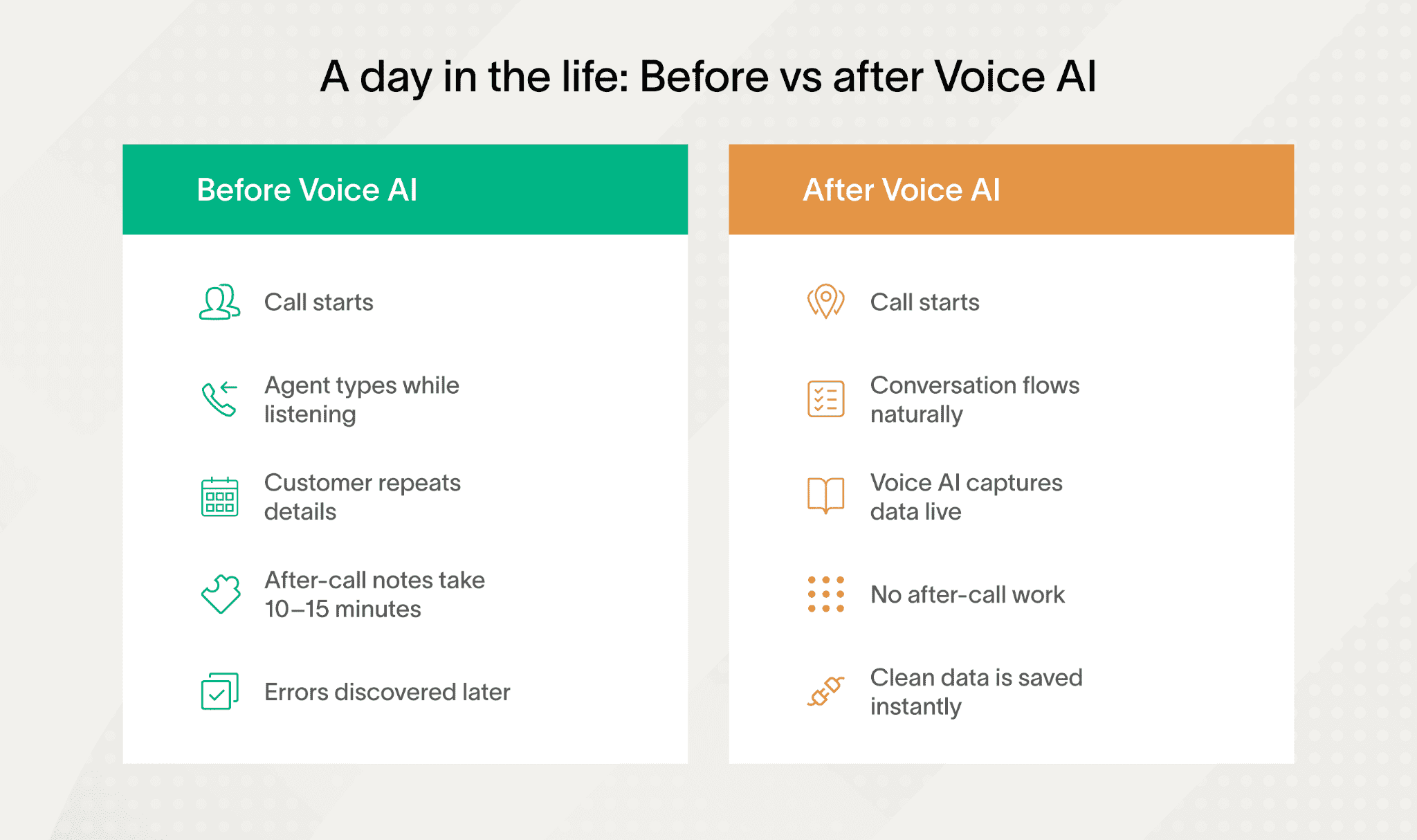
Voice AI integrates smoothly with insurance software like claims platforms, underwriting tools, and CRMs through APIs. This connection makes it easy to automate manual data entry across your entire system without extra work.

Core technologies behind Voice AI automation

Alongside Voice AI, related tech such as intelligent document processing (IDP), optical character recognition (OCR), and AI parsing helps handle documents and forms faster. 

Popular tools include Google Speech-to-Text, IBM Watson Speech, Amazon Transcribe, Microsoft Azure Speech Services for voice, and DocuClipper and Parseur for OCR and parsing. These tools make managing insurance data faster and less error-prone.

Here’s what Voice AI adds to your workflows:

  • Hands-free data capture, freeing your hands for other tasks.

  • Faster data input, speeding up claim and policy processing.

  • Reduced errors from manual typing mistakes.

  • Advanced security with end-to-end encryption, tokenization, and anonymization protecting sensitive info.

These improvements are only possible when Voice AI can accurately understand context in real time.

Accuracy, context awareness, and real-time intelligence

Voice AI’s advanced models understands insurance jargon, acronyms, and context better, improving accuracy. It’s trained with custom models that adapt to industry-specific language and different accents or dialects. 

This means it captures exactly what’s said no matter who’s speaking.

Emerging multimodal AI even combines voice with visual inputs, handling complex data capture in claims or underwriting. Real-time features like punctuation, speaker diarization, and emotion analysis further boost data quality and insight.

Security is key. Voice data streams sent via Voice AI are safeguarded using strict protocols to keep client info safe.

Strada is a top player offering Voice AI tailored to insurance. Their high-accuracy speech-to-text understands insurance terms and plugs right into your systems. 

They also provide conversational AI phone agents available 24/7, capturing data and interacting with customers without human agents. Plus, Strada Workflows extend Voice AI beyond transcription, automating full insurance processes seamlessly.

By adopting Voice AI solutions, you’ll drastically reduce the burden to automate manual data entry and make your insurance operations smarter and faster.

Talking about Voice AI is easy. Seeing it handle a real interaction is what matters. So let’s walk through a typical workflow.

How does Voice AI eliminate manual entry in insurance workflows?

The key is voice-driven data capture: instead of typing, agents or customers simply speak their information. 

The system transcribes this speech instantly and extracts the relevant details automatically. This means no tedious keyboard work and faster data processing.

Once the call starts, Voice AI follows a clear, predictable flow.

Step

What the user does

What the system does

#1 Call begins

Customer or agent speaks naturally

Voice AI listens in real time

#2 Information sharing

Details are given conversationally

Speech is transcribed instantly

#3 Data extraction

No action required

Key fields are identified automatically

#4 Validation

Errors corrected verbally

System checks formats and completeness

#5 System update

No typing or re-entry

Data is pushed into CRM or claims tools

Voice AI doesn’t work alone. It combines forces with OCR and AI parsing to handle documents, forms, and verbal inputs all at once. 

Imagine a claims agent taking in a damaged vehicle photo and the spoken accident details – the AI reads the form, listens to the voice, and pulls together all the data seamlessly.

Here are some concrete examples of where this shines in insurance:

  • Voice-assisted FNOL intake → First notice of loss calls become quick conversations, with the system capturing every fact live.

  • Claims data entry during customer calls → Adjusters talk through details while Voice AI fills out forms in the background.

  • Underwriting data capture through spoken interviews → Underwriters get all the responses transcribed and stored without typing.

All this info flows straight into key platforms like Dynamics 365, SAP, or NetSuite, thanks to smooth integration with insurance ERPs and CRMs. This means instant data transfers with no double entry. 

The AI also validates inputs in real time, keeping transcription accuracy as high as 98-99%, which slashes manual data entry problems and errors.

Security matters, too. Voice data is encrypted from end to end, and automated audit trails log every action, helping your team stay compliant with industry rules. When needed, a hybrid approach mixes Voice AI with manual reviews to catch anything AI might miss.

Voice AI goes beyond simple entry. You can use voice commands to trigger automated claim routing, alerts, or even generate documents. Role-based access controls ensure only authorized users interact with sensitive data, boosting security and compliance even more. 

Conversational AI chatbots further help customers serve themselves by capturing accurate data without human hands.

Keep an eye on key metrics after implementing Voice AI. Insurers often track:

  • Accuracy improvements in data capture.

  • Reduction in average time to process claims.

  • Positive employee feedback on reduced workload.

Strada’s AI phone agents take this to the next level. They handle high-volume call tasks like FNOL, renewals, and customer service with zero hold times. Data gets submitted instantly to AMS and CRMs, speeding up the entire customer journey. 

Plus, Strada Workflows automate what happens next – claim creation, adjuster assignment, customer notifications – all triggered by Voice AI captures. Their intelligent rules engine even enforces data validation and compliance throughout.
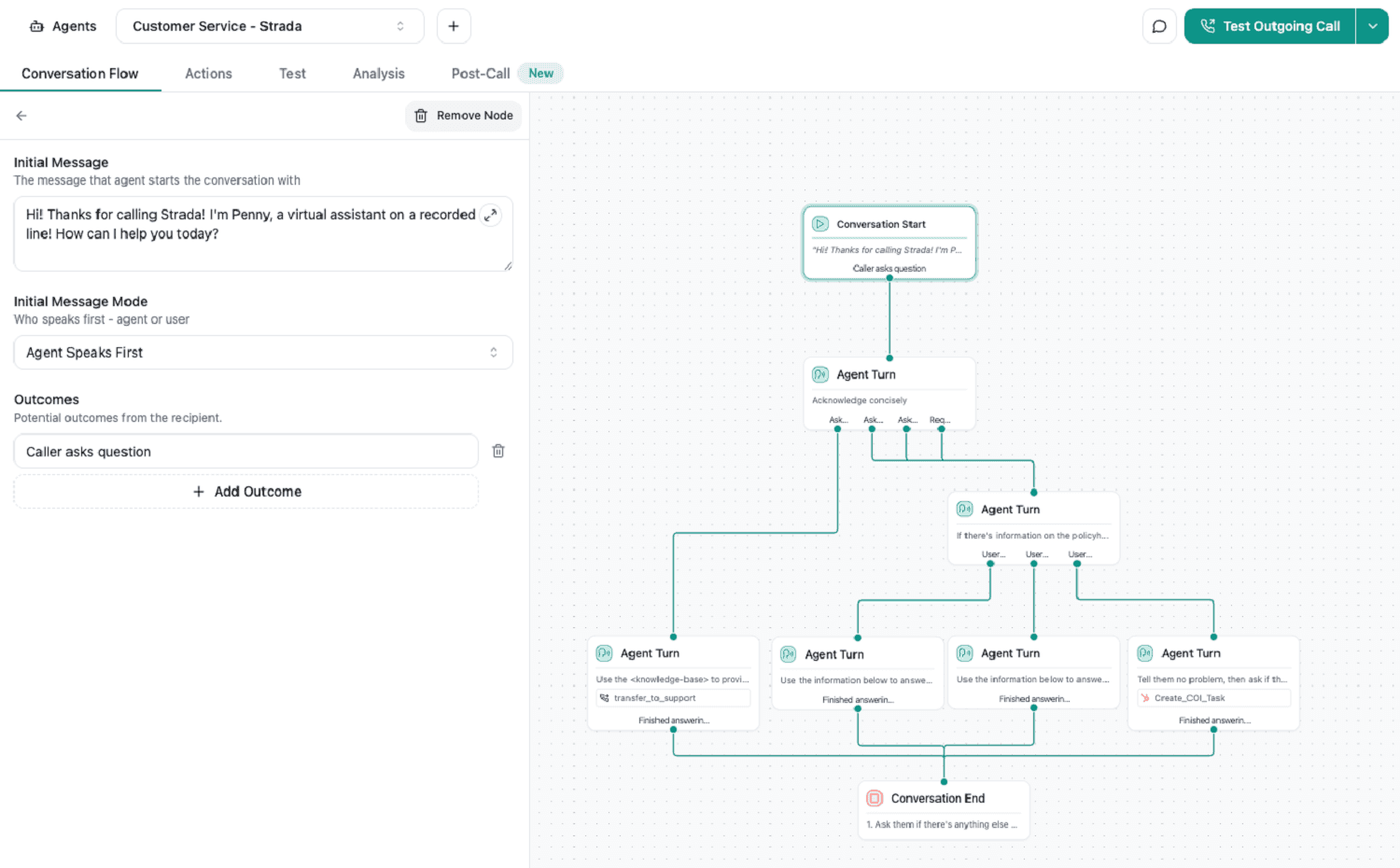
With Voice AI like Strada’s, you not only eliminate manual data entry but also unlock smarter, faster, and more secure insurance operations.

Understanding the workflow is only half the job. Making it work inside your team and systems takes a plan.

What practical steps can insurance companies take to implement Voice AI?

If you’re ready to reduce manual data entry and boost your team’s efficiency, implementing Voice AI is a smart move. 

But where do you start? You’ll learn how to take practical, hands-on steps to automate manual data entry in your insurance workflows. Let’s break this down step by step.

Step #1: Assess your current manual workflows

Begin by looking closely at your existing processes. Identify where your team spends the most time on manual data entry and where errors happen often. Common areas include claims intake and policy administration – these are great starting points for automation. 

Think about tasks that involve repetitive data entry or require gathering lots of details verbally.

Step #2: Choose the right Voice AI platform

Next, find a Voice AI platform that fits your insurance needs. There are several solid options on the market, and each comes with its own strengths.

When evaluating platforms, keep the following points in mind:

  • Available solutions → Options include Strada, Google Speech-to-Text, IBM Watson.

  • Fit with your goals → Different platforms excel at different tasks, so alignment matters.

  • Integration capabilities → The platform should work smoothly with your existing systems.

For quick pilots, consider solutions like Strada’s Voice AI agents that specialize in insurance workflows. They’re designed to help teams get started fast without heavy engineering effort.

Step #3: Run pilot projects with real data

Don’t just guess how it’ll work. Pilot your chosen Voice AI using actual insurance data. This helps you measure improvements in accuracy and efficiency. 

Track metrics carefully: Are claims processed faster? Is data entry error rate dropping? These insights guide you on whether to scale.

Step #4: Train your team and manage change

Introducing new tech can be intimidating. 

Provide clear, practical training for your staff on how to use Voice AI tools. Low-code or no-code platforms make this easier, letting your team adopt new processes without needing deep technical skills. 

Make sure people understand the benefits – you’re here to reduce manual data entry and ease their workload, not complicate it.

Step #5: Integrate with existing software

Voice AI works best when it plays nicely with the tools your team already uses. Use APIs and workflow automation platforms like Zapier to connect Voice AI outputs directly to your insurance management systems. 

Seamless integration cuts down on manual handoffs and keeps information flowing smoothly.

For example, you might automate data capture during claims calls and have the details instantly update your CRM or claims system without typing anything in manually.

Step #6: Set up monitoring and data governance

Once Voice AI is running, set up regular monitoring to check data accuracy and compliance. You want to ensure information captured matches your standards and regulatory requirements. 

Establish clear data governance policies that cover how voice data is collected, stored, and retained. This keeps you protected and builds trust internally and externally.

Step #7: Expand automation gradually

After successful pilots, broaden the automation scope department by department. This gradual approach minimizes disruptions and lets your team adapt at a comfortable pace. 

Each new area brings more efficiency and further reduces manual effort.

Step #8: Build cross-functional teams

Create an implementation team that brings together different parts of the organization. Involving multiple functions early helps avoid blind spots and reduces friction during rollout. 

A strong cross-functional team typically includes:

  • IT → To handle technical setup and integrations.

  • Compliance → To ensure legal and regulatory requirements are met.

  • Claims and underwriting → To align automation with real operational workflows.

  • Customer service → To account for day-to-day usability and customer impact.

This structure helps smooth implementation and ensures both regulatory standards and practical usability are addressed from the start.

Step #8: Use feedback loops to improve

Voice AI can get smarter over time. Encourage your users to provide feedback and use that to refine voice recognition lexicons and NLP models. 

This iterative approach keeps improving accuracy and user satisfaction, making the system more effective as you go.

Step #10: Boost trust with AI explainability

People trust what they understand. Use AI explainability tools to show how the Voice AI arrives at its outputs. 

When your team can see the reasoning behind automated decisions, they’ll feel more confident relying on the technology.

At this point, the problem usually isn’t “what to do.” It’s the time and coordination it takes to do it well. That’s why some insurers choose a platform that already bundles these pieces into a working setup.

How Strada can help you jumpstart Voice AI

If you want to automate manual data entry quickly, Strada’s solutions are worth a look. Strada offers insurance-specific Voice AI agents paired with workflow automation, requiring minimal engineering. 

Their configurable automation rules let your teams customize actions without code, speeding up adoption and ROI. Plus, their dedicated support and forward-deployed teams help with onboarding and compliance setup, so you’re never on your own. 

For practical inspiration, exploring Strada’s demo and case studies can help you build a strong case for Voice AI in your organization.

Here’s a handy checklist to help you get started:

  1. Identify high-volume, error-prone tasks for automation.

  2. Choose a Voice AI platform tailored to insurance needs.

  3. Pilot with real insurance data and measure results.

  4. Train your staff using low-code/no-code tools.

  5. Integrate outputs with existing systems via APIs.

  6. Monitor data accuracy and set governance policies.

  7. Expand automation gradually across departments.

  8. Form cross-functional teams for smooth rollout.

  9. Collect feedback to refine AI models continuously.

  10. Use AI explainability tools to build user trust.

Taking these practical steps will help you reduce manual data entry and unlock the full potential of Voice AI in your insurance company, making your workflows faster, smarter, and more reliable.

After initial rollout, teams often start rethinking how far automation can go. That’s when secondary benefits begin to surface.

What additional benefits does automating data entry with Voice AI bring?

When you eliminate manual data entry with Voice AI, you’re not just cutting down on grunt work – you’re unlocking a bunch of valuable perks. 

Once manual entry is gone, teams start noticing changes fast.
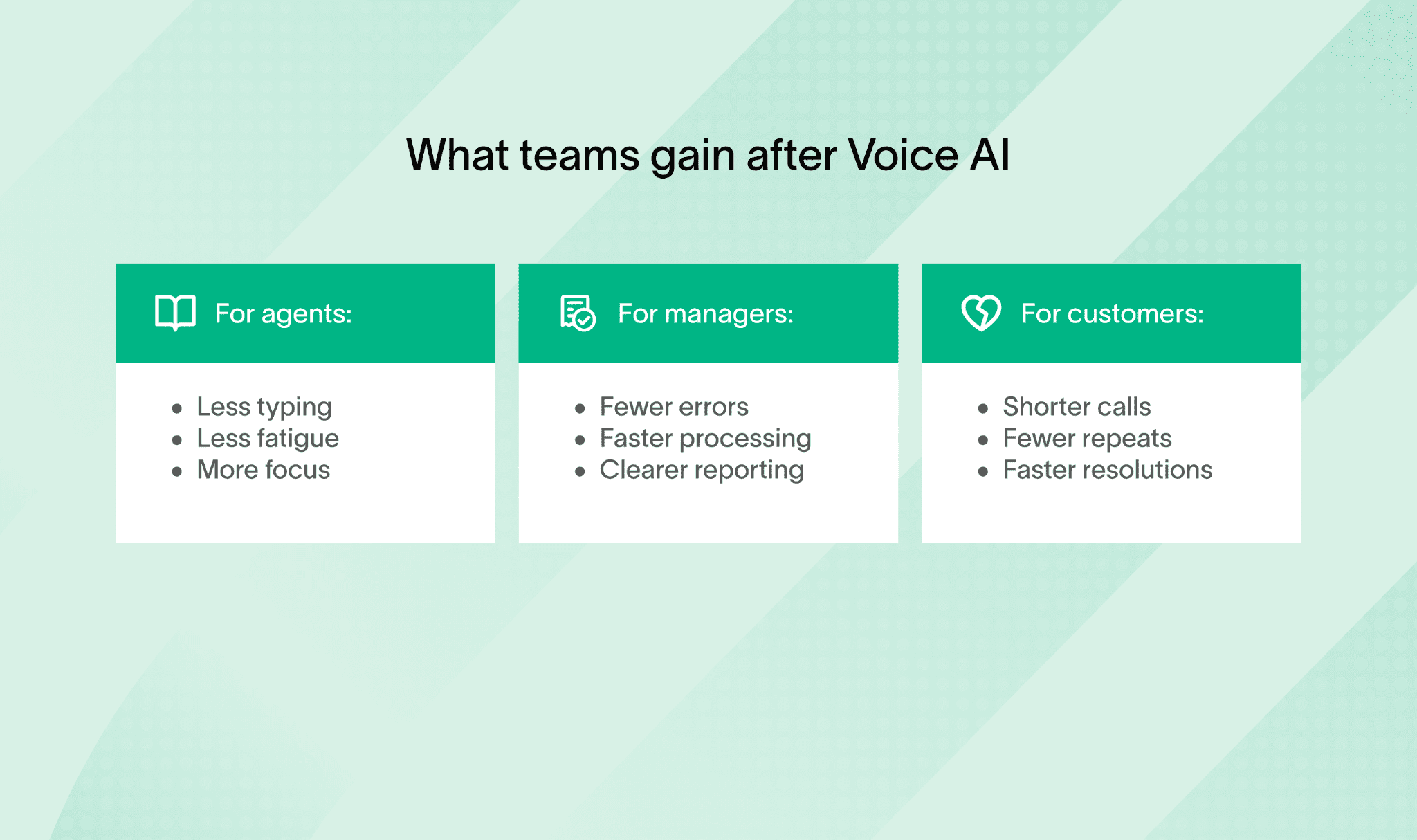
First off, it helps boost employee productivity by freeing up time for higher-value tasks. 

Instead of getting stuck on repetitive data input, your team can focus on solving problems and improving customer care.

Automating data entry also slashes operational costs. With less manual labor involved, you reduce errors and lower compliance penalties. This means smoother, faster claims processing that customers will love. 

Plus, Voice AI scales easily to handle busy periods without needing extra staff.

Here’s a quick look at the benefits you get with automation:

  • Faster turnaround times and enhanced accuracy.

  • Improved customer experience through quick, precise data capture.

  • Better data quality fueling analytics, fraud detection, and decision-making.

  • Higher employee morale as repetitive work goes away.

For example, Infrrd uses automation for claims, MortgageCheck AI speeds up mortgage validation, and Agentic AI ensures data accuracy. 

Strada customers report an 85% call answer rate with 24/7 availability, improving connection rates and processing speeds for renewals and claims, all while maintaining secure data isolation and privacy policies.

Automation also helps you reduce manual data entry and supports environmental goals by cutting paper use. Plus, aggregated voice data can boost predictive analytics for smarter underwriting and risk assessments. 

With all this, you get a powerful edge against competitors and happier employees to boot.

Even with strong automation results, not every task should be fully hands-off. Some situations still benefit from human involvement.

When is manual entry still needed and how to blend with AI?

You’ll find that manual data entry isn’t going away completely, even with Voice AI stepping in. Some cases still need a human touch  

Not everything should be automated. The key is knowing where humans still add value.
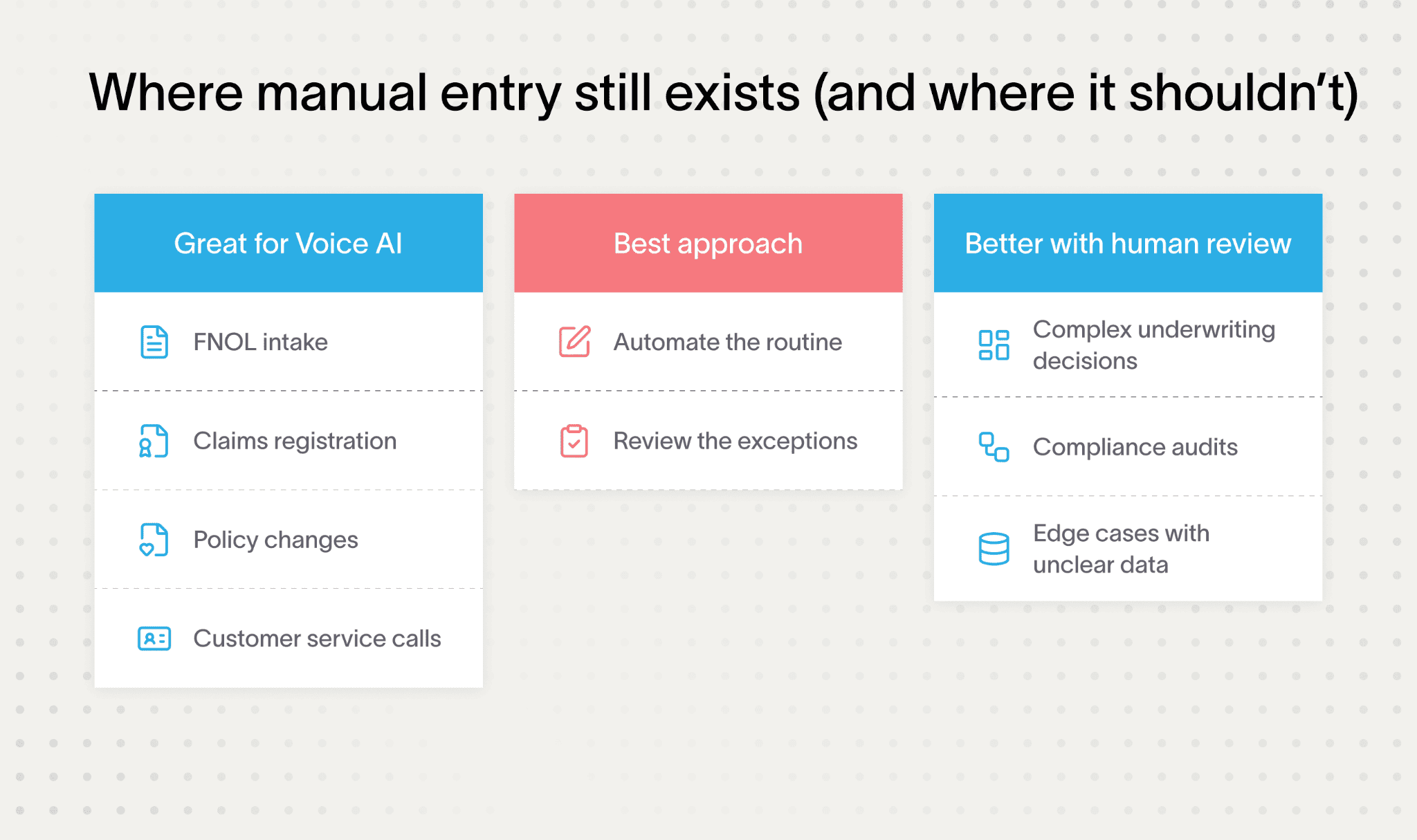
Think handwritten forms, complex documents, or nuanced underwriting decisions that require judgment. 

Compliance audits often demand human review to make sure everything’s above board.

That’s where hybrid workflows shine, mixing Voice AI automation with manual verification to keep quality high and control firm. Here’s how you can blend them smoothly:

  1. Select data points for automation that are clear-cut and repeatable. Save the complex stuff, like compliance checks or rare cases, for manual entry.

  2. Use human-in-the-loop frameworks where AI flags uncertainty and escalates those cases directly to a person.

During early adoption, oversight is key to build trust in AI outputs. Strada’s platform supports this well with supervised AI agents that pass tricky cases to human handlers seamlessly. 

Plus, Strada Workflows allow you to add manual override steps right into automated data capture, keeping compliance tight without slowing down.

Compliance also mandates manual checks or extra paperwork sometimes. Auditing blends automated logs with human validation to meet these standards confidently. Training your team to handle critical manual steps ensures smooth operation.

Don’t forget to collect feedback from manual fixes. This helps improve AI accuracy over time. Start with low-risk tasks and add human reviews gradually – you’ll secure trust while maximizing efficiency in your manual vs automated data entry balance.

Hybrid workflows only work when data can move cleanly from voice and documents into your core systems. That depends on the tooling and integrations you build around Voice AI.

What software, tools, and integrations support Voice AI data entry in insurance?

You’ll learn about the key software, tools, and integrations that power Voice AI data entry in insurance. 

These solutions help you automate manual data entry and even outsource manual data entry tasks when needed, speeding up workflows and reducing errors.

Leading Voice AI platforms

At the core, Voice AI platforms convert spoken words into digital data quickly and accurately.

Several well-established providers form the foundation of voice-based data capture in insurance, including:

  • Strada Voice AI

  • Google Cloud Speech-to-Text.

  • IBM Watson Speech-to-Text.

  • Amazon Transcribe.

  • Microsoft Azure Speech Services.

Each of these platforms offers powerful speech recognition, customizable accuracy for insurance-specific terminology, and support for multiple languages. 

Together, they serve as the backbone of voice data capture, turning calls and dictations into text automatically.

OCR platforms for document capture

Voice AI doesn’t work alone. Insurance involves lots of paperwork, so combining it with OCR technology is key to digitizing documents. 

Tools like DocuClipper, Adobe Acrobat OCR, and ABBYY FlexiCapture extract printed or handwritten text from scanned forms and policy documents. They ensure that all data, spoken or written, is processed efficiently.

AI parsing tools to structure data

Once voice and document data are converted into text, you need AI parsing tools to make sense of it. 

Parseur, Infrrd IDP platform, and Agentic AI components specialize in understanding complex insurance documents and extracting relevant info such as claim numbers, dates, and client details. 

They organize data into structured formats that your systems can easily use.

Integration and automation tools

To make automation work in practice, all tools need to communicate smoothly with each other and with your existing systems.

Different layers of integration solve different problems, and together they keep workflows seamless. Common components include:

  • Automation connectors → Tools like Zapier help automate routine tasks and connect apps without coding.

  • Core insurance systems → CRMs and ERPs such as Dynamics 365 or SAP store customer and policy data, making them critical integration points.

  • APIs → Enable secure data transfer across platforms and support a reliable data pipeline.

  • Middleware and ESB solutions → Act as translators between Voice AI and legacy insurance systems.

  • Low-code platforms → Solutions like Microsoft Power Automate and MuleSoft allow teams to build end-to-end workflows with minimal effort.

Together, these tools ensure that Voice AI outputs flow cleanly across the tech stack without manual handoffs or custom engineering.

Security, compliance, and monitoring

Insurance handles sensitive info, so any system you use must support strong data security and compliance with laws like HIPAA and GDPR. Voice and document processing tools today include built-in encryption, access control, and audit trails to keep data safe.

You can also add specialized compliance monitoring tools to track and report exactly how data moves through your system. This transparency helps meet regulatory requirements and builds trust.

Analytics and reporting suites

Data is more valuable when you can see real-time insights. Many Voice AI platforms integrate analytics and reporting suites that present dashboards showing transcription accuracy, data trends, or workflow bottlenecks. 

These visuals empower you to improve operations continuously.

Insights are useful, but only if they connect to real execution. Some platforms go beyond reporting and handle the full data lifecycle.

Strada as a practical Voice AI solution for insurance

Among these options, Strada deserves a special mention. It offers native integrations with leading insurance AMS, CRMs, and policy management tools. 

That means you can capture voice data and directly feed it into everyday workflows without extra steps.
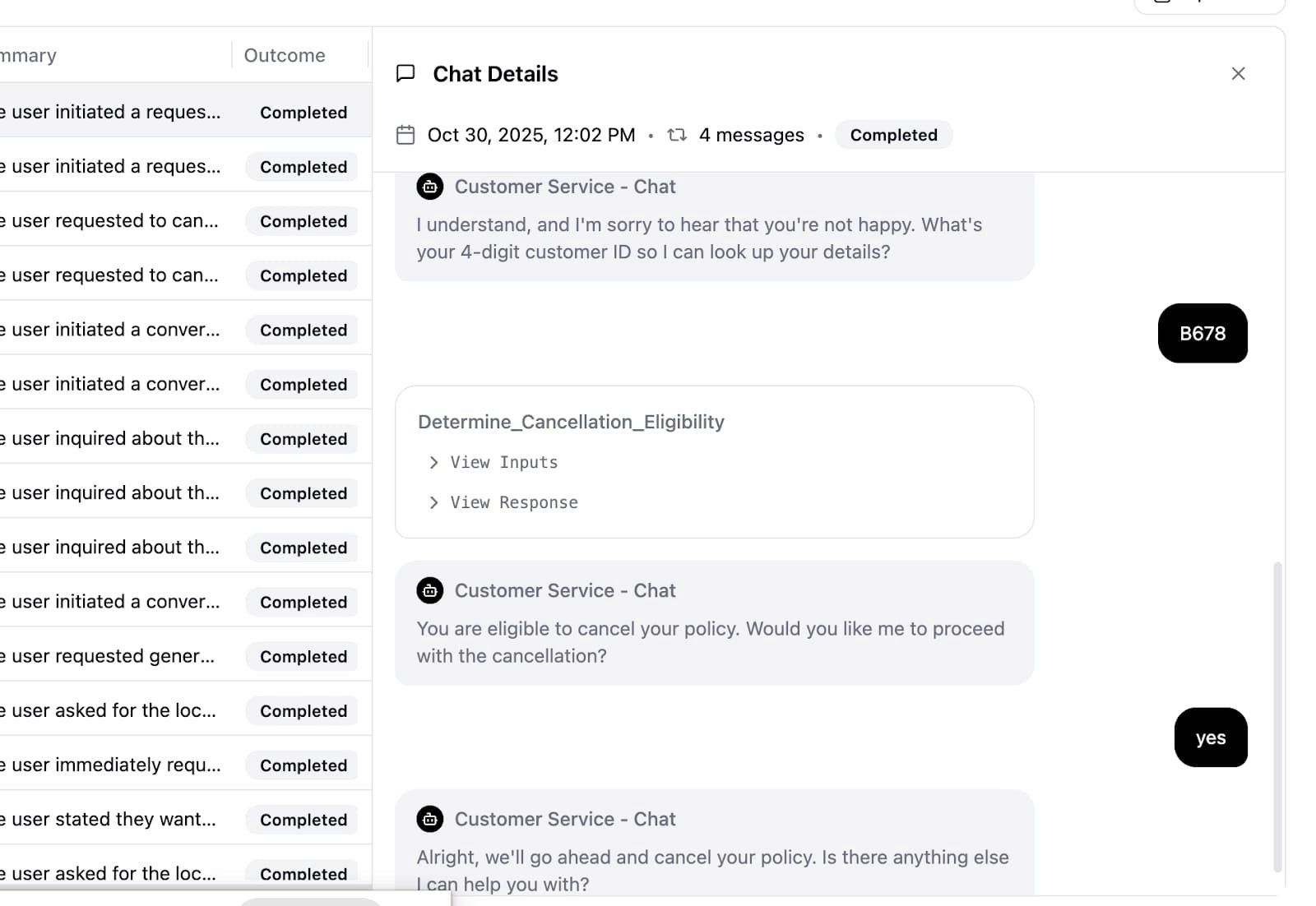
Strada’s API-first architecture ensures you won’t need a heavy engineering lift to plug it into your existing tech stack. 

What really stands out is Strada’s post-call workflow automation. Once a call ends, voice data is instantly connected to downstream business software. This eliminates manual data input and avoids custom development work, saving you time and reducing errors.

Here’s a quick look at how these categories fit together:

  • Voice AI platforms capture speech in real-time.

  • OCR tools digitize physical documents.

  • AI parsing software organizes raw data.

  • Integration tools link everything to your core systems.

  • Security and compliance safeguard sensitive info.

  • Analytics provide insights for smarter decisions.

  • Solutions like Strada streamline the entire process end-to-end.

By combining these tools smartly, you can fully automate manual data entry in insurance operations or choose to outsource manual data entry while maintaining control and accuracy. 

This blend of Voice AI, OCR, AI parsing, and integration solutions transforms how insurance data flows, making processes faster, safer, and less error-prone.

Once the stack is in place, the next question is simple: is it actually paying off? ROI becomes much easier to track when you know what to measure and where the numbers come from.

How can insurance companies measure the ROI of implementing Voice AI for data entry?

You’ll learn how to measure the ROI of Voice AI that helps eliminate manual data entry in insurance. First, identify KPIs that show real impact. 

These include error reduction rate, processing time savings, employee productivity improvements, and customer satisfaction scores. 

Tracking these gives you a clear picture of the improvements Voice AI brings, especially when evaluating manual vs automated data entry over time.

In practice, teams usually track a small set of metrics that directly show whether Voice AI is paying off.

Metric

What changes with Voice AI

Why it matters

Handling time

Calls are shorter, no typing

More cases handled per day

Data accuracy

Fewer missing or incorrect fields

Less rework and fewer delays

Cost per transaction

Lower operational effort

Direct cost savings

Employee workload

Less repetitive work

Higher productivity and retention

Customer experience

Faster resolutions

Better satisfaction and loyalty

To turn these metrics into meaningful ROI insights, teams need a clear way to measure change over time.

Establishing baselines and tracking performance over time

Before deployment, capture baseline metrics like manual entry times, current error rates, and processing costs. These numbers serve as your starting point to compare against future gains. 

Once Voice AI is active, use analytics dashboards and reports found in both the Voice AI platform and insurance management systems to track post-deployment progress. 

For example, Strada’s built-in dashboard analytics offer insights on call volumes, data capture accuracy, workflow completions, and follow-up task effectiveness, making it easier to monitor your results in real time.

Calculating total ROI beyond direct cost savings

Financial benefits matter a lot. Measure cost savings from reduced rework, fewer compliance fines, and overall operational efficiency. 

Don’t forget qualitative benefits too – run employee engagement surveys and gather customer feedback on claims speed and accuracy. These help paint a fuller picture of ROI beyond just dollars.

When calculating total cost of ownership (TCO), consider software licensing, training, and maintenance expenses. This shows you the true investment behind Voice AI. 

Use this data for continuous improvement cycles – adjust and tune the system based on ROI insights to get even better results over time.

Looking for benchmarks? Industry peers and vendor case studies often report impressive ROI ranges, highlighting quick wins and sustained gains. 

For instance, several Strada clients have reported immediate productivity boosts and cost savings as early as the first month of deployment, which you can explore as a reference to set realistic expectations.

By following these practical steps, you’ll confidently measure how Voice AI can revolutionize your data entry processes and deliver strong ROI for your insurance company.

ROI matters, but it’s not the only success metric in insurance. You also need to stay compliant while scaling automation. That’s where privacy, security, and regulation come into play.

How to address data privacy, security, and regulatory compliance when using Voice AI in insurance?

When you use Voice AI to automate manual data entry, you need to prioritize data privacy and security. Insurance is a sensitive field bound by rules like HIPAA, GDPR, CCPA, and various state regulations. 

These laws shape how voice data is stored, processed, and shared. To keep data safe, voice recordings and transcriptions must be encrypted with strong standards like AES 256-bit. Secure key management and data anonymization add extra layers of protection.

Access control is another key part of the puzzle – you’ll want role-based access control and multi-factor authentication to ensure only authorized people handle the info. Data retention policies are essential too. 

They help you store data only as long as regulations require and delete it when necessary.

Here’s a quick list of best practices to keep things secure and compliant:

  • Generate audit trails that capture every voice data event and user action automatically.

  • Choose vendors with certifications like ISO 27001, SOC 2, or HITRUST.

  • Embed privacy by design principles throughout the Voice AI lifecycle.

For example, Strada offers SOC 2 Type 2 certification, isolates customer data, and never uses it for training outside client environments. Their platform logs all data access and processing for audits and compliance. 

Plus, regular third-party penetration testing and a dedicated security team help avoid manual data entry problems and breach scenarios. Regular security assessments and staff training round out a strong defense, giving you confidence when adopting Voice AI.

Security can be perfect, and the rollout can still fail if people don’t use the system consistently. Adoption comes down to training, communication, and change management.

What training and change management practices optimize Voice AI adoption in insurance firms?

To successfully automate manual data entry in insurance, involving everyone – from leadership to frontline staff – is key. 

You’ll want to engage stakeholders early and often. This helps build trust and clears doubts about AI’s role.

Role-based training and practical onboarding

Start with comprehensive training that covers the AI’s capabilities, user interfaces, troubleshooting, and data privacy. Tailor this to specific roles like claims adjusters, underwriters, customer service agents, and compliance officers. 

Role-based training ensures everyone gets what they need without overload.

Two practical steps to make training effective:

  1. Promote familiarity with low-code/no-code platforms. These tools empower non-technical staff to customize workflows and reduce manual data entry hassle.

  2. Set up user feedback loops within training programs. This helps refine approaches and address real challenges as they arise.

Training alone isn’t enough to ensure long-term adoption.

Managing adoption, trust, and organizational change

Communication plays a huge part in easing fears about AI replacing jobs. Be clear that Voice AI augments work rather than replaces it. 

You can also appoint Voice AI champions or super-users to offer peer support and share tips. They become trusted voices during the transition.

Implementing change management frameworks like Prosci ADKAR or Kotter’s 8-Step Process breaks adoption into manageable steps. Consider phased rollouts, starting with pilot programs. This lets your team see success before scaling up.

Strada’s user-friendly platform and low-code workflow setup naturally reduce training complexity and help your staff get up to speed faster. Plus, Strada offers demo sessions and ongoing feedback loops – real assets during onboarding. 

Some clients have successfully managed cultural shifts by building strong internal Voice AI advocates, blending training with steady support.

Even with training, real-world deployment still brings surprises. The good news is most issues are predictable – and fixable if you plan for them early.

What are common challenges in implementing Voice AI in insurance and how can they be overcome?

Implementing Voice AI to reduce manual data entry in insurance sounds great, but it comes with real challenges. You’ll face issues like speech variability, background noise, and complex industry terms. 

Plus, integrating this tech with existing systems isn’t always easy. On top of that, limited voice models that understand accents or insurance jargon can slow things down. 

Organizational hurdles like resistance to change, patchy IT support, and fragmented systems add more bumps. Not to mention, data privacy and legal concerns can delay deployment.

Here’s how you can overcome these:

  • Customize NLP models with insurance-specific language and use noise cancellation tech to improve accuracy.

  • Run iterative pilot tests, gather feedback, and refine the AI before full rollout.

  • Invest in cross-functional teams combining AI experts, insurance specialists, and IT staff.

  • Choose vendors offering customizable, scalable Voice AI solutions.

  • Communicate clearly and provide training to build user trust and confidence.

  • Use phased integration to minimize disruption and ease culture shifts.

Strada tackles these challenges well, thanks to its insurance-trained AI models, continuous test tools, plus forward-deployed customer success teams. 

Its pre-built workflows and no-code rules help automate manual data entry, reducing reliance on IT and making integration smoother. For deeper insights, check the solutions other insurers have successfully implemented.

Once you understand the hurdles, one decision often comes next: build everything in-house, or bring in outside help. Outsourcing can speed things up, but it changes the risk and control model.

Should insurance companies outsource Voice AI data entry?

You might wonder if it’s a good idea to outsource manual data entry using Voice AI. Outsourcing voice data capture and automation workflows comes with clear pros and cons.

On the plus side, outsourcing helps you reduce manual data entry during peak volumes or when resources are tight. It lets your team focus on core tasks while experts handle data capture efficiently. 

Plus, specialized providers often bring deep insurance domain expertise, ensuring better accuracy and compliance. However, handing off data also means you must trust your partner with sensitive information, making data security and clear contracts vital.

When choosing a provider, look for these essentials:

  • Insurance domain knowledge to maximize accuracy.

  • Strong data security standards and certifications.

  • Service Level Agreements (SLAs) guaranteeing accuracy and quick turnaround.

Maintaining control over the process is key. Set up real-time dashboards and regular communication channels with your partner to monitor quality and fix issues fast. This teamwork prevents surprises and keeps data flowing smoothly.

Outsourcing makes the most sense in certain scenarios like handling sudden workload spikes or filling gaps when your internal staff is stretched thin. 

You can even explore hybrid models that combine your in-house team’s oversight with external processing – this balances risk and control.

Before you sign any contracts, do your homework. Run data privacy impact assessments, evaluate vendor risks, and ensure your agreements have compliance clauses to protect your interests.

Many specialized BPOs now offer Voice AI-enabled insurance data entry solutions. For example, Strada supports fully managed AI phone agents and hybrid setups, giving you flexibility. 

They back their service with SLA-backed accuracy guarantees, 24/7 availability, and strict security certifications. Choosing a provider like Strada, which specializes in insurance, helps you get domain-specific precision and compliance you can trust.

To decide what fits best, use a simple cost-benefit framework comparing in-house Voice AI investment versus outsourced services. Also, set clear KPIs so you measure success and keep everything transparent.

Ready to explore smart outsourcing? Book a demo with Strada and see how they can transform your data workflows with ease.

Frequently Asked Questions

Can Voice AI work with messy or incomplete customer information?

Yes. Voice AI can prompt for missing details in real time, validate formats during the call, and flag unclear inputs for quick follow-up instead of manual cleanup later.

Does Voice AI handle accents, fast speech, or background noise?

Framer is a design tool that allows you to design websites on a freeform canvas, and then publish them as websites with a single click.

What happens if Voice AI captures incorrect data?

Framer is a design tool that allows you to design websites on a freeform canvas, and then publish them as websites with a single click.

Can Voice AI scale during peak call volumes?

Framer is a design tool that allows you to design websites on a freeform canvas, and then publish them as websites with a single click.

Is Voice AI useful beyond claims and FNOL?

Framer is a design tool that allows you to design websites on a freeform canvas, and then publish them as websites with a single click.

Start scaling with voice AI agents today

Join innovative carriers and MGAs transforming their calls with Strada.

Blog

/

AI & Automation

How Voice AI Eliminates Manual Data Entry in Insurance in 2026

Amir Prodensky

CEO

Dec 25, 2025

17 min read

How insurers capture structured data without manual input

Manual data entry means typing information from calls, forms, or documents into systems by hand. Despite automation trends, it’s still everywhere in insurance. 

Why? The industry faces hurdles like complex regulations, messy varied data formats, and old legacy systems that don’t easily connect. This slows progress, costs time, and causes headaches.

Here’s what manual data entry costs you:

  • Lost time on repetitive tasks.

  • Frequent errors leading to costly fixes.

  • Employee burnout from tedious work.

  • Inefficiencies that drag down operations.

For example, the CAQH Index shows that manual entry errors cost billions yearly across healthcare-related sectors. The pandemic pushed insurers to rethink digital paths, boosting interest in smart tools like Voice AI. 

And most insurers don’t struggle because they lack tools. They struggle because the everyday process is slow and messy. 

That’s why it helps to zoom in on what “manual entry” really looks like day to day.

What is manual data entry and why does it matter in insurance?

Manual data entry means typing or rekeying info from paper forms or documents into digital systems. In insurance, this includes customer details, claims info, policy applications, underwriting data, and invoices. 

You’ll often see teams handling first notice of loss (FNOL) intake or claims registration by typing data from various sources.

Here’s a quick look at common manual entry tasks:

  • Entering handwritten forms or notes.

  • Typing details from faxes and emails.

  • Scanning documents but still needing corrections.

Accuracy matters because even small mistakes can lead to wrong insurance decisions, compliance issues, unhappy customers, and higher risks. Agents often enter hundreds of data points daily, creating bottlenecks and fatigue.

Different data formats, like handwritten notes and faxes, make manual entry tricky and prone to errors. Common validation methods like double entry or spot checks help but aren’t foolproof and slow things down further. 

In fact, manual vs automated data entry shows that automation can cut errors and speed up processing.

Strada’s conversational AI platform helps reduce manual data entry by capturing key info during phone calls like FNOL and quote intake. Their AI models understand insurance language, improving voice data accuracy and making your work easier and faster. 

Still, on paper, manual input looks like a small admin task. In practice, it quickly turns into a bottleneck across calls, claims, and back-office work.

What problems do manual data entry cause in insurance?

Manual data entry problems in insurance slow down workflows and make tasks tedious and repetitive. Employees spend hours typing and retyping data, which drains productivity. 

On average, manual entry error rates hover around 1%. 

These errors include spelling mistakes, misformatted fields, and missing data. Even a small slip can cause costly consequences like compliance penalties or rejected claims.

If you zoom in on daily operations, these issues show up in the same places again and again.

Area

What’s happening

Result

Live calls

Agents type while listening

Missed or incomplete details

Post-call work

Data is re-entered into systems

Duplicate effort and new errors

Forms and fields

Information is recalled from memory

Inconsistent records

Compliance review

Errors found late

Delays and rework

Follow-ups

Staff fix mistakes instead of progressing cases

Slower resolutions

You might be surprised to learn that each manual invoice processing costs about $15.97, while claim inquiry costs range from $12 to $16, according to CAQH data. Multiply that by thousands of transactions, and it quickly adds up. 

Here’s a quick look at the impact of manual entry:

  • Time lost → Employees spend significant daily hours on data entry instead of focusing on customers.

  • Employee burnout → Repetitive tasks kill engagement and increase turnover risks.

  • Compliance risks → Handling sensitive health and personal info manually raises the chance of breaches and audit failures under HIPAA, GDPR, and SOX frameworks.

For example, delayed claims or policy errors caused by manual mistakes can lead to regulatory fines and unhappy customers. These hidden costs also affect your frontline staff who could be working on proactive risk management instead.

You’ll find automation a game-changer here. Solutions like Strada automate manual data entry through Voice AI agents available 24/7 for claims intake and policy servicing. 

This technology delivers near real-time, accurate data capture with built-in security: SOC 2 Type 2 compliance, encrypted voice data, and customer data isolation. 

Given all these issues, it’s fair to ask why manual entry hasn’t disappeared yet. The answer isn’t technical. It’s practical, organizational, and sometimes cultural.

Why do insurance companies still rely on manual data entry?

You might wonder why many insurance companies still outsource manual data entry despite all the buzz around automation. 

The truth is, several practical barriers keep them tied to old methods.

Where cost and complexity slow automation

Cost worries top the list. Many insurers, especially smaller ones, fear the upfront investment and don’t have extensive automation knowledge to weigh benefits clearly. Large insurers have legacy systems that complicate updates. 

Plus, insurance data is complex and varies widely by product, geography, and regulation, making standardization tough and slowing automation efforts.

Organizational resistance and risk aversion

Organizational culture also plays a big role in slowing adoption. Even when automation is discussed, internal dynamics often push companies to move cautiously. 

Key factors include:

  • Risk aversion → Companies prefer familiar processes and avoid change.

  • Slow procurement processes → Decision-making takes time and delays adoption.

  • Siloed departments → Teams operate separately, limiting coordinated action.

  • Misconceptions about voice and AI automation → Beliefs that it’s expensive, complex, or unreliable.

  • Concerns about AI accuracy and data privacy → Fears around unintended consequences stop progress.

As a result, these organizational factors often block automation before technical limitations ever come into play.

Integration challenges and regulatory constraints

Integration fears add another layer. 

Choosing vendors and ensuring new tools work with existing ERPs and CRMs can feel overwhelming. For example, geographic regulations differ greatly; the EU has stricter data rules than the US, limiting automation options in some regions.

Here’s why Strada stands out: it offers no engineering lift integrations with common AMS, CRM, and insurance platforms, plus low-code/no-code workflow automation through Strada Workflows, making adoption hassle-free. 

You can reduce manual data entry with insurance-specific AI models that deliver high accuracy and compliance readiness. 

Plus, Strada’s forward-deployed team guides clients through implementation and security compliance, easing fears around data privacy and regulations.

So how do insurers break through these barriers? That’s where Voice AI enters the picture as a practical alternative to manual entry.

What is Voice AI and how does it improve data entry automation?

Voice AI uses speech-to-text technology and LLM models to turn spoken words into digital data. It lets you capture insurance info with simple voice commands instead of typing. 

This means you can eliminate manual data entry by having your spoken inputs directly transcribed into databases and forms.

Let’s bring this down to earth. Here’s how one workday changes with Voice AI.

Voice AI integrates smoothly with insurance software like claims platforms, underwriting tools, and CRMs through APIs. This connection makes it easy to automate manual data entry across your entire system without extra work.

Core technologies behind Voice AI automation

Alongside Voice AI, related tech such as intelligent document processing (IDP), optical character recognition (OCR), and AI parsing helps handle documents and forms faster. 

Popular tools include Google Speech-to-Text, IBM Watson Speech, Amazon Transcribe, Microsoft Azure Speech Services for voice, and DocuClipper and Parseur for OCR and parsing. These tools make managing insurance data faster and less error-prone.

Here’s what Voice AI adds to your workflows:

  • Hands-free data capture, freeing your hands for other tasks.

  • Faster data input, speeding up claim and policy processing.

  • Reduced errors from manual typing mistakes.

  • Advanced security with end-to-end encryption, tokenization, and anonymization protecting sensitive info.

These improvements are only possible when Voice AI can accurately understand context in real time.

Accuracy, context awareness, and real-time intelligence

Voice AI’s advanced models understands insurance jargon, acronyms, and context better, improving accuracy. It’s trained with custom models that adapt to industry-specific language and different accents or dialects. 

This means it captures exactly what’s said no matter who’s speaking.

Emerging multimodal AI even combines voice with visual inputs, handling complex data capture in claims or underwriting. Real-time features like punctuation, speaker diarization, and emotion analysis further boost data quality and insight.

Security is key. Voice data streams sent via Voice AI are safeguarded using strict protocols to keep client info safe.

Strada is a top player offering Voice AI tailored to insurance. Their high-accuracy speech-to-text understands insurance terms and plugs right into your systems. 

They also provide conversational AI phone agents available 24/7, capturing data and interacting with customers without human agents. Plus, Strada Workflows extend Voice AI beyond transcription, automating full insurance processes seamlessly.

By adopting Voice AI solutions, you’ll drastically reduce the burden to automate manual data entry and make your insurance operations smarter and faster.

Talking about Voice AI is easy. Seeing it handle a real interaction is what matters. So let’s walk through a typical workflow.

How does Voice AI eliminate manual entry in insurance workflows?

The key is voice-driven data capture: instead of typing, agents or customers simply speak their information. 

The system transcribes this speech instantly and extracts the relevant details automatically. This means no tedious keyboard work and faster data processing.

Once the call starts, Voice AI follows a clear, predictable flow.

Step

What the user does

What the system does

#1 Call begins

Customer or agent speaks naturally

Voice AI listens in real time

#2 Information sharing

Details are given conversationally

Speech is transcribed instantly

#3 Data extraction

No action required

Key fields are identified automatically

#4 Validation

Errors corrected verbally

System checks formats and completeness

#5 System update

No typing or re-entry

Data is pushed into CRM or claims tools

Voice AI doesn’t work alone. It combines forces with OCR and AI parsing to handle documents, forms, and verbal inputs all at once. 

Imagine a claims agent taking in a damaged vehicle photo and the spoken accident details – the AI reads the form, listens to the voice, and pulls together all the data seamlessly.

Here are some concrete examples of where this shines in insurance:

  • Voice-assisted FNOL intake → First notice of loss calls become quick conversations, with the system capturing every fact live.

  • Claims data entry during customer calls → Adjusters talk through details while Voice AI fills out forms in the background.

  • Underwriting data capture through spoken interviews → Underwriters get all the responses transcribed and stored without typing.

All this info flows straight into key platforms like Dynamics 365, SAP, or NetSuite, thanks to smooth integration with insurance ERPs and CRMs. This means instant data transfers with no double entry. 

The AI also validates inputs in real time, keeping transcription accuracy as high as 98-99%, which slashes manual data entry problems and errors.

Security matters, too. Voice data is encrypted from end to end, and automated audit trails log every action, helping your team stay compliant with industry rules. When needed, a hybrid approach mixes Voice AI with manual reviews to catch anything AI might miss.

Voice AI goes beyond simple entry. You can use voice commands to trigger automated claim routing, alerts, or even generate documents. Role-based access controls ensure only authorized users interact with sensitive data, boosting security and compliance even more. 

Conversational AI chatbots further help customers serve themselves by capturing accurate data without human hands.

Keep an eye on key metrics after implementing Voice AI. Insurers often track:

  • Accuracy improvements in data capture.

  • Reduction in average time to process claims.

  • Positive employee feedback on reduced workload.

Strada’s AI phone agents take this to the next level. They handle high-volume call tasks like FNOL, renewals, and customer service with zero hold times. Data gets submitted instantly to AMS and CRMs, speeding up the entire customer journey. 

Plus, Strada Workflows automate what happens next – claim creation, adjuster assignment, customer notifications – all triggered by Voice AI captures. Their intelligent rules engine even enforces data validation and compliance throughout.

With Voice AI like Strada’s, you not only eliminate manual data entry but also unlock smarter, faster, and more secure insurance operations.

Understanding the workflow is only half the job. Making it work inside your team and systems takes a plan.

What practical steps can insurance companies take to implement Voice AI?

If you’re ready to reduce manual data entry and boost your team’s efficiency, implementing Voice AI is a smart move. 

But where do you start? You’ll learn how to take practical, hands-on steps to automate manual data entry in your insurance workflows. Let’s break this down step by step.

Step #1: Assess your current manual workflows

Begin by looking closely at your existing processes. Identify where your team spends the most time on manual data entry and where errors happen often. Common areas include claims intake and policy administration – these are great starting points for automation. 

Think about tasks that involve repetitive data entry or require gathering lots of details verbally.

Step #2: Choose the right Voice AI platform

Next, find a Voice AI platform that fits your insurance needs. There are several solid options on the market, and each comes with its own strengths.

When evaluating platforms, keep the following points in mind:

  • Available solutions → Options include Strada, Google Speech-to-Text, IBM Watson.

  • Fit with your goals → Different platforms excel at different tasks, so alignment matters.

  • Integration capabilities → The platform should work smoothly with your existing systems.

For quick pilots, consider solutions like Strada’s Voice AI agents that specialize in insurance workflows. They’re designed to help teams get started fast without heavy engineering effort.

Step #3: Run pilot projects with real data

Don’t just guess how it’ll work. Pilot your chosen Voice AI using actual insurance data. This helps you measure improvements in accuracy and efficiency. 

Track metrics carefully: Are claims processed faster? Is data entry error rate dropping? These insights guide you on whether to scale.

Step #4: Train your team and manage change

Introducing new tech can be intimidating. 

Provide clear, practical training for your staff on how to use Voice AI tools. Low-code or no-code platforms make this easier, letting your team adopt new processes without needing deep technical skills. 

Make sure people understand the benefits – you’re here to reduce manual data entry and ease their workload, not complicate it.

Step #5: Integrate with existing software

Voice AI works best when it plays nicely with the tools your team already uses. Use APIs and workflow automation platforms like Zapier to connect Voice AI outputs directly to your insurance management systems. 

Seamless integration cuts down on manual handoffs and keeps information flowing smoothly.

For example, you might automate data capture during claims calls and have the details instantly update your CRM or claims system without typing anything in manually.

Step #6: Set up monitoring and data governance

Once Voice AI is running, set up regular monitoring to check data accuracy and compliance. You want to ensure information captured matches your standards and regulatory requirements. 

Establish clear data governance policies that cover how voice data is collected, stored, and retained. This keeps you protected and builds trust internally and externally.

Step #7: Expand automation gradually

After successful pilots, broaden the automation scope department by department. This gradual approach minimizes disruptions and lets your team adapt at a comfortable pace. 

Each new area brings more efficiency and further reduces manual effort.

Step #8: Build cross-functional teams

Create an implementation team that brings together different parts of the organization. Involving multiple functions early helps avoid blind spots and reduces friction during rollout. 

A strong cross-functional team typically includes:

  • IT → To handle technical setup and integrations.

  • Compliance → To ensure legal and regulatory requirements are met.

  • Claims and underwriting → To align automation with real operational workflows.

  • Customer service → To account for day-to-day usability and customer impact.

This structure helps smooth implementation and ensures both regulatory standards and practical usability are addressed from the start.

Step #8: Use feedback loops to improve

Voice AI can get smarter over time. Encourage your users to provide feedback and use that to refine voice recognition lexicons and NLP models. 

This iterative approach keeps improving accuracy and user satisfaction, making the system more effective as you go.

Step #10: Boost trust with AI explainability

People trust what they understand. Use AI explainability tools to show how the Voice AI arrives at its outputs. 

When your team can see the reasoning behind automated decisions, they’ll feel more confident relying on the technology.

At this point, the problem usually isn’t “what to do.” It’s the time and coordination it takes to do it well. That’s why some insurers choose a platform that already bundles these pieces into a working setup.

How Strada can help you jumpstart Voice AI

If you want to automate manual data entry quickly, Strada’s solutions are worth a look. Strada offers insurance-specific Voice AI agents paired with workflow automation, requiring minimal engineering. 

Their configurable automation rules let your teams customize actions without code, speeding up adoption and ROI. Plus, their dedicated support and forward-deployed teams help with onboarding and compliance setup, so you’re never on your own. 

For practical inspiration, exploring Strada’s demo and case studies can help you build a strong case for Voice AI in your organization.

Here’s a handy checklist to help you get started:

  1. Identify high-volume, error-prone tasks for automation.

  2. Choose a Voice AI platform tailored to insurance needs.

  3. Pilot with real insurance data and measure results.

  4. Train your staff using low-code/no-code tools.

  5. Integrate outputs with existing systems via APIs.

  6. Monitor data accuracy and set governance policies.

  7. Expand automation gradually across departments.

  8. Form cross-functional teams for smooth rollout.

  9. Collect feedback to refine AI models continuously.

  10. Use AI explainability tools to build user trust.

Taking these practical steps will help you reduce manual data entry and unlock the full potential of Voice AI in your insurance company, making your workflows faster, smarter, and more reliable.

After initial rollout, teams often start rethinking how far automation can go. That’s when secondary benefits begin to surface.

What additional benefits does automating data entry with Voice AI bring?

When you eliminate manual data entry with Voice AI, you’re not just cutting down on grunt work – you’re unlocking a bunch of valuable perks. 

Once manual entry is gone, teams start noticing changes fast.

First off, it helps boost employee productivity by freeing up time for higher-value tasks. 

Instead of getting stuck on repetitive data input, your team can focus on solving problems and improving customer care.

Automating data entry also slashes operational costs. With less manual labor involved, you reduce errors and lower compliance penalties. This means smoother, faster claims processing that customers will love. 

Plus, Voice AI scales easily to handle busy periods without needing extra staff.

Here’s a quick look at the benefits you get with automation:

  • Faster turnaround times and enhanced accuracy.

  • Improved customer experience through quick, precise data capture.

  • Better data quality fueling analytics, fraud detection, and decision-making.

  • Higher employee morale as repetitive work goes away.

For example, Infrrd uses automation for claims, MortgageCheck AI speeds up mortgage validation, and Agentic AI ensures data accuracy. 

Strada customers report an 85% call answer rate with 24/7 availability, improving connection rates and processing speeds for renewals and claims, all while maintaining secure data isolation and privacy policies.

Automation also helps you reduce manual data entry and supports environmental goals by cutting paper use. Plus, aggregated voice data can boost predictive analytics for smarter underwriting and risk assessments. 

With all this, you get a powerful edge against competitors and happier employees to boot.

Even with strong automation results, not every task should be fully hands-off. Some situations still benefit from human involvement.

When is manual entry still needed and how to blend with AI?

You’ll find that manual data entry isn’t going away completely, even with Voice AI stepping in. Some cases still need a human touch  

Not everything should be automated. The key is knowing where humans still add value.

Think handwritten forms, complex documents, or nuanced underwriting decisions that require judgment. 

Compliance audits often demand human review to make sure everything’s above board.

That’s where hybrid workflows shine, mixing Voice AI automation with manual verification to keep quality high and control firm. Here’s how you can blend them smoothly:

  1. Select data points for automation that are clear-cut and repeatable. Save the complex stuff, like compliance checks or rare cases, for manual entry.

  2. Use human-in-the-loop frameworks where AI flags uncertainty and escalates those cases directly to a person.

During early adoption, oversight is key to build trust in AI outputs. Strada’s platform supports this well with supervised AI agents that pass tricky cases to human handlers seamlessly. 

Plus, Strada Workflows allow you to add manual override steps right into automated data capture, keeping compliance tight without slowing down.

Compliance also mandates manual checks or extra paperwork sometimes. Auditing blends automated logs with human validation to meet these standards confidently. Training your team to handle critical manual steps ensures smooth operation.

Don’t forget to collect feedback from manual fixes. This helps improve AI accuracy over time. Start with low-risk tasks and add human reviews gradually – you’ll secure trust while maximizing efficiency in your manual vs automated data entry balance.

Hybrid workflows only work when data can move cleanly from voice and documents into your core systems. That depends on the tooling and integrations you build around Voice AI.

What software, tools, and integrations support Voice AI data entry in insurance?

You’ll learn about the key software, tools, and integrations that power Voice AI data entry in insurance. 

These solutions help you automate manual data entry and even outsource manual data entry tasks when needed, speeding up workflows and reducing errors.

Leading Voice AI platforms

At the core, Voice AI platforms convert spoken words into digital data quickly and accurately.

Several well-established providers form the foundation of voice-based data capture in insurance, including:

  • Strada Voice AI

  • Google Cloud Speech-to-Text.

  • IBM Watson Speech-to-Text.

  • Amazon Transcribe.

  • Microsoft Azure Speech Services.

Each of these platforms offers powerful speech recognition, customizable accuracy for insurance-specific terminology, and support for multiple languages. 

Together, they serve as the backbone of voice data capture, turning calls and dictations into text automatically.

OCR platforms for document capture

Voice AI doesn’t work alone. Insurance involves lots of paperwork, so combining it with OCR technology is key to digitizing documents. 

Tools like DocuClipper, Adobe Acrobat OCR, and ABBYY FlexiCapture extract printed or handwritten text from scanned forms and policy documents. They ensure that all data, spoken or written, is processed efficiently.

AI parsing tools to structure data

Once voice and document data are converted into text, you need AI parsing tools to make sense of it. 

Parseur, Infrrd IDP platform, and Agentic AI components specialize in understanding complex insurance documents and extracting relevant info such as claim numbers, dates, and client details. 

They organize data into structured formats that your systems can easily use.

Integration and automation tools

To make automation work in practice, all tools need to communicate smoothly with each other and with your existing systems.

Different layers of integration solve different problems, and together they keep workflows seamless. Common components include:

  • Automation connectors → Tools like Zapier help automate routine tasks and connect apps without coding.

  • Core insurance systems → CRMs and ERPs such as Dynamics 365 or SAP store customer and policy data, making them critical integration points.

  • APIs → Enable secure data transfer across platforms and support a reliable data pipeline.

  • Middleware and ESB solutions → Act as translators between Voice AI and legacy insurance systems.

  • Low-code platforms → Solutions like Microsoft Power Automate and MuleSoft allow teams to build end-to-end workflows with minimal effort.

Together, these tools ensure that Voice AI outputs flow cleanly across the tech stack without manual handoffs or custom engineering.

Security, compliance, and monitoring

Insurance handles sensitive info, so any system you use must support strong data security and compliance with laws like HIPAA and GDPR. Voice and document processing tools today include built-in encryption, access control, and audit trails to keep data safe.

You can also add specialized compliance monitoring tools to track and report exactly how data moves through your system. This transparency helps meet regulatory requirements and builds trust.

Analytics and reporting suites

Data is more valuable when you can see real-time insights. Many Voice AI platforms integrate analytics and reporting suites that present dashboards showing transcription accuracy, data trends, or workflow bottlenecks. 

These visuals empower you to improve operations continuously.

Insights are useful, but only if they connect to real execution. Some platforms go beyond reporting and handle the full data lifecycle.

Strada as a practical Voice AI solution for insurance

Among these options, Strada deserves a special mention. It offers native integrations with leading insurance AMS, CRMs, and policy management tools. 

That means you can capture voice data and directly feed it into everyday workflows without extra steps.

Strada’s API-first architecture ensures you won’t need a heavy engineering lift to plug it into your existing tech stack. 

What really stands out is Strada’s post-call workflow automation. Once a call ends, voice data is instantly connected to downstream business software. This eliminates manual data input and avoids custom development work, saving you time and reducing errors.

Here’s a quick look at how these categories fit together:

  • Voice AI platforms capture speech in real-time.

  • OCR tools digitize physical documents.

  • AI parsing software organizes raw data.

  • Integration tools link everything to your core systems.

  • Security and compliance safeguard sensitive info.

  • Analytics provide insights for smarter decisions.

  • Solutions like Strada streamline the entire process end-to-end.

By combining these tools smartly, you can fully automate manual data entry in insurance operations or choose to outsource manual data entry while maintaining control and accuracy. 

This blend of Voice AI, OCR, AI parsing, and integration solutions transforms how insurance data flows, making processes faster, safer, and less error-prone.

Once the stack is in place, the next question is simple: is it actually paying off? ROI becomes much easier to track when you know what to measure and where the numbers come from.

How can insurance companies measure the ROI of implementing Voice AI for data entry?

You’ll learn how to measure the ROI of Voice AI that helps eliminate manual data entry in insurance. First, identify KPIs that show real impact. 

These include error reduction rate, processing time savings, employee productivity improvements, and customer satisfaction scores. 

Tracking these gives you a clear picture of the improvements Voice AI brings, especially when evaluating manual vs automated data entry over time.

In practice, teams usually track a small set of metrics that directly show whether Voice AI is paying off.

Metric

What changes with Voice AI

Why it matters

Handling time

Calls are shorter, no typing

More cases handled per day

Data accuracy

Fewer missing or incorrect fields

Less rework and fewer delays

Cost per transaction

Lower operational effort

Direct cost savings

Employee workload

Less repetitive work

Higher productivity and retention

Customer experience

Faster resolutions

Better satisfaction and loyalty

To turn these metrics into meaningful ROI insights, teams need a clear way to measure change over time.

Establishing baselines and tracking performance over time

Before deployment, capture baseline metrics like manual entry times, current error rates, and processing costs. These numbers serve as your starting point to compare against future gains. 

Once Voice AI is active, use analytics dashboards and reports found in both the Voice AI platform and insurance management systems to track post-deployment progress. 

For example, Strada’s built-in dashboard analytics offer insights on call volumes, data capture accuracy, workflow completions, and follow-up task effectiveness, making it easier to monitor your results in real time.

Calculating total ROI beyond direct cost savings

Financial benefits matter a lot. Measure cost savings from reduced rework, fewer compliance fines, and overall operational efficiency. 

Don’t forget qualitative benefits too – run employee engagement surveys and gather customer feedback on claims speed and accuracy. These help paint a fuller picture of ROI beyond just dollars.

When calculating total cost of ownership (TCO), consider software licensing, training, and maintenance expenses. This shows you the true investment behind Voice AI. 

Use this data for continuous improvement cycles – adjust and tune the system based on ROI insights to get even better results over time.

Looking for benchmarks? Industry peers and vendor case studies often report impressive ROI ranges, highlighting quick wins and sustained gains. 

For instance, several Strada clients have reported immediate productivity boosts and cost savings as early as the first month of deployment, which you can explore as a reference to set realistic expectations.

By following these practical steps, you’ll confidently measure how Voice AI can revolutionize your data entry processes and deliver strong ROI for your insurance company.

ROI matters, but it’s not the only success metric in insurance. You also need to stay compliant while scaling automation. That’s where privacy, security, and regulation come into play.

How to address data privacy, security, and regulatory compliance when using Voice AI in insurance?

When you use Voice AI to automate manual data entry, you need to prioritize data privacy and security. Insurance is a sensitive field bound by rules like HIPAA, GDPR, CCPA, and various state regulations. 

These laws shape how voice data is stored, processed, and shared. To keep data safe, voice recordings and transcriptions must be encrypted with strong standards like AES 256-bit. Secure key management and data anonymization add extra layers of protection.

Access control is another key part of the puzzle – you’ll want role-based access control and multi-factor authentication to ensure only authorized people handle the info. Data retention policies are essential too. 

They help you store data only as long as regulations require and delete it when necessary.

Here’s a quick list of best practices to keep things secure and compliant:

  • Generate audit trails that capture every voice data event and user action automatically.

  • Choose vendors with certifications like ISO 27001, SOC 2, or HITRUST.

  • Embed privacy by design principles throughout the Voice AI lifecycle.

For example, Strada offers SOC 2 Type 2 certification, isolates customer data, and never uses it for training outside client environments. Their platform logs all data access and processing for audits and compliance. 

Plus, regular third-party penetration testing and a dedicated security team help avoid manual data entry problems and breach scenarios. Regular security assessments and staff training round out a strong defense, giving you confidence when adopting Voice AI.

Security can be perfect, and the rollout can still fail if people don’t use the system consistently. Adoption comes down to training, communication, and change management.

What training and change management practices optimize Voice AI adoption in insurance firms?

To successfully automate manual data entry in insurance, involving everyone – from leadership to frontline staff – is key. 

You’ll want to engage stakeholders early and often. This helps build trust and clears doubts about AI’s role.

Role-based training and practical onboarding

Start with comprehensive training that covers the AI’s capabilities, user interfaces, troubleshooting, and data privacy. Tailor this to specific roles like claims adjusters, underwriters, customer service agents, and compliance officers. 

Role-based training ensures everyone gets what they need without overload.

Two practical steps to make training effective:

  1. Promote familiarity with low-code/no-code platforms. These tools empower non-technical staff to customize workflows and reduce manual data entry hassle.

  2. Set up user feedback loops within training programs. This helps refine approaches and address real challenges as they arise.

Training alone isn’t enough to ensure long-term adoption.

Managing adoption, trust, and organizational change

Communication plays a huge part in easing fears about AI replacing jobs. Be clear that Voice AI augments work rather than replaces it. 

You can also appoint Voice AI champions or super-users to offer peer support and share tips. They become trusted voices during the transition.

Implementing change management frameworks like Prosci ADKAR or Kotter’s 8-Step Process breaks adoption into manageable steps. Consider phased rollouts, starting with pilot programs. This lets your team see success before scaling up.

Strada’s user-friendly platform and low-code workflow setup naturally reduce training complexity and help your staff get up to speed faster. Plus, Strada offers demo sessions and ongoing feedback loops – real assets during onboarding. 

Some clients have successfully managed cultural shifts by building strong internal Voice AI advocates, blending training with steady support.

Even with training, real-world deployment still brings surprises. The good news is most issues are predictable – and fixable if you plan for them early.

What are common challenges in implementing Voice AI in insurance and how can they be overcome?

Implementing Voice AI to reduce manual data entry in insurance sounds great, but it comes with real challenges. You’ll face issues like speech variability, background noise, and complex industry terms. 

Plus, integrating this tech with existing systems isn’t always easy. On top of that, limited voice models that understand accents or insurance jargon can slow things down. 

Organizational hurdles like resistance to change, patchy IT support, and fragmented systems add more bumps. Not to mention, data privacy and legal concerns can delay deployment.

Here’s how you can overcome these:

  • Customize NLP models with insurance-specific language and use noise cancellation tech to improve accuracy.

  • Run iterative pilot tests, gather feedback, and refine the AI before full rollout.

  • Invest in cross-functional teams combining AI experts, insurance specialists, and IT staff.

  • Choose vendors offering customizable, scalable Voice AI solutions.

  • Communicate clearly and provide training to build user trust and confidence.

  • Use phased integration to minimize disruption and ease culture shifts.

Strada tackles these challenges well, thanks to its insurance-trained AI models, continuous test tools, plus forward-deployed customer success teams. 

Its pre-built workflows and no-code rules help automate manual data entry, reducing reliance on IT and making integration smoother. For deeper insights, check the solutions other insurers have successfully implemented.

Once you understand the hurdles, one decision often comes next: build everything in-house, or bring in outside help. Outsourcing can speed things up, but it changes the risk and control model.

Should insurance companies outsource Voice AI data entry?

You might wonder if it’s a good idea to outsource manual data entry using Voice AI. Outsourcing voice data capture and automation workflows comes with clear pros and cons.

On the plus side, outsourcing helps you reduce manual data entry during peak volumes or when resources are tight. It lets your team focus on core tasks while experts handle data capture efficiently. 

Plus, specialized providers often bring deep insurance domain expertise, ensuring better accuracy and compliance. However, handing off data also means you must trust your partner with sensitive information, making data security and clear contracts vital.

When choosing a provider, look for these essentials:

  • Insurance domain knowledge to maximize accuracy.

  • Strong data security standards and certifications.

  • Service Level Agreements (SLAs) guaranteeing accuracy and quick turnaround.

Maintaining control over the process is key. Set up real-time dashboards and regular communication channels with your partner to monitor quality and fix issues fast. This teamwork prevents surprises and keeps data flowing smoothly.

Outsourcing makes the most sense in certain scenarios like handling sudden workload spikes or filling gaps when your internal staff is stretched thin. 

You can even explore hybrid models that combine your in-house team’s oversight with external processing – this balances risk and control.

Before you sign any contracts, do your homework. Run data privacy impact assessments, evaluate vendor risks, and ensure your agreements have compliance clauses to protect your interests.

Many specialized BPOs now offer Voice AI-enabled insurance data entry solutions. For example, Strada supports fully managed AI phone agents and hybrid setups, giving you flexibility. 

They back their service with SLA-backed accuracy guarantees, 24/7 availability, and strict security certifications. Choosing a provider like Strada, which specializes in insurance, helps you get domain-specific precision and compliance you can trust.

To decide what fits best, use a simple cost-benefit framework comparing in-house Voice AI investment versus outsourced services. Also, set clear KPIs so you measure success and keep everything transparent.

Ready to explore smart outsourcing? Book a demo with Strada and see how they can transform your data workflows with ease.

Frequently Asked Questions

Can Voice AI work with messy or incomplete customer information?

Yes. Voice AI can prompt for missing details in real time, validate formats during the call, and flag unclear inputs for quick follow-up instead of manual cleanup later.

Does Voice AI handle accents, fast speech, or background noise?

Framer is a design tool that allows you to design websites on a freeform canvas, and then publish them as websites with a single click.

What happens if Voice AI captures incorrect data?

Framer is a design tool that allows you to design websites on a freeform canvas, and then publish them as websites with a single click.

Can Voice AI scale during peak call volumes?

Framer is a design tool that allows you to design websites on a freeform canvas, and then publish them as websites with a single click.

Is Voice AI useful beyond claims and FNOL?

Framer is a design tool that allows you to design websites on a freeform canvas, and then publish them as websites with a single click.

Start scaling with voice AI agents today

Join innovative carriers and MGAs transforming their calls with Strada.

Blog

/

AI & Automation

How Voice AI Eliminates Manual Data Entry in Insurance in 2026

Amir Prodensky

CEO

Dec 25, 2025

17 min read

How insurers capture structured data without manual input

Manual data entry means typing information from calls, forms, or documents into systems by hand. Despite automation trends, it’s still everywhere in insurance. 

Why? The industry faces hurdles like complex regulations, messy varied data formats, and old legacy systems that don’t easily connect. This slows progress, costs time, and causes headaches.

Here’s what manual data entry costs you:

  • Lost time on repetitive tasks.

  • Frequent errors leading to costly fixes.

  • Employee burnout from tedious work.

  • Inefficiencies that drag down operations.

For example, the CAQH Index shows that manual entry errors cost billions yearly across healthcare-related sectors. The pandemic pushed insurers to rethink digital paths, boosting interest in smart tools like Voice AI. 

And most insurers don’t struggle because they lack tools. They struggle because the everyday process is slow and messy. 

That’s why it helps to zoom in on what “manual entry” really looks like day to day.

What is manual data entry and why does it matter in insurance?

Manual data entry means typing or rekeying info from paper forms or documents into digital systems. In insurance, this includes customer details, claims info, policy applications, underwriting data, and invoices. 

You’ll often see teams handling first notice of loss (FNOL) intake or claims registration by typing data from various sources.

Here’s a quick look at common manual entry tasks:

  • Entering handwritten forms or notes.

  • Typing details from faxes and emails.

  • Scanning documents but still needing corrections.

Accuracy matters because even small mistakes can lead to wrong insurance decisions, compliance issues, unhappy customers, and higher risks. Agents often enter hundreds of data points daily, creating bottlenecks and fatigue.

Different data formats, like handwritten notes and faxes, make manual entry tricky and prone to errors. Common validation methods like double entry or spot checks help but aren’t foolproof and slow things down further. 

In fact, manual vs automated data entry shows that automation can cut errors and speed up processing.

Strada’s conversational AI platform helps reduce manual data entry by capturing key info during phone calls like FNOL and quote intake. Their AI models understand insurance language, improving voice data accuracy and making your work easier and faster. 

Still, on paper, manual input looks like a small admin task. In practice, it quickly turns into a bottleneck across calls, claims, and back-office work.

What problems do manual data entry cause in insurance?

Manual data entry problems in insurance slow down workflows and make tasks tedious and repetitive. Employees spend hours typing and retyping data, which drains productivity. 

On average, manual entry error rates hover around 1%. 

These errors include spelling mistakes, misformatted fields, and missing data. Even a small slip can cause costly consequences like compliance penalties or rejected claims.

If you zoom in on daily operations, these issues show up in the same places again and again.

Area

What’s happening

Result

Live calls

Agents type while listening

Missed or incomplete details

Post-call work

Data is re-entered into systems

Duplicate effort and new errors

Forms and fields

Information is recalled from memory

Inconsistent records

Compliance review

Errors found late

Delays and rework

Follow-ups

Staff fix mistakes instead of progressing cases

Slower resolutions

You might be surprised to learn that each manual invoice processing costs about $15.97, while claim inquiry costs range from $12 to $16, according to CAQH data. Multiply that by thousands of transactions, and it quickly adds up. 

Here’s a quick look at the impact of manual entry:

  • Time lost → Employees spend significant daily hours on data entry instead of focusing on customers.

  • Employee burnout → Repetitive tasks kill engagement and increase turnover risks.

  • Compliance risks → Handling sensitive health and personal info manually raises the chance of breaches and audit failures under HIPAA, GDPR, and SOX frameworks.

For example, delayed claims or policy errors caused by manual mistakes can lead to regulatory fines and unhappy customers. These hidden costs also affect your frontline staff who could be working on proactive risk management instead.

You’ll find automation a game-changer here. Solutions like Strada automate manual data entry through Voice AI agents available 24/7 for claims intake and policy servicing. 

This technology delivers near real-time, accurate data capture with built-in security: SOC 2 Type 2 compliance, encrypted voice data, and customer data isolation. 

Given all these issues, it’s fair to ask why manual entry hasn’t disappeared yet. The answer isn’t technical. It’s practical, organizational, and sometimes cultural.

Why do insurance companies still rely on manual data entry?

You might wonder why many insurance companies still outsource manual data entry despite all the buzz around automation. 

The truth is, several practical barriers keep them tied to old methods.

Where cost and complexity slow automation

Cost worries top the list. Many insurers, especially smaller ones, fear the upfront investment and don’t have extensive automation knowledge to weigh benefits clearly. Large insurers have legacy systems that complicate updates. 

Plus, insurance data is complex and varies widely by product, geography, and regulation, making standardization tough and slowing automation efforts.

Organizational resistance and risk aversion

Organizational culture also plays a big role in slowing adoption. Even when automation is discussed, internal dynamics often push companies to move cautiously. 

Key factors include:

  • Risk aversion → Companies prefer familiar processes and avoid change.

  • Slow procurement processes → Decision-making takes time and delays adoption.

  • Siloed departments → Teams operate separately, limiting coordinated action.

  • Misconceptions about voice and AI automation → Beliefs that it’s expensive, complex, or unreliable.

  • Concerns about AI accuracy and data privacy → Fears around unintended consequences stop progress.

As a result, these organizational factors often block automation before technical limitations ever come into play.

Integration challenges and regulatory constraints

Integration fears add another layer. 

Choosing vendors and ensuring new tools work with existing ERPs and CRMs can feel overwhelming. For example, geographic regulations differ greatly; the EU has stricter data rules than the US, limiting automation options in some regions.

Here’s why Strada stands out: it offers no engineering lift integrations with common AMS, CRM, and insurance platforms, plus low-code/no-code workflow automation through Strada Workflows, making adoption hassle-free. 

You can reduce manual data entry with insurance-specific AI models that deliver high accuracy and compliance readiness. 

Plus, Strada’s forward-deployed team guides clients through implementation and security compliance, easing fears around data privacy and regulations.

So how do insurers break through these barriers? That’s where Voice AI enters the picture as a practical alternative to manual entry.

What is Voice AI and how does it improve data entry automation?

Voice AI uses speech-to-text technology and LLM models to turn spoken words into digital data. It lets you capture insurance info with simple voice commands instead of typing. 

This means you can eliminate manual data entry by having your spoken inputs directly transcribed into databases and forms.

Let’s bring this down to earth. Here’s how one workday changes with Voice AI.

Voice AI integrates smoothly with insurance software like claims platforms, underwriting tools, and CRMs through APIs. This connection makes it easy to automate manual data entry across your entire system without extra work.

Core technologies behind Voice AI automation

Alongside Voice AI, related tech such as intelligent document processing (IDP), optical character recognition (OCR), and AI parsing helps handle documents and forms faster. 

Popular tools include Google Speech-to-Text, IBM Watson Speech, Amazon Transcribe, Microsoft Azure Speech Services for voice, and DocuClipper and Parseur for OCR and parsing. These tools make managing insurance data faster and less error-prone.

Here’s what Voice AI adds to your workflows:

  • Hands-free data capture, freeing your hands for other tasks.

  • Faster data input, speeding up claim and policy processing.

  • Reduced errors from manual typing mistakes.

  • Advanced security with end-to-end encryption, tokenization, and anonymization protecting sensitive info.

These improvements are only possible when Voice AI can accurately understand context in real time.

Accuracy, context awareness, and real-time intelligence

Voice AI’s advanced models understands insurance jargon, acronyms, and context better, improving accuracy. It’s trained with custom models that adapt to industry-specific language and different accents or dialects. 

This means it captures exactly what’s said no matter who’s speaking.

Emerging multimodal AI even combines voice with visual inputs, handling complex data capture in claims or underwriting. Real-time features like punctuation, speaker diarization, and emotion analysis further boost data quality and insight.

Security is key. Voice data streams sent via Voice AI are safeguarded using strict protocols to keep client info safe.

Strada is a top player offering Voice AI tailored to insurance. Their high-accuracy speech-to-text understands insurance terms and plugs right into your systems. 

They also provide conversational AI phone agents available 24/7, capturing data and interacting with customers without human agents. Plus, Strada Workflows extend Voice AI beyond transcription, automating full insurance processes seamlessly.

By adopting Voice AI solutions, you’ll drastically reduce the burden to automate manual data entry and make your insurance operations smarter and faster.

Talking about Voice AI is easy. Seeing it handle a real interaction is what matters. So let’s walk through a typical workflow.

How does Voice AI eliminate manual entry in insurance workflows?

The key is voice-driven data capture: instead of typing, agents or customers simply speak their information. 

The system transcribes this speech instantly and extracts the relevant details automatically. This means no tedious keyboard work and faster data processing.

Once the call starts, Voice AI follows a clear, predictable flow.

Step

What the user does

What the system does

#1 Call begins

Customer or agent speaks naturally

Voice AI listens in real time

#2 Information sharing

Details are given conversationally

Speech is transcribed instantly

#3 Data extraction

No action required

Key fields are identified automatically

#4 Validation

Errors corrected verbally

System checks formats and completeness

#5 System update

No typing or re-entry

Data is pushed into CRM or claims tools

Voice AI doesn’t work alone. It combines forces with OCR and AI parsing to handle documents, forms, and verbal inputs all at once. 

Imagine a claims agent taking in a damaged vehicle photo and the spoken accident details – the AI reads the form, listens to the voice, and pulls together all the data seamlessly.

Here are some concrete examples of where this shines in insurance:

  • Voice-assisted FNOL intake → First notice of loss calls become quick conversations, with the system capturing every fact live.

  • Claims data entry during customer calls → Adjusters talk through details while Voice AI fills out forms in the background.

  • Underwriting data capture through spoken interviews → Underwriters get all the responses transcribed and stored without typing.

All this info flows straight into key platforms like Dynamics 365, SAP, or NetSuite, thanks to smooth integration with insurance ERPs and CRMs. This means instant data transfers with no double entry. 

The AI also validates inputs in real time, keeping transcription accuracy as high as 98-99%, which slashes manual data entry problems and errors.

Security matters, too. Voice data is encrypted from end to end, and automated audit trails log every action, helping your team stay compliant with industry rules. When needed, a hybrid approach mixes Voice AI with manual reviews to catch anything AI might miss.

Voice AI goes beyond simple entry. You can use voice commands to trigger automated claim routing, alerts, or even generate documents. Role-based access controls ensure only authorized users interact with sensitive data, boosting security and compliance even more. 

Conversational AI chatbots further help customers serve themselves by capturing accurate data without human hands.

Keep an eye on key metrics after implementing Voice AI. Insurers often track:

  • Accuracy improvements in data capture.

  • Reduction in average time to process claims.

  • Positive employee feedback on reduced workload.

Strada’s AI phone agents take this to the next level. They handle high-volume call tasks like FNOL, renewals, and customer service with zero hold times. Data gets submitted instantly to AMS and CRMs, speeding up the entire customer journey. 

Plus, Strada Workflows automate what happens next – claim creation, adjuster assignment, customer notifications – all triggered by Voice AI captures. Their intelligent rules engine even enforces data validation and compliance throughout.

With Voice AI like Strada’s, you not only eliminate manual data entry but also unlock smarter, faster, and more secure insurance operations.

Understanding the workflow is only half the job. Making it work inside your team and systems takes a plan.

What practical steps can insurance companies take to implement Voice AI?

If you’re ready to reduce manual data entry and boost your team’s efficiency, implementing Voice AI is a smart move. 

But where do you start? You’ll learn how to take practical, hands-on steps to automate manual data entry in your insurance workflows. Let’s break this down step by step.

Step #1: Assess your current manual workflows

Begin by looking closely at your existing processes. Identify where your team spends the most time on manual data entry and where errors happen often. Common areas include claims intake and policy administration – these are great starting points for automation. 

Think about tasks that involve repetitive data entry or require gathering lots of details verbally.

Step #2: Choose the right Voice AI platform

Next, find a Voice AI platform that fits your insurance needs. There are several solid options on the market, and each comes with its own strengths.

When evaluating platforms, keep the following points in mind:

  • Available solutions → Options include Strada, Google Speech-to-Text, IBM Watson.

  • Fit with your goals → Different platforms excel at different tasks, so alignment matters.

  • Integration capabilities → The platform should work smoothly with your existing systems.

For quick pilots, consider solutions like Strada’s Voice AI agents that specialize in insurance workflows. They’re designed to help teams get started fast without heavy engineering effort.

Step #3: Run pilot projects with real data

Don’t just guess how it’ll work. Pilot your chosen Voice AI using actual insurance data. This helps you measure improvements in accuracy and efficiency. 

Track metrics carefully: Are claims processed faster? Is data entry error rate dropping? These insights guide you on whether to scale.

Step #4: Train your team and manage change

Introducing new tech can be intimidating. 

Provide clear, practical training for your staff on how to use Voice AI tools. Low-code or no-code platforms make this easier, letting your team adopt new processes without needing deep technical skills. 

Make sure people understand the benefits – you’re here to reduce manual data entry and ease their workload, not complicate it.

Step #5: Integrate with existing software

Voice AI works best when it plays nicely with the tools your team already uses. Use APIs and workflow automation platforms like Zapier to connect Voice AI outputs directly to your insurance management systems. 

Seamless integration cuts down on manual handoffs and keeps information flowing smoothly.

For example, you might automate data capture during claims calls and have the details instantly update your CRM or claims system without typing anything in manually.

Step #6: Set up monitoring and data governance

Once Voice AI is running, set up regular monitoring to check data accuracy and compliance. You want to ensure information captured matches your standards and regulatory requirements. 

Establish clear data governance policies that cover how voice data is collected, stored, and retained. This keeps you protected and builds trust internally and externally.

Step #7: Expand automation gradually

After successful pilots, broaden the automation scope department by department. This gradual approach minimizes disruptions and lets your team adapt at a comfortable pace. 

Each new area brings more efficiency and further reduces manual effort.

Step #8: Build cross-functional teams

Create an implementation team that brings together different parts of the organization. Involving multiple functions early helps avoid blind spots and reduces friction during rollout. 

A strong cross-functional team typically includes:

  • IT → To handle technical setup and integrations.

  • Compliance → To ensure legal and regulatory requirements are met.

  • Claims and underwriting → To align automation with real operational workflows.

  • Customer service → To account for day-to-day usability and customer impact.

This structure helps smooth implementation and ensures both regulatory standards and practical usability are addressed from the start.

Step #8: Use feedback loops to improve

Voice AI can get smarter over time. Encourage your users to provide feedback and use that to refine voice recognition lexicons and NLP models. 

This iterative approach keeps improving accuracy and user satisfaction, making the system more effective as you go.

Step #10: Boost trust with AI explainability

People trust what they understand. Use AI explainability tools to show how the Voice AI arrives at its outputs. 

When your team can see the reasoning behind automated decisions, they’ll feel more confident relying on the technology.

At this point, the problem usually isn’t “what to do.” It’s the time and coordination it takes to do it well. That’s why some insurers choose a platform that already bundles these pieces into a working setup.

How Strada can help you jumpstart Voice AI

If you want to automate manual data entry quickly, Strada’s solutions are worth a look. Strada offers insurance-specific Voice AI agents paired with workflow automation, requiring minimal engineering. 

Their configurable automation rules let your teams customize actions without code, speeding up adoption and ROI. Plus, their dedicated support and forward-deployed teams help with onboarding and compliance setup, so you’re never on your own. 

For practical inspiration, exploring Strada’s demo and case studies can help you build a strong case for Voice AI in your organization.

Here’s a handy checklist to help you get started:

  1. Identify high-volume, error-prone tasks for automation.

  2. Choose a Voice AI platform tailored to insurance needs.

  3. Pilot with real insurance data and measure results.

  4. Train your staff using low-code/no-code tools.

  5. Integrate outputs with existing systems via APIs.

  6. Monitor data accuracy and set governance policies.

  7. Expand automation gradually across departments.

  8. Form cross-functional teams for smooth rollout.

  9. Collect feedback to refine AI models continuously.

  10. Use AI explainability tools to build user trust.

Taking these practical steps will help you reduce manual data entry and unlock the full potential of Voice AI in your insurance company, making your workflows faster, smarter, and more reliable.

After initial rollout, teams often start rethinking how far automation can go. That’s when secondary benefits begin to surface.

What additional benefits does automating data entry with Voice AI bring?

When you eliminate manual data entry with Voice AI, you’re not just cutting down on grunt work – you’re unlocking a bunch of valuable perks. 

Once manual entry is gone, teams start noticing changes fast.

First off, it helps boost employee productivity by freeing up time for higher-value tasks. 

Instead of getting stuck on repetitive data input, your team can focus on solving problems and improving customer care.

Automating data entry also slashes operational costs. With less manual labor involved, you reduce errors and lower compliance penalties. This means smoother, faster claims processing that customers will love. 

Plus, Voice AI scales easily to handle busy periods without needing extra staff.

Here’s a quick look at the benefits you get with automation:

  • Faster turnaround times and enhanced accuracy.

  • Improved customer experience through quick, precise data capture.

  • Better data quality fueling analytics, fraud detection, and decision-making.

  • Higher employee morale as repetitive work goes away.

For example, Infrrd uses automation for claims, MortgageCheck AI speeds up mortgage validation, and Agentic AI ensures data accuracy. 

Strada customers report an 85% call answer rate with 24/7 availability, improving connection rates and processing speeds for renewals and claims, all while maintaining secure data isolation and privacy policies.

Automation also helps you reduce manual data entry and supports environmental goals by cutting paper use. Plus, aggregated voice data can boost predictive analytics for smarter underwriting and risk assessments. 

With all this, you get a powerful edge against competitors and happier employees to boot.

Even with strong automation results, not every task should be fully hands-off. Some situations still benefit from human involvement.

When is manual entry still needed and how to blend with AI?

You’ll find that manual data entry isn’t going away completely, even with Voice AI stepping in. Some cases still need a human touch  

Not everything should be automated. The key is knowing where humans still add value.

Think handwritten forms, complex documents, or nuanced underwriting decisions that require judgment. 

Compliance audits often demand human review to make sure everything’s above board.

That’s where hybrid workflows shine, mixing Voice AI automation with manual verification to keep quality high and control firm. Here’s how you can blend them smoothly:

  1. Select data points for automation that are clear-cut and repeatable. Save the complex stuff, like compliance checks or rare cases, for manual entry.

  2. Use human-in-the-loop frameworks where AI flags uncertainty and escalates those cases directly to a person.

During early adoption, oversight is key to build trust in AI outputs. Strada’s platform supports this well with supervised AI agents that pass tricky cases to human handlers seamlessly. 

Plus, Strada Workflows allow you to add manual override steps right into automated data capture, keeping compliance tight without slowing down.

Compliance also mandates manual checks or extra paperwork sometimes. Auditing blends automated logs with human validation to meet these standards confidently. Training your team to handle critical manual steps ensures smooth operation.

Don’t forget to collect feedback from manual fixes. This helps improve AI accuracy over time. Start with low-risk tasks and add human reviews gradually – you’ll secure trust while maximizing efficiency in your manual vs automated data entry balance.

Hybrid workflows only work when data can move cleanly from voice and documents into your core systems. That depends on the tooling and integrations you build around Voice AI.

What software, tools, and integrations support Voice AI data entry in insurance?

You’ll learn about the key software, tools, and integrations that power Voice AI data entry in insurance. 

These solutions help you automate manual data entry and even outsource manual data entry tasks when needed, speeding up workflows and reducing errors.

Leading Voice AI platforms

At the core, Voice AI platforms convert spoken words into digital data quickly and accurately.

Several well-established providers form the foundation of voice-based data capture in insurance, including:

  • Strada Voice AI

  • Google Cloud Speech-to-Text.

  • IBM Watson Speech-to-Text.

  • Amazon Transcribe.

  • Microsoft Azure Speech Services.

Each of these platforms offers powerful speech recognition, customizable accuracy for insurance-specific terminology, and support for multiple languages. 

Together, they serve as the backbone of voice data capture, turning calls and dictations into text automatically.

OCR platforms for document capture

Voice AI doesn’t work alone. Insurance involves lots of paperwork, so combining it with OCR technology is key to digitizing documents. 

Tools like DocuClipper, Adobe Acrobat OCR, and ABBYY FlexiCapture extract printed or handwritten text from scanned forms and policy documents. They ensure that all data, spoken or written, is processed efficiently.

AI parsing tools to structure data

Once voice and document data are converted into text, you need AI parsing tools to make sense of it. 

Parseur, Infrrd IDP platform, and Agentic AI components specialize in understanding complex insurance documents and extracting relevant info such as claim numbers, dates, and client details. 

They organize data into structured formats that your systems can easily use.

Integration and automation tools

To make automation work in practice, all tools need to communicate smoothly with each other and with your existing systems.

Different layers of integration solve different problems, and together they keep workflows seamless. Common components include:

  • Automation connectors → Tools like Zapier help automate routine tasks and connect apps without coding.

  • Core insurance systems → CRMs and ERPs such as Dynamics 365 or SAP store customer and policy data, making them critical integration points.

  • APIs → Enable secure data transfer across platforms and support a reliable data pipeline.

  • Middleware and ESB solutions → Act as translators between Voice AI and legacy insurance systems.

  • Low-code platforms → Solutions like Microsoft Power Automate and MuleSoft allow teams to build end-to-end workflows with minimal effort.

Together, these tools ensure that Voice AI outputs flow cleanly across the tech stack without manual handoffs or custom engineering.

Security, compliance, and monitoring

Insurance handles sensitive info, so any system you use must support strong data security and compliance with laws like HIPAA and GDPR. Voice and document processing tools today include built-in encryption, access control, and audit trails to keep data safe.

You can also add specialized compliance monitoring tools to track and report exactly how data moves through your system. This transparency helps meet regulatory requirements and builds trust.

Analytics and reporting suites

Data is more valuable when you can see real-time insights. Many Voice AI platforms integrate analytics and reporting suites that present dashboards showing transcription accuracy, data trends, or workflow bottlenecks. 

These visuals empower you to improve operations continuously.

Insights are useful, but only if they connect to real execution. Some platforms go beyond reporting and handle the full data lifecycle.

Strada as a practical Voice AI solution for insurance

Among these options, Strada deserves a special mention. It offers native integrations with leading insurance AMS, CRMs, and policy management tools. 

That means you can capture voice data and directly feed it into everyday workflows without extra steps.

Strada’s API-first architecture ensures you won’t need a heavy engineering lift to plug it into your existing tech stack. 

What really stands out is Strada’s post-call workflow automation. Once a call ends, voice data is instantly connected to downstream business software. This eliminates manual data input and avoids custom development work, saving you time and reducing errors.

Here’s a quick look at how these categories fit together:

  • Voice AI platforms capture speech in real-time.

  • OCR tools digitize physical documents.

  • AI parsing software organizes raw data.

  • Integration tools link everything to your core systems.

  • Security and compliance safeguard sensitive info.

  • Analytics provide insights for smarter decisions.

  • Solutions like Strada streamline the entire process end-to-end.

By combining these tools smartly, you can fully automate manual data entry in insurance operations or choose to outsource manual data entry while maintaining control and accuracy. 

This blend of Voice AI, OCR, AI parsing, and integration solutions transforms how insurance data flows, making processes faster, safer, and less error-prone.

Once the stack is in place, the next question is simple: is it actually paying off? ROI becomes much easier to track when you know what to measure and where the numbers come from.

How can insurance companies measure the ROI of implementing Voice AI for data entry?

You’ll learn how to measure the ROI of Voice AI that helps eliminate manual data entry in insurance. First, identify KPIs that show real impact. 

These include error reduction rate, processing time savings, employee productivity improvements, and customer satisfaction scores. 

Tracking these gives you a clear picture of the improvements Voice AI brings, especially when evaluating manual vs automated data entry over time.

In practice, teams usually track a small set of metrics that directly show whether Voice AI is paying off.

Metric

What changes with Voice AI

Why it matters

Handling time

Calls are shorter, no typing

More cases handled per day

Data accuracy

Fewer missing or incorrect fields

Less rework and fewer delays

Cost per transaction

Lower operational effort

Direct cost savings

Employee workload

Less repetitive work

Higher productivity and retention

Customer experience

Faster resolutions

Better satisfaction and loyalty

To turn these metrics into meaningful ROI insights, teams need a clear way to measure change over time.

Establishing baselines and tracking performance over time

Before deployment, capture baseline metrics like manual entry times, current error rates, and processing costs. These numbers serve as your starting point to compare against future gains. 

Once Voice AI is active, use analytics dashboards and reports found in both the Voice AI platform and insurance management systems to track post-deployment progress. 

For example, Strada’s built-in dashboard analytics offer insights on call volumes, data capture accuracy, workflow completions, and follow-up task effectiveness, making it easier to monitor your results in real time.

Calculating total ROI beyond direct cost savings

Financial benefits matter a lot. Measure cost savings from reduced rework, fewer compliance fines, and overall operational efficiency. 

Don’t forget qualitative benefits too – run employee engagement surveys and gather customer feedback on claims speed and accuracy. These help paint a fuller picture of ROI beyond just dollars.

When calculating total cost of ownership (TCO), consider software licensing, training, and maintenance expenses. This shows you the true investment behind Voice AI. 

Use this data for continuous improvement cycles – adjust and tune the system based on ROI insights to get even better results over time.

Looking for benchmarks? Industry peers and vendor case studies often report impressive ROI ranges, highlighting quick wins and sustained gains. 

For instance, several Strada clients have reported immediate productivity boosts and cost savings as early as the first month of deployment, which you can explore as a reference to set realistic expectations.

By following these practical steps, you’ll confidently measure how Voice AI can revolutionize your data entry processes and deliver strong ROI for your insurance company.

ROI matters, but it’s not the only success metric in insurance. You also need to stay compliant while scaling automation. That’s where privacy, security, and regulation come into play.

How to address data privacy, security, and regulatory compliance when using Voice AI in insurance?

When you use Voice AI to automate manual data entry, you need to prioritize data privacy and security. Insurance is a sensitive field bound by rules like HIPAA, GDPR, CCPA, and various state regulations. 

These laws shape how voice data is stored, processed, and shared. To keep data safe, voice recordings and transcriptions must be encrypted with strong standards like AES 256-bit. Secure key management and data anonymization add extra layers of protection.

Access control is another key part of the puzzle – you’ll want role-based access control and multi-factor authentication to ensure only authorized people handle the info. Data retention policies are essential too. 

They help you store data only as long as regulations require and delete it when necessary.

Here’s a quick list of best practices to keep things secure and compliant:

  • Generate audit trails that capture every voice data event and user action automatically.

  • Choose vendors with certifications like ISO 27001, SOC 2, or HITRUST.

  • Embed privacy by design principles throughout the Voice AI lifecycle.

For example, Strada offers SOC 2 Type 2 certification, isolates customer data, and never uses it for training outside client environments. Their platform logs all data access and processing for audits and compliance. 

Plus, regular third-party penetration testing and a dedicated security team help avoid manual data entry problems and breach scenarios. Regular security assessments and staff training round out a strong defense, giving you confidence when adopting Voice AI.

Security can be perfect, and the rollout can still fail if people don’t use the system consistently. Adoption comes down to training, communication, and change management.

What training and change management practices optimize Voice AI adoption in insurance firms?

To successfully automate manual data entry in insurance, involving everyone – from leadership to frontline staff – is key. 

You’ll want to engage stakeholders early and often. This helps build trust and clears doubts about AI’s role.

Role-based training and practical onboarding

Start with comprehensive training that covers the AI’s capabilities, user interfaces, troubleshooting, and data privacy. Tailor this to specific roles like claims adjusters, underwriters, customer service agents, and compliance officers. 

Role-based training ensures everyone gets what they need without overload.

Two practical steps to make training effective:

  1. Promote familiarity with low-code/no-code platforms. These tools empower non-technical staff to customize workflows and reduce manual data entry hassle.

  2. Set up user feedback loops within training programs. This helps refine approaches and address real challenges as they arise.

Training alone isn’t enough to ensure long-term adoption.

Managing adoption, trust, and organizational change

Communication plays a huge part in easing fears about AI replacing jobs. Be clear that Voice AI augments work rather than replaces it. 

You can also appoint Voice AI champions or super-users to offer peer support and share tips. They become trusted voices during the transition.

Implementing change management frameworks like Prosci ADKAR or Kotter’s 8-Step Process breaks adoption into manageable steps. Consider phased rollouts, starting with pilot programs. This lets your team see success before scaling up.

Strada’s user-friendly platform and low-code workflow setup naturally reduce training complexity and help your staff get up to speed faster. Plus, Strada offers demo sessions and ongoing feedback loops – real assets during onboarding. 

Some clients have successfully managed cultural shifts by building strong internal Voice AI advocates, blending training with steady support.

Even with training, real-world deployment still brings surprises. The good news is most issues are predictable – and fixable if you plan for them early.

What are common challenges in implementing Voice AI in insurance and how can they be overcome?

Implementing Voice AI to reduce manual data entry in insurance sounds great, but it comes with real challenges. You’ll face issues like speech variability, background noise, and complex industry terms. 

Plus, integrating this tech with existing systems isn’t always easy. On top of that, limited voice models that understand accents or insurance jargon can slow things down. 

Organizational hurdles like resistance to change, patchy IT support, and fragmented systems add more bumps. Not to mention, data privacy and legal concerns can delay deployment.

Here’s how you can overcome these:

  • Customize NLP models with insurance-specific language and use noise cancellation tech to improve accuracy.

  • Run iterative pilot tests, gather feedback, and refine the AI before full rollout.

  • Invest in cross-functional teams combining AI experts, insurance specialists, and IT staff.

  • Choose vendors offering customizable, scalable Voice AI solutions.

  • Communicate clearly and provide training to build user trust and confidence.

  • Use phased integration to minimize disruption and ease culture shifts.

Strada tackles these challenges well, thanks to its insurance-trained AI models, continuous test tools, plus forward-deployed customer success teams. 

Its pre-built workflows and no-code rules help automate manual data entry, reducing reliance on IT and making integration smoother. For deeper insights, check the solutions other insurers have successfully implemented.

Once you understand the hurdles, one decision often comes next: build everything in-house, or bring in outside help. Outsourcing can speed things up, but it changes the risk and control model.

Should insurance companies outsource Voice AI data entry?

You might wonder if it’s a good idea to outsource manual data entry using Voice AI. Outsourcing voice data capture and automation workflows comes with clear pros and cons.

On the plus side, outsourcing helps you reduce manual data entry during peak volumes or when resources are tight. It lets your team focus on core tasks while experts handle data capture efficiently. 

Plus, specialized providers often bring deep insurance domain expertise, ensuring better accuracy and compliance. However, handing off data also means you must trust your partner with sensitive information, making data security and clear contracts vital.

When choosing a provider, look for these essentials:

  • Insurance domain knowledge to maximize accuracy.

  • Strong data security standards and certifications.

  • Service Level Agreements (SLAs) guaranteeing accuracy and quick turnaround.

Maintaining control over the process is key. Set up real-time dashboards and regular communication channels with your partner to monitor quality and fix issues fast. This teamwork prevents surprises and keeps data flowing smoothly.

Outsourcing makes the most sense in certain scenarios like handling sudden workload spikes or filling gaps when your internal staff is stretched thin. 

You can even explore hybrid models that combine your in-house team’s oversight with external processing – this balances risk and control.

Before you sign any contracts, do your homework. Run data privacy impact assessments, evaluate vendor risks, and ensure your agreements have compliance clauses to protect your interests.

Many specialized BPOs now offer Voice AI-enabled insurance data entry solutions. For example, Strada supports fully managed AI phone agents and hybrid setups, giving you flexibility. 

They back their service with SLA-backed accuracy guarantees, 24/7 availability, and strict security certifications. Choosing a provider like Strada, which specializes in insurance, helps you get domain-specific precision and compliance you can trust.

To decide what fits best, use a simple cost-benefit framework comparing in-house Voice AI investment versus outsourced services. Also, set clear KPIs so you measure success and keep everything transparent.

Ready to explore smart outsourcing? Book a demo with Strada and see how they can transform your data workflows with ease.

Frequently Asked Questions

Can Voice AI work with messy or incomplete customer information?

Yes. Voice AI can prompt for missing details in real time, validate formats during the call, and flag unclear inputs for quick follow-up instead of manual cleanup later.

Does Voice AI handle accents, fast speech, or background noise?

Framer is a design tool that allows you to design websites on a freeform canvas, and then publish them as websites with a single click.

What happens if Voice AI captures incorrect data?

Framer is a design tool that allows you to design websites on a freeform canvas, and then publish them as websites with a single click.

Can Voice AI scale during peak call volumes?

Framer is a design tool that allows you to design websites on a freeform canvas, and then publish them as websites with a single click.

Is Voice AI useful beyond claims and FNOL?

Framer is a design tool that allows you to design websites on a freeform canvas, and then publish them as websites with a single click.

Start scaling with voice AI agents today

Join innovative carriers and MGAs transforming their calls with Strada.