When the caller is an AI agent: how insurers should prepare

Personal AI agents are starting to contact insurers. Here's why insurance is harder than retail, and how carriers should recognize, verify and serve them.
The new caller
A policyholder rear-ends someone on the way to work. That evening, instead of calling the carrier, they send one line to their AI agent: "Report the accident and find out if I have rental coverage." The agent finds the policy in their inbox, calls the claims line with the details it needs, and reports back an hour later.
Each step in that scenario is possible today. In the space of a few weeks in fall 2026, Meta launched Muse on September 8, Instinct introduced Concierge, which places phone calls on a user's behalf, and OpenAI unveiled dots, always-on agents with their own cloud computer. The first standards for how such agents connect to businesses have also been published, with insurers already involved. And agents are already calling insurers: Guardian Life's technology chief has described healthcare providers using AI agents to verify patient benefits, working through whole patient lists in a single call.
Contact centers, portals and identity checks in insurance all assume that the caller is a person. A growing share of callers will not be. This post sets out how we think about agents working with insurers, where the technology stands today, what makes insurance harder than retail, and how Strada is approaching it.
Our position
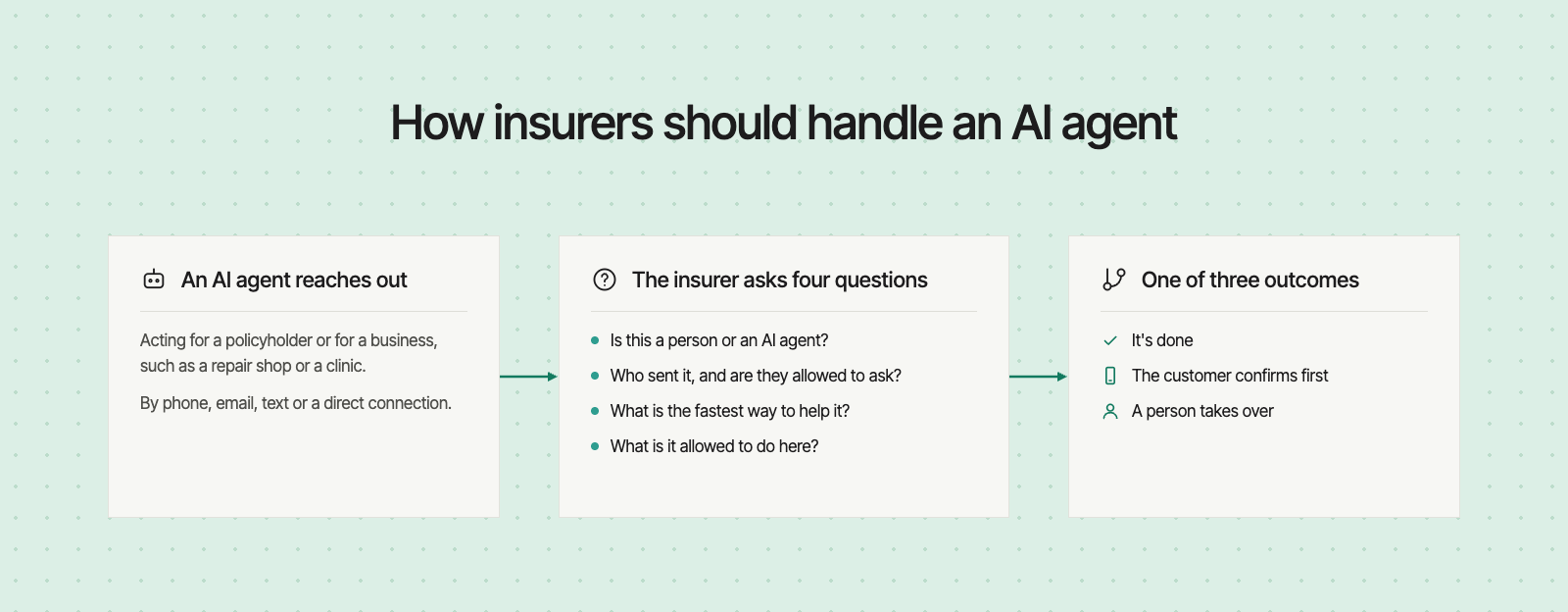
Our view is that personal agents will become a normal way for policyholders, claimants, providers and vendors to reach insurers. Insurance operations should be ready to serve them, not block them. Strada's approach is to recognize the agent, verify who it acts for, route it to workflows built for agents and let each carrier decide what agents may do, whatever channel or protocol they arrive through.
We start from the customer. A policyholder who sends an agent is still the policyholder. They have chosen a different way to reach their insurer, much as earlier generations moved from the agency counter to the web portal. Turning their agent away, or forcing it through a script written for a person, does not protect that customer. It just makes their insurer harder to deal with.
We also start from the operation. Most of the public discussion about personal agents is about shopping: carts, checkouts and price comparison. Insurance work is quoting, servicing and claims, where the question is less "can this agent complete a purchase?" and more "has this policyholder authorized this agent to act on this policy, and for which actions?" Answering that well is an operations problem as much as a technology one, and it is the problem we are focused on.
From there, our approach rests on five commitments:
- Recognize the agent. Every interaction should aim to know whether it is talking to a person or to software acting for one.
- Verify the delegation. Knowing a policy number is not the same as being authorized. The agent's link to the policyholder must be confirmed before anything sensitive happens.
- Serve agents in their own workflows. Agents need fast, structured and complete answers, not the conversation designed for a person.
- Let the carrier set the rules. Each insurer decides which actions an agent may take on its own, which need the policyholder's confirmation, and which go to a licensed person.
- Stay neutral on protocols. Phone, email, texting and web today, emerging AI agent standards as they mature. The rules should hold whichever channel the agent arrives through.
Who the agents work for
Personal agents work for a person. Muse, dots and Instinct are among the most prominent examples today. They hold a person's context (email, calendar, documents, payment methods) and act on it by booking, buying, filling in forms and making calls. Some can read email, book travel, fill in forms and pay on their user's behalf.
Business agents work for an organization. In insurance, these are the agents that answer a carrier's claims line, process an endorsement or respond to a TPA's service inbox. They hold the organization's context: policy data, claims systems, coverage rules and the procedures that govern what can be said and done.
Most insurance interactions will need both. The policyholder's agent can say what the policyholder wants and supply facts such as the date of loss or where the vehicle is, while the carrier's agent holds the policy, the coverage rules and the authority to act on them.
A third group is easy to overlook: other businesses' agents. Insurance operations serve far more than policyholders. Medical providers, repair shops, law firms, independent adjusters, vendors and other carriers contact insurers every day, and many of them are adopting agents of their own. The Guardian example above is one of these. OpenAI has also previewed specialist dots that can be given their own identities, credentials and tools for work inside organizations. For many insurers, the first sizable wave of agent traffic may come from this side rather than from consumers, and it can arrive in bulk.
Three phases of agents working with insurers
We see the relationship between personal agents and insurers moving through three phases. The phases will overlap, and different lines of business will move at different speeds, but the sequence is useful for deciding what to do now.
| Phases | How the agent reaches the insurer | What the insurer needs | Where it stands |
|---|---|---|---|
| Phase 1: imitation | Phone, website and email, the way a person would | Extra capacity for higher volumes, which is expensive and hard with people alone | Happening today |
| Phase 2: structured connection | A published protocol, APIs or the insurer's business agent | Agent-ready endpoints and delegated sign-in | Standards developing; few insurers live |
| Phase 3: continuous collaboration | Standing permissions and two-way updates | Durable authorization and event updates to agents | Early; largely ahead |
Phase 1: agents imitate people (today)
Today's personal agents mostly do what a person would do. They search for the insurer, open the website and click through forms, or dial the published phone number and talk their way through the menu. The agent finds what it needs the way a person would: a renewal notice in the inbox, a photo of an ID card, or a direct question to its user.
This works with no setup on the insurer's side, which is why it is spreading quickly. It also breaks in predictable ways. In September, the insurance marketplace Insurify temporarily restricted a consumer agent's access, concerned that quotes could be relayed as a bare price list without limits, deductibles, eligibility conditions or state-required disclosures. Less visibly, an agent with access to a policyholder's inbox can answer the knowledge-based questions that phone and web channels use to verify identity. The insurer often cannot tell whether it is speaking to the policyholder, an authorized agent or someone else holding the same details - unless they have the right tools.
Phase 2: agents connect to systems directly (emerging)
The second phase replaces imitation with a structured connection. A business publishes a file that tells agents how to work with it, through its business agent, its website or its APIs. A protocol builds on existing standards, including MCP and OpenAPI, and uses OAuth so the customer controls what their agent can do. Adoption is growing on the consumer and commerce side, and several insurers are among the early participants, although what they are building has not been published.
A few weeks after restricting access, Insurify opened an AI agent gateway that gives consumer agents structured access to quotes, with coverage details attached. Phase 2 still leaves insurance-specific questions open, which we cover below.
Phase 3: agents work together continuously (future)
In the third phase, the exchange stops being a series of separate requests. A policyholder gives their agent standing permission for a defined set of actions, such as checking claim status, paying a bill or requesting a certificate, and the carrier's agent recognizes that permission without re-verifying from scratch each time. Updates flow the other way too: the carrier's agent tells the personal agent when a claim moves, a payment is due or a renewal offer is ready. Some decisions, such as comparing renewal terms, could be worked through agent to agent and brought to the policyholder only for approval.
This phase is our view of where things are going, and it is still largely ahead. It also changes the economics. When comparing renewal terms costs a policyholder nothing, retention depends more on the quality of service and less on inertia.
Why insurance is harder than shopping
The early protocols are built around commerce, and a retail transaction is comparatively simple: a product, a price, a payment and a return policy. Insurance interactions carry more weight, for five reasons.
Authorization is per policy and per action. Signing in to a store account typically lets an agent shop within that account. An insurance policy can involve several named insureds, drivers, lienholders and authorized contacts. The right to check a claim's status is not the right to change a payment account or cancel coverage. The question an insurer needs answered is narrower and harder than identity: who delegated this agent, on which policy, for which actions? As one industry analysis puts it, an authenticated party can still be over-authorized.
Answers carry regulated context. A quote, a coverage answer or a claims decision often comes with limits, exclusions, conditions and state-required disclosures. An answer without them can mislead the policyholder even when the price or status is right. Some conversations also have to involve a licensed professional.
Claims are not transactions. A person reporting a loss may be shaken, injured or facing a large bill. Even when an agent places the call, the claim often reaches a point where judgment, empathy or a coverage decision needs a person. Handing off with full context matters more in claims than almost anywhere else.
Fraud adapts quickly. If agents can pass knowledge-based checks using data from an inbox, so can automated fraud. Agent traffic and verification have to be designed together.
Governance applies to both sides. Regulators already expect insurers to govern their use of AI, through the NAIC model bulletin, now adopted by many states, and New York DFS Circular Letter No. 7 for underwriting and pricing. How insurers handle other parties' agents is likely to draw the same attention.
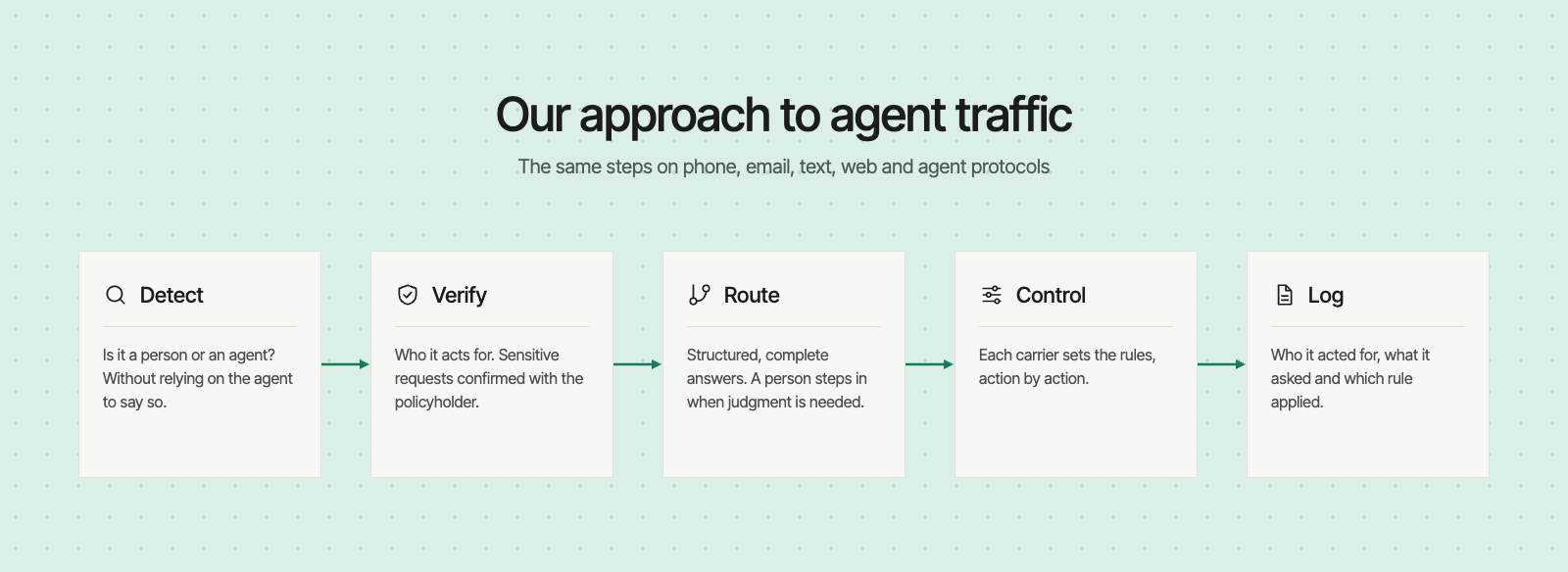
Our approach: detect, verify, route, control, log
Strada is built for insurance from the ground up. Our AI agents already handle claims and servicing work for carriers, MGAs and TPAs across voice, chat, email and SMS. They work inside the policy, claims and billing systems those operations run on, follow rules each client sets, and hand off to people with full context when judgment is needed. That matters for agent traffic. Recognizing that a caller is software is the easy part. The hard part is acting correctly on a real policy or claim, with insurance-specific controls, and that is where Strada already operates.
Our approach to agent traffic builds on that foundation and follows the order in which an interaction unfolds.
Detect. The first step is to assess whether the other party is a person or an agent, across voice, chat and email. Some agents identify themselves and many do not, so detection should not depend on the agent announcing itself. When an agent is recognized, the interaction can move to a path designed for it.
Verify. Detection says what the caller is. Verification establishes whom it acts for and what it is allowed to do, and it should not depend on detection: a capable agent can sound like a person, so sensitive actions need the same checks whoever is on the line. Answers to knowledge-based questions are not proof of delegation on their own. Before anything sensitive, the policyholder confirms the request through a channel already on file, such as a text or email to the contact details the carrier holds. Where a protocol supports it, a delegated sign-in that the policyholder granted directly can take the place of that step.
Route to agent workflows. An agent does not need small talk, empathy statements or a menu read aloud. It needs precise, structured and complete answers, with the relevant conditions and disclosures attached so that what reaches the policyholder is accurate. Agent workflows should also handle requests that a person would never make in one call, such as a provider checking the status of many claims at once. When a request needs judgment, the workflow hands off to a person with the full context of what the agent asked and what was already shared.
Control. Each carrier, MGA or TPA sets its own rules for agent traffic, action by action. As an illustration, a carrier might let a verified agent check claim status or request documents directly, require the policyholder's confirmation to change a payment method, add a driver or cancel a policy, and send coverage disputes or injury claims to a licensed adjuster. The rules can differ for personal agents and for business agents, and should apply the same way on every channel.
Log. Every agent interaction should be recorded: who the agent said it acted for, how that was verified, what it asked, what it received and which rule applied. That record supports the carrier's AI governance program and gives a clear answer if a policyholder later disputes what their agent did.
These principles hold regardless of how the agent arrives. Today that is mostly the phone, the web and email. As carriers adopt structured standards such as agent-to-agent protocols, MCP, or the Personal Agent Protocol, the same verification, rules and audit trail should carry over to those connections, and Strada will universally support them.
Why carriers should welcome agents, and what to do now
Agent traffic is an opportunity as well as a risk, and the economics favor insurers that prepare. Much of the effort in a servicing call goes into the conversation itself: greetings, identity questions, clarifying what the caller means and reading answers aloud. An agent needs none of that. A structured exchange can settle in a fraction of the time, a single bulk request can replace dozens of calls from a provider or repair shop, and fewer answers need to be repeated or corrected. Over time, agent-to-agent exchanges also reach past the contact center into the back office, where requests can flow straight into claims and policy workflows. Serving agents well frees licensed staff for the people and decisions that need them. And when switching insurers costs a policyholder almost nothing, being easy to deal with through an agent becomes part of retention.
Blocking is not a lasting answer. An insurer can restrict automated access to its website, but an agent can still pick up the phone, and a policyholder whose agent is turned away by both will notice.
For most carriers, MGAs and TPAs, the practical steps today are:
- Assume some inbound traffic already comes from agents, and ask front-line teams what they are seeing.
- Test whether current identity checks prove delegation or only knowledge of policy details.
- Decide, action by action, what an agent may do on its own, what needs the policyholder's confirmation and what needs a person.
- Check that quotes, coverage answers and claim updates keep their conditions and disclosures when another system relays them.
- Bring agent interactions, both inbound and the carrier's own, into the AI governance program.
- Follow the emerging standards and pilot where they fit, without waiting for them to settle before acting on the steps above.
What this means for insurers
Go back to the policyholder at the start of this post. They did not stop being a customer when they sent their agent to report the accident. What they will remember is whether the claim was opened correctly, whether the rental was arranged, and whether someone called them when a decision needed a person. If all of that works through an agent, the insurer earns the same goodwill as a well-handled phone call. If the agent is turned away or comes back with half an answer, the policyholder blames the insurer.
The principles are familiar, even if the implementation is new. Knowing who is on the line and what they are allowed to do, keeping answers complete and handing judgment calls to people are disciplines insurance operations teams already practice. What changes is the kind of caller they apply to. Carriers, MGAs and TPAs that start applying them to agents now will help set the rules for how agents work with insurers, rather than inherit rules written for retail.
Frequently asked questions
What is a personal AI agent?
Software that acts on a person's behalf. It can read email, fill in forms, make calls and complete tasks. Meta's Muse, OpenAI's dots and Instinct are some of the most prominent examples today.
Are AI agents already contacting insurers?
Yes. Most do it the way a person would, by calling the phone line or using the website. Healthcare providers are also already using AI agents to check patient benefits with insurers.
Should insurers block AI agents?
No. Blocking is a short-term fix: an insurer can restrict its website, but an agent can still call. A better approach is to serve agents with clear rules about what they can and cannot do.
How can an insurer tell if an AI agent is authorized to act for a policyholder?
Knowing a policy number or date of birth isn't proof. Before anything sensitive, the policyholder should confirm the request through a channel the insurer already has on file. Where a standard supports it, a sign-in the policyholder granted directly can replace that step.
Why is insurance harder than retail for AI agents?
Authorization is per policy and per action, and answers carry regulated disclosures. Claims often need human judgment, and fraud adapts quickly. Checking a claim's status and cancelling a policy call for very different levels of trust.
What are agent-to-agent standards?
Emerging ways for AI agents to connect to a business directly through structured APIs, instead of imitating a person on the phone or website. Examples include the Personal Agent Protocol and MCP. Adoption in insurance is still early.