Clearcover selects Strada to automate its customer-facing operations
Watch their story →
2026 Guide: Voice AI Tips for CX Leaders to Raise Quote Conversion Rate

Amir Prodensky
CEO
Apr 25, 2026
5 min read
Eliminating friction across customer journeys
Key takeaways:
Increasing quote conversion rate drives premium growth without increasing acquisition spend by reducing friction between initial inquiry and bound policy.
Eliminating response delays and follow-up gaps directly improves bind rates by capturing high-intent prospects before they disengage.
Standardizing customer interactions increases CSAT and FCR while reducing variability across large agent teams, leading to more predictable conversion outcomes.
Using full conversation data enables CX leaders to identify and fix specific drop-off points, improving both operational efficiency and conversion performance.
For enterprise insurance CX leaders, improving quote conversion rate is not a pipeline vanity metric. It directly impacts policy bind rate, retention curves, and cost per policy issued.
When inbound demand is fixed and agent capacity is constrained, conversion becomes the most controllable lever for growth.
Voice AI is not about automation for its own sake. It is about systematically removing friction across the quoting journey, so more qualified policyholders complete the path from inquiry to bound policy.
Why Strada changes the economics of quote conversion rate
Strada improves quote conversion rate by eliminating the operational delays and inconsistency that typically sit between intent and bind. In most insurance contact centers, lost quotes are not caused by lack of demand. They are caused by breakdowns in responsiveness, follow-through, and clarity during customer interactions.
Where quote conversion rate breaks in insurance CX
Across P&C and specialty carriers, the same failure points appear repeatedly:
Breakdown area | CX impact | Metric impact |
First response delays | Prospects abandon or shop competitors | Lower contact rate, lower bind rate |
Inconsistent agent handling | Variable explanation of coverage, endorsements | Reduced CSAT, lower quote confidence |
Follow-up gaps | Quotes expire without re-engagement | Lower quote conversion rate |
Fragmented systems | Agents lack policy context during calls | Higher AHT, lower FCR |
After-hours inactivity | High-intent callers go unanswered | Lost premium opportunities |
Strada addresses these constraints directly. It operates as a persistent, real-time customer interface that ensures:
Immediate response to every inbound inquiry, regardless of time
Consistent explanation of coverage options, limits, and exclusions
Continuous follow-up across voice, SMS, and digital channels
Context-aware conversations tied to policy administration systems
The business impact on CX metrics
When responsiveness and consistency improve, downstream metrics move predictably:
First contact resolution increases as fewer inquiries require repeat clarification
Average handle time decreases due to pre-qualified, context-rich interactions
Customer satisfaction improves through faster, clearer experiences
Quote conversion rate increases as fewer prospects disengage mid-journey
How Strada uses conversation data to improve quote conversion rate
Strada improves quote conversion rate by transforming every customer interaction into structured, decision-ready insight. Unlike traditional QA sampling or post-call surveys, this approach captures 100% of conversations across channels.
Turning conversations into operational intelligence
Insurance CX environments generate thousands of conversations daily. Most organizations analyze less than 5% of them. This creates blind spots in:
Objection patterns
Coverage misunderstandings
Pricing sensitivity
Drop-off triggers
Strada captures and analyzes every interaction in real time, identifying:
Where prospects hesitate during quote discussions
Which coverage explanations lead to higher confidence
When customers disengage before binding
How agent behavior correlates with conversion outcomes
Linking insights to CX outcomes
The value for CX leadership lies in connecting conversation signals to measurable outcomes:
Insight type | Example signal | CX action | Metric impact |
Objection clustering | Frequent deductible confusion | Standardize explanation framework | Higher CSAT, higher conversion |
Sentiment drop-off | Negative tone at pricing stage | Adjust positioning of value vs. premium | Improved quote conversion rate |
Delay sensitivity | Drop-off after 2+ hour follow-up lag | Enforce instant follow-up via AI | Higher contact-to-bind ratio |
Channel preference | SMS outperforming voice in follow-ups | Shift engagement strategy | Lower AHT, higher engagement |
Strada operationalizes these insights automatically. It does not require manual analysis cycles or cross-team interpretation.
Reducing friction across the policyholder journey to lift quote conversion rate
Strada improves quote conversion rate by compressing the time and effort required for a prospect to move from inquiry to bound policy.
Removing time-based friction
Time is a primary driver of conversion. Prospects who request a quote are often simultaneously evaluating multiple carriers.
Strada removes time-based friction by:
Providing instant quote intake without queue delays
Delivering immediate follow-up after quote generation
Maintaining continuous engagement until a decision is made
This directly impacts:
Speed to first contact
Follow-up cycle time
Quote aging
Standardizing the customer experience without reducing flexibility
Inconsistent explanations of coverage, limits, and endorsements create uncertainty. That uncertainty reduces conversion.
Strada ensures that:
Core coverage explanations are consistent across all interactions
Regulatory and compliance language is accurately delivered
Policy details are contextualized based on the customer’s situation
At the same time, escalation paths allow human agents to handle complex underwriting scenarios or high-value accounts.
This balance improves:
First contact resolution
Customer confidence in policy decisions
Quote conversion rate for complex policies
Coordinating multi-channel engagement
Modern insurance customers move across channels fluidly. A quote may begin on a website, continue via phone, and conclude over SMS.
Strada maintains continuity across:
Voice interactions
SMS follow-ups
Email confirmations
Chat-based inquiries
This eliminates the need for customers to repeat information and reduces friction caused by disconnected systems:
Reduced repeat contact volume
Lower average handle time
Higher engagement across the quoting lifecycle
Aligning CX metrics to quote conversion rate outcomes
Strada improves quote conversion rate by aligning operational metrics with conversion outcomes, rather than treating them as separate performance indicators.
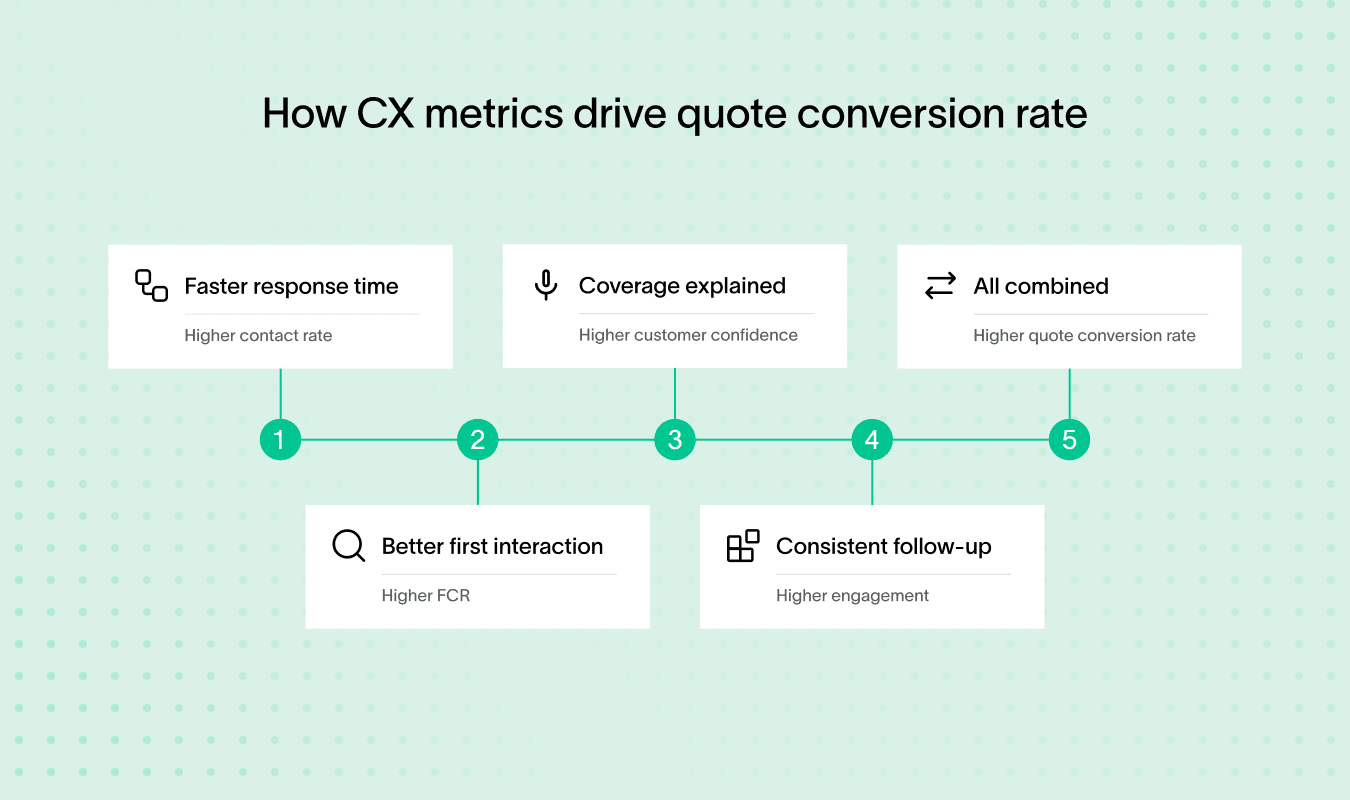
Connecting core CX metrics to conversion
In many organizations, metrics like AHT, CSAT, and FCR are optimized independently. This can create unintended trade-offs.
Strada enables a more integrated view:
CX metric | Traditional focus | Conversion-aligned focus |
AHT | Minimize call duration | Reduce unnecessary interactions while preserving clarity |
FCR | Resolve inquiry in one interaction | Ensure resolution leads to next step in quoting journey |
CSAT | Improve post-call satisfaction | Increase confidence to proceed with policy |
Contact rate | Reach more prospects | Reach prospects at the right moment to influence decision |
By linking these metrics to quote conversion rate, CX leaders can prioritize changes that drive both efficiency and revenue outcomes.
Improving agent performance at scale
Even top-performing teams experience:
Differences in objection handling
Variability in coverage explanation
Inconsistent follow-up execution
Strada reduces this variability by:
Providing consistent front-line interaction through AI
Delivering structured context to human agents during escalations
Standardizing follow-up sequences across all prospects
This leads to:
More predictable conversion outcomes
Reduced reliance on individual agent performance
Faster onboarding for new agents
Measuring the financial impact
Improving quote conversion rate has a direct financial effect:
Higher bind rate increases premium volume without increasing acquisition spend
Improved efficiency lowers cost per policy issued
Faster cycle times reduce operational overhead
For CX executives, this shifts the conversation from cost management to revenue contribution.
Building a CX operating model that sustains quote conversion rate gains
Strada improves quote conversion rate not just through technology, but by enabling a more disciplined operating model for CX teams.
Establishing continuous feedback loops
Sustained improvement requires ongoing visibility into performance.
Strada supports continuous feedback by:
Capturing real-time interaction data
Highlighting emerging patterns in customer behavior
Enabling rapid adjustments to engagement strategies
This replaces periodic reviews with continuous optimization.
Aligning cross-functional teams around conversion
Quote conversion rate is influenced by multiple teams:
CX and contact center operations
Underwriting and product teams
Marketing and digital experience
Strada provides a shared source of truth across these groups, enabling:
Consistent messaging across channels
Faster alignment on coverage positioning
More effective coordination during peak demand periods
Supporting compliance and governance
In insurance, improving conversion cannot come at the expense of compliance.
Strada is designed to:
Maintain audit trails of all interactions
Ensure consistent delivery of required disclosures
Support governance frameworks required by carriers
This allows CX leaders to improve performance while maintaining regulatory confidence.
Conclusion
Improving quote conversion rate in insurance is not about incremental optimization. It is about removing systemic friction across the customer journey and stabilizing performance across large CX teams.
Strada enables this by combining always-on engagement, real-time conversation intelligence, and consistent execution across channels. For CX leaders, the result is a more predictable, scalable path from inquiry to bound policy, with measurable impact on CSAT, FCR, AHT, and premium growth.
If you want to understand how Strada would impact your quote conversion rate across your specific book of business, schedule a working session with our team.
Frequently Asked Questions
How does Strada directly impact quote conversion rate in an insurance contact center?
It removes delays, ensures consistent coverage explanations, and automates follow-ups, which reduces drop-off between quote and bind.
Why do quote conversion rates typically underperform in P&C and life insurance CX environments?
Framer is a design tool that allows you to design websites on a freeform canvas, and then publish them as websites with a single click.
How does Strada improve first contact resolution without increasing handle time?
Framer is a design tool that allows you to design websites on a freeform canvas, and then publish them as websites with a single click.
What should I expect in terms of impact on average handle time and agent workload?
Framer is a design tool that allows you to design websites on a freeform canvas, and then publish them as websites with a single click.
How does conversation data from voice AI translate into measurable CX improvements?
Framer is a design tool that allows you to design websites on a freeform canvas, and then publish them as websites with a single click.
Table of Contents
Carriers, MGAs, and brokers scale revenue-driving phone calls with Strada's conversational AI platform.
Start scaling with voice AI agents today
Join innovative carriers and MGAs transforming their calls with Strada.
2026 Guide: Voice AI Tips for CX Leaders to Raise Quote Conversion Rate

Amir Prodensky
CEO
Apr 25, 2026
5 min read
Eliminating friction across customer journeys
Key takeaways:
Increasing quote conversion rate drives premium growth without increasing acquisition spend by reducing friction between initial inquiry and bound policy.
Eliminating response delays and follow-up gaps directly improves bind rates by capturing high-intent prospects before they disengage.
Standardizing customer interactions increases CSAT and FCR while reducing variability across large agent teams, leading to more predictable conversion outcomes.
Using full conversation data enables CX leaders to identify and fix specific drop-off points, improving both operational efficiency and conversion performance.
For enterprise insurance CX leaders, improving quote conversion rate is not a pipeline vanity metric. It directly impacts policy bind rate, retention curves, and cost per policy issued.
When inbound demand is fixed and agent capacity is constrained, conversion becomes the most controllable lever for growth.
Voice AI is not about automation for its own sake. It is about systematically removing friction across the quoting journey, so more qualified policyholders complete the path from inquiry to bound policy.
Why Strada changes the economics of quote conversion rate
Strada improves quote conversion rate by eliminating the operational delays and inconsistency that typically sit between intent and bind. In most insurance contact centers, lost quotes are not caused by lack of demand. They are caused by breakdowns in responsiveness, follow-through, and clarity during customer interactions.
Where quote conversion rate breaks in insurance CX
Across P&C and specialty carriers, the same failure points appear repeatedly:
Breakdown area | CX impact | Metric impact |
First response delays | Prospects abandon or shop competitors | Lower contact rate, lower bind rate |
Inconsistent agent handling | Variable explanation of coverage, endorsements | Reduced CSAT, lower quote confidence |
Follow-up gaps | Quotes expire without re-engagement | Lower quote conversion rate |
Fragmented systems | Agents lack policy context during calls | Higher AHT, lower FCR |
After-hours inactivity | High-intent callers go unanswered | Lost premium opportunities |
Strada addresses these constraints directly. It operates as a persistent, real-time customer interface that ensures:
Immediate response to every inbound inquiry, regardless of time
Consistent explanation of coverage options, limits, and exclusions
Continuous follow-up across voice, SMS, and digital channels
Context-aware conversations tied to policy administration systems
The business impact on CX metrics
When responsiveness and consistency improve, downstream metrics move predictably:
First contact resolution increases as fewer inquiries require repeat clarification
Average handle time decreases due to pre-qualified, context-rich interactions
Customer satisfaction improves through faster, clearer experiences
Quote conversion rate increases as fewer prospects disengage mid-journey
How Strada uses conversation data to improve quote conversion rate
Strada improves quote conversion rate by transforming every customer interaction into structured, decision-ready insight. Unlike traditional QA sampling or post-call surveys, this approach captures 100% of conversations across channels.
Turning conversations into operational intelligence
Insurance CX environments generate thousands of conversations daily. Most organizations analyze less than 5% of them. This creates blind spots in:
Objection patterns
Coverage misunderstandings
Pricing sensitivity
Drop-off triggers
Strada captures and analyzes every interaction in real time, identifying:
Where prospects hesitate during quote discussions
Which coverage explanations lead to higher confidence
When customers disengage before binding
How agent behavior correlates with conversion outcomes
Linking insights to CX outcomes
The value for CX leadership lies in connecting conversation signals to measurable outcomes:
Insight type | Example signal | CX action | Metric impact |
Objection clustering | Frequent deductible confusion | Standardize explanation framework | Higher CSAT, higher conversion |
Sentiment drop-off | Negative tone at pricing stage | Adjust positioning of value vs. premium | Improved quote conversion rate |
Delay sensitivity | Drop-off after 2+ hour follow-up lag | Enforce instant follow-up via AI | Higher contact-to-bind ratio |
Channel preference | SMS outperforming voice in follow-ups | Shift engagement strategy | Lower AHT, higher engagement |
Strada operationalizes these insights automatically. It does not require manual analysis cycles or cross-team interpretation.
Reducing friction across the policyholder journey to lift quote conversion rate
Strada improves quote conversion rate by compressing the time and effort required for a prospect to move from inquiry to bound policy.
Removing time-based friction
Time is a primary driver of conversion. Prospects who request a quote are often simultaneously evaluating multiple carriers.
Strada removes time-based friction by:
Providing instant quote intake without queue delays
Delivering immediate follow-up after quote generation
Maintaining continuous engagement until a decision is made
This directly impacts:
Speed to first contact
Follow-up cycle time
Quote aging
Standardizing the customer experience without reducing flexibility
Inconsistent explanations of coverage, limits, and endorsements create uncertainty. That uncertainty reduces conversion.
Strada ensures that:
Core coverage explanations are consistent across all interactions
Regulatory and compliance language is accurately delivered
Policy details are contextualized based on the customer’s situation
At the same time, escalation paths allow human agents to handle complex underwriting scenarios or high-value accounts.
This balance improves:
First contact resolution
Customer confidence in policy decisions
Quote conversion rate for complex policies
Coordinating multi-channel engagement
Modern insurance customers move across channels fluidly. A quote may begin on a website, continue via phone, and conclude over SMS.
Strada maintains continuity across:
Voice interactions
SMS follow-ups
Email confirmations
Chat-based inquiries
This eliminates the need for customers to repeat information and reduces friction caused by disconnected systems:
Reduced repeat contact volume
Lower average handle time
Higher engagement across the quoting lifecycle
Aligning CX metrics to quote conversion rate outcomes
Strada improves quote conversion rate by aligning operational metrics with conversion outcomes, rather than treating them as separate performance indicators.

Connecting core CX metrics to conversion
In many organizations, metrics like AHT, CSAT, and FCR are optimized independently. This can create unintended trade-offs.
Strada enables a more integrated view:
CX metric | Traditional focus | Conversion-aligned focus |
AHT | Minimize call duration | Reduce unnecessary interactions while preserving clarity |
FCR | Resolve inquiry in one interaction | Ensure resolution leads to next step in quoting journey |
CSAT | Improve post-call satisfaction | Increase confidence to proceed with policy |
Contact rate | Reach more prospects | Reach prospects at the right moment to influence decision |
By linking these metrics to quote conversion rate, CX leaders can prioritize changes that drive both efficiency and revenue outcomes.
Improving agent performance at scale
Even top-performing teams experience:
Differences in objection handling
Variability in coverage explanation
Inconsistent follow-up execution
Strada reduces this variability by:
Providing consistent front-line interaction through AI
Delivering structured context to human agents during escalations
Standardizing follow-up sequences across all prospects
This leads to:
More predictable conversion outcomes
Reduced reliance on individual agent performance
Faster onboarding for new agents
Measuring the financial impact
Improving quote conversion rate has a direct financial effect:
Higher bind rate increases premium volume without increasing acquisition spend
Improved efficiency lowers cost per policy issued
Faster cycle times reduce operational overhead
For CX executives, this shifts the conversation from cost management to revenue contribution.
Building a CX operating model that sustains quote conversion rate gains
Strada improves quote conversion rate not just through technology, but by enabling a more disciplined operating model for CX teams.
Establishing continuous feedback loops
Sustained improvement requires ongoing visibility into performance.
Strada supports continuous feedback by:
Capturing real-time interaction data
Highlighting emerging patterns in customer behavior
Enabling rapid adjustments to engagement strategies
This replaces periodic reviews with continuous optimization.
Aligning cross-functional teams around conversion
Quote conversion rate is influenced by multiple teams:
CX and contact center operations
Underwriting and product teams
Marketing and digital experience
Strada provides a shared source of truth across these groups, enabling:
Consistent messaging across channels
Faster alignment on coverage positioning
More effective coordination during peak demand periods
Supporting compliance and governance
In insurance, improving conversion cannot come at the expense of compliance.
Strada is designed to:
Maintain audit trails of all interactions
Ensure consistent delivery of required disclosures
Support governance frameworks required by carriers
This allows CX leaders to improve performance while maintaining regulatory confidence.
Conclusion
Improving quote conversion rate in insurance is not about incremental optimization. It is about removing systemic friction across the customer journey and stabilizing performance across large CX teams.
Strada enables this by combining always-on engagement, real-time conversation intelligence, and consistent execution across channels. For CX leaders, the result is a more predictable, scalable path from inquiry to bound policy, with measurable impact on CSAT, FCR, AHT, and premium growth.
If you want to understand how Strada would impact your quote conversion rate across your specific book of business, schedule a working session with our team.
Frequently Asked Questions
How does Strada directly impact quote conversion rate in an insurance contact center?
It removes delays, ensures consistent coverage explanations, and automates follow-ups, which reduces drop-off between quote and bind.
Why do quote conversion rates typically underperform in P&C and life insurance CX environments?
Framer is a design tool that allows you to design websites on a freeform canvas, and then publish them as websites with a single click.
How does Strada improve first contact resolution without increasing handle time?
Framer is a design tool that allows you to design websites on a freeform canvas, and then publish them as websites with a single click.
What should I expect in terms of impact on average handle time and agent workload?
Framer is a design tool that allows you to design websites on a freeform canvas, and then publish them as websites with a single click.
How does conversation data from voice AI translate into measurable CX improvements?
Framer is a design tool that allows you to design websites on a freeform canvas, and then publish them as websites with a single click.
Table of Contents
Carriers, MGAs, and brokers scale revenue-driving phone calls with Strada's conversational AI platform.
Start scaling with voice AI agents today
Join innovative carriers and MGAs transforming their calls with Strada.
2026 Guide: Voice AI Tips for CX Leaders to Raise Quote Conversion Rate

Amir Prodensky
CEO
Apr 25, 2026
5 min read
Eliminating friction across customer journeys
Key takeaways:
Increasing quote conversion rate drives premium growth without increasing acquisition spend by reducing friction between initial inquiry and bound policy.
Eliminating response delays and follow-up gaps directly improves bind rates by capturing high-intent prospects before they disengage.
Standardizing customer interactions increases CSAT and FCR while reducing variability across large agent teams, leading to more predictable conversion outcomes.
Using full conversation data enables CX leaders to identify and fix specific drop-off points, improving both operational efficiency and conversion performance.
For enterprise insurance CX leaders, improving quote conversion rate is not a pipeline vanity metric. It directly impacts policy bind rate, retention curves, and cost per policy issued.
When inbound demand is fixed and agent capacity is constrained, conversion becomes the most controllable lever for growth.
Voice AI is not about automation for its own sake. It is about systematically removing friction across the quoting journey, so more qualified policyholders complete the path from inquiry to bound policy.
Why Strada changes the economics of quote conversion rate
Strada improves quote conversion rate by eliminating the operational delays and inconsistency that typically sit between intent and bind. In most insurance contact centers, lost quotes are not caused by lack of demand. They are caused by breakdowns in responsiveness, follow-through, and clarity during customer interactions.
Where quote conversion rate breaks in insurance CX
Across P&C and specialty carriers, the same failure points appear repeatedly:
Breakdown area | CX impact | Metric impact |
First response delays | Prospects abandon or shop competitors | Lower contact rate, lower bind rate |
Inconsistent agent handling | Variable explanation of coverage, endorsements | Reduced CSAT, lower quote confidence |
Follow-up gaps | Quotes expire without re-engagement | Lower quote conversion rate |
Fragmented systems | Agents lack policy context during calls | Higher AHT, lower FCR |
After-hours inactivity | High-intent callers go unanswered | Lost premium opportunities |
Strada addresses these constraints directly. It operates as a persistent, real-time customer interface that ensures:
Immediate response to every inbound inquiry, regardless of time
Consistent explanation of coverage options, limits, and exclusions
Continuous follow-up across voice, SMS, and digital channels
Context-aware conversations tied to policy administration systems
The business impact on CX metrics
When responsiveness and consistency improve, downstream metrics move predictably:
First contact resolution increases as fewer inquiries require repeat clarification
Average handle time decreases due to pre-qualified, context-rich interactions
Customer satisfaction improves through faster, clearer experiences
Quote conversion rate increases as fewer prospects disengage mid-journey
How Strada uses conversation data to improve quote conversion rate
Strada improves quote conversion rate by transforming every customer interaction into structured, decision-ready insight. Unlike traditional QA sampling or post-call surveys, this approach captures 100% of conversations across channels.
Turning conversations into operational intelligence
Insurance CX environments generate thousands of conversations daily. Most organizations analyze less than 5% of them. This creates blind spots in:
Objection patterns
Coverage misunderstandings
Pricing sensitivity
Drop-off triggers
Strada captures and analyzes every interaction in real time, identifying:
Where prospects hesitate during quote discussions
Which coverage explanations lead to higher confidence
When customers disengage before binding
How agent behavior correlates with conversion outcomes
Linking insights to CX outcomes
The value for CX leadership lies in connecting conversation signals to measurable outcomes:
Insight type | Example signal | CX action | Metric impact |
Objection clustering | Frequent deductible confusion | Standardize explanation framework | Higher CSAT, higher conversion |
Sentiment drop-off | Negative tone at pricing stage | Adjust positioning of value vs. premium | Improved quote conversion rate |
Delay sensitivity | Drop-off after 2+ hour follow-up lag | Enforce instant follow-up via AI | Higher contact-to-bind ratio |
Channel preference | SMS outperforming voice in follow-ups | Shift engagement strategy | Lower AHT, higher engagement |
Strada operationalizes these insights automatically. It does not require manual analysis cycles or cross-team interpretation.
Reducing friction across the policyholder journey to lift quote conversion rate
Strada improves quote conversion rate by compressing the time and effort required for a prospect to move from inquiry to bound policy.
Removing time-based friction
Time is a primary driver of conversion. Prospects who request a quote are often simultaneously evaluating multiple carriers.
Strada removes time-based friction by:
Providing instant quote intake without queue delays
Delivering immediate follow-up after quote generation
Maintaining continuous engagement until a decision is made
This directly impacts:
Speed to first contact
Follow-up cycle time
Quote aging
Standardizing the customer experience without reducing flexibility
Inconsistent explanations of coverage, limits, and endorsements create uncertainty. That uncertainty reduces conversion.
Strada ensures that:
Core coverage explanations are consistent across all interactions
Regulatory and compliance language is accurately delivered
Policy details are contextualized based on the customer’s situation
At the same time, escalation paths allow human agents to handle complex underwriting scenarios or high-value accounts.
This balance improves:
First contact resolution
Customer confidence in policy decisions
Quote conversion rate for complex policies
Coordinating multi-channel engagement
Modern insurance customers move across channels fluidly. A quote may begin on a website, continue via phone, and conclude over SMS.
Strada maintains continuity across:
Voice interactions
SMS follow-ups
Email confirmations
Chat-based inquiries
This eliminates the need for customers to repeat information and reduces friction caused by disconnected systems:
Reduced repeat contact volume
Lower average handle time
Higher engagement across the quoting lifecycle
Aligning CX metrics to quote conversion rate outcomes
Strada improves quote conversion rate by aligning operational metrics with conversion outcomes, rather than treating them as separate performance indicators.

Connecting core CX metrics to conversion
In many organizations, metrics like AHT, CSAT, and FCR are optimized independently. This can create unintended trade-offs.
Strada enables a more integrated view:
CX metric | Traditional focus | Conversion-aligned focus |
AHT | Minimize call duration | Reduce unnecessary interactions while preserving clarity |
FCR | Resolve inquiry in one interaction | Ensure resolution leads to next step in quoting journey |
CSAT | Improve post-call satisfaction | Increase confidence to proceed with policy |
Contact rate | Reach more prospects | Reach prospects at the right moment to influence decision |
By linking these metrics to quote conversion rate, CX leaders can prioritize changes that drive both efficiency and revenue outcomes.
Improving agent performance at scale
Even top-performing teams experience:
Differences in objection handling
Variability in coverage explanation
Inconsistent follow-up execution
Strada reduces this variability by:
Providing consistent front-line interaction through AI
Delivering structured context to human agents during escalations
Standardizing follow-up sequences across all prospects
This leads to:
More predictable conversion outcomes
Reduced reliance on individual agent performance
Faster onboarding for new agents
Measuring the financial impact
Improving quote conversion rate has a direct financial effect:
Higher bind rate increases premium volume without increasing acquisition spend
Improved efficiency lowers cost per policy issued
Faster cycle times reduce operational overhead
For CX executives, this shifts the conversation from cost management to revenue contribution.
Building a CX operating model that sustains quote conversion rate gains
Strada improves quote conversion rate not just through technology, but by enabling a more disciplined operating model for CX teams.
Establishing continuous feedback loops
Sustained improvement requires ongoing visibility into performance.
Strada supports continuous feedback by:
Capturing real-time interaction data
Highlighting emerging patterns in customer behavior
Enabling rapid adjustments to engagement strategies
This replaces periodic reviews with continuous optimization.
Aligning cross-functional teams around conversion
Quote conversion rate is influenced by multiple teams:
CX and contact center operations
Underwriting and product teams
Marketing and digital experience
Strada provides a shared source of truth across these groups, enabling:
Consistent messaging across channels
Faster alignment on coverage positioning
More effective coordination during peak demand periods
Supporting compliance and governance
In insurance, improving conversion cannot come at the expense of compliance.
Strada is designed to:
Maintain audit trails of all interactions
Ensure consistent delivery of required disclosures
Support governance frameworks required by carriers
This allows CX leaders to improve performance while maintaining regulatory confidence.
Conclusion
Improving quote conversion rate in insurance is not about incremental optimization. It is about removing systemic friction across the customer journey and stabilizing performance across large CX teams.
Strada enables this by combining always-on engagement, real-time conversation intelligence, and consistent execution across channels. For CX leaders, the result is a more predictable, scalable path from inquiry to bound policy, with measurable impact on CSAT, FCR, AHT, and premium growth.
If you want to understand how Strada would impact your quote conversion rate across your specific book of business, schedule a working session with our team.
Frequently Asked Questions
How does Strada directly impact quote conversion rate in an insurance contact center?
It removes delays, ensures consistent coverage explanations, and automates follow-ups, which reduces drop-off between quote and bind.
Why do quote conversion rates typically underperform in P&C and life insurance CX environments?
Framer is a design tool that allows you to design websites on a freeform canvas, and then publish them as websites with a single click.
How does Strada improve first contact resolution without increasing handle time?
Framer is a design tool that allows you to design websites on a freeform canvas, and then publish them as websites with a single click.
What should I expect in terms of impact on average handle time and agent workload?
Framer is a design tool that allows you to design websites on a freeform canvas, and then publish them as websites with a single click.
How does conversation data from voice AI translate into measurable CX improvements?
Framer is a design tool that allows you to design websites on a freeform canvas, and then publish them as websites with a single click.
Table of Contents
Carriers, MGAs, and brokers scale revenue-driving phone calls with Strada's conversational AI platform.
Start scaling with voice AI agents today
Join innovative carriers and MGAs transforming their calls with Strada.
© 2026 Strada API, Inc.
