Introducing Strada Signals, our new report series on AI for insurance operations. Read our whitepaper →
Introducing Strada Signals, our new report series on AI for insurance operations.
Read our whitepaper →
Introducing Strada Signals, our new report series on AI for insurance operations. Read our whitepaper →
How to Use Proactive Messaging to Improve Insurance Renewals 2026

Amir Prodensky
CEO
8 min read
Proactive messaging strategies to reduce insurance contact center demand
Key takeaways:
Reducing inbound service demand improves contact center efficiency by resolving routine policyholder inquiries through proactive messaging before customers initiate calls.
Early renewal outreach protects premium revenue by engaging policyholders with reminders and policy information before they begin shopping alternative carriers.
Automating claims updates, billing reminders, and policy servicing interactions lowers average handle time while allowing agents to focus on complex customer needs.
Multi-channel proactive messaging improves policyholder communication by delivering timely updates through voice, SMS, chat, or email based on the context of the interaction.
Enterprise insurers operate at scale. A CX leader overseeing 50 to 500 agents manages metrics such as average handle time, call abandonment, service level adherence, claims cycle time, policyholder retention, and cost per contact. When contact volume spikes during renewal periods or catastrophe events, those metrics move quickly in the wrong direction.
Proactive messaging changes that equation. Instead of waiting for policyholders to initiate contact, insurers can resolve service needs earlier through automated outreach across voice, SMS, and digital channels. Platforms such as Strada enable this shift by connecting directly to policy, billing, and claims systems to initiate contextual conversations with policyholders before inbound demand occurs.
The result is measurable improvement across containment, agent utilization, and renewal retention.
How Strada enables proactive messaging for enterprise insurance CX
Strada is built specifically for insurance operations that manage high service volumes across claims, policy servicing, and renewals. Its approach to proactive messaging focuses on reducing inbound service demand while improving policyholder experience across multiple channels.
Here’s the easiest way to picture the shift.
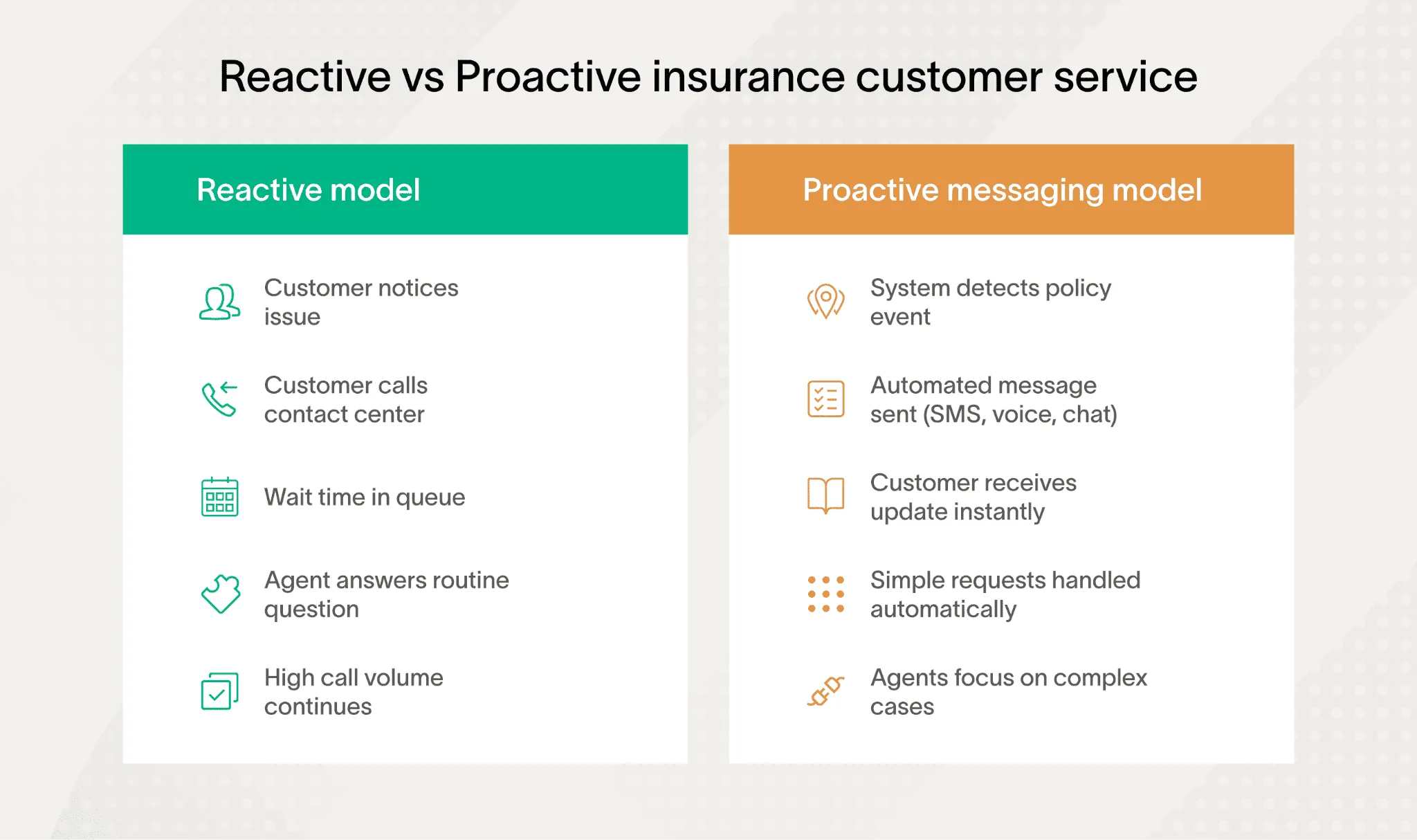
Rather than functioning as a simple messaging tool, Strada operates as a multi-channel proactive messaging vendor designed to automate high-volume insurance workflows.
Strada achieves this through three core capabilities:
Real-time integration with policy administration and claims systems
Automated outreach across voice, SMS, and chat
AI-driven containment that resolves common service interactions without agent intervention
In practice, this means a policyholder with a billing question, claim update, or upcoming renewal receives relevant information automatically instead of initiating a call.
Organizations deploying Strada commonly report:
CX metric | Typical improvement |
Call containment | ~65% automated resolution |
Average handle time | ~55% reduction |
Escalation rate | Reduced by routing simple requests to automation |
Renewal retention | Improved through early renewal engagement |
Agent productivity | Increased due to lower inbound demand |
These outcomes matter because CX leaders are measured not just on service quality but on operational efficiency.
Why proactive messaging matters to CX leaders
Insurance service demand is highly predictable. Renewals occur on fixed schedules. Billing cycles are recurring. Claims follow structured processes.
Yet most service organizations operate reactively.
When proactive messaging is implemented effectively, the interaction model shifts:
Reactive service model | Proactive messaging model |
Policyholder initiates contact | System initiates outreach |
Agents answer repetitive questions | Automation resolves common tasks |
High inbound volume | Reduced service demand |
Late renewal engagement | Early policyholder reminders |
The shift directly impacts the metrics CX executives track daily.
Using proactive messaging to reduce renewal risk
For many carriers, retention improvements of even 1 to 2 percent translate into millions in preserved premium revenue.
Strada’s proactive messaging capabilities address renewal risk by initiating outreach before policyholders begin shopping alternative carriers.
Instead of waiting for renewal questions to appear in the call queue, the platform automatically triggers messaging workflows tied to renewal timelines.
Renewal engagement through proactive messaging via SMS
One of the most effective channels for renewal engagement is proactive messaging via SMS. SMS provides high visibility and fast response rates without requiring the policyholder to log into a portal.
A typical renewal workflow might include:
Renewal timeline | Automated message |
45 days before renewal | Reminder that renewal is approaching |
30 days before renewal | Coverage review prompt |
14 days before renewal | Payment or policy update reminder |
3 days before renewal | Final renewal confirmation |
When policyholders respond with questions, Strada’s conversational AI resolves common requests such as:
Payment confirmation
Coverage clarification
Policy document retrieval
Renewal status updates
If the interaction becomes complex, the conversation is transferred to a licensed agent with full context.
Operational impact during renewal periods
Renewal periods often create inbound spikes that strain contact centers.
Without proactive messaging:
Policyholders call to confirm renewal status
Agents spend time answering repetitive questions
Call wait times increase
Customer satisfaction declines
With proactive outreach enabled by Strada:
Policyholders receive updates automatically
Many questions are resolved through automated conversations
Agents handle fewer routine contacts
Service levels remain stable during peak demand
For CX leaders, this translates directly to improved performance across service level adherence, abandonment rate, and cost per contact.
Where proactive messaging delivers the greatest operational impact
Proactive messaging is most effective when applied to predictable, high-volume service interactions. Strada focuses on the insurance workflows that generate the highest contact center demand.
These workflows typically fall into three categories.
Claims and first notice of loss
Instead of requiring policyholders to call, Strada initiates proactive communication after a claim is reported. Messages confirm claim intake, explain next steps, and provide status updates.
Examples include:
Claim confirmation notifications
Adjuster assignment updates
Document submission requests
Payment status alerts
These updates significantly reduce inbound “status check” calls.
For CX leaders managing claims service operations, this improves:
Claims cycle communication
Contact center load during catastrophe events
Policyholder transparency during claims processing
Billing and payment reminders
Billing inquiries account for a large percentage of inbound service calls in many insurers.
Strada automates proactive outreach tied to billing cycles, including reminders, payment confirmations, and overdue notifications.
These messages are delivered through:
SMS notifications
automated voice outreach
chat platforms proactive messaging on websites
When policyholders reply, automated workflows can process payments, provide billing details, or escalate complex issues to agents.
Policy servicing and document access
Another major driver of service demand is simple policy servicing requests.
Examples include:
Requesting proof of insurance
Updating contact information
Asking coverage questions
Retrieving policy documents
Through Strada’s conversational workflows, many of these requests are resolved automatically through chat or SMS without agent involvement.
For CX teams measured on first contact resolution and handle time, these automated interactions drive measurable improvements.
How Strada supports multi-channel proactive messaging at enterprise scale
Many insurers attempt proactive messaging through isolated tools such as SMS platforms or website chat widgets. The result is fragmented outreach that does not integrate with core insurance systems.
Strada addresses this challenge by functioning as a multi-channel proactive messaging vendor designed for enterprise insurance environments.
Multi-channel messaging architecture
Strada supports proactive messaging through several policyholder communication channels.
Channel | Use case |
Voice automation | FNOL intake and claims updates |
SMS messaging | Billing reminders and renewal notifications |
Website chat | Policy servicing through chat platforms proactive messaging on websites |
Document delivery and confirmations |
Each message is triggered by real events within policy administration or claims systems.
For example:
A billing system event triggers an SMS payment reminder
A claims status update triggers automated outreach
A renewal timeline triggers proactive engagement
Because these interactions are connected to policyholder data, conversations remain accurate and context aware.
How Strada compares to traditional chat tools
Many organizations evaluate top live chat tools with proactive messaging when exploring automation.
Traditional chat platforms typically focus on website engagement. While they can deliver proactive prompts, they often lack deep integration with insurance systems.
Strada operates differently.
Category | Traditional chat tools | Strada |
Primary focus | Website conversations | Insurance service workflows |
System integration | Limited policy system integration | Deep policy and claims integration |
Automation scope | Chat only | Voice, SMS, chat, email |
Use cases | Website assistance | Claims, billing, renewals |
Policyholders frequently contact insurers through voice or SMS, which means a platform limited to web chat cannot significantly reduce service demand.
Compliance and governance
Insurance communication must meet strict regulatory standards. Strada includes built-in safeguards for consent tracking and compliance with regulations such as:
TCPA for SMS communications
GDPR data protection requirements
SOC 2 Type II security controls
All interactions include opt-out mechanisms and consent tracking to ensure outreach remains compliant with insurance communication regulations.
For CX leaders responsible for regulatory oversight, this governance layer is essential.
Evaluating the ROI of proactive messaging for insurance CX operations
Enterprise CX leaders evaluate new technology through measurable operational outcomes. Proactive messaging is most compelling when framed through cost reduction and service improvement.
Strada customers often evaluate ROI using a simple framework tied to contact center economics.
Contact center cost reduction
The financial impact of proactive messaging is tied to automation rates.
A simplified calculation: Automation savings = automated contacts × cost per agent interaction
For example:
Metric | Example value |
Monthly inbound contacts | 200,000 |
Cost per agent interaction | $6 |
Automation rate | 65% |
This produces potential monthly savings exceeding $780,000 in agent handling costs.
Improved CX performance metrics
Beyond cost savings, proactive messaging improves several operational KPIs commonly tracked by CX executives.
CX KPI | Improvement driver |
Average handle time | Automation resolves routine requests |
Service level | Reduced inbound demand |
First contact resolution | Automated answers available immediately |
Agent utilization | Agents focus on complex cases |
Customer satisfaction | Faster responses and fewer hold times |
These improvements directly influence CX leadership scorecards and operational performance reviews.
When proactive messaging adoption accelerates
Most insurers begin adopting proactive messaging after experiencing one of the following pressures:
Catastrophe events overwhelming contact centers
Renewal periods driving service spikes
Rising service costs due to agent staffing requirements
In these environments, automation becomes less about experimentation and more about operational resilience.
Conclusion
Insurance CX leaders face increasing pressure to maintain service quality while managing rising contact volumes. Proactive messaging offers a structural solution to that challenge.
By initiating conversations with policyholders before they reach out, insurers can reduce inbound demand, improve service efficiency, and protect renewal revenue. Platforms such as Strada enable this shift through deep integration with insurance systems and automation across voice, SMS, and chat.
The result is a more predictable service operation where agents handle complex issues while automation resolves routine interactions.
If you want to see how proactive messaging can reduce contact volume and improve renewal retention in your organization, schedule a Strada demo to evaluate how automated outreach fits within your CX operation.
Frequently Asked Questions
How does proactive messaging reduce inbound contact volume in an insurance contact center?
Proactive messaging delivers updates and answers before policyholders need to call. By resolving routine questions through channels like SMS, voice, or chat, many interactions never reach the call queue.
Why is proactive messaging particularly important during insurance renewal periods?
Framer is a design tool that allows you to design websites on a freeform canvas, and then publish them as websites with a single click.
How can proactive messaging via SMS support renewal engagement with policyholders?
Framer is a design tool that allows you to design websites on a freeform canvas, and then publish them as websites with a single click.
How does voice AI and automation improve operational metrics for CX leaders?
Framer is a design tool that allows you to design websites on a freeform canvas, and then publish them as websites with a single click.
How should CX leaders evaluate the ROI of proactive messaging initiatives?
Framer is a design tool that allows you to design websites on a freeform canvas, and then publish them as websites with a single click.
Table of Contents
Carriers, MGAs, and brokers scale revenue-driving phone calls with Strada's conversational AI platform.
Start scaling with voice AI agents today
Join innovative carriers and MGAs transforming their calls with Strada.
How to Use Proactive Messaging to Improve Insurance Renewals 2026
Amir Prodensky
CEO
8 min read
Proactive messaging strategies to reduce insurance contact center demand
Key takeaways:
Reducing inbound service demand improves contact center efficiency by resolving routine policyholder inquiries through proactive messaging before customers initiate calls.
Early renewal outreach protects premium revenue by engaging policyholders with reminders and policy information before they begin shopping alternative carriers.
Automating claims updates, billing reminders, and policy servicing interactions lowers average handle time while allowing agents to focus on complex customer needs.
Multi-channel proactive messaging improves policyholder communication by delivering timely updates through voice, SMS, chat, or email based on the context of the interaction.
Enterprise insurers operate at scale. A CX leader overseeing 50 to 500 agents manages metrics such as average handle time, call abandonment, service level adherence, claims cycle time, policyholder retention, and cost per contact. When contact volume spikes during renewal periods or catastrophe events, those metrics move quickly in the wrong direction.
Proactive messaging changes that equation. Instead of waiting for policyholders to initiate contact, insurers can resolve service needs earlier through automated outreach across voice, SMS, and digital channels. Platforms such as Strada enable this shift by connecting directly to policy, billing, and claims systems to initiate contextual conversations with policyholders before inbound demand occurs.
The result is measurable improvement across containment, agent utilization, and renewal retention.
How Strada enables proactive messaging for enterprise insurance CX
Strada is built specifically for insurance operations that manage high service volumes across claims, policy servicing, and renewals. Its approach to proactive messaging focuses on reducing inbound service demand while improving policyholder experience across multiple channels.
Here’s the easiest way to picture the shift.
Rather than functioning as a simple messaging tool, Strada operates as a multi-channel proactive messaging vendor designed to automate high-volume insurance workflows.
Strada achieves this through three core capabilities:
Real-time integration with policy administration and claims systems
Automated outreach across voice, SMS, and chat
AI-driven containment that resolves common service interactions without agent intervention
In practice, this means a policyholder with a billing question, claim update, or upcoming renewal receives relevant information automatically instead of initiating a call.
Organizations deploying Strada commonly report:
CX metric | Typical improvement |
Call containment | ~65% automated resolution |
Average handle time | ~55% reduction |
Escalation rate | Reduced by routing simple requests to automation |
Renewal retention | Improved through early renewal engagement |
Agent productivity | Increased due to lower inbound demand |
These outcomes matter because CX leaders are measured not just on service quality but on operational efficiency.
Why proactive messaging matters to CX leaders
Insurance service demand is highly predictable. Renewals occur on fixed schedules. Billing cycles are recurring. Claims follow structured processes.
Yet most service organizations operate reactively.
When proactive messaging is implemented effectively, the interaction model shifts:
Reactive service model | Proactive messaging model |
Policyholder initiates contact | System initiates outreach |
Agents answer repetitive questions | Automation resolves common tasks |
High inbound volume | Reduced service demand |
Late renewal engagement | Early policyholder reminders |
The shift directly impacts the metrics CX executives track daily.
Using proactive messaging to reduce renewal risk
For many carriers, retention improvements of even 1 to 2 percent translate into millions in preserved premium revenue.
Strada’s proactive messaging capabilities address renewal risk by initiating outreach before policyholders begin shopping alternative carriers.
Instead of waiting for renewal questions to appear in the call queue, the platform automatically triggers messaging workflows tied to renewal timelines.
Renewal engagement through proactive messaging via SMS
One of the most effective channels for renewal engagement is proactive messaging via SMS. SMS provides high visibility and fast response rates without requiring the policyholder to log into a portal.
A typical renewal workflow might include:
Renewal timeline | Automated message |
45 days before renewal | Reminder that renewal is approaching |
30 days before renewal | Coverage review prompt |
14 days before renewal | Payment or policy update reminder |
3 days before renewal | Final renewal confirmation |
When policyholders respond with questions, Strada’s conversational AI resolves common requests such as:
Payment confirmation
Coverage clarification
Policy document retrieval
Renewal status updates
If the interaction becomes complex, the conversation is transferred to a licensed agent with full context.
Operational impact during renewal periods
Renewal periods often create inbound spikes that strain contact centers.
Without proactive messaging:
Policyholders call to confirm renewal status
Agents spend time answering repetitive questions
Call wait times increase
Customer satisfaction declines
With proactive outreach enabled by Strada:
Policyholders receive updates automatically
Many questions are resolved through automated conversations
Agents handle fewer routine contacts
Service levels remain stable during peak demand
For CX leaders, this translates directly to improved performance across service level adherence, abandonment rate, and cost per contact.
Where proactive messaging delivers the greatest operational impact
Proactive messaging is most effective when applied to predictable, high-volume service interactions. Strada focuses on the insurance workflows that generate the highest contact center demand.
These workflows typically fall into three categories.
Claims and first notice of loss
Instead of requiring policyholders to call, Strada initiates proactive communication after a claim is reported. Messages confirm claim intake, explain next steps, and provide status updates.
Examples include:
Claim confirmation notifications
Adjuster assignment updates
Document submission requests
Payment status alerts
These updates significantly reduce inbound “status check” calls.
For CX leaders managing claims service operations, this improves:
Claims cycle communication
Contact center load during catastrophe events
Policyholder transparency during claims processing
Billing and payment reminders
Billing inquiries account for a large percentage of inbound service calls in many insurers.
Strada automates proactive outreach tied to billing cycles, including reminders, payment confirmations, and overdue notifications.
These messages are delivered through:
SMS notifications
automated voice outreach
chat platforms proactive messaging on websites
When policyholders reply, automated workflows can process payments, provide billing details, or escalate complex issues to agents.
Policy servicing and document access
Another major driver of service demand is simple policy servicing requests.
Examples include:
Requesting proof of insurance
Updating contact information
Asking coverage questions
Retrieving policy documents
Through Strada’s conversational workflows, many of these requests are resolved automatically through chat or SMS without agent involvement.
For CX teams measured on first contact resolution and handle time, these automated interactions drive measurable improvements.
How Strada supports multi-channel proactive messaging at enterprise scale
Many insurers attempt proactive messaging through isolated tools such as SMS platforms or website chat widgets. The result is fragmented outreach that does not integrate with core insurance systems.
Strada addresses this challenge by functioning as a multi-channel proactive messaging vendor designed for enterprise insurance environments.
Multi-channel messaging architecture
Strada supports proactive messaging through several policyholder communication channels.
Channel | Use case |
Voice automation | FNOL intake and claims updates |
SMS messaging | Billing reminders and renewal notifications |
Website chat | Policy servicing through chat platforms proactive messaging on websites |
Document delivery and confirmations |
Each message is triggered by real events within policy administration or claims systems.
For example:
A billing system event triggers an SMS payment reminder
A claims status update triggers automated outreach
A renewal timeline triggers proactive engagement
Because these interactions are connected to policyholder data, conversations remain accurate and context aware.
How Strada compares to traditional chat tools
Many organizations evaluate top live chat tools with proactive messaging when exploring automation.
Traditional chat platforms typically focus on website engagement. While they can deliver proactive prompts, they often lack deep integration with insurance systems.
Strada operates differently.
Category | Traditional chat tools | Strada |
Primary focus | Website conversations | Insurance service workflows |
System integration | Limited policy system integration | Deep policy and claims integration |
Automation scope | Chat only | Voice, SMS, chat, email |
Use cases | Website assistance | Claims, billing, renewals |
Policyholders frequently contact insurers through voice or SMS, which means a platform limited to web chat cannot significantly reduce service demand.
Compliance and governance
Insurance communication must meet strict regulatory standards. Strada includes built-in safeguards for consent tracking and compliance with regulations such as:
TCPA for SMS communications
GDPR data protection requirements
SOC 2 Type II security controls
All interactions include opt-out mechanisms and consent tracking to ensure outreach remains compliant with insurance communication regulations.
For CX leaders responsible for regulatory oversight, this governance layer is essential.
Evaluating the ROI of proactive messaging for insurance CX operations
Enterprise CX leaders evaluate new technology through measurable operational outcomes. Proactive messaging is most compelling when framed through cost reduction and service improvement.
Strada customers often evaluate ROI using a simple framework tied to contact center economics.
Contact center cost reduction
The financial impact of proactive messaging is tied to automation rates.
A simplified calculation: Automation savings = automated contacts × cost per agent interaction
For example:
Metric | Example value |
Monthly inbound contacts | 200,000 |
Cost per agent interaction | $6 |
Automation rate | 65% |
This produces potential monthly savings exceeding $780,000 in agent handling costs.
Improved CX performance metrics
Beyond cost savings, proactive messaging improves several operational KPIs commonly tracked by CX executives.
CX KPI | Improvement driver |
Average handle time | Automation resolves routine requests |
Service level | Reduced inbound demand |
First contact resolution | Automated answers available immediately |
Agent utilization | Agents focus on complex cases |
Customer satisfaction | Faster responses and fewer hold times |
These improvements directly influence CX leadership scorecards and operational performance reviews.
When proactive messaging adoption accelerates
Most insurers begin adopting proactive messaging after experiencing one of the following pressures:
Catastrophe events overwhelming contact centers
Renewal periods driving service spikes
Rising service costs due to agent staffing requirements
In these environments, automation becomes less about experimentation and more about operational resilience.
Conclusion
Insurance CX leaders face increasing pressure to maintain service quality while managing rising contact volumes. Proactive messaging offers a structural solution to that challenge.
By initiating conversations with policyholders before they reach out, insurers can reduce inbound demand, improve service efficiency, and protect renewal revenue. Platforms such as Strada enable this shift through deep integration with insurance systems and automation across voice, SMS, and chat.
The result is a more predictable service operation where agents handle complex issues while automation resolves routine interactions.
If you want to see how proactive messaging can reduce contact volume and improve renewal retention in your organization, schedule a Strada demo to evaluate how automated outreach fits within your CX operation.
Frequently Asked Questions
How does proactive messaging reduce inbound contact volume in an insurance contact center?
Proactive messaging delivers updates and answers before policyholders need to call. By resolving routine questions through channels like SMS, voice, or chat, many interactions never reach the call queue.
Why is proactive messaging particularly important during insurance renewal periods?
Framer is a design tool that allows you to design websites on a freeform canvas, and then publish them as websites with a single click.
How can proactive messaging via SMS support renewal engagement with policyholders?
Framer is a design tool that allows you to design websites on a freeform canvas, and then publish them as websites with a single click.
How does voice AI and automation improve operational metrics for CX leaders?
Framer is a design tool that allows you to design websites on a freeform canvas, and then publish them as websites with a single click.
How should CX leaders evaluate the ROI of proactive messaging initiatives?
Framer is a design tool that allows you to design websites on a freeform canvas, and then publish them as websites with a single click.
Table of Contents
Carriers, MGAs, and brokers scale revenue-driving phone calls with Strada's conversational AI platform.
Start scaling with voice AI agents today
Join innovative carriers and MGAs transforming their calls with Strada.
How to Use Proactive Messaging to Improve Insurance Renewals 2026
Amir Prodensky
CEO
8 min read
Proactive messaging strategies to reduce insurance contact center demand
Key takeaways:
Reducing inbound service demand improves contact center efficiency by resolving routine policyholder inquiries through proactive messaging before customers initiate calls.
Early renewal outreach protects premium revenue by engaging policyholders with reminders and policy information before they begin shopping alternative carriers.
Automating claims updates, billing reminders, and policy servicing interactions lowers average handle time while allowing agents to focus on complex customer needs.
Multi-channel proactive messaging improves policyholder communication by delivering timely updates through voice, SMS, chat, or email based on the context of the interaction.
Enterprise insurers operate at scale. A CX leader overseeing 50 to 500 agents manages metrics such as average handle time, call abandonment, service level adherence, claims cycle time, policyholder retention, and cost per contact. When contact volume spikes during renewal periods or catastrophe events, those metrics move quickly in the wrong direction.
Proactive messaging changes that equation. Instead of waiting for policyholders to initiate contact, insurers can resolve service needs earlier through automated outreach across voice, SMS, and digital channels. Platforms such as Strada enable this shift by connecting directly to policy, billing, and claims systems to initiate contextual conversations with policyholders before inbound demand occurs.
The result is measurable improvement across containment, agent utilization, and renewal retention.
How Strada enables proactive messaging for enterprise insurance CX
Strada is built specifically for insurance operations that manage high service volumes across claims, policy servicing, and renewals. Its approach to proactive messaging focuses on reducing inbound service demand while improving policyholder experience across multiple channels.
Here’s the easiest way to picture the shift.
Rather than functioning as a simple messaging tool, Strada operates as a multi-channel proactive messaging vendor designed to automate high-volume insurance workflows.
Strada achieves this through three core capabilities:
Real-time integration with policy administration and claims systems
Automated outreach across voice, SMS, and chat
AI-driven containment that resolves common service interactions without agent intervention
In practice, this means a policyholder with a billing question, claim update, or upcoming renewal receives relevant information automatically instead of initiating a call.
Organizations deploying Strada commonly report:
CX metric | Typical improvement |
Call containment | ~65% automated resolution |
Average handle time | ~55% reduction |
Escalation rate | Reduced by routing simple requests to automation |
Renewal retention | Improved through early renewal engagement |
Agent productivity | Increased due to lower inbound demand |
These outcomes matter because CX leaders are measured not just on service quality but on operational efficiency.
Why proactive messaging matters to CX leaders
Insurance service demand is highly predictable. Renewals occur on fixed schedules. Billing cycles are recurring. Claims follow structured processes.
Yet most service organizations operate reactively.
When proactive messaging is implemented effectively, the interaction model shifts:
Reactive service model | Proactive messaging model |
Policyholder initiates contact | System initiates outreach |
Agents answer repetitive questions | Automation resolves common tasks |
High inbound volume | Reduced service demand |
Late renewal engagement | Early policyholder reminders |
The shift directly impacts the metrics CX executives track daily.
Using proactive messaging to reduce renewal risk
For many carriers, retention improvements of even 1 to 2 percent translate into millions in preserved premium revenue.
Strada’s proactive messaging capabilities address renewal risk by initiating outreach before policyholders begin shopping alternative carriers.
Instead of waiting for renewal questions to appear in the call queue, the platform automatically triggers messaging workflows tied to renewal timelines.
Renewal engagement through proactive messaging via SMS
One of the most effective channels for renewal engagement is proactive messaging via SMS. SMS provides high visibility and fast response rates without requiring the policyholder to log into a portal.
A typical renewal workflow might include:
Renewal timeline | Automated message |
45 days before renewal | Reminder that renewal is approaching |
30 days before renewal | Coverage review prompt |
14 days before renewal | Payment or policy update reminder |
3 days before renewal | Final renewal confirmation |
When policyholders respond with questions, Strada’s conversational AI resolves common requests such as:
Payment confirmation
Coverage clarification
Policy document retrieval
Renewal status updates
If the interaction becomes complex, the conversation is transferred to a licensed agent with full context.
Operational impact during renewal periods
Renewal periods often create inbound spikes that strain contact centers.
Without proactive messaging:
Policyholders call to confirm renewal status
Agents spend time answering repetitive questions
Call wait times increase
Customer satisfaction declines
With proactive outreach enabled by Strada:
Policyholders receive updates automatically
Many questions are resolved through automated conversations
Agents handle fewer routine contacts
Service levels remain stable during peak demand
For CX leaders, this translates directly to improved performance across service level adherence, abandonment rate, and cost per contact.
Where proactive messaging delivers the greatest operational impact
Proactive messaging is most effective when applied to predictable, high-volume service interactions. Strada focuses on the insurance workflows that generate the highest contact center demand.
These workflows typically fall into three categories.
Claims and first notice of loss
Instead of requiring policyholders to call, Strada initiates proactive communication after a claim is reported. Messages confirm claim intake, explain next steps, and provide status updates.
Examples include:
Claim confirmation notifications
Adjuster assignment updates
Document submission requests
Payment status alerts
These updates significantly reduce inbound “status check” calls.
For CX leaders managing claims service operations, this improves:
Claims cycle communication
Contact center load during catastrophe events
Policyholder transparency during claims processing
Billing and payment reminders
Billing inquiries account for a large percentage of inbound service calls in many insurers.
Strada automates proactive outreach tied to billing cycles, including reminders, payment confirmations, and overdue notifications.
These messages are delivered through:
SMS notifications
automated voice outreach
chat platforms proactive messaging on websites
When policyholders reply, automated workflows can process payments, provide billing details, or escalate complex issues to agents.
Policy servicing and document access
Another major driver of service demand is simple policy servicing requests.
Examples include:
Requesting proof of insurance
Updating contact information
Asking coverage questions
Retrieving policy documents
Through Strada’s conversational workflows, many of these requests are resolved automatically through chat or SMS without agent involvement.
For CX teams measured on first contact resolution and handle time, these automated interactions drive measurable improvements.
How Strada supports multi-channel proactive messaging at enterprise scale
Many insurers attempt proactive messaging through isolated tools such as SMS platforms or website chat widgets. The result is fragmented outreach that does not integrate with core insurance systems.
Strada addresses this challenge by functioning as a multi-channel proactive messaging vendor designed for enterprise insurance environments.
Multi-channel messaging architecture
Strada supports proactive messaging through several policyholder communication channels.
Channel | Use case |
Voice automation | FNOL intake and claims updates |
SMS messaging | Billing reminders and renewal notifications |
Website chat | Policy servicing through chat platforms proactive messaging on websites |
Document delivery and confirmations |
Each message is triggered by real events within policy administration or claims systems.
For example:
A billing system event triggers an SMS payment reminder
A claims status update triggers automated outreach
A renewal timeline triggers proactive engagement
Because these interactions are connected to policyholder data, conversations remain accurate and context aware.
How Strada compares to traditional chat tools
Many organizations evaluate top live chat tools with proactive messaging when exploring automation.
Traditional chat platforms typically focus on website engagement. While they can deliver proactive prompts, they often lack deep integration with insurance systems.
Strada operates differently.
Category | Traditional chat tools | Strada |
Primary focus | Website conversations | Insurance service workflows |
System integration | Limited policy system integration | Deep policy and claims integration |
Automation scope | Chat only | Voice, SMS, chat, email |
Use cases | Website assistance | Claims, billing, renewals |
Policyholders frequently contact insurers through voice or SMS, which means a platform limited to web chat cannot significantly reduce service demand.
Compliance and governance
Insurance communication must meet strict regulatory standards. Strada includes built-in safeguards for consent tracking and compliance with regulations such as:
TCPA for SMS communications
GDPR data protection requirements
SOC 2 Type II security controls
All interactions include opt-out mechanisms and consent tracking to ensure outreach remains compliant with insurance communication regulations.
For CX leaders responsible for regulatory oversight, this governance layer is essential.
Evaluating the ROI of proactive messaging for insurance CX operations
Enterprise CX leaders evaluate new technology through measurable operational outcomes. Proactive messaging is most compelling when framed through cost reduction and service improvement.
Strada customers often evaluate ROI using a simple framework tied to contact center economics.
Contact center cost reduction
The financial impact of proactive messaging is tied to automation rates.
A simplified calculation: Automation savings = automated contacts × cost per agent interaction
For example:
Metric | Example value |
Monthly inbound contacts | 200,000 |
Cost per agent interaction | $6 |
Automation rate | 65% |
This produces potential monthly savings exceeding $780,000 in agent handling costs.
Improved CX performance metrics
Beyond cost savings, proactive messaging improves several operational KPIs commonly tracked by CX executives.
CX KPI | Improvement driver |
Average handle time | Automation resolves routine requests |
Service level | Reduced inbound demand |
First contact resolution | Automated answers available immediately |
Agent utilization | Agents focus on complex cases |
Customer satisfaction | Faster responses and fewer hold times |
These improvements directly influence CX leadership scorecards and operational performance reviews.
When proactive messaging adoption accelerates
Most insurers begin adopting proactive messaging after experiencing one of the following pressures:
Catastrophe events overwhelming contact centers
Renewal periods driving service spikes
Rising service costs due to agent staffing requirements
In these environments, automation becomes less about experimentation and more about operational resilience.
Conclusion
Insurance CX leaders face increasing pressure to maintain service quality while managing rising contact volumes. Proactive messaging offers a structural solution to that challenge.
By initiating conversations with policyholders before they reach out, insurers can reduce inbound demand, improve service efficiency, and protect renewal revenue. Platforms such as Strada enable this shift through deep integration with insurance systems and automation across voice, SMS, and chat.
The result is a more predictable service operation where agents handle complex issues while automation resolves routine interactions.
If you want to see how proactive messaging can reduce contact volume and improve renewal retention in your organization, schedule a Strada demo to evaluate how automated outreach fits within your CX operation.
Frequently Asked Questions
How does proactive messaging reduce inbound contact volume in an insurance contact center?
Proactive messaging delivers updates and answers before policyholders need to call. By resolving routine questions through channels like SMS, voice, or chat, many interactions never reach the call queue.
Why is proactive messaging particularly important during insurance renewal periods?
Framer is a design tool that allows you to design websites on a freeform canvas, and then publish them as websites with a single click.
How can proactive messaging via SMS support renewal engagement with policyholders?
Framer is a design tool that allows you to design websites on a freeform canvas, and then publish them as websites with a single click.
How does voice AI and automation improve operational metrics for CX leaders?
Framer is a design tool that allows you to design websites on a freeform canvas, and then publish them as websites with a single click.
How should CX leaders evaluate the ROI of proactive messaging initiatives?
Framer is a design tool that allows you to design websites on a freeform canvas, and then publish them as websites with a single click.
Table of Contents
Carriers, MGAs, and brokers scale revenue-driving phone calls with Strada's conversational AI platform.
Start scaling with voice AI agents today
Join innovative carriers and MGAs transforming their calls with Strada.

Agentic AI for insurance operations
© 2026 Strada API, Inc.
Agentic AI for insurance operations
© 2026 Strada API, Inc.
Agentic AI for insurance operations
© 2026 Strada API, Inc.