Introducing Strada Signals, our new report series on AI for insurance operations. Read our whitepaper →
Introducing Strada Signals, our new report series on AI for insurance operations.
Read our whitepaper →
Introducing Strada Signals, our new report series on AI for insurance operations. Read our whitepaper →
How to Be Omnichannel in Insurance to Boost Customer Service in 2026

Amir Prodensky
CEO
15 min read
A practical guide to connecting every customer touchpoint
By 2026, omnichannel in insurance isn’t just a trend I see in industry reports.
It’s something I see firsthand in nearly every customer interaction. People are no longer comparing insurers only to other insurers; they’re comparing us to the frictionless experiences they get from retail, banking apps, and even food delivery.
They expect to move from phone to chat to email without starting their story over, and when that doesn’t happen, the frustration is immediate.
That’s why omnichannel CX in insurance matters right now:
It meets real, rising expectations for convenience, speed, and continuity.
It keeps you competitive as more carriers embrace smarter, AI-driven tools.
In this article, you’ll learn how to bring all your service channels together and build a truly connected customer journey.
I’ll walk through practical steps insurers are taking today, and along the way, you’ll get a look at how Strada, an AI-powered conversational platform, uses voice AI agents built specifically for carriers, MGAs, and brokers to turn complex customer moments into seamless, intuitive experiences.
Yet, we’ll start with the foundations.
What is omnichannel in insurance and why does it matter?
You’ve probably heard about omnichannel in insurance, but what does it really mean? Simply put, it’s about giving your customers a smooth, connected experience across all touchpoints (whether online or offline).
That means their journey feels seamless, with no hiccups when they switch from your website to a mobile app, call center, or even a physical branch.
Now, omnichannel is very different from traditional multichannel. With multichannel, you do offer customers multiple ways to reach you (phone, email, chat, maybe even a mobile app), but each one tends to live in its own silo.
Data doesn’t flow between them, agents don’t see the full picture, and customers end up repeating themselves or getting inconsistent answers.
Omnichannel fixes this. It’s built on one unified platform where every channel shares context, history, and data. That makes interactions feel personalized, effortless, and consistent, no matter if someone is on your website, in your app, talking to an agent, or speaking with an AI-powered voice assistant like Strada’s platform.
Here’s a quick, practical comparison:
Multichannel | Omnichannel |
Channels exist separately | Channels are fully connected on one platform |
Customer must repeat information | Customer context carries over automatically |
Inconsistent answers across channels | Consistent, unified experience everywhere |
Harder to track customer journeys | Full journey visibility for teams and AI |
Reactive service | Proactive, personalized service |
Higher operational friction | Lower effort, faster resolutions |
Key channels in an omnichannel ecosystem include websites, mobile apps, call centers, physical offices, messaging apps like WhatsApp and SMS, social media, email, chatbots, and even AI-powered phone agents such as Strada’s voice AI, all working together as one coordinated system.
Why does this matter?
Technology’s evolving fast. Your customers want instant, personal service anytime, anywhere. They don’t want to repeat their policy info every time they switch channels or wait on hold forever. In fact, common complaints with multichannel setups include inconsistent messaging and lost customer history.
Omnichannel fixes this. To picture how omnichannel feels from a customer’s point of view, here’s a simple loop you can keep in mind. Think of it as the journey your customers take when everything just… works.
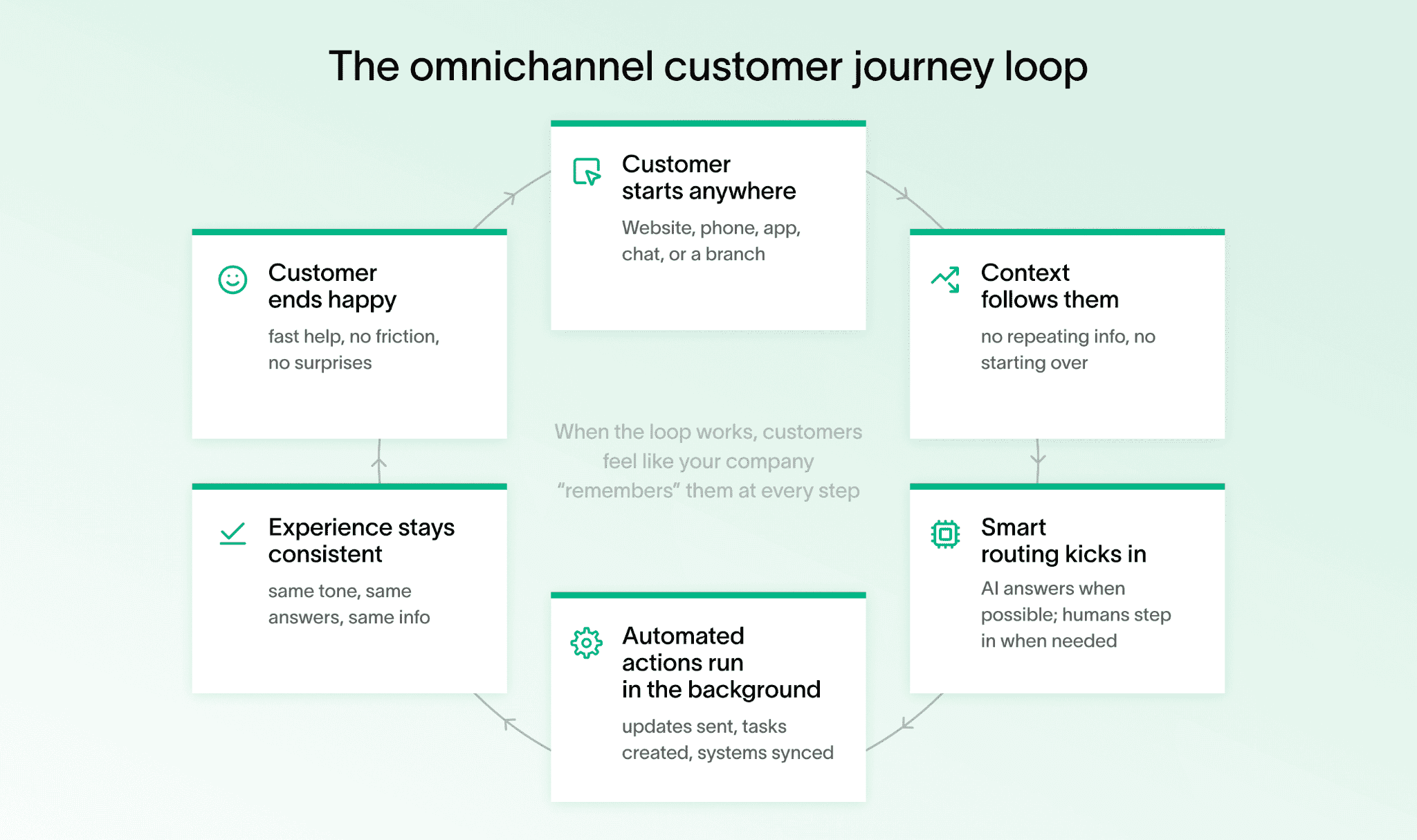
Take an example from the field: Strada lets customers research policies online, chat live with AI-powered voice agents, and seamlessly hand over calls to live reps without losing info. That’s real convenience.
Market reports from McKinsey and Accenture underline how crucial omnichannel engagement in P&C insurance is for staying competitive.
Now that you know what omnichannel really means, let’s look at why it’s worth the effort. You’ll see how it improves customer service in ways your team will feel every day.
What benefits does omnichannel bring to insurance customer service?
You’ll quickly see that adopting an omnichannel approach in insurance customer service brings huge benefits, for both your customers and your business.
Here’s a simple breakdown of what changes when you shift from traditional workflows to a real omnichannel setup.
What you’re doing today | How omnichannel improves it | What this means for you |
Customers repeat info across channels | Customer context travels everywhere | Fewer frustrated callers, shorter interactions |
Agents switch between 5–10 systems | Unified data + shared history | Less chaos, fewer errors, faster resolutions |
Inconsistent messaging across teams | One content source for all channels | Compliance-friendly, trust-building communication |
Limited visibility into customer journey | Full journey mapping across touchpoints | Better personalization, smarter decisions |
Manual follow-up after calls | Automated workflows (e.g., Strada) | No missed tasks, faster operations |
Reactive service | Proactive alerts + next-best-action | Happier customers and better retention |
And let’s talk details.
First off, it’s all about making the customer experience smoother and more personal. By integrating customer data across channels, you can offer tailored communication that feels as effortless as shopping on Amazon or streaming Netflix.
Customers appreciate being able to engage on their terms, wno matter if that’s via phone, chat, email, or social media.
This seamless experience drives better business results. For example, studies show that higher customer retention rates come directly from unified, omnichannel journeys. Customers who receive consistent, personalized service tend to stick around longer, boosting your brand’s reputation and lifetime value.
Plus, data insights help spot smart upsell or cross-sell opportunities without being pushy, increasing revenue quietly but effectively. Here are a few practical examples of what that looks like in real interactions:
Suggesting roadside assistance when a customer calls about a flat tire
Notifying a homeowner about a discounted flood add-on after they update their address
Offering travel coverage when a customer is already discussing an upcoming trip
Highlighting a multi-policy discount when someone asks about adding a new vehicle
Recommending life insurance when a customer reports a major life event, like a new child
You’ll also enjoy some serious operational perks. Shared customer data cuts down on errors and duplication. Workflow automation tools like UiPath or Automation Anywhere can handle routine tasks, while Strada’s AI workflows automate calls and follow-up work, freeing your team to focus on what matters.
Just imagine automated claims status notifications or AI-powered policy renewals handled with top-notch accuracy and less hassle.
Speaking of AI, tools like IBM Watson Assistant or Google Dialogflow, alongside Strada’s specialized models, can handle everything from chatbot claim intakes to predictive fraud detection.
This leads to faster, smarter service that customers notice and appreciate.
Transparent, consistent messaging isn’t just nice. It builds trust and compliance, boosting confidence in your brand. Platforms like Power BI or Tableau help you track customer satisfaction and Net Promoter Scores in real time, feeding continuous improvements.
And when you combine these insights with top omnichannel suites like Salesforce Customer 360 or Adobe Experience Cloud, integrated seamlessly with Strada’s AI phone agents, the entire customer journey becomes a well-oiled machine.
Once you understand the benefits, the next step is designing a strategy that actually works. Here’s how you can build one without overcomplicating things.
How to design effective omnichannel strategies for insurance
An omnichannel strategy means bringing all your customer touchpoints together into one smooth, consistent experience.
How to do it? Here’s a quick blueprint to follow, a simple layout you can use to design an omnichannel strategy that actually works in real life:
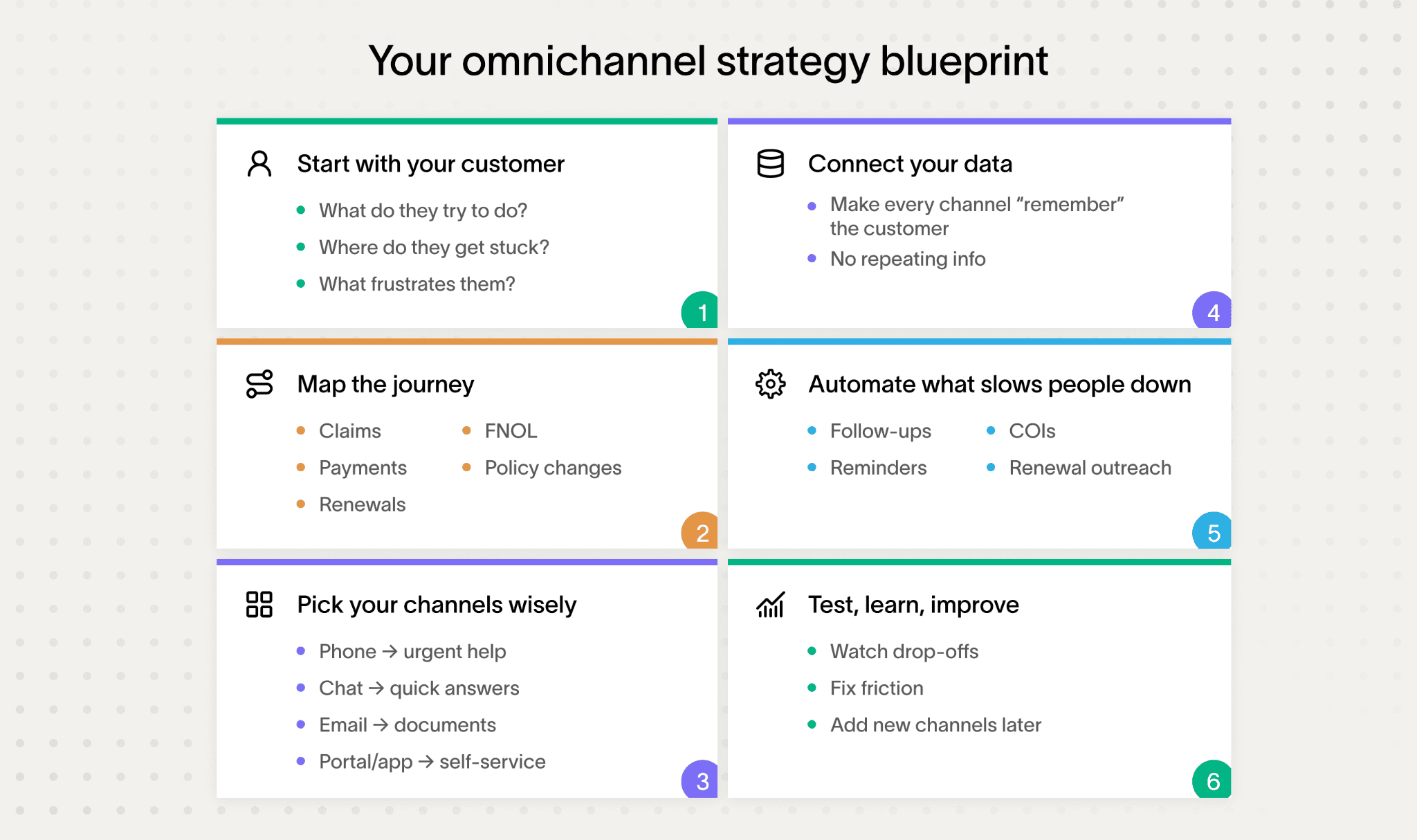
Basically, you want your brand’s story to flow naturally, whether a customer’s chatting with a chatbot, browsing your website, or talking on the phone.
This means adapting your storytelling for each channel, while keeping the brand voice steady across phone scripts, digital content, and even the tone of AI assistants like Strada.
Doing this right means happier customers, stronger loyalty, higher conversion rates, and smarter decisions powered by deep data insights. But to nail it, you need everyone on board (sales, marketing, service reps, brokers), all working together to shape the strategy.
Here’s where to focus your efforts: digital channels like web, mobile apps, and chatbots; offline touchpoints including branches and call centers; social media and messaging apps; plus voice AI platforms powered by Strada.
Using personalization tools like Dynamic Yield or Adobe Target, customer segmentation methods such as RFM analysis or behavioral segmentation, and journey mapping software like Salesforce Journey Builder or Smaply makes it easier to create relevant experiences.
To start, try this step-by-step approach:
Audit your current channels to see what’s working and what’s not.
Define clear customer personas based on real insights.
Map existing customer journeys and spot any gaps or friction points.
Design integrated workflows that connect channels seamlessly.
Pilot your strategy, gather feedback, and refine continuously.
For example, you can send personalized emails that reference previous chatbot or Strada AI phone conversations, ensuring the messaging feels like one ongoing dialogue. Keep your brand consistent everywhere: physical documents, emails, and digital platforms should all tell the same story.
Helpful tools for your team include personalization engines like Evergage or Monetate, journey mapping software such as UXPressia or Microsoft Visio, and segmentation platforms like Segment or Optimove.
On the organizational side, form cross-team task forces, hold regular alignment meetings, and create “single source of truth” data hubs to keep everyone on the same page.
A standout example is Strada Workflows.
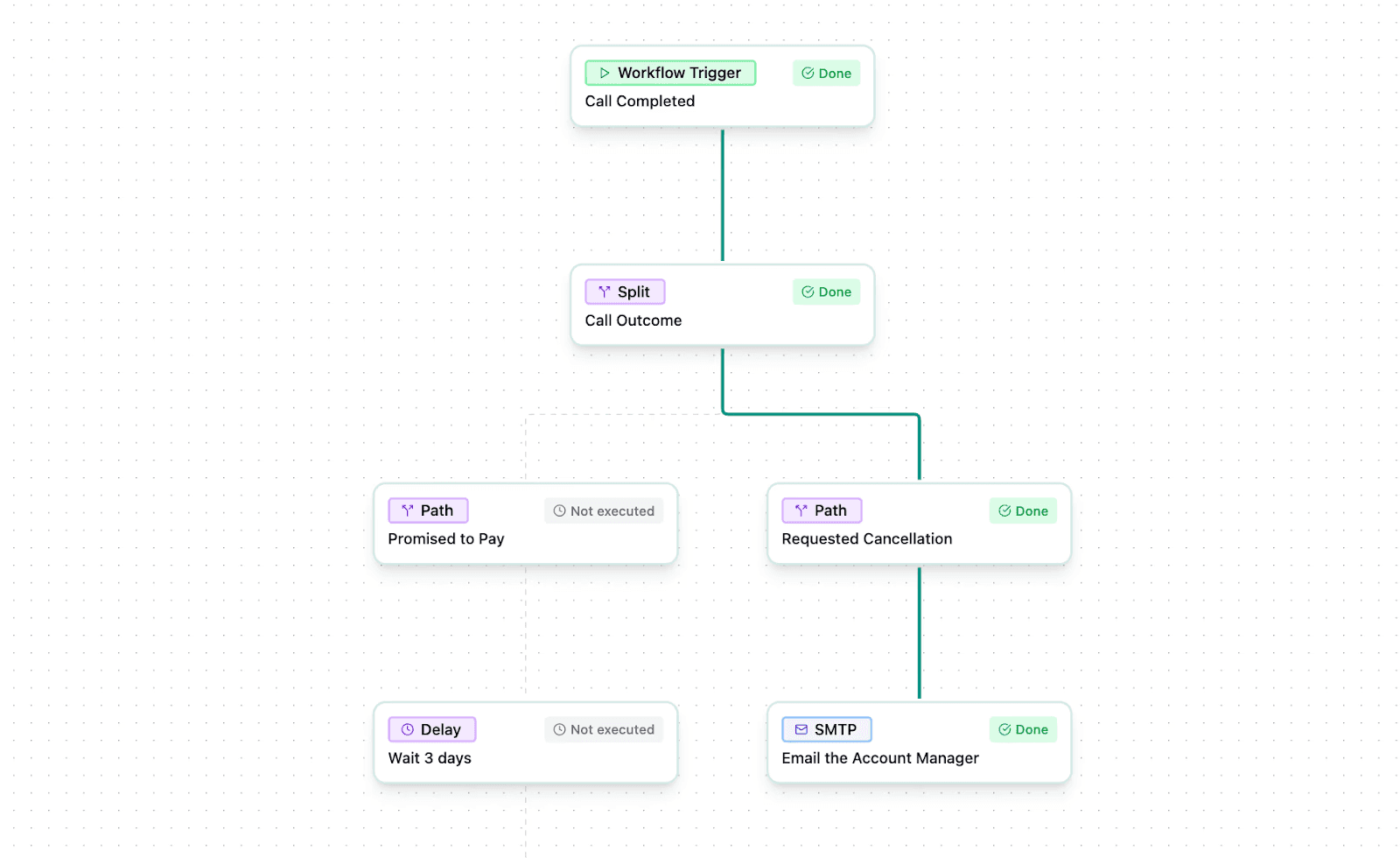
It turns call outcomes into instant CRM updates, AMS tasks, or email follow-ups, speeding up responses and boosting the consistent omnichannel experience in insurance. This kind of intelligent automation is a game changer for customer service automation in 2026.
A good strategy is only half the story. Let’s walk through how to put it into action so customers feel the difference right away.
How to implement omnichannel experiences successfully
You want to create an omnichannel experience in insurance that boosts customer service and keeps clients coming back.
But where do you start?
Implementing omnichannel CX in the insurance space can seem complex at first. You’ll face technical challenges, data integration issues, and the need for simple, accessible design.
Don’t worry! We’ll break it down step by step so you can build a smooth, effective solution.
Step 1: Tackle key challenges head-on
Before diving into tools and tech, you need to understand the hurdles. The biggest challenges include:
Technical platform complexity → multiple systems must work together seamlessly.
Data integration across legacy systems → older systems often don’t “talk” well to new software.
UI/UX design for simplicity and accessibility → your customers should find the experience intuitive and easy, no matter their device or ability.
Address these issues early by auditing your current tech stack and mapping out where customer data and content live. Simplify interfaces and test for accessibility compliance to make sure everyone can interact without frustration.
Step 2: Build your martech stack essentials
To keep messaging consistent and engaging across channels, you need a solid marketing technology stack. Here’s what should be part of yours:
Centralized content repositories → use platforms like Contentful, Sitecore, or Magnolia DXP. These serve as your single source of truth, ensuring all channels (from websites to mobile apps and kiosks), share the same messaging.
Content governance workflows → implement multi-tier approval, compliance checks, and version control with tools like Microsoft SharePoint or Workfront. This keeps content accurate and compliant, especially important in regulated insurance environments.
Analytics tools → gain insights into customer behavior using Google Analytics 4, Power BI, or Adobe Analytics. Track what’s working and where customers drop off.
Personalization platforms → deliver contextually relevant content dynamically. Platforms like Strada, Salesforce Einstein, and Adobe Target help tailor experiences to individual customer profiles.
Multi-channel distribution → ensure systems can push content seamlessly across devices (desktop, mobile, IVR systems, kiosks, and even AI-driven phone channels powered by Strada), keeping every customer journey fluid, consistent, and connected.
Combining these tools gives you the infrastructure needed for an omnichannel experience that feels cohesive and responsive.
Once your martech stack is in place, adding Strada into your ecosystem is straightforward. Here’s how to start quickly and get value fast:
Step 2.1. Identify high-impact use cases
Begin with the phone-heavy workflows where Strada delivers immediate ROI: renewals, FNOL, customer service, or quote intake.
These are pre-built, insurance-specific use cases, so you don’t need to design anything from scratch.
Step 2.2. Connect your core systems
Strada integrates natively with AMS, CRM, policy, billing, and claims systems.
Simply map your core data (policy info, customer records, claims statuses), and Strada syncs context across channels, ensuring your AI agents provide accurate, compliant answers.
Step 2.3. Upload your knowledge content
Bring in your SOPs, FAQs, underwriting guides, and policy info. Strada’s knowledge base turns them into actionable responses for both voice agents and Strada Chat, ensuring consistent answers across all customer touchpoints.
Step 2.4. Configure your conversational flows
Use Strada’s no-code builder to set up how calls and chats should behave:
What information to collect
Which workflows to trigger
When to schedule follow-ups or send documents
What qualifies as a renewal, quote, or churn risk
No engineering work required. Your operations team can update flows in minutes.
Step 2.5. Set up Strada Workflows to automate post-interaction tasks
Every conversation can automatically trigger next steps: CRM updates, AMS changes, reminders, certificate issuance, retention alerts, payment follow-ups, or new claim creation.
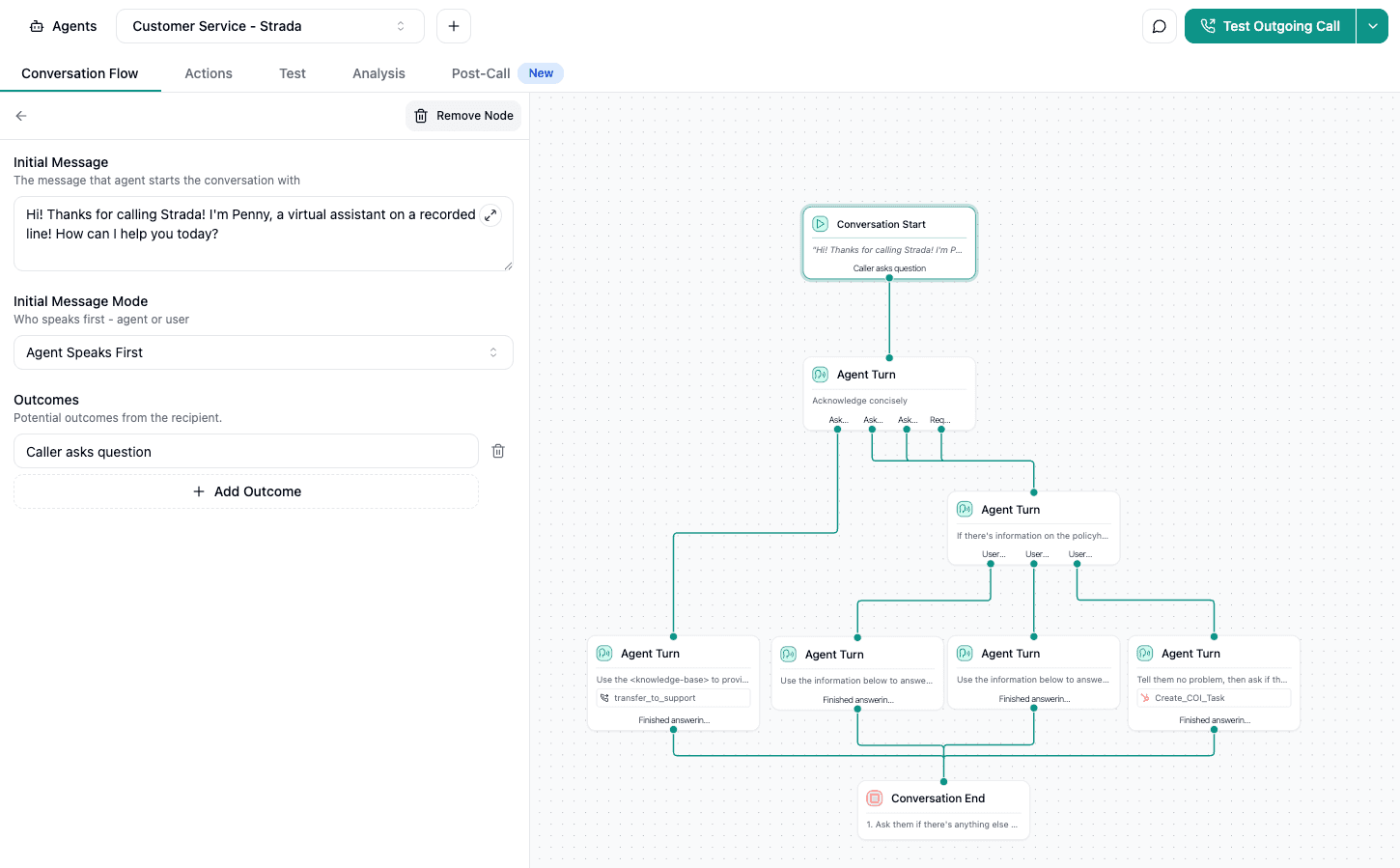
This removes manual busywork and ensures nothing slips through the cracks.
Step 2.6. Test with built-in evaluation tools
Use Strada’s internal AI evaluation suite to validate accuracy, reduce E&O risk, and ensure agents handle insurance terminology correctly.
Fix errors or refine responses before going live.
Step 2.7. Deploy across channels
Start with voice, then add SMS and chat with Strada Chat.
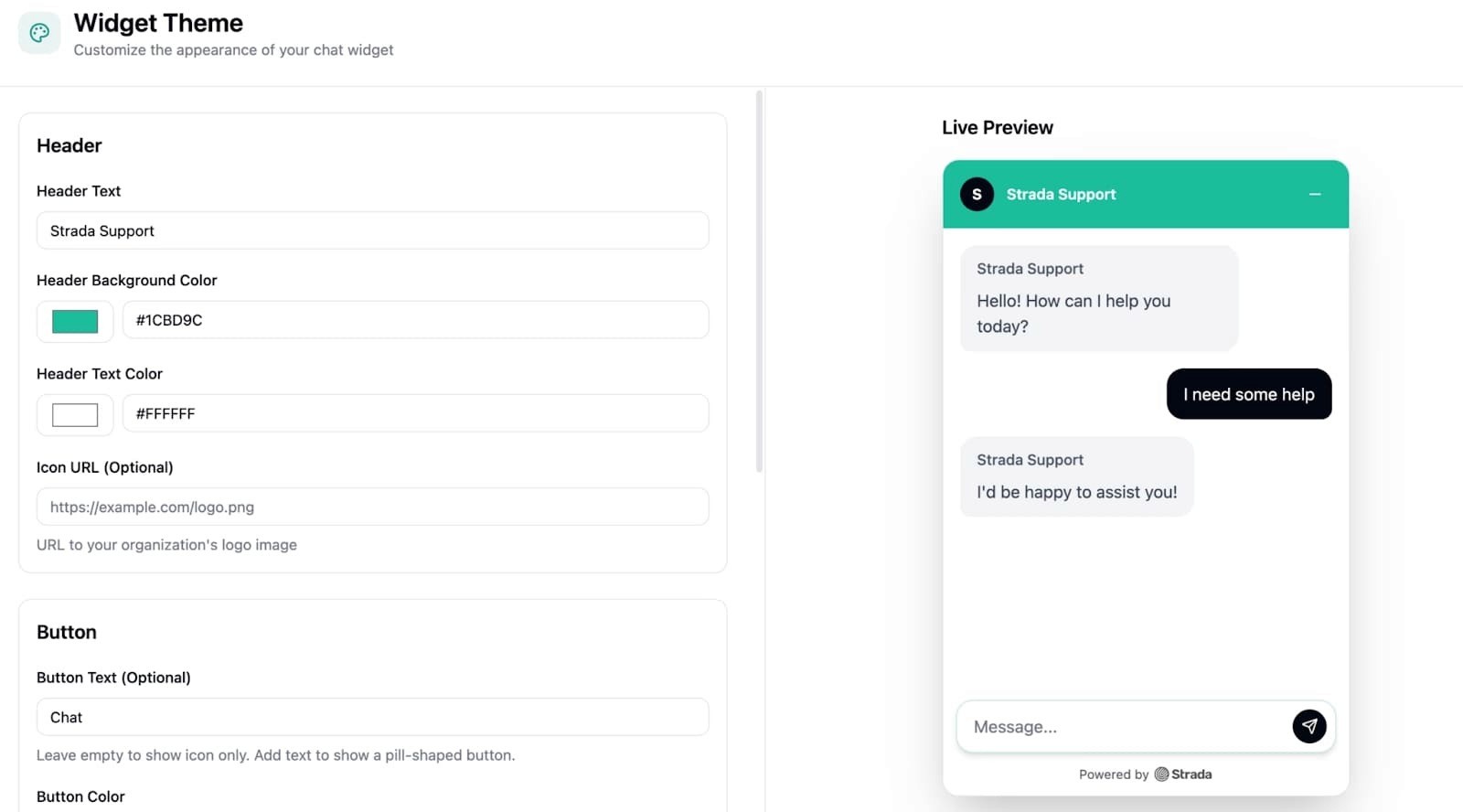
You can embed chat in your customer portal, mobile app, or website so customers get instant help anywhere.
All channels draw from the same knowledge base and workflows.
Step 2.8. Monitor, learn, and optimize
Track call completion, FCR, containment rate, accuracy scores, and workflow performance.

Strada’s analytics surface patterns, knowledge gaps, and emerging trends so you can keep improving your omnichannel experience.
Step 2.9. Scale when ready
Once core use cases are performing, expand to outbound renewals, call campaigns, policy updates, or custom flows. Strada is infinitely scalable, so you can grow without hiring additional staff.
Step 3: Implement data privacy and security frameworks
Handling sensitive customer information means you must prioritize privacy and security. Comply with regulations like GDPR, CCPA, or HIPAA as required by your region.
To protect data:
Use encryption both at rest and in transit.
Employ Identity and Access Management (IAM) systems such as Okta or Ping Identity to control who accesses what.
Follow the principle of data minimization – only collect what you absolutely need.
Embed compliance checkpoints in your workflows.
For instance, check out how Strada’s SOC 2 Type 2 certified platform manages data isolation and training data privacy. They ensure call data remains secure and never misused, which is a model for trusted omnichannel voice AI deployments.
Step 4: Centralize with Digital Experience Platforms (DXPs)
DXPs like Magnolia, Liferay, and Sitecore act as your project’s nerve center. They unify data, content, and channels on an API-first architecture, making integration easier.
Here’s a super-simple comparison table to help you spot what matters most.
Feature | What it looks like in real life | Why you need it |
Unified customer profiles | Every channel knows who the customer is | Personalized, no-repeat journeys |
AI-assisted content editing | Auto-suggestions, fast updates | Keeps messaging fresh + compliant |
Easy integrations (API-first) | Plug in CRM, AMS, billing, Strada | Avoids costly engineering work |
Role-based permissions | Different access levels | Good for compliance-heavy teams |
Multi-channel publishing | Push content to web, app, chat, phone | Ensures brand consistency |
Scalability | Handles traffic spikes, new products | Future-proofs your tech |
Key features to look for include AI-assisted content management to speed up updates while maintaining quality, unified customer profiles so every channel “knows” the customer and carries context forward, and the flexibility to extend your stack as you grow and plug in new systems without disrupting existing workflows.
A centralized DXP cuts down complexity and improves the customer journey’s consistency. Many leading insurers are adopting DXPs for exactly this reason.
Step 5: Monitor KPIs continuously
Real-time measurement lets you spot issues early and improve steadily. Keep an eye on these metrics:
Metric | How to calculate | What it tells you | Benchmarks (insurance / service industries) |
Session duration | Average time spent per session (minutes or seconds) | Measures engagement and content relevance | 2–4 min on web; 30–90 sec in self-service flows |
Bounce rate | % of sessions with no interaction beyond landing | Shows friction or mismatch between intent and content | Under 40% is good; 40–55% is typical; 55%+ needs review |
Drop-off points | Track where users abandon workflows or funnels | Identifies friction areas in journeys | Step-to-step drop-off ideally <20% for key flows |
CSAT (customer satisfaction) | (Positive ratings ÷ Total responses) × 100 | Direct measure of satisfaction after interactions | 80–90% is strong; under 75% indicates issues |
NPS (net promoter score) | % Promoters – % Detractors | Measures customer loyalty and advocacy | 20–40 is typical; 40+ is excellent in insurance |
First contact resolution (FCR) | (Issues resolved on first contact ÷ Total issues) × 100 | Shows service efficiency and accuracy | 70–80% is good; >85% is excellent |
Average handle time (AHT) | Total time spent handling interactions ÷ Number of interactions | Measures efficiency across human + AI channels | 4–6 min typical for human support; AI ideally <1 min |
Containment rate (AI / self-service) | (Interactions resolved in self-service ÷ Total interactions) × 100 | Shows how effectively digital channels resolve issues | 30–50% is solid; advanced AI can reach 60–70% |
Transfer rate | % of AI or self-service interactions transferred to a human | Helps gauge whether automation is calibrated correctly | Under 35% ideal; 15–25% is excellent |
Resolution time | Average time to fully resolve a case | Reflects overall CX and operational efficiency | Insurance targets: <1 day for simple tasks; <5 days for complex |
Channel switch rate | % of customers who switch channels during a single journey | Measures true omnichannel performance | Lower is better; <20% after first interaction is strong |
Agent / AI accuracy | % of correct information provided | Ensures consistency and compliance | 95%+ expected in regulated environments |
Customer effort score (CES) | Survey asking “How easy was this?” scored on a scale | Measures friction from the customer’s perspective | Scores of 5–7 (on a 7-point scale) are strong |
Digital completion rate | % of customers completing tasks digitally without human help | Shows digital maturity | 60–75% is common; 80%+ for top performers |
Use analytics dashboards from Strada, Tableau, Adobe Audience Manager, or Salesforce Einstein Analytics to keep these KPIs front and center.
This helps you make data-driven decisions day to day.
Step 6: Put together a practical tech stack blueprint
To visualize this, here’s a practical example of a tech stack you can start with:
Magnolia DXP for content and experience management.
Salesforce CRM to track customer data and interactions.
Segment CDP for collecting and unifying customer data.
UiPath RPA to automate repetitive back-office tasks.
Twilio to orchestrate communications (SMS, calls, chat).
Strada AI voice agents to deliver seamless, natural phone experiences.
This combination balances AI-powered automation with scalable, customizable systems. It lets you deliver personalized experiences at scale and handle calls smartly without losing the human touch.
Step 7: Establish strong governance frameworks
Governance ensures that your content and data remain trustworthy over time. Set up:
Clear documentation covering the entire content lifecycle.
Regular content and data audits.
Defined data stewardship roles to own compliance responsibilities.
Embedded compliance checkpoints built into workflows to catch errors early.
Strong governance helps you stay compliant and maintain customer trust, especially as regulations evolve.
Step 8: Keep privacy protocols tight and transparent
Data privacy isn’t just about ticking boxes; it’s about respecting your customers. Follow these best practices:
Use customer consent management platforms like OneTrust or TrustArc and configure them properly. Don’t just collect consent; make it clear, specific, and easy to adjust. Set up granular options (e.g., marketing, profiling, third-party sharing) and sync consent states across all channels so a user’s choice applies everywhere instantly.
Conduct periodic security audits, but make them comprehensive, not symbolic. Include penetration testing, code reviews, vendor assessments, and policy checks. Ensure findings turn into action items with deadlines, owners, and follow-up verification so issues don’t become recurring risks.
Encrypt sensitive data everywhere, not just at rest or in transit. Apply end-to-end encryption, protect encryption keys in isolated key-management systems, and regularly rotate keys. Test decryption paths to ensure no channel can accidentally expose raw data.
Apply data minimization principles and build rules for automatic cleanup. Define retention policies based on actual business value, not convenience. Tag data with expiration dates, automate deletion workflows, and routinely verify that legacy systems aren’t keeping shadow copies.
Transparency in privacy builds loyalty and avoids costly violations down the road.
Step 9: Lean on partners for success
Finally, don’t go it alone.
Platforms like Strada provide a forward-deployed customer success team that partners with you throughout your omnichannel journey. Their team helps ensure your voice AI implementations are reliable, secure, and scalable.
Strada also exemplifies how to merge AI innovation with privacy and operational maturity – perfect for insurers wanting to modernize customer service safely.
By following these steps, you’ll implement a successful omnichannel experience in insurance. You’ll streamline complex tech, unify data, deliver personalized, seamless interactions, and keep your customers delighted, all while protecting their data and meeting.
As you start building, you’ll hit a few common roadblocks. Every insurer does. The good news? You can solve most of them with a few smart moves.
Challenges insurers face and how to overcome them
You’ll find that becoming truly omnichannel in insurance isn’t without its bumps.
One big challenge is legacy systems. These old systems create data silos and fragmented customer journeys, which slow down real-time data flow. When data stays stuck in different places, it’s tough to get a complete picture of your customers, making personalization tricky.
Another common hurdle is data quality. Inconsistent or messy data hurts your ability to offer seamless, tailored experiences.
Plus, integrating offline advisory services with online channels into one smooth journey can feel like fitting square pegs into round holes. You also have to maintain the same message across all channels and regions, which gets complicated with compliance rules changing so often.
Measuring success is no walk in the park either, especially when you try to attribute growth to multiple channels simultaneously.
Don’t forget internal resistance. Shifting culture and encouraging collaboration across departments is a challenge on its own. And through it all, managing compliance and tight data security with evolving rules is non-negotiable.
The good news? There are powerful solutions you can use to tackle these issues head-on. Here’s a practical list to get you started:
Use API-first integration tools like Mulesoft or Apigee. These connect legacy systems with new platforms, breaking down data silos.
Implement Customer Data Platforms such as Segment or Tealium to unify customer profiles. Pair these with data cleansing tools like Talend or Informatica to keep your data reliable.
Establish strong content governance using tools like Workfront or Microsoft SharePoint, including version control and automated compliance checks. You might also explore Strada’s automated compliance validations embedded directly into call workflows.
Roll out training programs to build an omnichannel culture and encourage ownership across teams.
Define clear KPIs with balanced scorecards that track CSAT, NPS, channel efficiency, and operational metrics like AHT.
Drive culture change through executive sponsorship, rewards for cross-team collaboration, and celebrating wins early.
Strengthen security by embedding Privacy by Design principles, regular penetration tests via Nessus or Qualys, and robust incident response plans, aligned with Strada’s enterprise-grade SOC 2 compliance and data isolation safeguards.
With these steps, you’ll break down blockers and build an omnichannel CX in insurance that delights customers and drives business growth in 2026 and beyond.
And once the basics are in place, AI becomes your secret advantage. Here’s how automation can take your omnichannel experience to the next level.
How AI and automation will reshape insurance omnichannel service
You’ll see AI and automation dramatically change omnichannel engagement in P&C insurance by 2026.
These technologies are making customer service faster, smarter, and more personal, while freeing up agents to focus on what really matters: complex cases that need a human touch.
First, AI chatbots and virtual assistants are already providing instant, 24/7 support. They handle everything from claim intake to answering FAQs. Tools like Strada keep customer conversations smooth and efficient.
On top of that, Strada’s AI voice agents take phone calls with insurance-specific natural language understanding to make phone interactions as natural as talking to a real agent. This means less waiting on hold and more immediate help.
Here are some simple, practical ways insurers use Strada today:
Quote intake → capture customer info, eligibility, and coverage needs instantly, without tying up producers.
First Notice of Loss → collect accident details over phone or SMS and push them directly into claims systems.
Policy servicing → handle tasks like ID card requests, coverage questions, or billing inquiries automatically.
Renewals → run outbound call campaigns, answer renewal questions, and flag at-risk customers for your retention team.
Certificate of Insurance requests → validate the policy, generate the COI, and deliver it immediately via email or SMS.
Payment reminders & recovery → automate reminders, check payment status later, and follow up only when necessary.
Lead qualification → identify hot prospects during inbound calls and route them to producers with full context.
Abandoned quote follow-up → automatically reach out to prospects who didn’t finish the application process.
Proactive service → trigger outreach when workflows detect churn risk, policy changes, or important milestones.
Multichannel support with Strada Chat → give customers instant help on your website, portal, or mobile app with the same accuracy as phone agents.
Next, AI-powered next-best-action engines make policy recommendations smarter and more personalized. Platforms like Salesforce Einstein, Adobe Sensei, and Microsoft Azure AI analyze individual profiles to suggest renewals, cross-sells, or upgrades exactly when customers need them.
Strada’s workflows ensure that every conversation automatically updates your CRM and AMS systems, keeping data fresh and relevant without any extra effort.
Automation doesn’t stop there. Imagine onboarding, renewals, and claims status updates happening automatically through robotic process automation (RPA) tools like UiPath and Blue Prism.
These tools cut turnaround times dramatically and reduce manual errors.
Strada boosts this further with intelligent call follow-ups and post-call automation to keep customers in the loop without extra human input.
Payment support gets a major upgrade, too. AI can send EMI reminders via SMS or email, schedule automated deductions, and spot potential fraud in transactions. This cuts missed payments and enhances security, making your omnichannel customer experience in insurance more reliable and convenient.
Advanced data analytics also play a big role. Using machine learning frameworks like TensorFlow and PyTorch, insurers can drill down into granular customer segments and predict churn before it happens. This helps optimize the customer journey, so insurance companies can act faster and keep more customers happy.
Here’s a quick look at the practical benefits AI and automation bring to your insurance service:
Speed → cut claim processing time by 30-50%.
Accuracy → reduce manual errors with automated workflows.
Customer satisfaction → increase CSAT scores by 15%.
Cost savings → lower operational costs through automation.
Integrating these AI frameworks isn’t complicated either. Strada’s platform seamlessly connects calls, AI workflows, CRM, and digital experience platforms (DXP) with messaging apps. This means you get true end-to-end automation that ties every customer touchpoint together.
You can measure success with clear metrics like first-call resolution (FCR), chatbot and AI voice resolution rates, and other operational KPIs that show real improvements.
Finally, Strada can scale effortlessly. No matter if you’re handling thousands of inbound or outbound calls, their conversational AI stays consistent. It maintains the right tone, accuracy, and compliance, no matter the volume.
That ensures every customer feels valued and supported.
To help you decide where AI fits best (and where humans still shine), here’s a quick, practical split you can use when planning your omnichannel strategy.
Task | AI should handle | Humans should handle | Why this split works |
Routine questions | ✔ | Fast, accurate, 24/7 | |
Emotional or complex cases | ✔ | Humans build trust | |
Payment reminders | ✔ | Predictable workflow | |
Policy consultations | ✔ | Needs judgment | |
FNOL data collection | ✔ | Structured data intake | |
Claims disputes | ✔ | Requires empathy | |
Follow-up tasks | ✔ | Automation prevents delays | |
Final decisions | ✔ | Humans ensure fairness |
At this point, you might wonder whether omnichannel fits your organization. The short answer is yes, but in different ways for different teams. Let’s break it down.
Who can benefit from omnichannel insurance platforms?
You might wonder if omnichannel insurance platforms are only for big players.
The truth is, both large insurers and smaller providers can gain huge advantages by adopting scalable, modular omnichannel solutions. These platforms can be tailored to fit your resources, goals, and digital maturity, no matter your size.
To help you see where you fit, here’s a simple snapshot of who gets the most value from omnichannel and why.
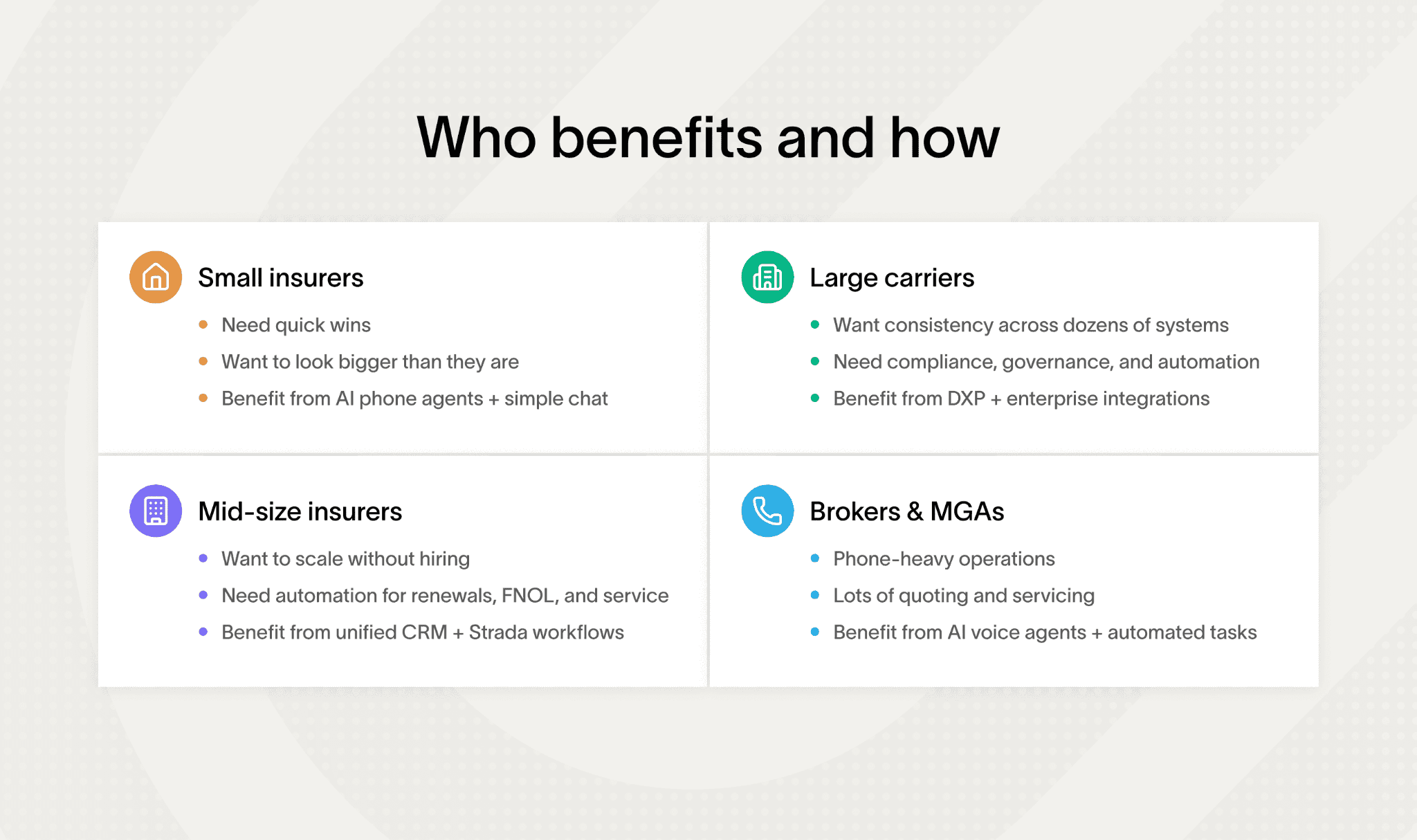
To pick the right platform, it’s important to align your choice with your insurer size, product complexity, and tech readiness. Modular, cloud-native options like Ensurite or Salesforce Financial Services Cloud let you roll out features step-by-step.
This phased approach reduces risk and spreads out investments in a way that’s manageable for you.
For smaller insurers, low-code or no-code tools (think Microsoft Power Platform or OutSystems) allow fast customization without heavy IT costs.
Plus, AI voice agents like Strada’s can be deployed easily without needing engineering help. This means you can improve customer experience quickly and with minimal fuss.
On the flip side, large insurers benefit from deep integrations, advanced AI, and analytics to handle high volumes and stay competitive. Platforms like Salesforce combined with Magnolia DXP and UiPath can automate complex tasks seamlessly.
Strada’s enterprise-grade security and scalable AI specifically built for insurance further boost operational efficiency.
Here’s a simple framework to help you figure out what fits best:
Use a size vs. complexity matrix to match platform features with your needs.
Look at case examples, for instance, a small insurer succeeding with Ensurite versus a large one deploying Salesforce plus Magnolia DXP and Strada AI to automate customer calls.
To balance costs and returns, start with pilot projects that have clear KPIs. Cloud subscriptions help keep expenses predictable, and negotiating vendor support and SLAs ensures you get reliable service.
Platforms like Strada also help lower operational costs by automating routine phone tasks, freeing up your agents to focus on what really matters, delivering outstanding omnichannel CX in the insurance industry.
Now it’s time to bring everything together. Here’s how to quickly check whether your current customer journey is ready for today’s expectations.
Is your customer journey set up for modern expectations?
Omnichannel in insurance isn’t just a trend.
It’s quickly becoming essential for delivering the level of service customers now expect. By unifying your channels and using AI to personalize each interaction, you’ll boost retention, reduce effort, and stay competitive in a fast-changing market.
As you begin shaping your strategy, keep these core priorities in mind:
Connect all customer-facing channels so conversations flow without repetition
Ensure consistent content and messaging across every touchpoint
Use AI and automation to make service faster, more accurate, and available 24/7
Monitor key CX metrics to continuously optimize the journey
Start with the basics: connect your platforms, streamline your content, and experiment with small, low-risk pilots. As you refine your approach, exploring tools and real-world examples will help you scale confidently.
Platforms like Strada offer demos and guidance that show what AI-driven voice and chat support look like in practice and how easily they can fit into your existing workflows.
If you’re curious about what this could mean for your team, booking a short demo with Strada is an easy way to see the possibilities.
No pressure, just practical insights to help you take your next step.
Frequently Asked Questions
What’s the fastest way to start omnichannel without rebuilding everything?
Start with one high-impact workflow (renewals, FNOL, billing), connect data, and automate simple tasks first. Expand once the early wins prove the value.
How do I reduce customer repetition across channels?
Framer is a design tool that allows you to design websites on a freeform canvas, and then publish them as websites with a single click.
What’s the easiest part to automate first?
Framer is a design tool that allows you to design websites on a freeform canvas, and then publish them as websites with a single click.
How do I measure if omnichannel is actually working?
Framer is a design tool that allows you to design websites on a freeform canvas, and then publish them as websites with a single click.
Can omnichannel help with retention automatically?
Framer is a design tool that allows you to design websites on a freeform canvas, and then publish them as websites with a single click.
Table of Contents
Carriers, MGAs, and brokers scale revenue-driving phone calls with Strada's conversational AI platform.
Start scaling with voice AI agents today
Join innovative carriers and MGAs transforming their calls with Strada.
How to Be Omnichannel in Insurance to Boost Customer Service in 2026
Amir Prodensky
CEO
15 min read
A practical guide to connecting every customer touchpoint
By 2026, omnichannel in insurance isn’t just a trend I see in industry reports.
It’s something I see firsthand in nearly every customer interaction. People are no longer comparing insurers only to other insurers; they’re comparing us to the frictionless experiences they get from retail, banking apps, and even food delivery.
They expect to move from phone to chat to email without starting their story over, and when that doesn’t happen, the frustration is immediate.
That’s why omnichannel CX in insurance matters right now:
It meets real, rising expectations for convenience, speed, and continuity.
It keeps you competitive as more carriers embrace smarter, AI-driven tools.
In this article, you’ll learn how to bring all your service channels together and build a truly connected customer journey.
I’ll walk through practical steps insurers are taking today, and along the way, you’ll get a look at how Strada, an AI-powered conversational platform, uses voice AI agents built specifically for carriers, MGAs, and brokers to turn complex customer moments into seamless, intuitive experiences.
Yet, we’ll start with the foundations.
What is omnichannel in insurance and why does it matter?
You’ve probably heard about omnichannel in insurance, but what does it really mean? Simply put, it’s about giving your customers a smooth, connected experience across all touchpoints (whether online or offline).
That means their journey feels seamless, with no hiccups when they switch from your website to a mobile app, call center, or even a physical branch.
Now, omnichannel is very different from traditional multichannel. With multichannel, you do offer customers multiple ways to reach you (phone, email, chat, maybe even a mobile app), but each one tends to live in its own silo.
Data doesn’t flow between them, agents don’t see the full picture, and customers end up repeating themselves or getting inconsistent answers.
Omnichannel fixes this. It’s built on one unified platform where every channel shares context, history, and data. That makes interactions feel personalized, effortless, and consistent, no matter if someone is on your website, in your app, talking to an agent, or speaking with an AI-powered voice assistant like Strada’s platform.
Here’s a quick, practical comparison:
Multichannel | Omnichannel |
Channels exist separately | Channels are fully connected on one platform |
Customer must repeat information | Customer context carries over automatically |
Inconsistent answers across channels | Consistent, unified experience everywhere |
Harder to track customer journeys | Full journey visibility for teams and AI |
Reactive service | Proactive, personalized service |
Higher operational friction | Lower effort, faster resolutions |
Key channels in an omnichannel ecosystem include websites, mobile apps, call centers, physical offices, messaging apps like WhatsApp and SMS, social media, email, chatbots, and even AI-powered phone agents such as Strada’s voice AI, all working together as one coordinated system.
Why does this matter?
Technology’s evolving fast. Your customers want instant, personal service anytime, anywhere. They don’t want to repeat their policy info every time they switch channels or wait on hold forever. In fact, common complaints with multichannel setups include inconsistent messaging and lost customer history.
Omnichannel fixes this. To picture how omnichannel feels from a customer’s point of view, here’s a simple loop you can keep in mind. Think of it as the journey your customers take when everything just… works.
Take an example from the field: Strada lets customers research policies online, chat live with AI-powered voice agents, and seamlessly hand over calls to live reps without losing info. That’s real convenience.
Market reports from McKinsey and Accenture underline how crucial omnichannel engagement in P&C insurance is for staying competitive.
Now that you know what omnichannel really means, let’s look at why it’s worth the effort. You’ll see how it improves customer service in ways your team will feel every day.
What benefits does omnichannel bring to insurance customer service?
You’ll quickly see that adopting an omnichannel approach in insurance customer service brings huge benefits, for both your customers and your business.
Here’s a simple breakdown of what changes when you shift from traditional workflows to a real omnichannel setup.
What you’re doing today | How omnichannel improves it | What this means for you |
Customers repeat info across channels | Customer context travels everywhere | Fewer frustrated callers, shorter interactions |
Agents switch between 5–10 systems | Unified data + shared history | Less chaos, fewer errors, faster resolutions |
Inconsistent messaging across teams | One content source for all channels | Compliance-friendly, trust-building communication |
Limited visibility into customer journey | Full journey mapping across touchpoints | Better personalization, smarter decisions |
Manual follow-up after calls | Automated workflows (e.g., Strada) | No missed tasks, faster operations |
Reactive service | Proactive alerts + next-best-action | Happier customers and better retention |
And let’s talk details.
First off, it’s all about making the customer experience smoother and more personal. By integrating customer data across channels, you can offer tailored communication that feels as effortless as shopping on Amazon or streaming Netflix.
Customers appreciate being able to engage on their terms, wno matter if that’s via phone, chat, email, or social media.
This seamless experience drives better business results. For example, studies show that higher customer retention rates come directly from unified, omnichannel journeys. Customers who receive consistent, personalized service tend to stick around longer, boosting your brand’s reputation and lifetime value.
Plus, data insights help spot smart upsell or cross-sell opportunities without being pushy, increasing revenue quietly but effectively. Here are a few practical examples of what that looks like in real interactions:
Suggesting roadside assistance when a customer calls about a flat tire
Notifying a homeowner about a discounted flood add-on after they update their address
Offering travel coverage when a customer is already discussing an upcoming trip
Highlighting a multi-policy discount when someone asks about adding a new vehicle
Recommending life insurance when a customer reports a major life event, like a new child
You’ll also enjoy some serious operational perks. Shared customer data cuts down on errors and duplication. Workflow automation tools like UiPath or Automation Anywhere can handle routine tasks, while Strada’s AI workflows automate calls and follow-up work, freeing your team to focus on what matters.
Just imagine automated claims status notifications or AI-powered policy renewals handled with top-notch accuracy and less hassle.
Speaking of AI, tools like IBM Watson Assistant or Google Dialogflow, alongside Strada’s specialized models, can handle everything from chatbot claim intakes to predictive fraud detection.
This leads to faster, smarter service that customers notice and appreciate.
Transparent, consistent messaging isn’t just nice. It builds trust and compliance, boosting confidence in your brand. Platforms like Power BI or Tableau help you track customer satisfaction and Net Promoter Scores in real time, feeding continuous improvements.
And when you combine these insights with top omnichannel suites like Salesforce Customer 360 or Adobe Experience Cloud, integrated seamlessly with Strada’s AI phone agents, the entire customer journey becomes a well-oiled machine.
Once you understand the benefits, the next step is designing a strategy that actually works. Here’s how you can build one without overcomplicating things.
How to design effective omnichannel strategies for insurance
An omnichannel strategy means bringing all your customer touchpoints together into one smooth, consistent experience.
How to do it? Here’s a quick blueprint to follow, a simple layout you can use to design an omnichannel strategy that actually works in real life:
Basically, you want your brand’s story to flow naturally, whether a customer’s chatting with a chatbot, browsing your website, or talking on the phone.
This means adapting your storytelling for each channel, while keeping the brand voice steady across phone scripts, digital content, and even the tone of AI assistants like Strada.
Doing this right means happier customers, stronger loyalty, higher conversion rates, and smarter decisions powered by deep data insights. But to nail it, you need everyone on board (sales, marketing, service reps, brokers), all working together to shape the strategy.
Here’s where to focus your efforts: digital channels like web, mobile apps, and chatbots; offline touchpoints including branches and call centers; social media and messaging apps; plus voice AI platforms powered by Strada.
Using personalization tools like Dynamic Yield or Adobe Target, customer segmentation methods such as RFM analysis or behavioral segmentation, and journey mapping software like Salesforce Journey Builder or Smaply makes it easier to create relevant experiences.
To start, try this step-by-step approach:
Audit your current channels to see what’s working and what’s not.
Define clear customer personas based on real insights.
Map existing customer journeys and spot any gaps or friction points.
Design integrated workflows that connect channels seamlessly.
Pilot your strategy, gather feedback, and refine continuously.
For example, you can send personalized emails that reference previous chatbot or Strada AI phone conversations, ensuring the messaging feels like one ongoing dialogue. Keep your brand consistent everywhere: physical documents, emails, and digital platforms should all tell the same story.
Helpful tools for your team include personalization engines like Evergage or Monetate, journey mapping software such as UXPressia or Microsoft Visio, and segmentation platforms like Segment or Optimove.
On the organizational side, form cross-team task forces, hold regular alignment meetings, and create “single source of truth” data hubs to keep everyone on the same page.
A standout example is Strada Workflows.
It turns call outcomes into instant CRM updates, AMS tasks, or email follow-ups, speeding up responses and boosting the consistent omnichannel experience in insurance. This kind of intelligent automation is a game changer for customer service automation in 2026.
A good strategy is only half the story. Let’s walk through how to put it into action so customers feel the difference right away.
How to implement omnichannel experiences successfully
You want to create an omnichannel experience in insurance that boosts customer service and keeps clients coming back.
But where do you start?
Implementing omnichannel CX in the insurance space can seem complex at first. You’ll face technical challenges, data integration issues, and the need for simple, accessible design.
Don’t worry! We’ll break it down step by step so you can build a smooth, effective solution.
Step 1: Tackle key challenges head-on
Before diving into tools and tech, you need to understand the hurdles. The biggest challenges include:
Technical platform complexity → multiple systems must work together seamlessly.
Data integration across legacy systems → older systems often don’t “talk” well to new software.
UI/UX design for simplicity and accessibility → your customers should find the experience intuitive and easy, no matter their device or ability.
Address these issues early by auditing your current tech stack and mapping out where customer data and content live. Simplify interfaces and test for accessibility compliance to make sure everyone can interact without frustration.
Step 2: Build your martech stack essentials
To keep messaging consistent and engaging across channels, you need a solid marketing technology stack. Here’s what should be part of yours:
Centralized content repositories → use platforms like Contentful, Sitecore, or Magnolia DXP. These serve as your single source of truth, ensuring all channels (from websites to mobile apps and kiosks), share the same messaging.
Content governance workflows → implement multi-tier approval, compliance checks, and version control with tools like Microsoft SharePoint or Workfront. This keeps content accurate and compliant, especially important in regulated insurance environments.
Analytics tools → gain insights into customer behavior using Google Analytics 4, Power BI, or Adobe Analytics. Track what’s working and where customers drop off.
Personalization platforms → deliver contextually relevant content dynamically. Platforms like Strada, Salesforce Einstein, and Adobe Target help tailor experiences to individual customer profiles.
Multi-channel distribution → ensure systems can push content seamlessly across devices (desktop, mobile, IVR systems, kiosks, and even AI-driven phone channels powered by Strada), keeping every customer journey fluid, consistent, and connected.
Combining these tools gives you the infrastructure needed for an omnichannel experience that feels cohesive and responsive.
Once your martech stack is in place, adding Strada into your ecosystem is straightforward. Here’s how to start quickly and get value fast:
Step 2.1. Identify high-impact use cases
Begin with the phone-heavy workflows where Strada delivers immediate ROI: renewals, FNOL, customer service, or quote intake.
These are pre-built, insurance-specific use cases, so you don’t need to design anything from scratch.
Step 2.2. Connect your core systems
Strada integrates natively with AMS, CRM, policy, billing, and claims systems.
Simply map your core data (policy info, customer records, claims statuses), and Strada syncs context across channels, ensuring your AI agents provide accurate, compliant answers.
Step 2.3. Upload your knowledge content
Bring in your SOPs, FAQs, underwriting guides, and policy info. Strada’s knowledge base turns them into actionable responses for both voice agents and Strada Chat, ensuring consistent answers across all customer touchpoints.
Step 2.4. Configure your conversational flows
Use Strada’s no-code builder to set up how calls and chats should behave:
What information to collect
Which workflows to trigger
When to schedule follow-ups or send documents
What qualifies as a renewal, quote, or churn risk
No engineering work required. Your operations team can update flows in minutes.
Step 2.5. Set up Strada Workflows to automate post-interaction tasks
Every conversation can automatically trigger next steps: CRM updates, AMS changes, reminders, certificate issuance, retention alerts, payment follow-ups, or new claim creation.
This removes manual busywork and ensures nothing slips through the cracks.
Step 2.6. Test with built-in evaluation tools
Use Strada’s internal AI evaluation suite to validate accuracy, reduce E&O risk, and ensure agents handle insurance terminology correctly.
Fix errors or refine responses before going live.
Step 2.7. Deploy across channels
Start with voice, then add SMS and chat with Strada Chat.
You can embed chat in your customer portal, mobile app, or website so customers get instant help anywhere.
All channels draw from the same knowledge base and workflows.
Step 2.8. Monitor, learn, and optimize
Track call completion, FCR, containment rate, accuracy scores, and workflow performance.
Strada’s analytics surface patterns, knowledge gaps, and emerging trends so you can keep improving your omnichannel experience.
Step 2.9. Scale when ready
Once core use cases are performing, expand to outbound renewals, call campaigns, policy updates, or custom flows. Strada is infinitely scalable, so you can grow without hiring additional staff.
Step 3: Implement data privacy and security frameworks
Handling sensitive customer information means you must prioritize privacy and security. Comply with regulations like GDPR, CCPA, or HIPAA as required by your region.
To protect data:
Use encryption both at rest and in transit.
Employ Identity and Access Management (IAM) systems such as Okta or Ping Identity to control who accesses what.
Follow the principle of data minimization – only collect what you absolutely need.
Embed compliance checkpoints in your workflows.
For instance, check out how Strada’s SOC 2 Type 2 certified platform manages data isolation and training data privacy. They ensure call data remains secure and never misused, which is a model for trusted omnichannel voice AI deployments.
Step 4: Centralize with Digital Experience Platforms (DXPs)
DXPs like Magnolia, Liferay, and Sitecore act as your project’s nerve center. They unify data, content, and channels on an API-first architecture, making integration easier.
Here’s a super-simple comparison table to help you spot what matters most.
Feature | What it looks like in real life | Why you need it |
Unified customer profiles | Every channel knows who the customer is | Personalized, no-repeat journeys |
AI-assisted content editing | Auto-suggestions, fast updates | Keeps messaging fresh + compliant |
Easy integrations (API-first) | Plug in CRM, AMS, billing, Strada | Avoids costly engineering work |
Role-based permissions | Different access levels | Good for compliance-heavy teams |
Multi-channel publishing | Push content to web, app, chat, phone | Ensures brand consistency |
Scalability | Handles traffic spikes, new products | Future-proofs your tech |
Key features to look for include AI-assisted content management to speed up updates while maintaining quality, unified customer profiles so every channel “knows” the customer and carries context forward, and the flexibility to extend your stack as you grow and plug in new systems without disrupting existing workflows.
A centralized DXP cuts down complexity and improves the customer journey’s consistency. Many leading insurers are adopting DXPs for exactly this reason.
Step 5: Monitor KPIs continuously
Real-time measurement lets you spot issues early and improve steadily. Keep an eye on these metrics:
Metric | How to calculate | What it tells you | Benchmarks (insurance / service industries) |
Session duration | Average time spent per session (minutes or seconds) | Measures engagement and content relevance | 2–4 min on web; 30–90 sec in self-service flows |
Bounce rate | % of sessions with no interaction beyond landing | Shows friction or mismatch between intent and content | Under 40% is good; 40–55% is typical; 55%+ needs review |
Drop-off points | Track where users abandon workflows or funnels | Identifies friction areas in journeys | Step-to-step drop-off ideally <20% for key flows |
CSAT (customer satisfaction) | (Positive ratings ÷ Total responses) × 100 | Direct measure of satisfaction after interactions | 80–90% is strong; under 75% indicates issues |
NPS (net promoter score) | % Promoters – % Detractors | Measures customer loyalty and advocacy | 20–40 is typical; 40+ is excellent in insurance |
First contact resolution (FCR) | (Issues resolved on first contact ÷ Total issues) × 100 | Shows service efficiency and accuracy | 70–80% is good; >85% is excellent |
Average handle time (AHT) | Total time spent handling interactions ÷ Number of interactions | Measures efficiency across human + AI channels | 4–6 min typical for human support; AI ideally <1 min |
Containment rate (AI / self-service) | (Interactions resolved in self-service ÷ Total interactions) × 100 | Shows how effectively digital channels resolve issues | 30–50% is solid; advanced AI can reach 60–70% |
Transfer rate | % of AI or self-service interactions transferred to a human | Helps gauge whether automation is calibrated correctly | Under 35% ideal; 15–25% is excellent |
Resolution time | Average time to fully resolve a case | Reflects overall CX and operational efficiency | Insurance targets: <1 day for simple tasks; <5 days for complex |
Channel switch rate | % of customers who switch channels during a single journey | Measures true omnichannel performance | Lower is better; <20% after first interaction is strong |
Agent / AI accuracy | % of correct information provided | Ensures consistency and compliance | 95%+ expected in regulated environments |
Customer effort score (CES) | Survey asking “How easy was this?” scored on a scale | Measures friction from the customer’s perspective | Scores of 5–7 (on a 7-point scale) are strong |
Digital completion rate | % of customers completing tasks digitally without human help | Shows digital maturity | 60–75% is common; 80%+ for top performers |
Use analytics dashboards from Strada, Tableau, Adobe Audience Manager, or Salesforce Einstein Analytics to keep these KPIs front and center.
This helps you make data-driven decisions day to day.
Step 6: Put together a practical tech stack blueprint
To visualize this, here’s a practical example of a tech stack you can start with:
Magnolia DXP for content and experience management.
Salesforce CRM to track customer data and interactions.
Segment CDP for collecting and unifying customer data.
UiPath RPA to automate repetitive back-office tasks.
Twilio to orchestrate communications (SMS, calls, chat).
Strada AI voice agents to deliver seamless, natural phone experiences.
This combination balances AI-powered automation with scalable, customizable systems. It lets you deliver personalized experiences at scale and handle calls smartly without losing the human touch.
Step 7: Establish strong governance frameworks
Governance ensures that your content and data remain trustworthy over time. Set up:
Clear documentation covering the entire content lifecycle.
Regular content and data audits.
Defined data stewardship roles to own compliance responsibilities.
Embedded compliance checkpoints built into workflows to catch errors early.
Strong governance helps you stay compliant and maintain customer trust, especially as regulations evolve.
Step 8: Keep privacy protocols tight and transparent
Data privacy isn’t just about ticking boxes; it’s about respecting your customers. Follow these best practices:
Use customer consent management platforms like OneTrust or TrustArc and configure them properly. Don’t just collect consent; make it clear, specific, and easy to adjust. Set up granular options (e.g., marketing, profiling, third-party sharing) and sync consent states across all channels so a user’s choice applies everywhere instantly.
Conduct periodic security audits, but make them comprehensive, not symbolic. Include penetration testing, code reviews, vendor assessments, and policy checks. Ensure findings turn into action items with deadlines, owners, and follow-up verification so issues don’t become recurring risks.
Encrypt sensitive data everywhere, not just at rest or in transit. Apply end-to-end encryption, protect encryption keys in isolated key-management systems, and regularly rotate keys. Test decryption paths to ensure no channel can accidentally expose raw data.
Apply data minimization principles and build rules for automatic cleanup. Define retention policies based on actual business value, not convenience. Tag data with expiration dates, automate deletion workflows, and routinely verify that legacy systems aren’t keeping shadow copies.
Transparency in privacy builds loyalty and avoids costly violations down the road.
Step 9: Lean on partners for success
Finally, don’t go it alone.
Platforms like Strada provide a forward-deployed customer success team that partners with you throughout your omnichannel journey. Their team helps ensure your voice AI implementations are reliable, secure, and scalable.
Strada also exemplifies how to merge AI innovation with privacy and operational maturity – perfect for insurers wanting to modernize customer service safely.
By following these steps, you’ll implement a successful omnichannel experience in insurance. You’ll streamline complex tech, unify data, deliver personalized, seamless interactions, and keep your customers delighted, all while protecting their data and meeting.
As you start building, you’ll hit a few common roadblocks. Every insurer does. The good news? You can solve most of them with a few smart moves.
Challenges insurers face and how to overcome them
You’ll find that becoming truly omnichannel in insurance isn’t without its bumps.
One big challenge is legacy systems. These old systems create data silos and fragmented customer journeys, which slow down real-time data flow. When data stays stuck in different places, it’s tough to get a complete picture of your customers, making personalization tricky.
Another common hurdle is data quality. Inconsistent or messy data hurts your ability to offer seamless, tailored experiences.
Plus, integrating offline advisory services with online channels into one smooth journey can feel like fitting square pegs into round holes. You also have to maintain the same message across all channels and regions, which gets complicated with compliance rules changing so often.
Measuring success is no walk in the park either, especially when you try to attribute growth to multiple channels simultaneously.
Don’t forget internal resistance. Shifting culture and encouraging collaboration across departments is a challenge on its own. And through it all, managing compliance and tight data security with evolving rules is non-negotiable.
The good news? There are powerful solutions you can use to tackle these issues head-on. Here’s a practical list to get you started:
Use API-first integration tools like Mulesoft or Apigee. These connect legacy systems with new platforms, breaking down data silos.
Implement Customer Data Platforms such as Segment or Tealium to unify customer profiles. Pair these with data cleansing tools like Talend or Informatica to keep your data reliable.
Establish strong content governance using tools like Workfront or Microsoft SharePoint, including version control and automated compliance checks. You might also explore Strada’s automated compliance validations embedded directly into call workflows.
Roll out training programs to build an omnichannel culture and encourage ownership across teams.
Define clear KPIs with balanced scorecards that track CSAT, NPS, channel efficiency, and operational metrics like AHT.
Drive culture change through executive sponsorship, rewards for cross-team collaboration, and celebrating wins early.
Strengthen security by embedding Privacy by Design principles, regular penetration tests via Nessus or Qualys, and robust incident response plans, aligned with Strada’s enterprise-grade SOC 2 compliance and data isolation safeguards.
With these steps, you’ll break down blockers and build an omnichannel CX in insurance that delights customers and drives business growth in 2026 and beyond.
And once the basics are in place, AI becomes your secret advantage. Here’s how automation can take your omnichannel experience to the next level.
How AI and automation will reshape insurance omnichannel service
You’ll see AI and automation dramatically change omnichannel engagement in P&C insurance by 2026.
These technologies are making customer service faster, smarter, and more personal, while freeing up agents to focus on what really matters: complex cases that need a human touch.
First, AI chatbots and virtual assistants are already providing instant, 24/7 support. They handle everything from claim intake to answering FAQs. Tools like Strada keep customer conversations smooth and efficient.
On top of that, Strada’s AI voice agents take phone calls with insurance-specific natural language understanding to make phone interactions as natural as talking to a real agent. This means less waiting on hold and more immediate help.
Here are some simple, practical ways insurers use Strada today:
Quote intake → capture customer info, eligibility, and coverage needs instantly, without tying up producers.
First Notice of Loss → collect accident details over phone or SMS and push them directly into claims systems.
Policy servicing → handle tasks like ID card requests, coverage questions, or billing inquiries automatically.
Renewals → run outbound call campaigns, answer renewal questions, and flag at-risk customers for your retention team.
Certificate of Insurance requests → validate the policy, generate the COI, and deliver it immediately via email or SMS.
Payment reminders & recovery → automate reminders, check payment status later, and follow up only when necessary.
Lead qualification → identify hot prospects during inbound calls and route them to producers with full context.
Abandoned quote follow-up → automatically reach out to prospects who didn’t finish the application process.
Proactive service → trigger outreach when workflows detect churn risk, policy changes, or important milestones.
Multichannel support with Strada Chat → give customers instant help on your website, portal, or mobile app with the same accuracy as phone agents.
Next, AI-powered next-best-action engines make policy recommendations smarter and more personalized. Platforms like Salesforce Einstein, Adobe Sensei, and Microsoft Azure AI analyze individual profiles to suggest renewals, cross-sells, or upgrades exactly when customers need them.
Strada’s workflows ensure that every conversation automatically updates your CRM and AMS systems, keeping data fresh and relevant without any extra effort.
Automation doesn’t stop there. Imagine onboarding, renewals, and claims status updates happening automatically through robotic process automation (RPA) tools like UiPath and Blue Prism.
These tools cut turnaround times dramatically and reduce manual errors.
Strada boosts this further with intelligent call follow-ups and post-call automation to keep customers in the loop without extra human input.
Payment support gets a major upgrade, too. AI can send EMI reminders via SMS or email, schedule automated deductions, and spot potential fraud in transactions. This cuts missed payments and enhances security, making your omnichannel customer experience in insurance more reliable and convenient.
Advanced data analytics also play a big role. Using machine learning frameworks like TensorFlow and PyTorch, insurers can drill down into granular customer segments and predict churn before it happens. This helps optimize the customer journey, so insurance companies can act faster and keep more customers happy.
Here’s a quick look at the practical benefits AI and automation bring to your insurance service:
Speed → cut claim processing time by 30-50%.
Accuracy → reduce manual errors with automated workflows.
Customer satisfaction → increase CSAT scores by 15%.
Cost savings → lower operational costs through automation.
Integrating these AI frameworks isn’t complicated either. Strada’s platform seamlessly connects calls, AI workflows, CRM, and digital experience platforms (DXP) with messaging apps. This means you get true end-to-end automation that ties every customer touchpoint together.
You can measure success with clear metrics like first-call resolution (FCR), chatbot and AI voice resolution rates, and other operational KPIs that show real improvements.
Finally, Strada can scale effortlessly. No matter if you’re handling thousands of inbound or outbound calls, their conversational AI stays consistent. It maintains the right tone, accuracy, and compliance, no matter the volume.
That ensures every customer feels valued and supported.
To help you decide where AI fits best (and where humans still shine), here’s a quick, practical split you can use when planning your omnichannel strategy.
Task | AI should handle | Humans should handle | Why this split works |
Routine questions | ✔ | Fast, accurate, 24/7 | |
Emotional or complex cases | ✔ | Humans build trust | |
Payment reminders | ✔ | Predictable workflow | |
Policy consultations | ✔ | Needs judgment | |
FNOL data collection | ✔ | Structured data intake | |
Claims disputes | ✔ | Requires empathy | |
Follow-up tasks | ✔ | Automation prevents delays | |
Final decisions | ✔ | Humans ensure fairness |
At this point, you might wonder whether omnichannel fits your organization. The short answer is yes, but in different ways for different teams. Let’s break it down.
Who can benefit from omnichannel insurance platforms?
You might wonder if omnichannel insurance platforms are only for big players.
The truth is, both large insurers and smaller providers can gain huge advantages by adopting scalable, modular omnichannel solutions. These platforms can be tailored to fit your resources, goals, and digital maturity, no matter your size.
To help you see where you fit, here’s a simple snapshot of who gets the most value from omnichannel and why.
To pick the right platform, it’s important to align your choice with your insurer size, product complexity, and tech readiness. Modular, cloud-native options like Ensurite or Salesforce Financial Services Cloud let you roll out features step-by-step.
This phased approach reduces risk and spreads out investments in a way that’s manageable for you.
For smaller insurers, low-code or no-code tools (think Microsoft Power Platform or OutSystems) allow fast customization without heavy IT costs.
Plus, AI voice agents like Strada’s can be deployed easily without needing engineering help. This means you can improve customer experience quickly and with minimal fuss.
On the flip side, large insurers benefit from deep integrations, advanced AI, and analytics to handle high volumes and stay competitive. Platforms like Salesforce combined with Magnolia DXP and UiPath can automate complex tasks seamlessly.
Strada’s enterprise-grade security and scalable AI specifically built for insurance further boost operational efficiency.
Here’s a simple framework to help you figure out what fits best:
Use a size vs. complexity matrix to match platform features with your needs.
Look at case examples, for instance, a small insurer succeeding with Ensurite versus a large one deploying Salesforce plus Magnolia DXP and Strada AI to automate customer calls.
To balance costs and returns, start with pilot projects that have clear KPIs. Cloud subscriptions help keep expenses predictable, and negotiating vendor support and SLAs ensures you get reliable service.
Platforms like Strada also help lower operational costs by automating routine phone tasks, freeing up your agents to focus on what really matters, delivering outstanding omnichannel CX in the insurance industry.
Now it’s time to bring everything together. Here’s how to quickly check whether your current customer journey is ready for today’s expectations.
Is your customer journey set up for modern expectations?
Omnichannel in insurance isn’t just a trend.
It’s quickly becoming essential for delivering the level of service customers now expect. By unifying your channels and using AI to personalize each interaction, you’ll boost retention, reduce effort, and stay competitive in a fast-changing market.
As you begin shaping your strategy, keep these core priorities in mind:
Connect all customer-facing channels so conversations flow without repetition
Ensure consistent content and messaging across every touchpoint
Use AI and automation to make service faster, more accurate, and available 24/7
Monitor key CX metrics to continuously optimize the journey
Start with the basics: connect your platforms, streamline your content, and experiment with small, low-risk pilots. As you refine your approach, exploring tools and real-world examples will help you scale confidently.
Platforms like Strada offer demos and guidance that show what AI-driven voice and chat support look like in practice and how easily they can fit into your existing workflows.
If you’re curious about what this could mean for your team, booking a short demo with Strada is an easy way to see the possibilities.
No pressure, just practical insights to help you take your next step.
Frequently Asked Questions
What’s the fastest way to start omnichannel without rebuilding everything?
Start with one high-impact workflow (renewals, FNOL, billing), connect data, and automate simple tasks first. Expand once the early wins prove the value.
How do I reduce customer repetition across channels?
Framer is a design tool that allows you to design websites on a freeform canvas, and then publish them as websites with a single click.
What’s the easiest part to automate first?
Framer is a design tool that allows you to design websites on a freeform canvas, and then publish them as websites with a single click.
How do I measure if omnichannel is actually working?
Framer is a design tool that allows you to design websites on a freeform canvas, and then publish them as websites with a single click.
Can omnichannel help with retention automatically?
Framer is a design tool that allows you to design websites on a freeform canvas, and then publish them as websites with a single click.
Table of Contents
Carriers, MGAs, and brokers scale revenue-driving phone calls with Strada's conversational AI platform.
Start scaling with voice AI agents today
Join innovative carriers and MGAs transforming their calls with Strada.
How to Be Omnichannel in Insurance to Boost Customer Service in 2026
Amir Prodensky
CEO
15 min read
A practical guide to connecting every customer touchpoint
By 2026, omnichannel in insurance isn’t just a trend I see in industry reports.
It’s something I see firsthand in nearly every customer interaction. People are no longer comparing insurers only to other insurers; they’re comparing us to the frictionless experiences they get from retail, banking apps, and even food delivery.
They expect to move from phone to chat to email without starting their story over, and when that doesn’t happen, the frustration is immediate.
That’s why omnichannel CX in insurance matters right now:
It meets real, rising expectations for convenience, speed, and continuity.
It keeps you competitive as more carriers embrace smarter, AI-driven tools.
In this article, you’ll learn how to bring all your service channels together and build a truly connected customer journey.
I’ll walk through practical steps insurers are taking today, and along the way, you’ll get a look at how Strada, an AI-powered conversational platform, uses voice AI agents built specifically for carriers, MGAs, and brokers to turn complex customer moments into seamless, intuitive experiences.
Yet, we’ll start with the foundations.
What is omnichannel in insurance and why does it matter?
You’ve probably heard about omnichannel in insurance, but what does it really mean? Simply put, it’s about giving your customers a smooth, connected experience across all touchpoints (whether online or offline).
That means their journey feels seamless, with no hiccups when they switch from your website to a mobile app, call center, or even a physical branch.
Now, omnichannel is very different from traditional multichannel. With multichannel, you do offer customers multiple ways to reach you (phone, email, chat, maybe even a mobile app), but each one tends to live in its own silo.
Data doesn’t flow between them, agents don’t see the full picture, and customers end up repeating themselves or getting inconsistent answers.
Omnichannel fixes this. It’s built on one unified platform where every channel shares context, history, and data. That makes interactions feel personalized, effortless, and consistent, no matter if someone is on your website, in your app, talking to an agent, or speaking with an AI-powered voice assistant like Strada’s platform.
Here’s a quick, practical comparison:
Multichannel | Omnichannel |
Channels exist separately | Channels are fully connected on one platform |
Customer must repeat information | Customer context carries over automatically |
Inconsistent answers across channels | Consistent, unified experience everywhere |
Harder to track customer journeys | Full journey visibility for teams and AI |
Reactive service | Proactive, personalized service |
Higher operational friction | Lower effort, faster resolutions |
Key channels in an omnichannel ecosystem include websites, mobile apps, call centers, physical offices, messaging apps like WhatsApp and SMS, social media, email, chatbots, and even AI-powered phone agents such as Strada’s voice AI, all working together as one coordinated system.
Why does this matter?
Technology’s evolving fast. Your customers want instant, personal service anytime, anywhere. They don’t want to repeat their policy info every time they switch channels or wait on hold forever. In fact, common complaints with multichannel setups include inconsistent messaging and lost customer history.
Omnichannel fixes this. To picture how omnichannel feels from a customer’s point of view, here’s a simple loop you can keep in mind. Think of it as the journey your customers take when everything just… works.
Take an example from the field: Strada lets customers research policies online, chat live with AI-powered voice agents, and seamlessly hand over calls to live reps without losing info. That’s real convenience.
Market reports from McKinsey and Accenture underline how crucial omnichannel engagement in P&C insurance is for staying competitive.
Now that you know what omnichannel really means, let’s look at why it’s worth the effort. You’ll see how it improves customer service in ways your team will feel every day.
What benefits does omnichannel bring to insurance customer service?
You’ll quickly see that adopting an omnichannel approach in insurance customer service brings huge benefits, for both your customers and your business.
Here’s a simple breakdown of what changes when you shift from traditional workflows to a real omnichannel setup.
What you’re doing today | How omnichannel improves it | What this means for you |
Customers repeat info across channels | Customer context travels everywhere | Fewer frustrated callers, shorter interactions |
Agents switch between 5–10 systems | Unified data + shared history | Less chaos, fewer errors, faster resolutions |
Inconsistent messaging across teams | One content source for all channels | Compliance-friendly, trust-building communication |
Limited visibility into customer journey | Full journey mapping across touchpoints | Better personalization, smarter decisions |
Manual follow-up after calls | Automated workflows (e.g., Strada) | No missed tasks, faster operations |
Reactive service | Proactive alerts + next-best-action | Happier customers and better retention |
And let’s talk details.
First off, it’s all about making the customer experience smoother and more personal. By integrating customer data across channels, you can offer tailored communication that feels as effortless as shopping on Amazon or streaming Netflix.
Customers appreciate being able to engage on their terms, wno matter if that’s via phone, chat, email, or social media.
This seamless experience drives better business results. For example, studies show that higher customer retention rates come directly from unified, omnichannel journeys. Customers who receive consistent, personalized service tend to stick around longer, boosting your brand’s reputation and lifetime value.
Plus, data insights help spot smart upsell or cross-sell opportunities without being pushy, increasing revenue quietly but effectively. Here are a few practical examples of what that looks like in real interactions:
Suggesting roadside assistance when a customer calls about a flat tire
Notifying a homeowner about a discounted flood add-on after they update their address
Offering travel coverage when a customer is already discussing an upcoming trip
Highlighting a multi-policy discount when someone asks about adding a new vehicle
Recommending life insurance when a customer reports a major life event, like a new child
You’ll also enjoy some serious operational perks. Shared customer data cuts down on errors and duplication. Workflow automation tools like UiPath or Automation Anywhere can handle routine tasks, while Strada’s AI workflows automate calls and follow-up work, freeing your team to focus on what matters.
Just imagine automated claims status notifications or AI-powered policy renewals handled with top-notch accuracy and less hassle.
Speaking of AI, tools like IBM Watson Assistant or Google Dialogflow, alongside Strada’s specialized models, can handle everything from chatbot claim intakes to predictive fraud detection.
This leads to faster, smarter service that customers notice and appreciate.
Transparent, consistent messaging isn’t just nice. It builds trust and compliance, boosting confidence in your brand. Platforms like Power BI or Tableau help you track customer satisfaction and Net Promoter Scores in real time, feeding continuous improvements.
And when you combine these insights with top omnichannel suites like Salesforce Customer 360 or Adobe Experience Cloud, integrated seamlessly with Strada’s AI phone agents, the entire customer journey becomes a well-oiled machine.
Once you understand the benefits, the next step is designing a strategy that actually works. Here’s how you can build one without overcomplicating things.
How to design effective omnichannel strategies for insurance
An omnichannel strategy means bringing all your customer touchpoints together into one smooth, consistent experience.
How to do it? Here’s a quick blueprint to follow, a simple layout you can use to design an omnichannel strategy that actually works in real life:
Basically, you want your brand’s story to flow naturally, whether a customer’s chatting with a chatbot, browsing your website, or talking on the phone.
This means adapting your storytelling for each channel, while keeping the brand voice steady across phone scripts, digital content, and even the tone of AI assistants like Strada.
Doing this right means happier customers, stronger loyalty, higher conversion rates, and smarter decisions powered by deep data insights. But to nail it, you need everyone on board (sales, marketing, service reps, brokers), all working together to shape the strategy.
Here’s where to focus your efforts: digital channels like web, mobile apps, and chatbots; offline touchpoints including branches and call centers; social media and messaging apps; plus voice AI platforms powered by Strada.
Using personalization tools like Dynamic Yield or Adobe Target, customer segmentation methods such as RFM analysis or behavioral segmentation, and journey mapping software like Salesforce Journey Builder or Smaply makes it easier to create relevant experiences.
To start, try this step-by-step approach:
Audit your current channels to see what’s working and what’s not.
Define clear customer personas based on real insights.
Map existing customer journeys and spot any gaps or friction points.
Design integrated workflows that connect channels seamlessly.
Pilot your strategy, gather feedback, and refine continuously.
For example, you can send personalized emails that reference previous chatbot or Strada AI phone conversations, ensuring the messaging feels like one ongoing dialogue. Keep your brand consistent everywhere: physical documents, emails, and digital platforms should all tell the same story.
Helpful tools for your team include personalization engines like Evergage or Monetate, journey mapping software such as UXPressia or Microsoft Visio, and segmentation platforms like Segment or Optimove.
On the organizational side, form cross-team task forces, hold regular alignment meetings, and create “single source of truth” data hubs to keep everyone on the same page.
A standout example is Strada Workflows.
It turns call outcomes into instant CRM updates, AMS tasks, or email follow-ups, speeding up responses and boosting the consistent omnichannel experience in insurance. This kind of intelligent automation is a game changer for customer service automation in 2026.
A good strategy is only half the story. Let’s walk through how to put it into action so customers feel the difference right away.
How to implement omnichannel experiences successfully
You want to create an omnichannel experience in insurance that boosts customer service and keeps clients coming back.
But where do you start?
Implementing omnichannel CX in the insurance space can seem complex at first. You’ll face technical challenges, data integration issues, and the need for simple, accessible design.
Don’t worry! We’ll break it down step by step so you can build a smooth, effective solution.
Step 1: Tackle key challenges head-on
Before diving into tools and tech, you need to understand the hurdles. The biggest challenges include:
Technical platform complexity → multiple systems must work together seamlessly.
Data integration across legacy systems → older systems often don’t “talk” well to new software.
UI/UX design for simplicity and accessibility → your customers should find the experience intuitive and easy, no matter their device or ability.
Address these issues early by auditing your current tech stack and mapping out where customer data and content live. Simplify interfaces and test for accessibility compliance to make sure everyone can interact without frustration.
Step 2: Build your martech stack essentials
To keep messaging consistent and engaging across channels, you need a solid marketing technology stack. Here’s what should be part of yours:
Centralized content repositories → use platforms like Contentful, Sitecore, or Magnolia DXP. These serve as your single source of truth, ensuring all channels (from websites to mobile apps and kiosks), share the same messaging.
Content governance workflows → implement multi-tier approval, compliance checks, and version control with tools like Microsoft SharePoint or Workfront. This keeps content accurate and compliant, especially important in regulated insurance environments.
Analytics tools → gain insights into customer behavior using Google Analytics 4, Power BI, or Adobe Analytics. Track what’s working and where customers drop off.
Personalization platforms → deliver contextually relevant content dynamically. Platforms like Strada, Salesforce Einstein, and Adobe Target help tailor experiences to individual customer profiles.
Multi-channel distribution → ensure systems can push content seamlessly across devices (desktop, mobile, IVR systems, kiosks, and even AI-driven phone channels powered by Strada), keeping every customer journey fluid, consistent, and connected.
Combining these tools gives you the infrastructure needed for an omnichannel experience that feels cohesive and responsive.
Once your martech stack is in place, adding Strada into your ecosystem is straightforward. Here’s how to start quickly and get value fast:
Step 2.1. Identify high-impact use cases
Begin with the phone-heavy workflows where Strada delivers immediate ROI: renewals, FNOL, customer service, or quote intake.
These are pre-built, insurance-specific use cases, so you don’t need to design anything from scratch.
Step 2.2. Connect your core systems
Strada integrates natively with AMS, CRM, policy, billing, and claims systems.
Simply map your core data (policy info, customer records, claims statuses), and Strada syncs context across channels, ensuring your AI agents provide accurate, compliant answers.
Step 2.3. Upload your knowledge content
Bring in your SOPs, FAQs, underwriting guides, and policy info. Strada’s knowledge base turns them into actionable responses for both voice agents and Strada Chat, ensuring consistent answers across all customer touchpoints.
Step 2.4. Configure your conversational flows
Use Strada’s no-code builder to set up how calls and chats should behave:
What information to collect
Which workflows to trigger
When to schedule follow-ups or send documents
What qualifies as a renewal, quote, or churn risk
No engineering work required. Your operations team can update flows in minutes.
Step 2.5. Set up Strada Workflows to automate post-interaction tasks
Every conversation can automatically trigger next steps: CRM updates, AMS changes, reminders, certificate issuance, retention alerts, payment follow-ups, or new claim creation.
This removes manual busywork and ensures nothing slips through the cracks.
Step 2.6. Test with built-in evaluation tools
Use Strada’s internal AI evaluation suite to validate accuracy, reduce E&O risk, and ensure agents handle insurance terminology correctly.
Fix errors or refine responses before going live.
Step 2.7. Deploy across channels
Start with voice, then add SMS and chat with Strada Chat.
You can embed chat in your customer portal, mobile app, or website so customers get instant help anywhere.
All channels draw from the same knowledge base and workflows.
Step 2.8. Monitor, learn, and optimize
Track call completion, FCR, containment rate, accuracy scores, and workflow performance.
Strada’s analytics surface patterns, knowledge gaps, and emerging trends so you can keep improving your omnichannel experience.
Step 2.9. Scale when ready
Once core use cases are performing, expand to outbound renewals, call campaigns, policy updates, or custom flows. Strada is infinitely scalable, so you can grow without hiring additional staff.
Step 3: Implement data privacy and security frameworks
Handling sensitive customer information means you must prioritize privacy and security. Comply with regulations like GDPR, CCPA, or HIPAA as required by your region.
To protect data:
Use encryption both at rest and in transit.
Employ Identity and Access Management (IAM) systems such as Okta or Ping Identity to control who accesses what.
Follow the principle of data minimization – only collect what you absolutely need.
Embed compliance checkpoints in your workflows.
For instance, check out how Strada’s SOC 2 Type 2 certified platform manages data isolation and training data privacy. They ensure call data remains secure and never misused, which is a model for trusted omnichannel voice AI deployments.
Step 4: Centralize with Digital Experience Platforms (DXPs)
DXPs like Magnolia, Liferay, and Sitecore act as your project’s nerve center. They unify data, content, and channels on an API-first architecture, making integration easier.
Here’s a super-simple comparison table to help you spot what matters most.
Feature | What it looks like in real life | Why you need it |
Unified customer profiles | Every channel knows who the customer is | Personalized, no-repeat journeys |
AI-assisted content editing | Auto-suggestions, fast updates | Keeps messaging fresh + compliant |
Easy integrations (API-first) | Plug in CRM, AMS, billing, Strada | Avoids costly engineering work |
Role-based permissions | Different access levels | Good for compliance-heavy teams |
Multi-channel publishing | Push content to web, app, chat, phone | Ensures brand consistency |
Scalability | Handles traffic spikes, new products | Future-proofs your tech |
Key features to look for include AI-assisted content management to speed up updates while maintaining quality, unified customer profiles so every channel “knows” the customer and carries context forward, and the flexibility to extend your stack as you grow and plug in new systems without disrupting existing workflows.
A centralized DXP cuts down complexity and improves the customer journey’s consistency. Many leading insurers are adopting DXPs for exactly this reason.
Step 5: Monitor KPIs continuously
Real-time measurement lets you spot issues early and improve steadily. Keep an eye on these metrics:
Metric | How to calculate | What it tells you | Benchmarks (insurance / service industries) |
Session duration | Average time spent per session (minutes or seconds) | Measures engagement and content relevance | 2–4 min on web; 30–90 sec in self-service flows |
Bounce rate | % of sessions with no interaction beyond landing | Shows friction or mismatch between intent and content | Under 40% is good; 40–55% is typical; 55%+ needs review |
Drop-off points | Track where users abandon workflows or funnels | Identifies friction areas in journeys | Step-to-step drop-off ideally <20% for key flows |
CSAT (customer satisfaction) | (Positive ratings ÷ Total responses) × 100 | Direct measure of satisfaction after interactions | 80–90% is strong; under 75% indicates issues |
NPS (net promoter score) | % Promoters – % Detractors | Measures customer loyalty and advocacy | 20–40 is typical; 40+ is excellent in insurance |
First contact resolution (FCR) | (Issues resolved on first contact ÷ Total issues) × 100 | Shows service efficiency and accuracy | 70–80% is good; >85% is excellent |
Average handle time (AHT) | Total time spent handling interactions ÷ Number of interactions | Measures efficiency across human + AI channels | 4–6 min typical for human support; AI ideally <1 min |
Containment rate (AI / self-service) | (Interactions resolved in self-service ÷ Total interactions) × 100 | Shows how effectively digital channels resolve issues | 30–50% is solid; advanced AI can reach 60–70% |
Transfer rate | % of AI or self-service interactions transferred to a human | Helps gauge whether automation is calibrated correctly | Under 35% ideal; 15–25% is excellent |
Resolution time | Average time to fully resolve a case | Reflects overall CX and operational efficiency | Insurance targets: <1 day for simple tasks; <5 days for complex |
Channel switch rate | % of customers who switch channels during a single journey | Measures true omnichannel performance | Lower is better; <20% after first interaction is strong |
Agent / AI accuracy | % of correct information provided | Ensures consistency and compliance | 95%+ expected in regulated environments |
Customer effort score (CES) | Survey asking “How easy was this?” scored on a scale | Measures friction from the customer’s perspective | Scores of 5–7 (on a 7-point scale) are strong |
Digital completion rate | % of customers completing tasks digitally without human help | Shows digital maturity | 60–75% is common; 80%+ for top performers |
Use analytics dashboards from Strada, Tableau, Adobe Audience Manager, or Salesforce Einstein Analytics to keep these KPIs front and center.
This helps you make data-driven decisions day to day.
Step 6: Put together a practical tech stack blueprint
To visualize this, here’s a practical example of a tech stack you can start with:
Magnolia DXP for content and experience management.
Salesforce CRM to track customer data and interactions.
Segment CDP for collecting and unifying customer data.
UiPath RPA to automate repetitive back-office tasks.
Twilio to orchestrate communications (SMS, calls, chat).
Strada AI voice agents to deliver seamless, natural phone experiences.
This combination balances AI-powered automation with scalable, customizable systems. It lets you deliver personalized experiences at scale and handle calls smartly without losing the human touch.
Step 7: Establish strong governance frameworks
Governance ensures that your content and data remain trustworthy over time. Set up:
Clear documentation covering the entire content lifecycle.
Regular content and data audits.
Defined data stewardship roles to own compliance responsibilities.
Embedded compliance checkpoints built into workflows to catch errors early.
Strong governance helps you stay compliant and maintain customer trust, especially as regulations evolve.
Step 8: Keep privacy protocols tight and transparent
Data privacy isn’t just about ticking boxes; it’s about respecting your customers. Follow these best practices:
Use customer consent management platforms like OneTrust or TrustArc and configure them properly. Don’t just collect consent; make it clear, specific, and easy to adjust. Set up granular options (e.g., marketing, profiling, third-party sharing) and sync consent states across all channels so a user’s choice applies everywhere instantly.
Conduct periodic security audits, but make them comprehensive, not symbolic. Include penetration testing, code reviews, vendor assessments, and policy checks. Ensure findings turn into action items with deadlines, owners, and follow-up verification so issues don’t become recurring risks.
Encrypt sensitive data everywhere, not just at rest or in transit. Apply end-to-end encryption, protect encryption keys in isolated key-management systems, and regularly rotate keys. Test decryption paths to ensure no channel can accidentally expose raw data.
Apply data minimization principles and build rules for automatic cleanup. Define retention policies based on actual business value, not convenience. Tag data with expiration dates, automate deletion workflows, and routinely verify that legacy systems aren’t keeping shadow copies.
Transparency in privacy builds loyalty and avoids costly violations down the road.
Step 9: Lean on partners for success
Finally, don’t go it alone.
Platforms like Strada provide a forward-deployed customer success team that partners with you throughout your omnichannel journey. Their team helps ensure your voice AI implementations are reliable, secure, and scalable.
Strada also exemplifies how to merge AI innovation with privacy and operational maturity – perfect for insurers wanting to modernize customer service safely.
By following these steps, you’ll implement a successful omnichannel experience in insurance. You’ll streamline complex tech, unify data, deliver personalized, seamless interactions, and keep your customers delighted, all while protecting their data and meeting.
As you start building, you’ll hit a few common roadblocks. Every insurer does. The good news? You can solve most of them with a few smart moves.
Challenges insurers face and how to overcome them
You’ll find that becoming truly omnichannel in insurance isn’t without its bumps.
One big challenge is legacy systems. These old systems create data silos and fragmented customer journeys, which slow down real-time data flow. When data stays stuck in different places, it’s tough to get a complete picture of your customers, making personalization tricky.
Another common hurdle is data quality. Inconsistent or messy data hurts your ability to offer seamless, tailored experiences.
Plus, integrating offline advisory services with online channels into one smooth journey can feel like fitting square pegs into round holes. You also have to maintain the same message across all channels and regions, which gets complicated with compliance rules changing so often.
Measuring success is no walk in the park either, especially when you try to attribute growth to multiple channels simultaneously.
Don’t forget internal resistance. Shifting culture and encouraging collaboration across departments is a challenge on its own. And through it all, managing compliance and tight data security with evolving rules is non-negotiable.
The good news? There are powerful solutions you can use to tackle these issues head-on. Here’s a practical list to get you started:
Use API-first integration tools like Mulesoft or Apigee. These connect legacy systems with new platforms, breaking down data silos.
Implement Customer Data Platforms such as Segment or Tealium to unify customer profiles. Pair these with data cleansing tools like Talend or Informatica to keep your data reliable.
Establish strong content governance using tools like Workfront or Microsoft SharePoint, including version control and automated compliance checks. You might also explore Strada’s automated compliance validations embedded directly into call workflows.
Roll out training programs to build an omnichannel culture and encourage ownership across teams.
Define clear KPIs with balanced scorecards that track CSAT, NPS, channel efficiency, and operational metrics like AHT.
Drive culture change through executive sponsorship, rewards for cross-team collaboration, and celebrating wins early.
Strengthen security by embedding Privacy by Design principles, regular penetration tests via Nessus or Qualys, and robust incident response plans, aligned with Strada’s enterprise-grade SOC 2 compliance and data isolation safeguards.
With these steps, you’ll break down blockers and build an omnichannel CX in insurance that delights customers and drives business growth in 2026 and beyond.
And once the basics are in place, AI becomes your secret advantage. Here’s how automation can take your omnichannel experience to the next level.
How AI and automation will reshape insurance omnichannel service
You’ll see AI and automation dramatically change omnichannel engagement in P&C insurance by 2026.
These technologies are making customer service faster, smarter, and more personal, while freeing up agents to focus on what really matters: complex cases that need a human touch.
First, AI chatbots and virtual assistants are already providing instant, 24/7 support. They handle everything from claim intake to answering FAQs. Tools like Strada keep customer conversations smooth and efficient.
On top of that, Strada’s AI voice agents take phone calls with insurance-specific natural language understanding to make phone interactions as natural as talking to a real agent. This means less waiting on hold and more immediate help.
Here are some simple, practical ways insurers use Strada today:
Quote intake → capture customer info, eligibility, and coverage needs instantly, without tying up producers.
First Notice of Loss → collect accident details over phone or SMS and push them directly into claims systems.
Policy servicing → handle tasks like ID card requests, coverage questions, or billing inquiries automatically.
Renewals → run outbound call campaigns, answer renewal questions, and flag at-risk customers for your retention team.
Certificate of Insurance requests → validate the policy, generate the COI, and deliver it immediately via email or SMS.
Payment reminders & recovery → automate reminders, check payment status later, and follow up only when necessary.
Lead qualification → identify hot prospects during inbound calls and route them to producers with full context.
Abandoned quote follow-up → automatically reach out to prospects who didn’t finish the application process.
Proactive service → trigger outreach when workflows detect churn risk, policy changes, or important milestones.
Multichannel support with Strada Chat → give customers instant help on your website, portal, or mobile app with the same accuracy as phone agents.
Next, AI-powered next-best-action engines make policy recommendations smarter and more personalized. Platforms like Salesforce Einstein, Adobe Sensei, and Microsoft Azure AI analyze individual profiles to suggest renewals, cross-sells, or upgrades exactly when customers need them.
Strada’s workflows ensure that every conversation automatically updates your CRM and AMS systems, keeping data fresh and relevant without any extra effort.
Automation doesn’t stop there. Imagine onboarding, renewals, and claims status updates happening automatically through robotic process automation (RPA) tools like UiPath and Blue Prism.
These tools cut turnaround times dramatically and reduce manual errors.
Strada boosts this further with intelligent call follow-ups and post-call automation to keep customers in the loop without extra human input.
Payment support gets a major upgrade, too. AI can send EMI reminders via SMS or email, schedule automated deductions, and spot potential fraud in transactions. This cuts missed payments and enhances security, making your omnichannel customer experience in insurance more reliable and convenient.
Advanced data analytics also play a big role. Using machine learning frameworks like TensorFlow and PyTorch, insurers can drill down into granular customer segments and predict churn before it happens. This helps optimize the customer journey, so insurance companies can act faster and keep more customers happy.
Here’s a quick look at the practical benefits AI and automation bring to your insurance service:
Speed → cut claim processing time by 30-50%.
Accuracy → reduce manual errors with automated workflows.
Customer satisfaction → increase CSAT scores by 15%.
Cost savings → lower operational costs through automation.
Integrating these AI frameworks isn’t complicated either. Strada’s platform seamlessly connects calls, AI workflows, CRM, and digital experience platforms (DXP) with messaging apps. This means you get true end-to-end automation that ties every customer touchpoint together.
You can measure success with clear metrics like first-call resolution (FCR), chatbot and AI voice resolution rates, and other operational KPIs that show real improvements.
Finally, Strada can scale effortlessly. No matter if you’re handling thousands of inbound or outbound calls, their conversational AI stays consistent. It maintains the right tone, accuracy, and compliance, no matter the volume.
That ensures every customer feels valued and supported.
To help you decide where AI fits best (and where humans still shine), here’s a quick, practical split you can use when planning your omnichannel strategy.
Task | AI should handle | Humans should handle | Why this split works |
Routine questions | ✔ | Fast, accurate, 24/7 | |
Emotional or complex cases | ✔ | Humans build trust | |
Payment reminders | ✔ | Predictable workflow | |
Policy consultations | ✔ | Needs judgment | |
FNOL data collection | ✔ | Structured data intake | |
Claims disputes | ✔ | Requires empathy | |
Follow-up tasks | ✔ | Automation prevents delays | |
Final decisions | ✔ | Humans ensure fairness |
At this point, you might wonder whether omnichannel fits your organization. The short answer is yes, but in different ways for different teams. Let’s break it down.
Who can benefit from omnichannel insurance platforms?
You might wonder if omnichannel insurance platforms are only for big players.
The truth is, both large insurers and smaller providers can gain huge advantages by adopting scalable, modular omnichannel solutions. These platforms can be tailored to fit your resources, goals, and digital maturity, no matter your size.
To help you see where you fit, here’s a simple snapshot of who gets the most value from omnichannel and why.
To pick the right platform, it’s important to align your choice with your insurer size, product complexity, and tech readiness. Modular, cloud-native options like Ensurite or Salesforce Financial Services Cloud let you roll out features step-by-step.
This phased approach reduces risk and spreads out investments in a way that’s manageable for you.
For smaller insurers, low-code or no-code tools (think Microsoft Power Platform or OutSystems) allow fast customization without heavy IT costs.
Plus, AI voice agents like Strada’s can be deployed easily without needing engineering help. This means you can improve customer experience quickly and with minimal fuss.
On the flip side, large insurers benefit from deep integrations, advanced AI, and analytics to handle high volumes and stay competitive. Platforms like Salesforce combined with Magnolia DXP and UiPath can automate complex tasks seamlessly.
Strada’s enterprise-grade security and scalable AI specifically built for insurance further boost operational efficiency.
Here’s a simple framework to help you figure out what fits best:
Use a size vs. complexity matrix to match platform features with your needs.
Look at case examples, for instance, a small insurer succeeding with Ensurite versus a large one deploying Salesforce plus Magnolia DXP and Strada AI to automate customer calls.
To balance costs and returns, start with pilot projects that have clear KPIs. Cloud subscriptions help keep expenses predictable, and negotiating vendor support and SLAs ensures you get reliable service.
Platforms like Strada also help lower operational costs by automating routine phone tasks, freeing up your agents to focus on what really matters, delivering outstanding omnichannel CX in the insurance industry.
Now it’s time to bring everything together. Here’s how to quickly check whether your current customer journey is ready for today’s expectations.
Is your customer journey set up for modern expectations?
Omnichannel in insurance isn’t just a trend.
It’s quickly becoming essential for delivering the level of service customers now expect. By unifying your channels and using AI to personalize each interaction, you’ll boost retention, reduce effort, and stay competitive in a fast-changing market.
As you begin shaping your strategy, keep these core priorities in mind:
Connect all customer-facing channels so conversations flow without repetition
Ensure consistent content and messaging across every touchpoint
Use AI and automation to make service faster, more accurate, and available 24/7
Monitor key CX metrics to continuously optimize the journey
Start with the basics: connect your platforms, streamline your content, and experiment with small, low-risk pilots. As you refine your approach, exploring tools and real-world examples will help you scale confidently.
Platforms like Strada offer demos and guidance that show what AI-driven voice and chat support look like in practice and how easily they can fit into your existing workflows.
If you’re curious about what this could mean for your team, booking a short demo with Strada is an easy way to see the possibilities.
No pressure, just practical insights to help you take your next step.
Frequently Asked Questions
What’s the fastest way to start omnichannel without rebuilding everything?
Start with one high-impact workflow (renewals, FNOL, billing), connect data, and automate simple tasks first. Expand once the early wins prove the value.
How do I reduce customer repetition across channels?
Framer is a design tool that allows you to design websites on a freeform canvas, and then publish them as websites with a single click.
What’s the easiest part to automate first?
Framer is a design tool that allows you to design websites on a freeform canvas, and then publish them as websites with a single click.
How do I measure if omnichannel is actually working?
Framer is a design tool that allows you to design websites on a freeform canvas, and then publish them as websites with a single click.
Can omnichannel help with retention automatically?
Framer is a design tool that allows you to design websites on a freeform canvas, and then publish them as websites with a single click.
Table of Contents
Carriers, MGAs, and brokers scale revenue-driving phone calls with Strada's conversational AI platform.
Start scaling with voice AI agents today
Join innovative carriers and MGAs transforming their calls with Strada.

Agentic AI for insurance operations
© 2026 Strada API, Inc.
Agentic AI for insurance operations
© 2026 Strada API, Inc.
Agentic AI for insurance operations
© 2026 Strada API, Inc.