Clearcover selects Strada to automate its customer-facing operations

Watch their story →

Blog

/

AI & Automation

How CX Leaders Use Multichannel Outreach to Fix Insurance Calls in 2026

Amir Prodensky

CEO

Mar 30, 2026

6 min read

Reduce call volume while improving FCR and CX stability

Key takeaways:

  • Reducing inbound call volume improves CX performance more than handling calls faster, by proactively resolving customer needs before they reach the contact center.

  • Aligning multichannel outreach to insurance workflows increases first contact resolution and stabilizes demand by delivering the right information at the right moment.

  • Providing agents with full cross-channel context shortens handle time and improves customer satisfaction by eliminating repeated explanations.

  • Consolidating communication channels into a single system reduces operational friction and improves consistency across large agent teams.

  • Embedding compliance into outreach execution protects customer trust and prevents opt-outs, preserving reachable customers and reducing avoidable contact volume.

Insurance CX leaders are no longer asking how to increase contact volume. They are focused on how to reduce avoidable calls, improve first contact resolution, and stabilize customer experience across policy servicing and claims. 

Multichannel outreach has emerged as a control layer for inbound volatility, not just a communication tactic.

Strada’s role in multichannel outreach: Turning call volume into controlled customer journeys

Strada reframes multichannel outreach from a reactive communication layer into a proactive CX orchestration system. Instead of waiting for inbound calls to spike, it distributes interactions across voice, SMS, email, and chat in a way that directly impacts handle time, FCR, and policyholder satisfaction.

For CX executives managing 50–500+ agents, this shift changes how performance is measured. Instead of asking “How many calls did we answer?”, the question becomes “How many calls did we prevent without degrading experience?”

From call deflection to call avoidance

Traditional approaches focus on deflection through IVR or self-service portals. Strada operates earlier in the lifecycle.

  • Claims updates are proactively delivered via SMS or voice AI before the policyholder calls

  • Renewal reminders are sequenced across channels to reduce last-minute inbound spikes

  • FNOL intake is initiated through outbound voice or digital channels to compress reporting time

This changes key metrics:

Metric

Traditional model

With Strada multichannel outreach service

Average handle time

Reduced incrementally

Reduced by removing low-value calls entirely

First contact resolution

Dependent on agent skill

Increased through pre-call context delivery

Call volume

Reactive

Actively shaped and redistributed

Customer effort score

Measured post-call

Reduced by eliminating unnecessary calls

AI in multichannel outreach as a CX control layer

AI in multichannel outreach is not about automation for its own sake. In Strada’s model, AI determines:

  • Which channel prevents a call most effectively

  • When outreach should occur to reduce inbound pressure

  • How context should follow the customer across channels

For example, a policyholder who receives an SMS claim update and then calls will reach an agent already equipped with that interaction history. This reduces repeat explanation, a key driver of low CSAT.

Designing multichannel sales outreach around insurance workflows, not channels

Most multichannel sales outreach frameworks are channel-first. Insurance CX requires workflow-first design.
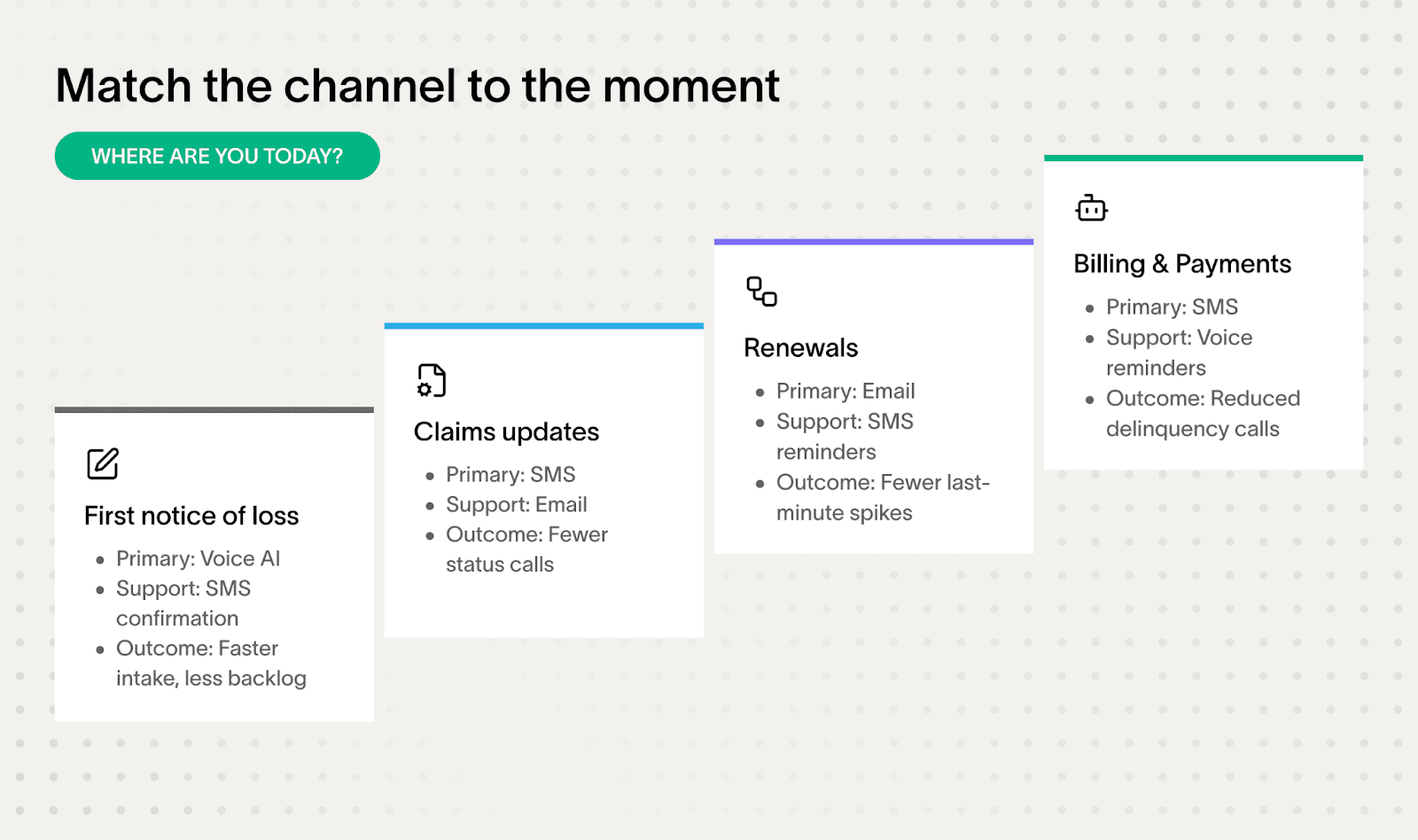
Designing multichannel sales outreach around insurance workflows, not channels

Strada aligns outreach to core insurance moments:

  • First notice of loss

  • Claims status updates

  • Billing and payment reminders

  • Policy renewals

  • Coverage changes

Each of these moments carries different urgency, compliance requirements, and customer expectations.

Channel strategy by workflow impact

Rather than asking which channel performs best, CX leaders should evaluate which channel reduces operational strain per workflow.

Workflow

Primary channel

Supporting channels

CX outcome

FNOL

Voice AI

SMS follow-up

Faster intake, reduced backlog

Claims updates

SMS

Email, Chat

Lower call volume, higher transparency

Renewals

Email

SMS reminders

Improved retention, fewer last-minute calls

Billing

SMS

Voice

Reduced delinquency-related calls

Strada operationalizes this by embedding channel logic directly into workflows, not campaigns.

Sequencing that reduces inbound volatility

Sequencing in insurance is not about persistence. It is about timing relative to customer anxiety.

  • Claims updates too late → inbound spike

  • Renewal reminders too early → ignored

  • Billing alerts too frequent → opt-outs

Strada uses behavioral signals and policy lifecycle data to time outreach so that it replaces inbound intent rather than reacting to it.

This is where most generic attempts to explain multichannel outreach tools fall short. They optimize engagement, not operational stability.

What a purpose-built multichannel outreach tool looks like in insurance

To explain multichannel outreach tools in an insurance context, the key distinction is integration depth, not channel count.

Strada is not a layer on top of communication. It is embedded into:

  • Policy administration systems

  • Claims platforms

  • CRM environments

This allows it to act on real-time policyholder context.

Category comparison: Generic tools vs. Insurance-specific platforms

Capability

Generic multichannel outreach tool

Strada multichannel outreach tool

Channel coverage

Broad

Focused and workflow-aligned

Integration

Surface-level (CRM only)

Deep (policy + claims systems)

Compliance handling

Manual configuration

Built into workflows

Context sharing

Limited

Real-time across channels

Use case fit

Campaign-driven

Operations-driven

The implication for CX leaders is direct: generic tools increase outreach activity, but do not necessarily improve CX metrics.

Why consolidation matters at scale

Many CX teams operate fragmented stacks:

  • Separate tools for SMS, voice, and email

  • Disconnected analytics

  • Manual context transfer between systems

This fragmentation creates hidden costs:

  • Increased AHT due to missing context

  • Lower FCR due to repeated explanations

  • Higher agent training complexity

Strada consolidates these into a single multichannel outreach service, reducing both operational friction and vendor overhead.

Compliance, risk, and trust in multichannel outreach

In insurance, outreach is constrained by regulation as much as by customer preference. TCPA, GDPR, and internal compliance policies shape what is permissible.

Strada embeds compliance directly into execution, not as an afterthought.

Compliance as a CX metric driver

Compliance failures do not just create legal risk. They degrade trust and increase opt-outs, which in turn increase inbound calls.

Strada enforces:

  • Consent tracking across channels

  • Frequency caps aligned with regulations

  • Automated opt-out handling

  • Channel-specific compliance logic

This ensures that multichannel outreach service delivery improves accessibility without increasing risk exposure.

Balancing automation with customer trust

Over-automation creates a different problem: perceived impersonality.

Strada maintains balance by:

  • Escalating to human agents with full context when needed

  • Preserving conversational continuity across channels

  • Avoiding redundant or repetitive messaging

The result is not fewer interactions, but more meaningful ones.

For CX leaders, this directly impacts:

  • CSAT (less frustration)

  • Retention (higher trust)

  • Agent satisfaction (less repetitive work)

Measuring the impact of multichannel outreach on core CX metrics

The success of multichannel outreach is not measured in engagement rates. It is measured in operational and customer outcomes.

Strada aligns measurement with metrics CX leaders already own.

Core metrics impacted

Metric

How multichannel outreach improves it

CSAT

Reduced effort through proactive communication

First contact resolution

Better context, fewer repeat contacts

Average handle time

Shorter calls due to pre-informed customers

Call volume

Reduced through proactive outreach

Policy retention

Improved through timely, relevant communication

Attribution across channels

A key challenge is understanding which channel actually prevented a call.

Strada uses multi-touch attribution tied to outcomes:

  • Did an SMS prevent a call?

  • Did a voice AI interaction resolve FNOL without agent involvement?

  • Did email reduce renewal-related inquiries?

This shifts analysis from channel performance to operational impact.

Continuous optimization through AI in multichannel outreach

AI in multichannel outreach enables ongoing adjustment:

  • Channel selection adapts based on response patterns

  • Timing shifts based on engagement and policy lifecycle

  • Messaging evolves based on outcomes, not templates

This is not campaign optimization. It is system optimization tied to CX KPIs.

Conclusion

Multichannel outreach is no longer a communication strategy. For insurance CX leaders, it is an operational lever that directly shapes call volume, agent workload, and customer experience.

Strada positions multichannel outreach as a system of control rather than a set of channels. By embedding AI, compliance, and workflow logic into a unified platform, it allows CX teams to move from reactive call handling to proactive experience design.

If your team is still measuring success by calls answered instead of calls avoided, it is time to evaluate how Strada can redesign your CX operating model.

Frequently Asked Questions

How does multichannel outreach reduce inbound call volume without negatively impacting customer experience?

It proactively delivers policy and claims information across channels, eliminating the need for customers to call while still keeping them informed and supported.

Why is call avoidance a more meaningful metric than call deflection for CX leaders?

Framer is a design tool that allows you to design websites on a freeform canvas, and then publish them as websites with a single click.

How should multichannel sales outreach be structured around insurance workflows like FNOL and renewals?

Framer is a design tool that allows you to design websites on a freeform canvas, and then publish them as websites with a single click.

How does AI in multichannel outreach improve first contact resolution (FCR) in insurance contact centers?

Framer is a design tool that allows you to design websites on a freeform canvas, and then publish them as websites with a single click.

What should CX leaders look for when evaluating a multichannel outreach tool for insurance use cases?

Framer is a design tool that allows you to design websites on a freeform canvas, and then publish them as websites with a single click.

Start scaling with voice AI agents today

Join innovative carriers and MGAs transforming their calls with Strada.

Blog

/

AI & Automation

How CX Leaders Use Multichannel Outreach to Fix Insurance Calls in 2026

Amir Prodensky

CEO

Mar 30, 2026

6 min read

Reduce call volume while improving FCR and CX stability

Key takeaways:

  • Reducing inbound call volume improves CX performance more than handling calls faster, by proactively resolving customer needs before they reach the contact center.

  • Aligning multichannel outreach to insurance workflows increases first contact resolution and stabilizes demand by delivering the right information at the right moment.

  • Providing agents with full cross-channel context shortens handle time and improves customer satisfaction by eliminating repeated explanations.

  • Consolidating communication channels into a single system reduces operational friction and improves consistency across large agent teams.

  • Embedding compliance into outreach execution protects customer trust and prevents opt-outs, preserving reachable customers and reducing avoidable contact volume.

Insurance CX leaders are no longer asking how to increase contact volume. They are focused on how to reduce avoidable calls, improve first contact resolution, and stabilize customer experience across policy servicing and claims. 

Multichannel outreach has emerged as a control layer for inbound volatility, not just a communication tactic.

Strada’s role in multichannel outreach: Turning call volume into controlled customer journeys

Strada reframes multichannel outreach from a reactive communication layer into a proactive CX orchestration system. Instead of waiting for inbound calls to spike, it distributes interactions across voice, SMS, email, and chat in a way that directly impacts handle time, FCR, and policyholder satisfaction.

For CX executives managing 50–500+ agents, this shift changes how performance is measured. Instead of asking “How many calls did we answer?”, the question becomes “How many calls did we prevent without degrading experience?”

From call deflection to call avoidance

Traditional approaches focus on deflection through IVR or self-service portals. Strada operates earlier in the lifecycle.

  • Claims updates are proactively delivered via SMS or voice AI before the policyholder calls

  • Renewal reminders are sequenced across channels to reduce last-minute inbound spikes

  • FNOL intake is initiated through outbound voice or digital channels to compress reporting time

This changes key metrics:

Metric

Traditional model

With Strada multichannel outreach service

Average handle time

Reduced incrementally

Reduced by removing low-value calls entirely

First contact resolution

Dependent on agent skill

Increased through pre-call context delivery

Call volume

Reactive

Actively shaped and redistributed

Customer effort score

Measured post-call

Reduced by eliminating unnecessary calls

AI in multichannel outreach as a CX control layer

AI in multichannel outreach is not about automation for its own sake. In Strada’s model, AI determines:

  • Which channel prevents a call most effectively

  • When outreach should occur to reduce inbound pressure

  • How context should follow the customer across channels

For example, a policyholder who receives an SMS claim update and then calls will reach an agent already equipped with that interaction history. This reduces repeat explanation, a key driver of low CSAT.

Designing multichannel sales outreach around insurance workflows, not channels

Most multichannel sales outreach frameworks are channel-first. Insurance CX requires workflow-first design.

Designing multichannel sales outreach around insurance workflows, not channels

Strada aligns outreach to core insurance moments:

  • First notice of loss

  • Claims status updates

  • Billing and payment reminders

  • Policy renewals

  • Coverage changes

Each of these moments carries different urgency, compliance requirements, and customer expectations.

Channel strategy by workflow impact

Rather than asking which channel performs best, CX leaders should evaluate which channel reduces operational strain per workflow.

Workflow

Primary channel

Supporting channels

CX outcome

FNOL

Voice AI

SMS follow-up

Faster intake, reduced backlog

Claims updates

SMS

Email, Chat

Lower call volume, higher transparency

Renewals

Email

SMS reminders

Improved retention, fewer last-minute calls

Billing

SMS

Voice

Reduced delinquency-related calls

Strada operationalizes this by embedding channel logic directly into workflows, not campaigns.

Sequencing that reduces inbound volatility

Sequencing in insurance is not about persistence. It is about timing relative to customer anxiety.

  • Claims updates too late → inbound spike

  • Renewal reminders too early → ignored

  • Billing alerts too frequent → opt-outs

Strada uses behavioral signals and policy lifecycle data to time outreach so that it replaces inbound intent rather than reacting to it.

This is where most generic attempts to explain multichannel outreach tools fall short. They optimize engagement, not operational stability.

What a purpose-built multichannel outreach tool looks like in insurance

To explain multichannel outreach tools in an insurance context, the key distinction is integration depth, not channel count.

Strada is not a layer on top of communication. It is embedded into:

  • Policy administration systems

  • Claims platforms

  • CRM environments

This allows it to act on real-time policyholder context.

Category comparison: Generic tools vs. Insurance-specific platforms

Capability

Generic multichannel outreach tool

Strada multichannel outreach tool

Channel coverage

Broad

Focused and workflow-aligned

Integration

Surface-level (CRM only)

Deep (policy + claims systems)

Compliance handling

Manual configuration

Built into workflows

Context sharing

Limited

Real-time across channels

Use case fit

Campaign-driven

Operations-driven

The implication for CX leaders is direct: generic tools increase outreach activity, but do not necessarily improve CX metrics.

Why consolidation matters at scale

Many CX teams operate fragmented stacks:

  • Separate tools for SMS, voice, and email

  • Disconnected analytics

  • Manual context transfer between systems

This fragmentation creates hidden costs:

  • Increased AHT due to missing context

  • Lower FCR due to repeated explanations

  • Higher agent training complexity

Strada consolidates these into a single multichannel outreach service, reducing both operational friction and vendor overhead.

Compliance, risk, and trust in multichannel outreach

In insurance, outreach is constrained by regulation as much as by customer preference. TCPA, GDPR, and internal compliance policies shape what is permissible.

Strada embeds compliance directly into execution, not as an afterthought.

Compliance as a CX metric driver

Compliance failures do not just create legal risk. They degrade trust and increase opt-outs, which in turn increase inbound calls.

Strada enforces:

  • Consent tracking across channels

  • Frequency caps aligned with regulations

  • Automated opt-out handling

  • Channel-specific compliance logic

This ensures that multichannel outreach service delivery improves accessibility without increasing risk exposure.

Balancing automation with customer trust

Over-automation creates a different problem: perceived impersonality.

Strada maintains balance by:

  • Escalating to human agents with full context when needed

  • Preserving conversational continuity across channels

  • Avoiding redundant or repetitive messaging

The result is not fewer interactions, but more meaningful ones.

For CX leaders, this directly impacts:

  • CSAT (less frustration)

  • Retention (higher trust)

  • Agent satisfaction (less repetitive work)

Measuring the impact of multichannel outreach on core CX metrics

The success of multichannel outreach is not measured in engagement rates. It is measured in operational and customer outcomes.

Strada aligns measurement with metrics CX leaders already own.

Core metrics impacted

Metric

How multichannel outreach improves it

CSAT

Reduced effort through proactive communication

First contact resolution

Better context, fewer repeat contacts

Average handle time

Shorter calls due to pre-informed customers

Call volume

Reduced through proactive outreach

Policy retention

Improved through timely, relevant communication

Attribution across channels

A key challenge is understanding which channel actually prevented a call.

Strada uses multi-touch attribution tied to outcomes:

  • Did an SMS prevent a call?

  • Did a voice AI interaction resolve FNOL without agent involvement?

  • Did email reduce renewal-related inquiries?

This shifts analysis from channel performance to operational impact.

Continuous optimization through AI in multichannel outreach

AI in multichannel outreach enables ongoing adjustment:

  • Channel selection adapts based on response patterns

  • Timing shifts based on engagement and policy lifecycle

  • Messaging evolves based on outcomes, not templates

This is not campaign optimization. It is system optimization tied to CX KPIs.

Conclusion

Multichannel outreach is no longer a communication strategy. For insurance CX leaders, it is an operational lever that directly shapes call volume, agent workload, and customer experience.

Strada positions multichannel outreach as a system of control rather than a set of channels. By embedding AI, compliance, and workflow logic into a unified platform, it allows CX teams to move from reactive call handling to proactive experience design.

If your team is still measuring success by calls answered instead of calls avoided, it is time to evaluate how Strada can redesign your CX operating model.

Frequently Asked Questions

How does multichannel outreach reduce inbound call volume without negatively impacting customer experience?

It proactively delivers policy and claims information across channels, eliminating the need for customers to call while still keeping them informed and supported.

Why is call avoidance a more meaningful metric than call deflection for CX leaders?

Framer is a design tool that allows you to design websites on a freeform canvas, and then publish them as websites with a single click.

How should multichannel sales outreach be structured around insurance workflows like FNOL and renewals?

Framer is a design tool that allows you to design websites on a freeform canvas, and then publish them as websites with a single click.

How does AI in multichannel outreach improve first contact resolution (FCR) in insurance contact centers?

Framer is a design tool that allows you to design websites on a freeform canvas, and then publish them as websites with a single click.

What should CX leaders look for when evaluating a multichannel outreach tool for insurance use cases?

Framer is a design tool that allows you to design websites on a freeform canvas, and then publish them as websites with a single click.

Start scaling with voice AI agents today

Join innovative carriers and MGAs transforming their calls with Strada.

Blog

/

AI & Automation

How CX Leaders Use Multichannel Outreach to Fix Insurance Calls in 2026

Amir Prodensky

CEO

Mar 30, 2026

6 min read

Reduce call volume while improving FCR and CX stability

Key takeaways:

  • Reducing inbound call volume improves CX performance more than handling calls faster, by proactively resolving customer needs before they reach the contact center.

  • Aligning multichannel outreach to insurance workflows increases first contact resolution and stabilizes demand by delivering the right information at the right moment.

  • Providing agents with full cross-channel context shortens handle time and improves customer satisfaction by eliminating repeated explanations.

  • Consolidating communication channels into a single system reduces operational friction and improves consistency across large agent teams.

  • Embedding compliance into outreach execution protects customer trust and prevents opt-outs, preserving reachable customers and reducing avoidable contact volume.

Insurance CX leaders are no longer asking how to increase contact volume. They are focused on how to reduce avoidable calls, improve first contact resolution, and stabilize customer experience across policy servicing and claims. 

Multichannel outreach has emerged as a control layer for inbound volatility, not just a communication tactic.

Strada’s role in multichannel outreach: Turning call volume into controlled customer journeys

Strada reframes multichannel outreach from a reactive communication layer into a proactive CX orchestration system. Instead of waiting for inbound calls to spike, it distributes interactions across voice, SMS, email, and chat in a way that directly impacts handle time, FCR, and policyholder satisfaction.

For CX executives managing 50–500+ agents, this shift changes how performance is measured. Instead of asking “How many calls did we answer?”, the question becomes “How many calls did we prevent without degrading experience?”

From call deflection to call avoidance

Traditional approaches focus on deflection through IVR or self-service portals. Strada operates earlier in the lifecycle.

  • Claims updates are proactively delivered via SMS or voice AI before the policyholder calls

  • Renewal reminders are sequenced across channels to reduce last-minute inbound spikes

  • FNOL intake is initiated through outbound voice or digital channels to compress reporting time

This changes key metrics:

Metric

Traditional model

With Strada multichannel outreach service

Average handle time

Reduced incrementally

Reduced by removing low-value calls entirely

First contact resolution

Dependent on agent skill

Increased through pre-call context delivery

Call volume

Reactive

Actively shaped and redistributed

Customer effort score

Measured post-call

Reduced by eliminating unnecessary calls

AI in multichannel outreach as a CX control layer

AI in multichannel outreach is not about automation for its own sake. In Strada’s model, AI determines:

  • Which channel prevents a call most effectively

  • When outreach should occur to reduce inbound pressure

  • How context should follow the customer across channels

For example, a policyholder who receives an SMS claim update and then calls will reach an agent already equipped with that interaction history. This reduces repeat explanation, a key driver of low CSAT.

Designing multichannel sales outreach around insurance workflows, not channels

Most multichannel sales outreach frameworks are channel-first. Insurance CX requires workflow-first design.

Designing multichannel sales outreach around insurance workflows, not channels

Strada aligns outreach to core insurance moments:

  • First notice of loss

  • Claims status updates

  • Billing and payment reminders

  • Policy renewals

  • Coverage changes

Each of these moments carries different urgency, compliance requirements, and customer expectations.

Channel strategy by workflow impact

Rather than asking which channel performs best, CX leaders should evaluate which channel reduces operational strain per workflow.

Workflow

Primary channel

Supporting channels

CX outcome

FNOL

Voice AI

SMS follow-up

Faster intake, reduced backlog

Claims updates

SMS

Email, Chat

Lower call volume, higher transparency

Renewals

Email

SMS reminders

Improved retention, fewer last-minute calls

Billing

SMS

Voice

Reduced delinquency-related calls

Strada operationalizes this by embedding channel logic directly into workflows, not campaigns.

Sequencing that reduces inbound volatility

Sequencing in insurance is not about persistence. It is about timing relative to customer anxiety.

  • Claims updates too late → inbound spike

  • Renewal reminders too early → ignored

  • Billing alerts too frequent → opt-outs

Strada uses behavioral signals and policy lifecycle data to time outreach so that it replaces inbound intent rather than reacting to it.

This is where most generic attempts to explain multichannel outreach tools fall short. They optimize engagement, not operational stability.

What a purpose-built multichannel outreach tool looks like in insurance

To explain multichannel outreach tools in an insurance context, the key distinction is integration depth, not channel count.

Strada is not a layer on top of communication. It is embedded into:

  • Policy administration systems

  • Claims platforms

  • CRM environments

This allows it to act on real-time policyholder context.

Category comparison: Generic tools vs. Insurance-specific platforms

Capability

Generic multichannel outreach tool

Strada multichannel outreach tool

Channel coverage

Broad

Focused and workflow-aligned

Integration

Surface-level (CRM only)

Deep (policy + claims systems)

Compliance handling

Manual configuration

Built into workflows

Context sharing

Limited

Real-time across channels

Use case fit

Campaign-driven

Operations-driven

The implication for CX leaders is direct: generic tools increase outreach activity, but do not necessarily improve CX metrics.

Why consolidation matters at scale

Many CX teams operate fragmented stacks:

  • Separate tools for SMS, voice, and email

  • Disconnected analytics

  • Manual context transfer between systems

This fragmentation creates hidden costs:

  • Increased AHT due to missing context

  • Lower FCR due to repeated explanations

  • Higher agent training complexity

Strada consolidates these into a single multichannel outreach service, reducing both operational friction and vendor overhead.

Compliance, risk, and trust in multichannel outreach

In insurance, outreach is constrained by regulation as much as by customer preference. TCPA, GDPR, and internal compliance policies shape what is permissible.

Strada embeds compliance directly into execution, not as an afterthought.

Compliance as a CX metric driver

Compliance failures do not just create legal risk. They degrade trust and increase opt-outs, which in turn increase inbound calls.

Strada enforces:

  • Consent tracking across channels

  • Frequency caps aligned with regulations

  • Automated opt-out handling

  • Channel-specific compliance logic

This ensures that multichannel outreach service delivery improves accessibility without increasing risk exposure.

Balancing automation with customer trust

Over-automation creates a different problem: perceived impersonality.

Strada maintains balance by:

  • Escalating to human agents with full context when needed

  • Preserving conversational continuity across channels

  • Avoiding redundant or repetitive messaging

The result is not fewer interactions, but more meaningful ones.

For CX leaders, this directly impacts:

  • CSAT (less frustration)

  • Retention (higher trust)

  • Agent satisfaction (less repetitive work)

Measuring the impact of multichannel outreach on core CX metrics

The success of multichannel outreach is not measured in engagement rates. It is measured in operational and customer outcomes.

Strada aligns measurement with metrics CX leaders already own.

Core metrics impacted

Metric

How multichannel outreach improves it

CSAT

Reduced effort through proactive communication

First contact resolution

Better context, fewer repeat contacts

Average handle time

Shorter calls due to pre-informed customers

Call volume

Reduced through proactive outreach

Policy retention

Improved through timely, relevant communication

Attribution across channels

A key challenge is understanding which channel actually prevented a call.

Strada uses multi-touch attribution tied to outcomes:

  • Did an SMS prevent a call?

  • Did a voice AI interaction resolve FNOL without agent involvement?

  • Did email reduce renewal-related inquiries?

This shifts analysis from channel performance to operational impact.

Continuous optimization through AI in multichannel outreach

AI in multichannel outreach enables ongoing adjustment:

  • Channel selection adapts based on response patterns

  • Timing shifts based on engagement and policy lifecycle

  • Messaging evolves based on outcomes, not templates

This is not campaign optimization. It is system optimization tied to CX KPIs.

Conclusion

Multichannel outreach is no longer a communication strategy. For insurance CX leaders, it is an operational lever that directly shapes call volume, agent workload, and customer experience.

Strada positions multichannel outreach as a system of control rather than a set of channels. By embedding AI, compliance, and workflow logic into a unified platform, it allows CX teams to move from reactive call handling to proactive experience design.

If your team is still measuring success by calls answered instead of calls avoided, it is time to evaluate how Strada can redesign your CX operating model.

Frequently Asked Questions

How does multichannel outreach reduce inbound call volume without negatively impacting customer experience?

It proactively delivers policy and claims information across channels, eliminating the need for customers to call while still keeping them informed and supported.

Why is call avoidance a more meaningful metric than call deflection for CX leaders?

Framer is a design tool that allows you to design websites on a freeform canvas, and then publish them as websites with a single click.

How should multichannel sales outreach be structured around insurance workflows like FNOL and renewals?

Framer is a design tool that allows you to design websites on a freeform canvas, and then publish them as websites with a single click.

How does AI in multichannel outreach improve first contact resolution (FCR) in insurance contact centers?

Framer is a design tool that allows you to design websites on a freeform canvas, and then publish them as websites with a single click.

What should CX leaders look for when evaluating a multichannel outreach tool for insurance use cases?

Framer is a design tool that allows you to design websites on a freeform canvas, and then publish them as websites with a single click.

Start scaling with voice AI agents today

Join innovative carriers and MGAs transforming their calls with Strada.