Introducing Strada Signals, our new report series on AI for insurance operations. Read our whitepaper →
Introducing Strada Signals, our new report series on AI for insurance operations.
Read our whitepaper →
Introducing Strada Signals, our new report series on AI for insurance operations. Read our whitepaper →

Multi-Channel FNOL Is Live: Strada Now Handles Claim Intake Across Voice, Chat, Email, and SMS
Introduction
Filing a claim is rarely a single interaction. A policyholder calls to report an incident, sends photos by email the next morning, and expects an SMS confirmation before the day is out. For most carriers, those interactions become separate tickets, separate records, or separate inboxes. Operations teams spend their time stitching them back together.
Strada's multi-channel FNOL capability changes that. It enables persistent claim context: one AI agent that follows the policyholder across every channel, treating every interaction as part of a single, continuous claim. As of today, carriers, MGAs, and TPAs can run AI-powered claims intake across voice, chat, email, and SMS, with information written automatically into the claims management system as it is collected.
Why this matters for insurers
FNOL sets the tone for the entire claims experience. It is the policyholder's first interaction after a loss, and the quality of that intake directly affects the cost, timeline and ultimately outcome of a claim.
With traditional solutions, adjusters spend significant time on phone tag, manual data reconciliation, and chasing down documentation that arrived through a separate channel. Strada eliminates that overhead and saves adjusters up to 30% of their time. More adjuster capacity means lower LAE, shorter cycle times, and less leakage from claims that sit too long without action.
Strada's multi-channel FNOL addresses this across the lines where intake volume is highest: auto, home, workers' compensation, general liability, warranty, and BOP.
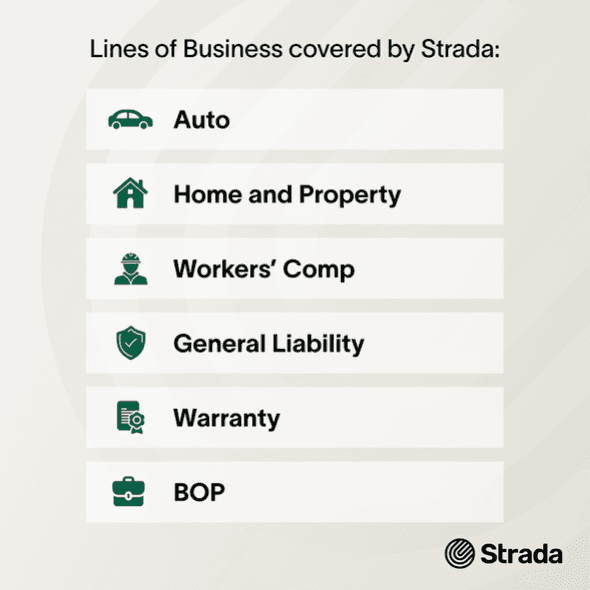
Lines of Business covered by Strada’s FNOL agents
The four channels
Voice
Voice remains the dominant channel for FNOL. When a policyholder calls to report a loss, Strada's AI agent answers, identifies the caller’s policy, and guides them through the intake process conversationally. The agent follows the carrier's existing FNOL process, asks only the questions that apply based on previous answers, and adapts the conversation naturally rather than following a rigid script. There is no IVR maze, no hold queue, no form to fill out after the call.
For carriers, this means every inbound FNOL call is handled consistently, at any hour, without routing to a live representative unless the situation genuinely calls for it.
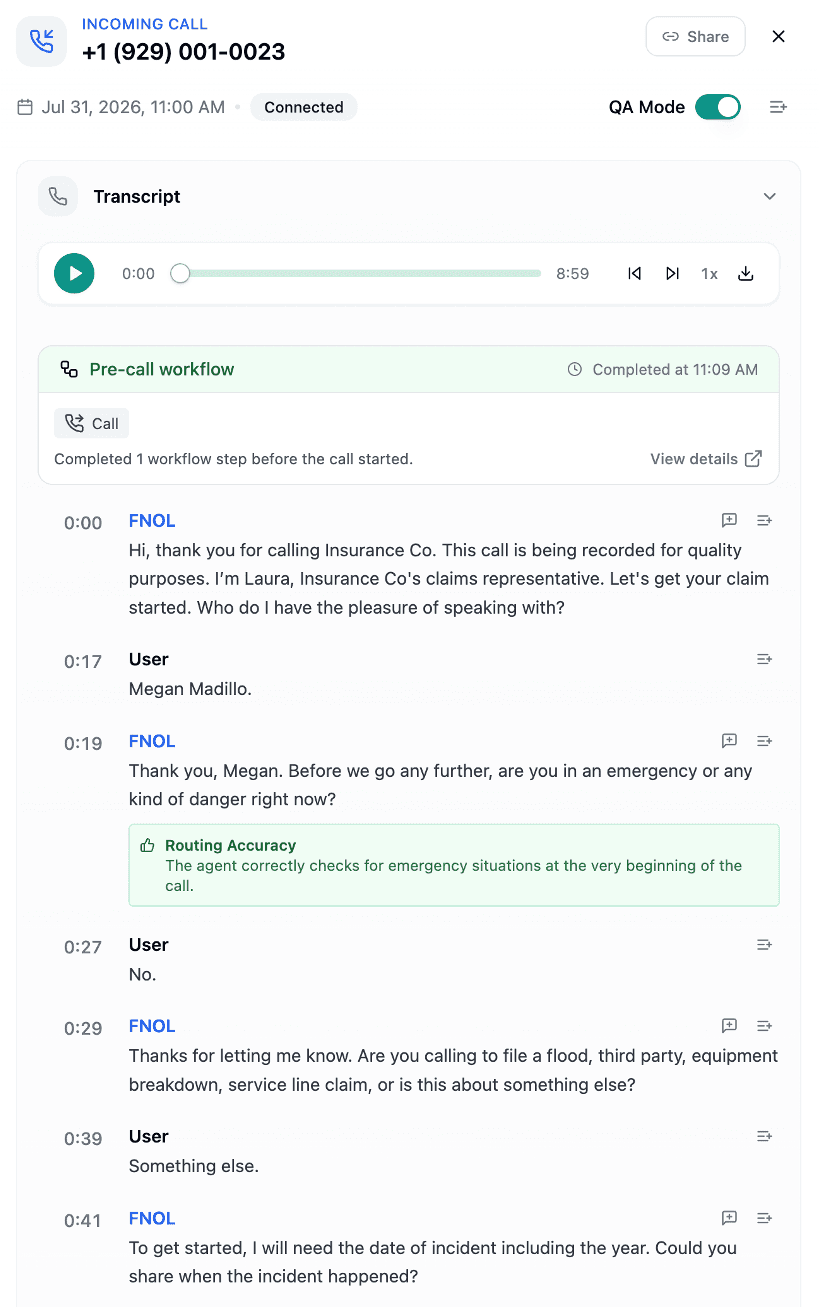
Voice call transcript of the beginning of a claim intake
Chat
Some policyholders prefer not to call. Chat gives them a way to report a loss on their own terms through a web widget, a mobile app, or a messaging interface the carrier is already running. Because the same AI workflow powers both voice and chat, carriers don't maintain separate intake processes for different channels.
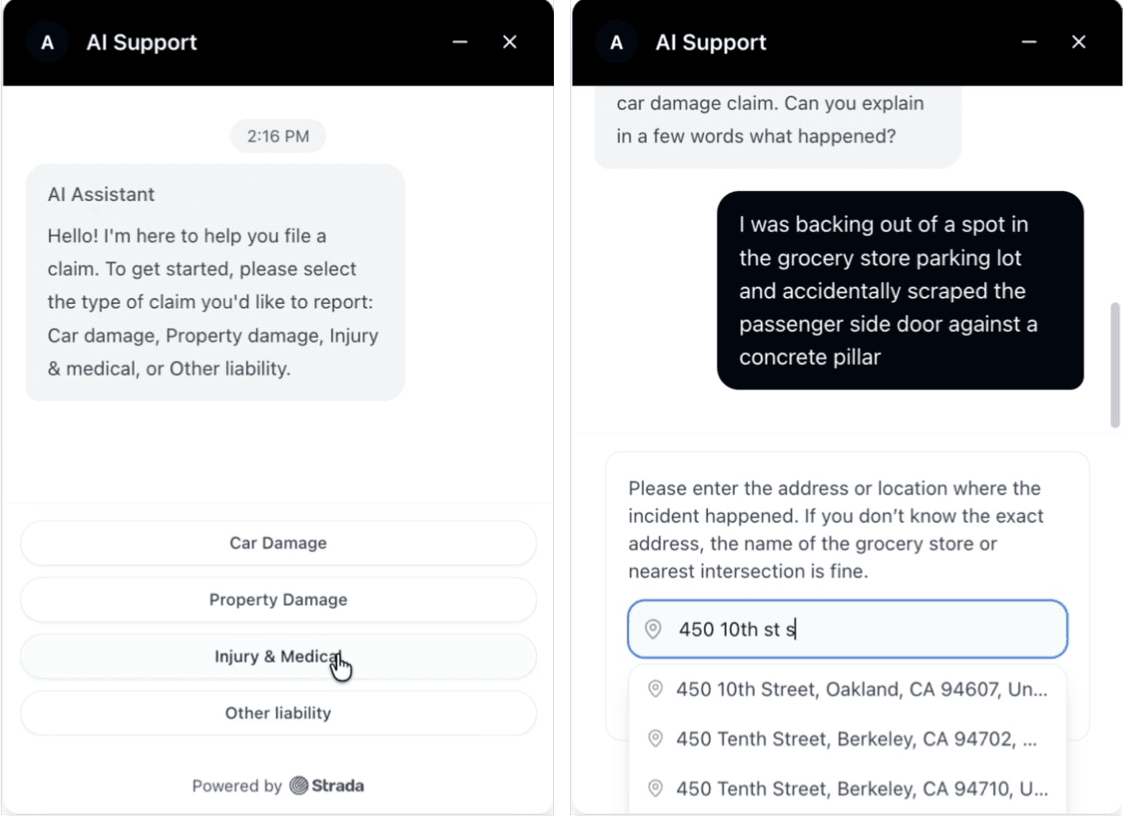
Chat support for FNOL
Email can be used to start a claim, but it is more often where supporting documentation arrives: photos of damage, police reports, third-party information. Strada automatically associates incoming emails with the correct claim, extracts structured information from attachments, and appends both documents and metadata to the claim record. For carriers running high-volume operations, this eliminates a significant amount of manual document handling.
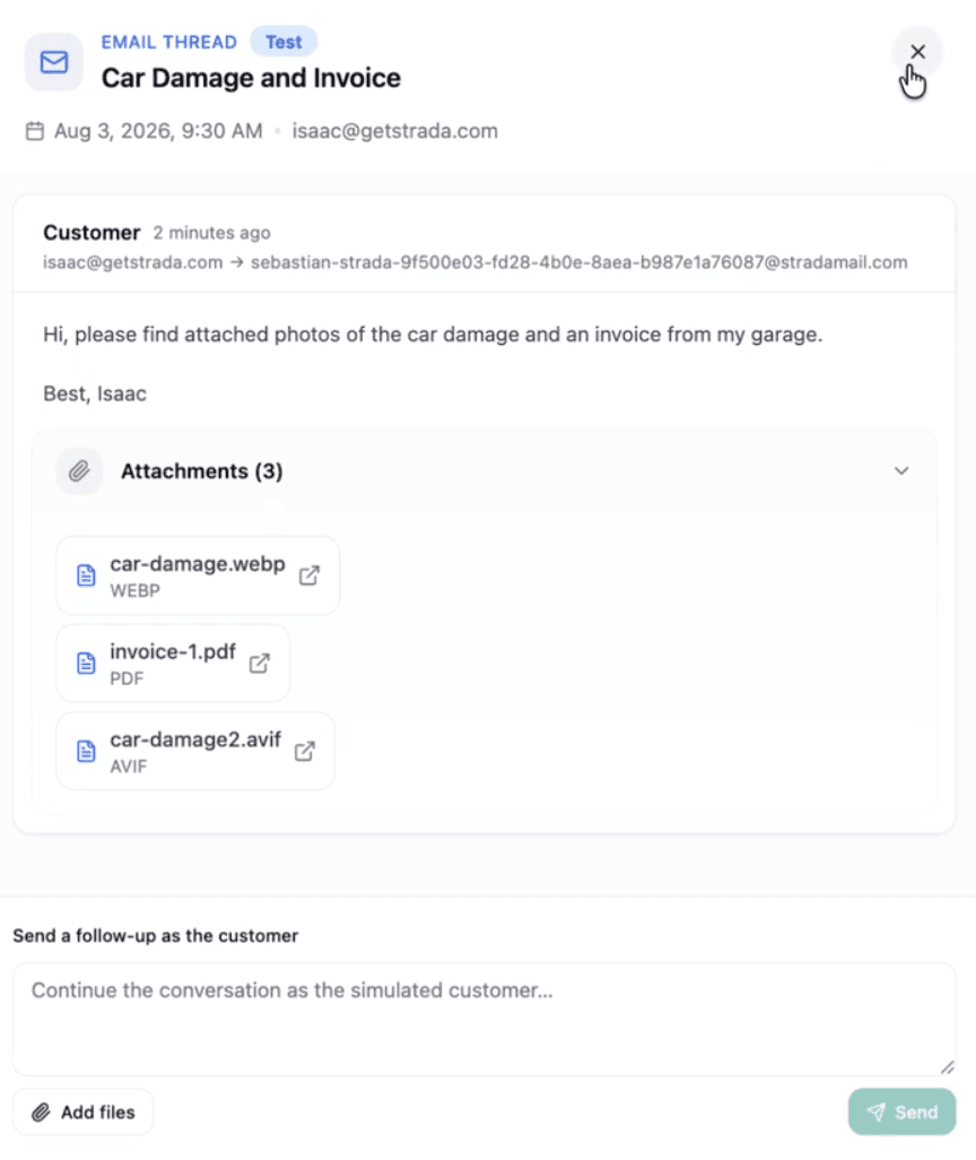
Email interaction handled by Strada agent
SMS
SMS has two applications. It can support full claim intake for policyholders who prefer to file entirely over text, or serve as a follow-up layer after a claim is initiated by phone, chat, or email, like sending confirmations, next steps, or requests for additional information. Policyholders can respond via SMS to provide missing details or answer follow-up questions. It closes the loop for policyholders who want a record of what was filed without having to log into a portal.
How the channels work together
Most conversational AI platforms treat every channel independently. A phone call is one interaction, an email is another, an SMS thread is a third. Insurance claims don't work that way.
A policyholder can start a claim over the phone, send supporting photos by email, and receive an SMS confirmation. Strada's agents recognize all three interactions as part of the same claim. Context gathered in one channel carries forward into the next. The policyholder never has to repeat themselves, and the carrier never has to reconcile information across separate systems.
As information is collected, Strada progressively updates the carrier's systems rather than waiting until the interaction ends. If a call drops halfway through, everything captured so far is saved. Throughout the interaction, claim data is written into the carrier's claims system, with structured loss data, policyholder details, and supporting documentation, all captured without manual data entry.
How carriers deploy it
Rather than redesigning FNOL from scratch, carriers simply provide their existing intake questionnaire or SOP (Standard Operation Procedures). Strada’s intake engine converts these into an AI agent, including complex branching logic and conditional routing. Once ingested, the carrier's team can begin iterating and refining the agent configuration immediately. End-to-end deployment is typically completed in weeks.
Strada's claims capability also includes intelligent routing, directing policyholders to the right workflow from the first interaction, and claim status lookup, allowing policyholders to check the state of an existing claim without reaching a live representative.
Conclusion
FNOL is where most carriers start their AI journey, and for good reason. It is high volume, highly repetitive, and directly visible to policyholders, so getting it right matters. Multi-channel FNOL gives carriers a foundation that handles intake at scale, across every channel their policyholders already use, and feeds clean data into their systems from the first interaction. That foundation is what makes everything that comes next faster to build and faster to prove.
Multi-channel FNOL is available today for P&C carriers, MGAs, and TPAs.
To see how it works, watch the product demo or contact us at info@getstrada.com.
Carriers, MGAs, and brokers scale revenue-driving phone calls with Strada's conversational AI platform.
Start scaling with voice AI agents today
Join innovative carriers and MGAs transforming their calls with Strada.
Multi-Channel FNOL Is Live: Strada Now Handles Claim Intake Across Voice, Chat, Email, and SMS
Introduction
Filing a claim is rarely a single interaction. A policyholder calls to report an incident, sends photos by email the next morning, and expects an SMS confirmation before the day is out. For most carriers, those interactions become separate tickets, separate records, or separate inboxes. Operations teams spend their time stitching them back together.
Strada's multi-channel FNOL capability changes that. It enables persistent claim context: one AI agent that follows the policyholder across every channel, treating every interaction as part of a single, continuous claim. As of today, carriers, MGAs, and TPAs can run AI-powered claims intake across voice, chat, email, and SMS, with information written automatically into the claims management system as it is collected.
Why this matters for insurers
FNOL sets the tone for the entire claims experience. It is the policyholder's first interaction after a loss, and the quality of that intake directly affects the cost, timeline and ultimately outcome of a claim.
With traditional solutions, adjusters spend significant time on phone tag, manual data reconciliation, and chasing down documentation that arrived through a separate channel. Strada eliminates that overhead and saves adjusters up to 30% of their time. More adjuster capacity means lower LAE, shorter cycle times, and less leakage from claims that sit too long without action.
Strada's multi-channel FNOL addresses this across the lines where intake volume is highest: auto, home, workers' compensation, general liability, warranty, and BOP.
Lines of Business covered by Strada’s FNOL agents
The four channels
Voice
Voice remains the dominant channel for FNOL. When a policyholder calls to report a loss, Strada's AI agent answers, identifies the caller’s policy, and guides them through the intake process conversationally. The agent follows the carrier's existing FNOL process, asks only the questions that apply based on previous answers, and adapts the conversation naturally rather than following a rigid script. There is no IVR maze, no hold queue, no form to fill out after the call.
For carriers, this means every inbound FNOL call is handled consistently, at any hour, without routing to a live representative unless the situation genuinely calls for it.
Voice call transcript of the beginning of a claim intake
Chat
Some policyholders prefer not to call. Chat gives them a way to report a loss on their own terms through a web widget, a mobile app, or a messaging interface the carrier is already running. Because the same AI workflow powers both voice and chat, carriers don't maintain separate intake processes for different channels.
Chat support for FNOL
Email can be used to start a claim, but it is more often where supporting documentation arrives: photos of damage, police reports, third-party information. Strada automatically associates incoming emails with the correct claim, extracts structured information from attachments, and appends both documents and metadata to the claim record. For carriers running high-volume operations, this eliminates a significant amount of manual document handling.
Email interaction handled by Strada agent
SMS
SMS has two applications. It can support full claim intake for policyholders who prefer to file entirely over text, or serve as a follow-up layer after a claim is initiated by phone, chat, or email, like sending confirmations, next steps, or requests for additional information. Policyholders can respond via SMS to provide missing details or answer follow-up questions. It closes the loop for policyholders who want a record of what was filed without having to log into a portal.
How the channels work together
Most conversational AI platforms treat every channel independently. A phone call is one interaction, an email is another, an SMS thread is a third. Insurance claims don't work that way.
A policyholder can start a claim over the phone, send supporting photos by email, and receive an SMS confirmation. Strada's agents recognize all three interactions as part of the same claim. Context gathered in one channel carries forward into the next. The policyholder never has to repeat themselves, and the carrier never has to reconcile information across separate systems.
As information is collected, Strada progressively updates the carrier's systems rather than waiting until the interaction ends. If a call drops halfway through, everything captured so far is saved. Throughout the interaction, claim data is written into the carrier's claims system, with structured loss data, policyholder details, and supporting documentation, all captured without manual data entry.
How carriers deploy it
Rather than redesigning FNOL from scratch, carriers simply provide their existing intake questionnaire or SOP (Standard Operation Procedures). Strada’s intake engine converts these into an AI agent, including complex branching logic and conditional routing. Once ingested, the carrier's team can begin iterating and refining the agent configuration immediately. End-to-end deployment is typically completed in weeks.
Strada's claims capability also includes intelligent routing, directing policyholders to the right workflow from the first interaction, and claim status lookup, allowing policyholders to check the state of an existing claim without reaching a live representative.
Conclusion
FNOL is where most carriers start their AI journey, and for good reason. It is high volume, highly repetitive, and directly visible to policyholders, so getting it right matters. Multi-channel FNOL gives carriers a foundation that handles intake at scale, across every channel their policyholders already use, and feeds clean data into their systems from the first interaction. That foundation is what makes everything that comes next faster to build and faster to prove.
Multi-channel FNOL is available today for P&C carriers, MGAs, and TPAs.
To see how it works, watch the product demo or contact us at info@getstrada.com.
Carriers, MGAs, and brokers scale revenue-driving phone calls with Strada's conversational AI platform.
Start scaling with voice AI agents today
Join innovative carriers and MGAs transforming their calls with Strada.
Multi-Channel FNOL Is Live: Strada Now Handles Claim Intake Across Voice, Chat, Email, and SMS
Introduction
Filing a claim is rarely a single interaction. A policyholder calls to report an incident, sends photos by email the next morning, and expects an SMS confirmation before the day is out. For most carriers, those interactions become separate tickets, separate records, or separate inboxes. Operations teams spend their time stitching them back together.
Strada's multi-channel FNOL capability changes that. It enables persistent claim context: one AI agent that follows the policyholder across every channel, treating every interaction as part of a single, continuous claim. As of today, carriers, MGAs, and TPAs can run AI-powered claims intake across voice, chat, email, and SMS, with information written automatically into the claims management system as it is collected.
Why this matters for insurers
FNOL sets the tone for the entire claims experience. It is the policyholder's first interaction after a loss, and the quality of that intake directly affects the cost, timeline and ultimately outcome of a claim.
With traditional solutions, adjusters spend significant time on phone tag, manual data reconciliation, and chasing down documentation that arrived through a separate channel. Strada eliminates that overhead and saves adjusters up to 30% of their time. More adjuster capacity means lower LAE, shorter cycle times, and less leakage from claims that sit too long without action.
Strada's multi-channel FNOL addresses this across the lines where intake volume is highest: auto, home, workers' compensation, general liability, warranty, and BOP.
Lines of Business covered by Strada’s FNOL agents
The four channels
Voice
Voice remains the dominant channel for FNOL. When a policyholder calls to report a loss, Strada's AI agent answers, identifies the caller’s policy, and guides them through the intake process conversationally. The agent follows the carrier's existing FNOL process, asks only the questions that apply based on previous answers, and adapts the conversation naturally rather than following a rigid script. There is no IVR maze, no hold queue, no form to fill out after the call.
For carriers, this means every inbound FNOL call is handled consistently, at any hour, without routing to a live representative unless the situation genuinely calls for it.
Voice call transcript of the beginning of a claim intake
Chat
Some policyholders prefer not to call. Chat gives them a way to report a loss on their own terms through a web widget, a mobile app, or a messaging interface the carrier is already running. Because the same AI workflow powers both voice and chat, carriers don't maintain separate intake processes for different channels.
Chat support for FNOL
Email can be used to start a claim, but it is more often where supporting documentation arrives: photos of damage, police reports, third-party information. Strada automatically associates incoming emails with the correct claim, extracts structured information from attachments, and appends both documents and metadata to the claim record. For carriers running high-volume operations, this eliminates a significant amount of manual document handling.
Email interaction handled by Strada agent
SMS
SMS has two applications. It can support full claim intake for policyholders who prefer to file entirely over text, or serve as a follow-up layer after a claim is initiated by phone, chat, or email, like sending confirmations, next steps, or requests for additional information. Policyholders can respond via SMS to provide missing details or answer follow-up questions. It closes the loop for policyholders who want a record of what was filed without having to log into a portal.
How the channels work together
Most conversational AI platforms treat every channel independently. A phone call is one interaction, an email is another, an SMS thread is a third. Insurance claims don't work that way.
A policyholder can start a claim over the phone, send supporting photos by email, and receive an SMS confirmation. Strada's agents recognize all three interactions as part of the same claim. Context gathered in one channel carries forward into the next. The policyholder never has to repeat themselves, and the carrier never has to reconcile information across separate systems.
As information is collected, Strada progressively updates the carrier's systems rather than waiting until the interaction ends. If a call drops halfway through, everything captured so far is saved. Throughout the interaction, claim data is written into the carrier's claims system, with structured loss data, policyholder details, and supporting documentation, all captured without manual data entry.
How carriers deploy it
Rather than redesigning FNOL from scratch, carriers simply provide their existing intake questionnaire or SOP (Standard Operation Procedures). Strada’s intake engine converts these into an AI agent, including complex branching logic and conditional routing. Once ingested, the carrier's team can begin iterating and refining the agent configuration immediately. End-to-end deployment is typically completed in weeks.
Strada's claims capability also includes intelligent routing, directing policyholders to the right workflow from the first interaction, and claim status lookup, allowing policyholders to check the state of an existing claim without reaching a live representative.
Conclusion
FNOL is where most carriers start their AI journey, and for good reason. It is high volume, highly repetitive, and directly visible to policyholders, so getting it right matters. Multi-channel FNOL gives carriers a foundation that handles intake at scale, across every channel their policyholders already use, and feeds clean data into their systems from the first interaction. That foundation is what makes everything that comes next faster to build and faster to prove.
Multi-channel FNOL is available today for P&C carriers, MGAs, and TPAs.
To see how it works, watch the product demo or contact us at info@getstrada.com.
Carriers, MGAs, and brokers scale revenue-driving phone calls with Strada's conversational AI platform.
Start scaling with voice AI agents today
Join innovative carriers and MGAs transforming their calls with Strada.

Agentic AI for insurance operations
© 2026 Strada API, Inc.
Agentic AI for insurance operations
© 2026 Strada API, Inc.
Agentic AI for insurance operations
© 2026 Strada API, Inc.