Blog

/

AI & Automation

How Insurance Reminder Software Protects Retention | 2026

Amir Prodensky

CEO

Feb 9, 2026

7 min read

Transform insurance renewals with AI-driven reminder workflows

Key takeaways:

  • Lower handle time and improve first-call resolution by shifting renewal outreach from reactive inbound spikes to proactive Voice AI engagement before policy expiration 

  • Protect retention and stabilize CSAT by converting renewal reminders into structured, conversational confirmations that reduce lapse risk before agents become involved 

  • Preserve agent capacity for high-value interactions by automating first-touch renewal segmentation and routing across policy types at enterprise scale 

  • Reduce compliance risk and administrative overhead through audit-ready documentation, consent capture, and DOI-aligned scripting embedded directly into renewal outreach workflows 

  • Decrease repeat calls and renewal friction by integrating claims status awareness into renewal conversations, improving resolution across both claims and policy servicing queues


Enterprise insurance carriers do not struggle with renewals because they lack reminders. They struggle because renewal outreach is operationally expensive, inconsistent, and disconnected from CX metrics. When FNOL queues are full and agents are measured on handle time and first-call resolution, chasing renewal reminders becomes a structural drag on performance.

Strada reframes insurance reminder software as a CX and retention lever, not a notification tool. Voice AI–driven renewal reminders, claims follow-ups, and compliance-safe outreach reduce handle time, protect retention, and improve CSAT at enterprise scale.

Insurance reminder software as a retention and CSAT strategy

Strada’s insurance reminder software is designed for carriers managing 50 to 500+ agents who are accountable for CSAT, first-call resolution, and retention. Renewal reminders are not administrative tasks. They are moments that either protect premium or create friction.

Renewal leakage is a CX problem, not a marketing problem

In P&C, life, and health insurance, policy expiration often triggers inbound spikes. Customers call for clarification, late payment exceptions, or reinstatement. Those calls lengthen handle time and reduce FCR because they are reactive and emotionally charged.

Let’s look at what really happens when renewal reminders fail. It’s not just a missed payment. It’s a chain reaction inside your contact center.
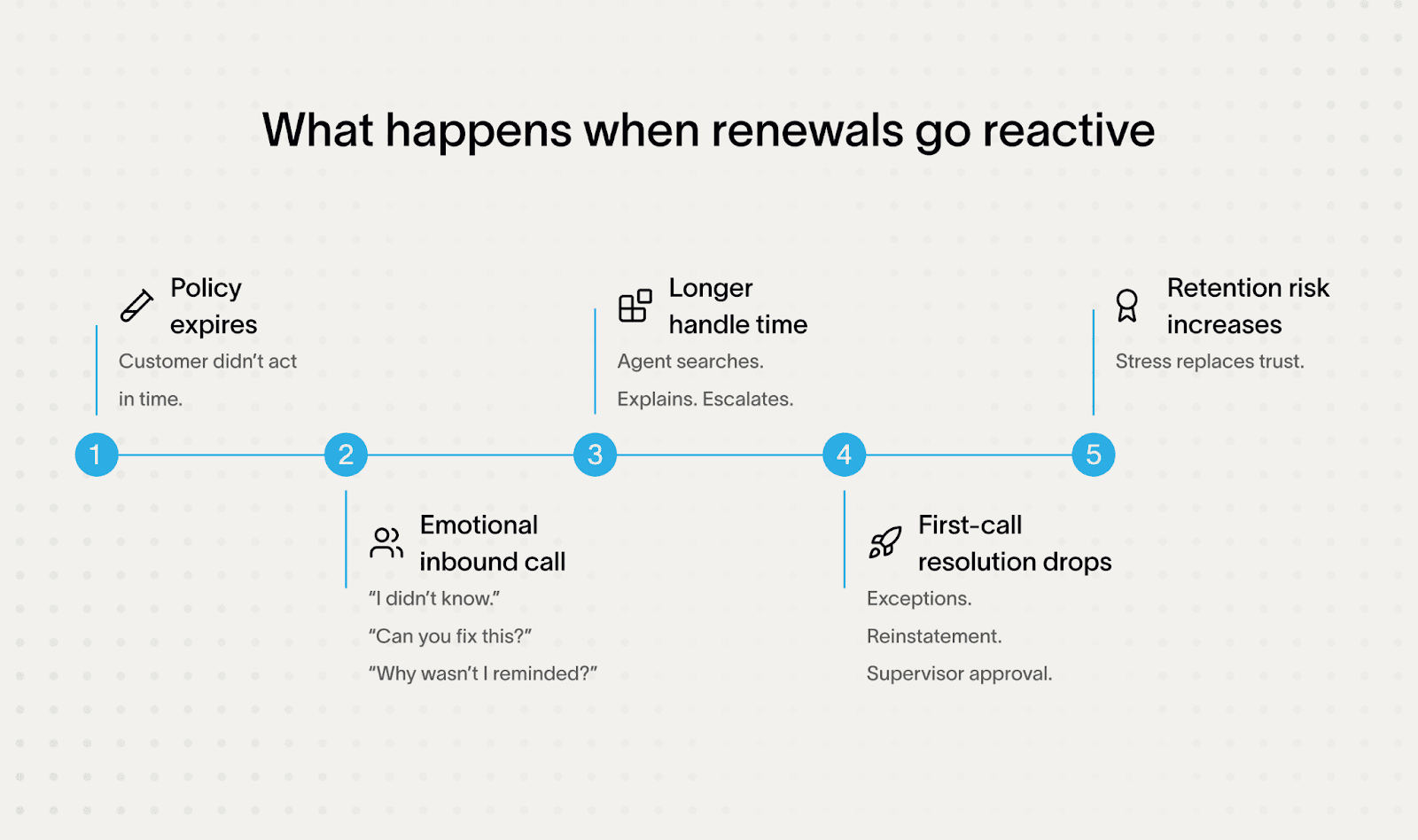
what happens when renewals go reactive by using insurance reminder software

Strada converts reactive renewal conversations into proactive engagement through insurance renewal reminder software powered by Voice AI. Instead of waiting for customers to call after expiration, Strada places structured outbound calls and coordinated insurance renewal reminder SMS outreach before the deadline.

The impact is operational:

  • Fewer last-minute renewal calls in core queues

  • Reduced handle time for complex policy discussions

  • Improved first-call resolution for inbound service calls

  • Higher on-time renewal rates, protecting retention

For CX leaders, this translates into measurable improvement across renewal reminders and contact center KPIs.

Retention protection through automatic renewal reminders

Retention in insurance is rarely lost in one dramatic moment. It erodes through silence. When policyholders miss renewal notices or feel unsure about next steps, friction compounds.

Strada’s automatic renewal reminders combine voice calls with follow-up digital confirmation. The Voice AI agent can:

  • Confirm renewal intent

  • Address common P&C terminology questions

  • Route complex policy questions to licensed agents

  • Trigger insurance top-up reminders when coverage changes are detected

Because the outreach is conversational rather than transactional, customers are more likely to confirm renewal during the initial interaction. That reduces the probability of churn before renewal even reaches an agent’s queue.

The table below illustrates the business lens through which CX leaders evaluate renewal automation:

CX metric

Manual renewal outreach

Strada Voice AI renewal outreach

CSAT

Reactive, frustration-driven

Proactive, structured experience

Handle time

Longer due to confusion

Shorter, pre-qualified calls

First-call resolution

Lower for late renewals

Higher with early confirmation

Retention

Exposure to lapse risk

Protected through early engagement

Renewals are not just billing events. They are structured opportunities to reinforce trust.

Insurance reminder software at enterprise scale

Strada’s insurance reminder software is built for carrier-scale operations, not small agency workflows. When renewal volumes reach tens or hundreds of thousands per cycle, operational variability becomes a risk factor.

FNOL routing and renewal segmentation

Enterprise carriers already optimize FNOL routing carefully. The same logic should apply to renewal outreach. Strada segments renewal reminders based on policy type, risk class, and prior engagement history.

For example:

  • Auto and homeowners P&C policies receive structured pre-renewal voice outreach

  • Life policies trigger compliance-reviewed scripts

  • Health policies follow regulated communication pathways

  • At-risk policies receive escalated routing to licensed agents

This segmentation protects DOI compliance while maintaining a consistent CX tone.

By automating first-touch renewal reminders, Strada preserves agent capacity for high-value conversations such as coverage adjustments, underwriting clarifications, and claims escalations. That has a direct handle time impact across the broader contact center.

Claims status follow-up and renewal interlock

One of the most overlooked drivers of renewal churn is unresolved claims friction. A policyholder waiting on claims status follow-up is unlikely to renew smoothly.

Strada connects renewal outreach with claims status awareness. If a policyholder references an open claim during a renewal reminder call, the Voice AI can:

  • Provide structured claims status follow-up

  • Log sentiment indicators

  • Route to appropriate claims teams

  • Document the interaction for compliance

This interlock reduces repeat calls and improves first-call resolution across both claims and renewal conversations.

Instead of treating renewal reminders and claims interactions as separate operational silos, Strada integrates them into a unified CX layer.

Insurance reminder software and compliance confidence

For enterprise carriers, outreach is governed by DOI compliance, consent tracking, and documentation requirements. Generic AI platforms rarely address insurance-specific compliance nuance.

Strada’s insurance reminder software is built around regulatory guardrails from the outset.

DOI compliance and audit-ready documentation

Renewal outreach must be documented, consistent, and compliant with state-level DOI expectations. Strada logs:

  • Call transcripts

  • Consent capture

  • Opt-out handling

  • Escalation pathways

  • Timing of automatic renewal reminders

Because every interaction is structured and stored, compliance teams gain visibility without additional manual reporting. This reduces audit risk and administrative overhead.

Voice AI scripts are configurable to reflect state-level language requirements, especially relevant in P&C and health insurance contexts. The result is not just automated renewal reminders, but compliant renewal reminders.

Structured scripts reduce CX variability

In large contact centers, script variability can erode CSAT. Different agents may frame renewal conversations differently, leading to inconsistent experiences.

Strada standardizes first-touch renewal reminders while allowing agent intervention for complexity. That balance produces:

  • More predictable CSAT scores

  • Reduced training burden

  • Lower compliance drift

  • Fewer escalations due to misinformation

By anchoring insurance renewal reminder software in insurance-specific language models, Strada avoids the risks associated with generic conversational AI.

Strada’s differentiation becomes clear when positioned against categories rather than vendor lists.

Legacy IVR: Structured but friction-heavy

Traditional IVR systems can deliver renewal reminders, but they are static and menu-driven. Customers must navigate options before reaching resolution.

Operational impact of legacy IVR:

  • Increased abandonment rates

  • Higher repeat call volume

  • Lower CSAT due to friction

  • Limited personalization

Strada replaces menu trees with conversational Voice AI. Instead of pressing options, customers respond naturally. That conversational layer reduces friction and shortens average handle time when escalations occur.

Generic AI platforms: Flexible but insurance-agnostic

Generic AI vendors offer conversational capabilities, but they lack deep familiarity with P&C terminology, underwriting nuance, and DOI compliance structures.

This creates risk in renewal contexts:

  • Misinterpretation of coverage language

  • Inconsistent compliance phrasing

  • Inaccurate routing for regulated conversations

Strada’s models are trained on insurance-specific use cases including renewal reminders, insurance top-up reminders, and claims-related language. That domain specificity improves accuracy and reduces compliance exposure.

BPO models: Scalable but cost-heavy

Business process outsourcing can scale renewal outreach, but it introduces cost and variability.

Challenges include:

  • Ongoing staffing expense

  • Quality drift across agents

  • Extended training cycles

  • Limited integration with internal CRM systems

Strada scales without proportional headcount growth. Automatic renewal reminders operate continuously, preserving human agents for complex interactions.

The comparison below captures strategic differences:

Category

Cost structure

Consistency

Insurance depth

CX impact

Legacy IVR

Low fixed, high friction cost

High

Low

Frustration risk

Generic AI

Variable

Moderate

Moderate

Inconsistent

BPO

High ongoing labor

Variable

Moderate

Dependent on staffing

Strada

Scalable AI

High

High

Proactive, structured

For CX executives, the question is not which tool can make calls. It is which model protects CSAT and retention while reducing handle time.

Strada’s insurance reminder software extends beyond renewal reminders into adjacent high-volume interactions that affect CX metrics.

Insurance renewal reminder SMS and multichannel reinforcement

Voice outreach is reinforced by insurance renewal reminder SMS confirmations. Customers receive a concise summary and next steps after the call.

This multichannel structure increases:

  • Confirmation rates

  • On-time renewals

  • Reduced repeat inquiries

Insurance renewal reminder software becomes part of a coordinated engagement strategy rather than a single notification.

Insurance top-up reminders and coverage adjustments

Mid-term coverage adjustments and insurance top-up reminders are another retention-sensitive moment. When coverage changes are not clearly communicated, dissatisfaction can surface at renewal.

Strada proactively engages policyholders about:

  • Coverage gaps

  • Optional endorsements

  • Policy updates before renewal cycles

Because these conversations are structured, they reduce surprise at renewal and protect retention.

Renewal outreach is not administrative overhead. It is a structural driver of retention, CSAT, and contact center efficiency. When renewal reminders are inconsistent or reactive, they inflate handle time and expose carriers to churn and compliance risk.

Strada’s insurance reminder software reframes renewal reminders, insurance renewal reminder SMS outreach, and insurance top-up reminders as strategic CX levers. By integrating automatic renewal reminders with claims status follow-up, FNOL-aware routing, and DOI compliance guardrails, Strada enables enterprise carriers to scale renewal engagement without scaling cost or variability.

If renewal performance is affecting your handle time, CSAT, or retention targets, evaluate how Strada can restructure your renewal strategy at enterprise scale.

Frequently Asked Questions

How would proactive voice AI renewal outreach reduce handle time pressure in my core queues?

Reactive renewal calls often arrive after expiration, making them longer and more emotionally charged. By placing structured outbound calls before deadlines, voice AI shifts conversations earlier in the lifecycle, reducing last-minute spikes and pre-qualifying policyholders. This decreases unnecessary complexity in inbound queues and shortens handle time for higher-value service calls.

Why should I treat renewal leakage as a CX issue instead of a marketing or billing problem?

Framer is a design tool that allows you to design websites on a freeform canvas, and then publish them as websites with a single click.

How does conversational Voice AI improve first-call resolution compared to manual reminder outreach?

Framer is a design tool that allows you to design websites on a freeform canvas, and then publish them as websites with a single click.

What should I expect in terms of FNOL routing alignment and renewal segmentation at enterprise scale?

Framer is a design tool that allows you to design websites on a freeform canvas, and then publish them as websites with a single click.

How does integrating claims status awareness into renewal reminders reduce churn risk?

Framer is a design tool that allows you to design websites on a freeform canvas, and then publish them as websites with a single click.

Start scaling with voice AI agents today

Join innovative carriers and MGAs transforming their calls with Strada.

Blog

/

AI & Automation

How Insurance Reminder Software Protects Retention | 2026

Amir Prodensky

CEO

Feb 9, 2026

7 min read

Transform insurance renewals with AI-driven reminder workflows

Key takeaways:

  • Lower handle time and improve first-call resolution by shifting renewal outreach from reactive inbound spikes to proactive Voice AI engagement before policy expiration 

  • Protect retention and stabilize CSAT by converting renewal reminders into structured, conversational confirmations that reduce lapse risk before agents become involved 

  • Preserve agent capacity for high-value interactions by automating first-touch renewal segmentation and routing across policy types at enterprise scale 

  • Reduce compliance risk and administrative overhead through audit-ready documentation, consent capture, and DOI-aligned scripting embedded directly into renewal outreach workflows 

  • Decrease repeat calls and renewal friction by integrating claims status awareness into renewal conversations, improving resolution across both claims and policy servicing queues


Enterprise insurance carriers do not struggle with renewals because they lack reminders. They struggle because renewal outreach is operationally expensive, inconsistent, and disconnected from CX metrics. When FNOL queues are full and agents are measured on handle time and first-call resolution, chasing renewal reminders becomes a structural drag on performance.

Strada reframes insurance reminder software as a CX and retention lever, not a notification tool. Voice AI–driven renewal reminders, claims follow-ups, and compliance-safe outreach reduce handle time, protect retention, and improve CSAT at enterprise scale.

Insurance reminder software as a retention and CSAT strategy

Strada’s insurance reminder software is designed for carriers managing 50 to 500+ agents who are accountable for CSAT, first-call resolution, and retention. Renewal reminders are not administrative tasks. They are moments that either protect premium or create friction.

Renewal leakage is a CX problem, not a marketing problem

In P&C, life, and health insurance, policy expiration often triggers inbound spikes. Customers call for clarification, late payment exceptions, or reinstatement. Those calls lengthen handle time and reduce FCR because they are reactive and emotionally charged.

Let’s look at what really happens when renewal reminders fail. It’s not just a missed payment. It’s a chain reaction inside your contact center.

what happens when renewals go reactive by using insurance reminder software

Strada converts reactive renewal conversations into proactive engagement through insurance renewal reminder software powered by Voice AI. Instead of waiting for customers to call after expiration, Strada places structured outbound calls and coordinated insurance renewal reminder SMS outreach before the deadline.

The impact is operational:

  • Fewer last-minute renewal calls in core queues

  • Reduced handle time for complex policy discussions

  • Improved first-call resolution for inbound service calls

  • Higher on-time renewal rates, protecting retention

For CX leaders, this translates into measurable improvement across renewal reminders and contact center KPIs.

Retention protection through automatic renewal reminders

Retention in insurance is rarely lost in one dramatic moment. It erodes through silence. When policyholders miss renewal notices or feel unsure about next steps, friction compounds.

Strada’s automatic renewal reminders combine voice calls with follow-up digital confirmation. The Voice AI agent can:

  • Confirm renewal intent

  • Address common P&C terminology questions

  • Route complex policy questions to licensed agents

  • Trigger insurance top-up reminders when coverage changes are detected

Because the outreach is conversational rather than transactional, customers are more likely to confirm renewal during the initial interaction. That reduces the probability of churn before renewal even reaches an agent’s queue.

The table below illustrates the business lens through which CX leaders evaluate renewal automation:

CX metric

Manual renewal outreach

Strada Voice AI renewal outreach

CSAT

Reactive, frustration-driven

Proactive, structured experience

Handle time

Longer due to confusion

Shorter, pre-qualified calls

First-call resolution

Lower for late renewals

Higher with early confirmation

Retention

Exposure to lapse risk

Protected through early engagement

Renewals are not just billing events. They are structured opportunities to reinforce trust.

Insurance reminder software at enterprise scale

Strada’s insurance reminder software is built for carrier-scale operations, not small agency workflows. When renewal volumes reach tens or hundreds of thousands per cycle, operational variability becomes a risk factor.

FNOL routing and renewal segmentation

Enterprise carriers already optimize FNOL routing carefully. The same logic should apply to renewal outreach. Strada segments renewal reminders based on policy type, risk class, and prior engagement history.

For example:

  • Auto and homeowners P&C policies receive structured pre-renewal voice outreach

  • Life policies trigger compliance-reviewed scripts

  • Health policies follow regulated communication pathways

  • At-risk policies receive escalated routing to licensed agents

This segmentation protects DOI compliance while maintaining a consistent CX tone.

By automating first-touch renewal reminders, Strada preserves agent capacity for high-value conversations such as coverage adjustments, underwriting clarifications, and claims escalations. That has a direct handle time impact across the broader contact center.

Claims status follow-up and renewal interlock

One of the most overlooked drivers of renewal churn is unresolved claims friction. A policyholder waiting on claims status follow-up is unlikely to renew smoothly.

Strada connects renewal outreach with claims status awareness. If a policyholder references an open claim during a renewal reminder call, the Voice AI can:

  • Provide structured claims status follow-up

  • Log sentiment indicators

  • Route to appropriate claims teams

  • Document the interaction for compliance

This interlock reduces repeat calls and improves first-call resolution across both claims and renewal conversations.

Instead of treating renewal reminders and claims interactions as separate operational silos, Strada integrates them into a unified CX layer.

Insurance reminder software and compliance confidence

For enterprise carriers, outreach is governed by DOI compliance, consent tracking, and documentation requirements. Generic AI platforms rarely address insurance-specific compliance nuance.

Strada’s insurance reminder software is built around regulatory guardrails from the outset.

DOI compliance and audit-ready documentation

Renewal outreach must be documented, consistent, and compliant with state-level DOI expectations. Strada logs:

  • Call transcripts

  • Consent capture

  • Opt-out handling

  • Escalation pathways

  • Timing of automatic renewal reminders

Because every interaction is structured and stored, compliance teams gain visibility without additional manual reporting. This reduces audit risk and administrative overhead.

Voice AI scripts are configurable to reflect state-level language requirements, especially relevant in P&C and health insurance contexts. The result is not just automated renewal reminders, but compliant renewal reminders.

Structured scripts reduce CX variability

In large contact centers, script variability can erode CSAT. Different agents may frame renewal conversations differently, leading to inconsistent experiences.

Strada standardizes first-touch renewal reminders while allowing agent intervention for complexity. That balance produces:

  • More predictable CSAT scores

  • Reduced training burden

  • Lower compliance drift

  • Fewer escalations due to misinformation

By anchoring insurance renewal reminder software in insurance-specific language models, Strada avoids the risks associated with generic conversational AI.

Strada’s differentiation becomes clear when positioned against categories rather than vendor lists.

Legacy IVR: Structured but friction-heavy

Traditional IVR systems can deliver renewal reminders, but they are static and menu-driven. Customers must navigate options before reaching resolution.

Operational impact of legacy IVR:

  • Increased abandonment rates

  • Higher repeat call volume

  • Lower CSAT due to friction

  • Limited personalization

Strada replaces menu trees with conversational Voice AI. Instead of pressing options, customers respond naturally. That conversational layer reduces friction and shortens average handle time when escalations occur.

Generic AI platforms: Flexible but insurance-agnostic

Generic AI vendors offer conversational capabilities, but they lack deep familiarity with P&C terminology, underwriting nuance, and DOI compliance structures.

This creates risk in renewal contexts:

  • Misinterpretation of coverage language

  • Inconsistent compliance phrasing

  • Inaccurate routing for regulated conversations

Strada’s models are trained on insurance-specific use cases including renewal reminders, insurance top-up reminders, and claims-related language. That domain specificity improves accuracy and reduces compliance exposure.

BPO models: Scalable but cost-heavy

Business process outsourcing can scale renewal outreach, but it introduces cost and variability.

Challenges include:

  • Ongoing staffing expense

  • Quality drift across agents

  • Extended training cycles

  • Limited integration with internal CRM systems

Strada scales without proportional headcount growth. Automatic renewal reminders operate continuously, preserving human agents for complex interactions.

The comparison below captures strategic differences:

Category

Cost structure

Consistency

Insurance depth

CX impact

Legacy IVR

Low fixed, high friction cost

High

Low

Frustration risk

Generic AI

Variable

Moderate

Moderate

Inconsistent

BPO

High ongoing labor

Variable

Moderate

Dependent on staffing

Strada

Scalable AI

High

High

Proactive, structured

For CX executives, the question is not which tool can make calls. It is which model protects CSAT and retention while reducing handle time.

Strada’s insurance reminder software extends beyond renewal reminders into adjacent high-volume interactions that affect CX metrics.

Insurance renewal reminder SMS and multichannel reinforcement

Voice outreach is reinforced by insurance renewal reminder SMS confirmations. Customers receive a concise summary and next steps after the call.

This multichannel structure increases:

  • Confirmation rates

  • On-time renewals

  • Reduced repeat inquiries

Insurance renewal reminder software becomes part of a coordinated engagement strategy rather than a single notification.

Insurance top-up reminders and coverage adjustments

Mid-term coverage adjustments and insurance top-up reminders are another retention-sensitive moment. When coverage changes are not clearly communicated, dissatisfaction can surface at renewal.

Strada proactively engages policyholders about:

  • Coverage gaps

  • Optional endorsements

  • Policy updates before renewal cycles

Because these conversations are structured, they reduce surprise at renewal and protect retention.

Renewal outreach is not administrative overhead. It is a structural driver of retention, CSAT, and contact center efficiency. When renewal reminders are inconsistent or reactive, they inflate handle time and expose carriers to churn and compliance risk.

Strada’s insurance reminder software reframes renewal reminders, insurance renewal reminder SMS outreach, and insurance top-up reminders as strategic CX levers. By integrating automatic renewal reminders with claims status follow-up, FNOL-aware routing, and DOI compliance guardrails, Strada enables enterprise carriers to scale renewal engagement without scaling cost or variability.

If renewal performance is affecting your handle time, CSAT, or retention targets, evaluate how Strada can restructure your renewal strategy at enterprise scale.

Frequently Asked Questions

How would proactive voice AI renewal outreach reduce handle time pressure in my core queues?

Reactive renewal calls often arrive after expiration, making them longer and more emotionally charged. By placing structured outbound calls before deadlines, voice AI shifts conversations earlier in the lifecycle, reducing last-minute spikes and pre-qualifying policyholders. This decreases unnecessary complexity in inbound queues and shortens handle time for higher-value service calls.

Why should I treat renewal leakage as a CX issue instead of a marketing or billing problem?

Framer is a design tool that allows you to design websites on a freeform canvas, and then publish them as websites with a single click.

How does conversational Voice AI improve first-call resolution compared to manual reminder outreach?

Framer is a design tool that allows you to design websites on a freeform canvas, and then publish them as websites with a single click.

What should I expect in terms of FNOL routing alignment and renewal segmentation at enterprise scale?

Framer is a design tool that allows you to design websites on a freeform canvas, and then publish them as websites with a single click.

How does integrating claims status awareness into renewal reminders reduce churn risk?

Framer is a design tool that allows you to design websites on a freeform canvas, and then publish them as websites with a single click.

Start scaling with voice AI agents today

Join innovative carriers and MGAs transforming their calls with Strada.

Blog

/

AI & Automation

How Insurance Reminder Software Protects Retention | 2026

Amir Prodensky

CEO

Feb 9, 2026

7 min read

Transform insurance renewals with AI-driven reminder workflows

Key takeaways:

  • Lower handle time and improve first-call resolution by shifting renewal outreach from reactive inbound spikes to proactive Voice AI engagement before policy expiration 

  • Protect retention and stabilize CSAT by converting renewal reminders into structured, conversational confirmations that reduce lapse risk before agents become involved 

  • Preserve agent capacity for high-value interactions by automating first-touch renewal segmentation and routing across policy types at enterprise scale 

  • Reduce compliance risk and administrative overhead through audit-ready documentation, consent capture, and DOI-aligned scripting embedded directly into renewal outreach workflows 

  • Decrease repeat calls and renewal friction by integrating claims status awareness into renewal conversations, improving resolution across both claims and policy servicing queues


Enterprise insurance carriers do not struggle with renewals because they lack reminders. They struggle because renewal outreach is operationally expensive, inconsistent, and disconnected from CX metrics. When FNOL queues are full and agents are measured on handle time and first-call resolution, chasing renewal reminders becomes a structural drag on performance.

Strada reframes insurance reminder software as a CX and retention lever, not a notification tool. Voice AI–driven renewal reminders, claims follow-ups, and compliance-safe outreach reduce handle time, protect retention, and improve CSAT at enterprise scale.

Insurance reminder software as a retention and CSAT strategy

Strada’s insurance reminder software is designed for carriers managing 50 to 500+ agents who are accountable for CSAT, first-call resolution, and retention. Renewal reminders are not administrative tasks. They are moments that either protect premium or create friction.

Renewal leakage is a CX problem, not a marketing problem

In P&C, life, and health insurance, policy expiration often triggers inbound spikes. Customers call for clarification, late payment exceptions, or reinstatement. Those calls lengthen handle time and reduce FCR because they are reactive and emotionally charged.

Let’s look at what really happens when renewal reminders fail. It’s not just a missed payment. It’s a chain reaction inside your contact center.

what happens when renewals go reactive by using insurance reminder software

Strada converts reactive renewal conversations into proactive engagement through insurance renewal reminder software powered by Voice AI. Instead of waiting for customers to call after expiration, Strada places structured outbound calls and coordinated insurance renewal reminder SMS outreach before the deadline.

The impact is operational:

  • Fewer last-minute renewal calls in core queues

  • Reduced handle time for complex policy discussions

  • Improved first-call resolution for inbound service calls

  • Higher on-time renewal rates, protecting retention

For CX leaders, this translates into measurable improvement across renewal reminders and contact center KPIs.

Retention protection through automatic renewal reminders

Retention in insurance is rarely lost in one dramatic moment. It erodes through silence. When policyholders miss renewal notices or feel unsure about next steps, friction compounds.

Strada’s automatic renewal reminders combine voice calls with follow-up digital confirmation. The Voice AI agent can:

  • Confirm renewal intent

  • Address common P&C terminology questions

  • Route complex policy questions to licensed agents

  • Trigger insurance top-up reminders when coverage changes are detected

Because the outreach is conversational rather than transactional, customers are more likely to confirm renewal during the initial interaction. That reduces the probability of churn before renewal even reaches an agent’s queue.

The table below illustrates the business lens through which CX leaders evaluate renewal automation:

CX metric

Manual renewal outreach

Strada Voice AI renewal outreach

CSAT

Reactive, frustration-driven

Proactive, structured experience

Handle time

Longer due to confusion

Shorter, pre-qualified calls

First-call resolution

Lower for late renewals

Higher with early confirmation

Retention

Exposure to lapse risk

Protected through early engagement

Renewals are not just billing events. They are structured opportunities to reinforce trust.

Insurance reminder software at enterprise scale

Strada’s insurance reminder software is built for carrier-scale operations, not small agency workflows. When renewal volumes reach tens or hundreds of thousands per cycle, operational variability becomes a risk factor.

FNOL routing and renewal segmentation

Enterprise carriers already optimize FNOL routing carefully. The same logic should apply to renewal outreach. Strada segments renewal reminders based on policy type, risk class, and prior engagement history.

For example:

  • Auto and homeowners P&C policies receive structured pre-renewal voice outreach

  • Life policies trigger compliance-reviewed scripts

  • Health policies follow regulated communication pathways

  • At-risk policies receive escalated routing to licensed agents

This segmentation protects DOI compliance while maintaining a consistent CX tone.

By automating first-touch renewal reminders, Strada preserves agent capacity for high-value conversations such as coverage adjustments, underwriting clarifications, and claims escalations. That has a direct handle time impact across the broader contact center.

Claims status follow-up and renewal interlock

One of the most overlooked drivers of renewal churn is unresolved claims friction. A policyholder waiting on claims status follow-up is unlikely to renew smoothly.

Strada connects renewal outreach with claims status awareness. If a policyholder references an open claim during a renewal reminder call, the Voice AI can:

  • Provide structured claims status follow-up

  • Log sentiment indicators

  • Route to appropriate claims teams

  • Document the interaction for compliance

This interlock reduces repeat calls and improves first-call resolution across both claims and renewal conversations.

Instead of treating renewal reminders and claims interactions as separate operational silos, Strada integrates them into a unified CX layer.

Insurance reminder software and compliance confidence

For enterprise carriers, outreach is governed by DOI compliance, consent tracking, and documentation requirements. Generic AI platforms rarely address insurance-specific compliance nuance.

Strada’s insurance reminder software is built around regulatory guardrails from the outset.

DOI compliance and audit-ready documentation

Renewal outreach must be documented, consistent, and compliant with state-level DOI expectations. Strada logs:

  • Call transcripts

  • Consent capture

  • Opt-out handling

  • Escalation pathways

  • Timing of automatic renewal reminders

Because every interaction is structured and stored, compliance teams gain visibility without additional manual reporting. This reduces audit risk and administrative overhead.

Voice AI scripts are configurable to reflect state-level language requirements, especially relevant in P&C and health insurance contexts. The result is not just automated renewal reminders, but compliant renewal reminders.

Structured scripts reduce CX variability

In large contact centers, script variability can erode CSAT. Different agents may frame renewal conversations differently, leading to inconsistent experiences.

Strada standardizes first-touch renewal reminders while allowing agent intervention for complexity. That balance produces:

  • More predictable CSAT scores

  • Reduced training burden

  • Lower compliance drift

  • Fewer escalations due to misinformation

By anchoring insurance renewal reminder software in insurance-specific language models, Strada avoids the risks associated with generic conversational AI.

Strada’s differentiation becomes clear when positioned against categories rather than vendor lists.

Legacy IVR: Structured but friction-heavy

Traditional IVR systems can deliver renewal reminders, but they are static and menu-driven. Customers must navigate options before reaching resolution.

Operational impact of legacy IVR:

  • Increased abandonment rates

  • Higher repeat call volume

  • Lower CSAT due to friction

  • Limited personalization

Strada replaces menu trees with conversational Voice AI. Instead of pressing options, customers respond naturally. That conversational layer reduces friction and shortens average handle time when escalations occur.

Generic AI platforms: Flexible but insurance-agnostic

Generic AI vendors offer conversational capabilities, but they lack deep familiarity with P&C terminology, underwriting nuance, and DOI compliance structures.

This creates risk in renewal contexts:

  • Misinterpretation of coverage language

  • Inconsistent compliance phrasing

  • Inaccurate routing for regulated conversations

Strada’s models are trained on insurance-specific use cases including renewal reminders, insurance top-up reminders, and claims-related language. That domain specificity improves accuracy and reduces compliance exposure.

BPO models: Scalable but cost-heavy

Business process outsourcing can scale renewal outreach, but it introduces cost and variability.

Challenges include:

  • Ongoing staffing expense

  • Quality drift across agents

  • Extended training cycles

  • Limited integration with internal CRM systems

Strada scales without proportional headcount growth. Automatic renewal reminders operate continuously, preserving human agents for complex interactions.

The comparison below captures strategic differences:

Category

Cost structure

Consistency

Insurance depth

CX impact

Legacy IVR

Low fixed, high friction cost

High

Low

Frustration risk

Generic AI

Variable

Moderate

Moderate

Inconsistent

BPO

High ongoing labor

Variable

Moderate

Dependent on staffing

Strada

Scalable AI

High

High

Proactive, structured

For CX executives, the question is not which tool can make calls. It is which model protects CSAT and retention while reducing handle time.

Strada’s insurance reminder software extends beyond renewal reminders into adjacent high-volume interactions that affect CX metrics.

Insurance renewal reminder SMS and multichannel reinforcement

Voice outreach is reinforced by insurance renewal reminder SMS confirmations. Customers receive a concise summary and next steps after the call.

This multichannel structure increases:

  • Confirmation rates

  • On-time renewals

  • Reduced repeat inquiries

Insurance renewal reminder software becomes part of a coordinated engagement strategy rather than a single notification.

Insurance top-up reminders and coverage adjustments

Mid-term coverage adjustments and insurance top-up reminders are another retention-sensitive moment. When coverage changes are not clearly communicated, dissatisfaction can surface at renewal.

Strada proactively engages policyholders about:

  • Coverage gaps

  • Optional endorsements

  • Policy updates before renewal cycles

Because these conversations are structured, they reduce surprise at renewal and protect retention.

Renewal outreach is not administrative overhead. It is a structural driver of retention, CSAT, and contact center efficiency. When renewal reminders are inconsistent or reactive, they inflate handle time and expose carriers to churn and compliance risk.

Strada’s insurance reminder software reframes renewal reminders, insurance renewal reminder SMS outreach, and insurance top-up reminders as strategic CX levers. By integrating automatic renewal reminders with claims status follow-up, FNOL-aware routing, and DOI compliance guardrails, Strada enables enterprise carriers to scale renewal engagement without scaling cost or variability.

If renewal performance is affecting your handle time, CSAT, or retention targets, evaluate how Strada can restructure your renewal strategy at enterprise scale.

Frequently Asked Questions

How would proactive voice AI renewal outreach reduce handle time pressure in my core queues?

Reactive renewal calls often arrive after expiration, making them longer and more emotionally charged. By placing structured outbound calls before deadlines, voice AI shifts conversations earlier in the lifecycle, reducing last-minute spikes and pre-qualifying policyholders. This decreases unnecessary complexity in inbound queues and shortens handle time for higher-value service calls.

Why should I treat renewal leakage as a CX issue instead of a marketing or billing problem?

Framer is a design tool that allows you to design websites on a freeform canvas, and then publish them as websites with a single click.

How does conversational Voice AI improve first-call resolution compared to manual reminder outreach?

Framer is a design tool that allows you to design websites on a freeform canvas, and then publish them as websites with a single click.

What should I expect in terms of FNOL routing alignment and renewal segmentation at enterprise scale?

Framer is a design tool that allows you to design websites on a freeform canvas, and then publish them as websites with a single click.

How does integrating claims status awareness into renewal reminders reduce churn risk?

Framer is a design tool that allows you to design websites on a freeform canvas, and then publish them as websites with a single click.

Start scaling with voice AI agents today

Join innovative carriers and MGAs transforming their calls with Strada.