Introducing Strada Signals, our new report series on AI for insurance operations. Read our whitepaper →
Introducing Strada Signals, our new report series on AI for insurance operations.
Read our whitepaper →
Introducing Strada Signals, our new report series on AI for insurance operations. Read our whitepaper →
How to Build a Winning Insurance Digital Strategy in 2026

Amir Prodensky
CEO
12 min read
Simple steps insurers can take to upgrade workflows and customer experience in 2026.
A few years ago, I sat across from an insurance agency owner who told me, “We’ve always done it this way. Why change now?” Six months later, half his clients had switched to competitors offering faster digital service.
That moment stuck with me.
The truth is, the insurance world isn’t just changing. It’s transforming. Technology, customer expectations, and new players are rewriting the rules. AI, data analytics, cloud tools, and new regulations are all reshaping how business gets done.
Even climate and demographic shifts are adding pressure.
Without digital tools, insurers risk falling behind. Studies show companies without strong digital systems are up to 30% more likely to lose customers who prefer quick, digital-first experiences.
Since the pandemic, SaaS adoption has exploded, pushing agencies to modernize faster than ever.
That’s why a solid insurance digital strategy isn’t optional anymore. it’s survival.
In this guide, you’ll learn how to build one that’s practical, future-ready, and built for real growth. You’ll also see how Strada, an AI-driven voice platform built for insurers, MGAs, and brokers, helps teams automate service, cut call wait times, and keep customers loyal, all while boosting revenue.
Now let’s get practical. Digital transformation can feel overwhelming, so the smartest move is to start small and focused.
Where should insurers start their digital transformation?
If you’re looking to build a winning insurance digital strategy, the first step is to understand where you stand before diving into big tech changes. Rushing into new technology without a clear view of your current state can lead to costly mistakes.
Instead, start with a thorough business, technology, and data assessment.
Begin by mapping your key business processes: claims, underwriting, and customer service are great starting points. This helps you spot pain points and inefficiencies that digital tools can fix. Use practical templates like SIPOC diagrams or value stream mapping to get a clear, visual understanding of the workflows.
Here’s a simple way to approach it:
List your core processes → start with claims, underwriting, customer onboarding, renewals, and support.
Identify key steps → note who does what at each stage, from intake to resolution.
Spot bottlenecks → look for manual data entry, duplicated tasks, or long approval loops.
Map supporting tools → write down which software or spreadsheets your team uses today.
Highlight opportunities → mark areas where automation, AI, or integrations could save time or reduce errors.
This quick exercise gives you a clear view of where digital transformation can make the biggest impact right away.
Next, audit your legacy systems and data quality. This is crucial because integration issues and poor data flow often block smooth digital transformation. But beware of the “rip and replace” trap. Don’t just throw out old systems without a solid plan.
Gradual modernization that blends new tech with legacy systems usually works best.
You can also lean on some proven frameworks and tools to guide your efforts and keep everything aligned with your goals. Here’s a quick cheat sheet to help you choose the right framework:
Framework / tool | What it does | Best for | How to use it practically |
Balanced scorecard | Links digital goals to business outcomes | Aligning strategy and execution | Define KPIs under four lenses: financial, customer, process, and learning |
SWOT analysis | Identifies strengths, weaknesses, opportunities, and threats | Planning and prioritization | List key internal/external factors before launching new initiatives |
Heat map | Visually ranks areas by risk or impact | Resource allocation | Color-code processes by urgency or business value |
Deloitte Digital Maturity Model | Assesses how digitally advanced your organization is | Benchmarking progress | Score each function (strategy, tech, operations, culture) from 1–5 |
Capgemini Digital Effectiveness Index | Evaluates effectiveness of digital programs | Continuous improvement | Use results to guide investment and training priorities |
To nail your technology choices, check out resources like Gartner’s Hype Cycle and Forrester’s Wave Reports. They provide great insights into technology maturity and the risks of adoption, helping you pick practical solutions that fit your situation.
One smart entry point for your digital transformation strategy in insurance is evaluating AI conversational platforms like Strada Workflows early.
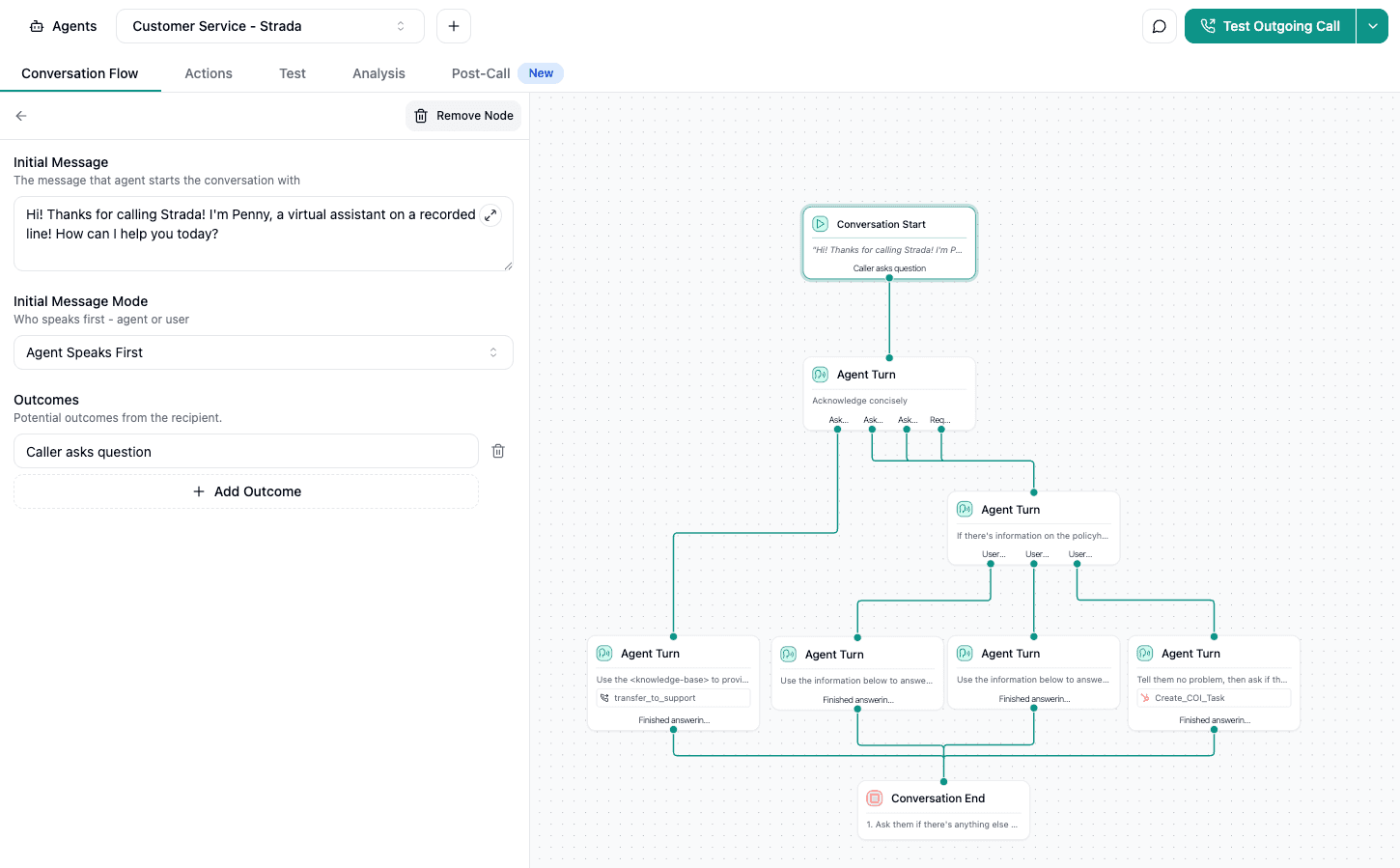
These tools automate front-office tasks with zero engineering lift. That means you can run pilots that deliver immediate ROI and build your team’s digital skills quickly.
Starting this way makes your insurance digital strategy practical, manageable, and poised for success.
Once you know where to begin, the next step is making sure your business and tech teams move in sync. Without alignment, even the best tools can’t deliver results.
How to align business and technology for success in your insurance digital strategy
In this section, you’ll learn how to bring business leaders and IT teams together to make your insurance digital strategy work smoothly. The secret is partnership. When these groups don’t collaborate, digital initiatives can stall or miss the mark.
Use this alignment framework to keep everyone moving in the same direction.
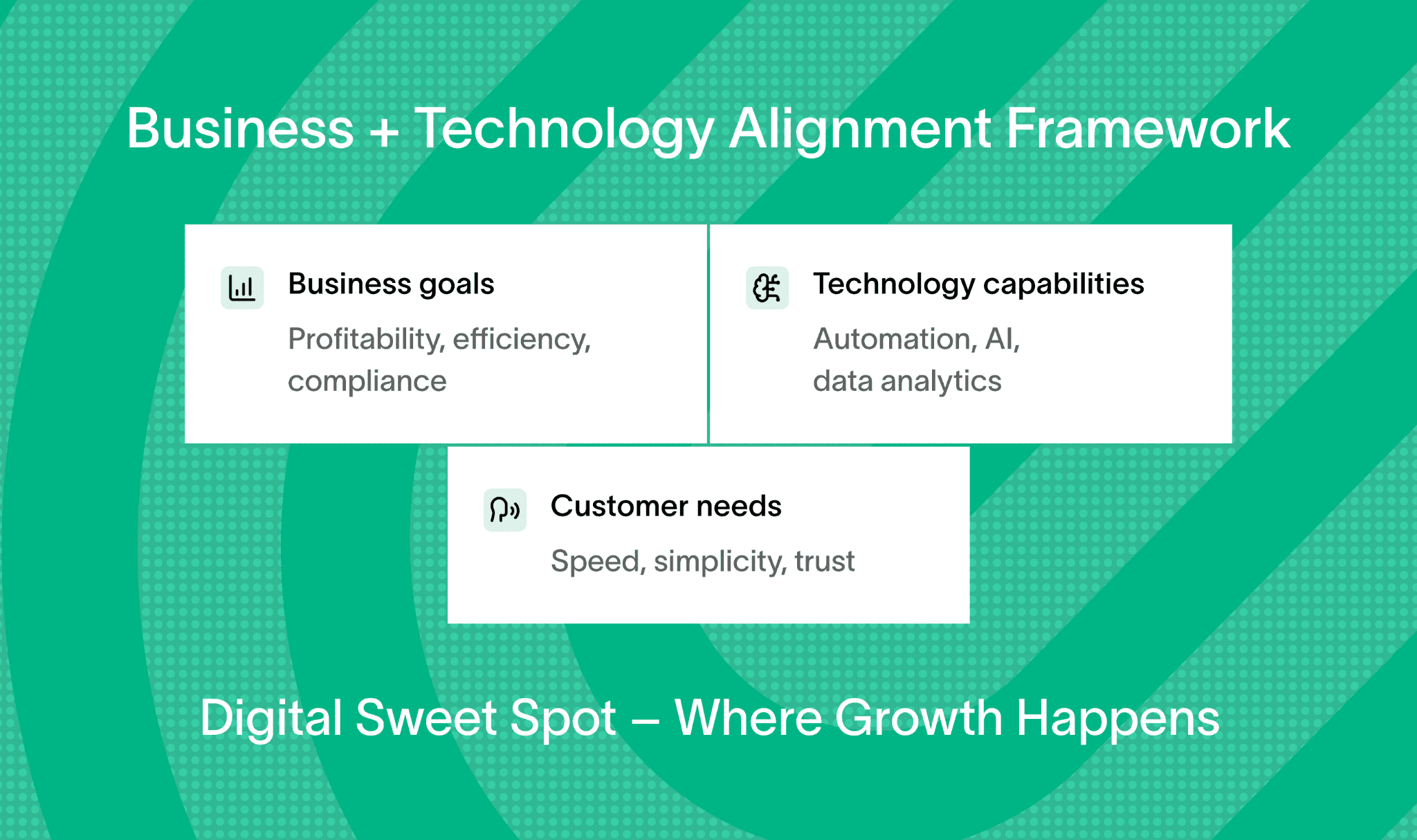
So, where to start?
First, build joint governance structures that include members from both sides. Regular progress meetings help keep everyone on the same page. Cross-functional teams, made up of diverse experts, create a shared vision and drive success.
Clear goals are your roadmap. Use frameworks like SMART goals or OKRs (Objectives and Key Results) to set targets everyone understands and can measure. Here’s an ultra-practical list of KPIs tied directly to business value you can track:
Net Promoter Score (NPS) for customer satisfaction
Straight-through processing rate to speed up workflows
Customer retention ratio showing loyalty
Claim settlement cycle time to boost efficiency
Add a RACI matrix to clarify who’s Responsible, Accountable, Consulted, and Informed for each task. This cuts confusion and speeds decision-making.
Communication is the glue that holds your teams together. Here’s how to make communication and alignment stick:
Set clear channels → define where each type of conversation happens – sales in Teams, support in Slack, documentation in Confluence.
Share updates often → keep everyone in the loop with quick weekly check-ins or async updates.
Use visuals → diagrams, workflows, and dashboards make information easier to grasp.
Run alignment sessions → use Kotter or ADKAR workshops to connect leadership goals with day-to-day actions.
Celebrate progress → recognize small wins – momentum motivates change more than memos do.
These help ensure everyone’s motivated and ready for change.
With your teams aligned, it’s time to talk tools. The right technology stack turns your strategy from theory into action.
Let’s explore the essentials you’ll need to compete and grow in 2026.
Core technologies and tools for a winning insurance digital strategy in 2026
To build a winning insurance digital strategy in 2026, you need to focus on the right technologies and tools that will future-proof your business and delight your customers. It’s about creating a flexible, resilient, and intelligent digital ecosystem strategy for insurance that helps you respond quickly to market changes and customer expectations.
Here’s what a modern insurance tech stack looks like in practice: flexible, connected, and built for growth.
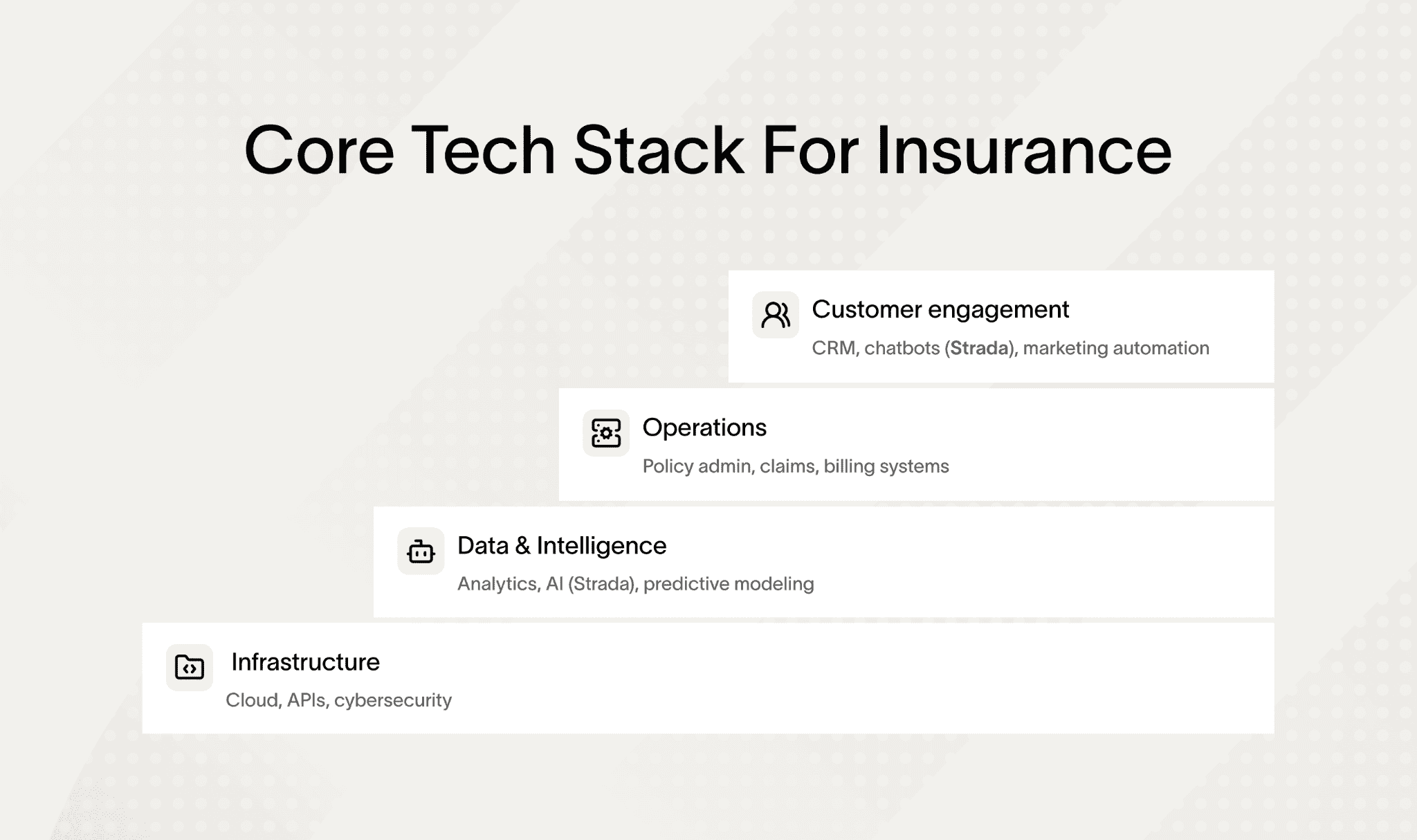
And let’s break down the must-haves for your tech stack and why each plays a crucial role.
Modernize your infrastructure with cloud
Start by modernizing your infrastructure with cloud platforms. These platforms offer the agility and scalability insurance businesses need today.
Yet, don’t just pick one.
Think about multi-cloud or hybrid cloud strategies. Multi-cloud means you avoid vendor lock-in and can optimize costs by choosing the best features from each provider. Here’s how to make the most of it:
Compare strengths → use AWS for storage, Azure for analytics, and Google Cloud for AI tools.
Distribute workloads → run different services across clouds to boost performance and reduce downtime.
Set clear integration rules → use APIs and management tools like Terraform or Kubernetes to keep systems talking smoothly.
Monitor costs in real time → track usage and pricing across platforms to avoid surprises.
Plan for failover → keep backups on a secondary cloud to stay online even if one provider goes down.
Hybrid cloud lets you balance security, compliance, and speed by combining on-premises and cloud resources. This setup gives you resilience, so your systems stay up and running no matter what.
Adopt an API-first architecture
Next, consider adopting an API-first architecture. Using tools like Apigee, Kong, or MuleSoft, you ensure your systems can talk to each other effortlessly. An API-first approach keeps your digital ecosystem strategy for insurance open and adaptable.
It makes it easier to integrate new partners, third-party services, or internal apps quickly, critical when you want to innovate without tearing everything apart.
Use AI and automation
For customer interactions, use generative AI models such as OpenAI’s ChatGPT API or Anthropic's Claude to automate responses and personalize experiences.
On the underwriting front, AI-driven platforms like Shift Technology or Lemonade’s AI tools speed up risk assessment, reducing manual errors.
And don’t forget robotic process automation (RPA) with platforms like UiPath, Blue Prism, or Automation Anywhere to automate repetitive tasks, freeing your team to focus on higher-value work.
Personalize experiences with data platforms
To serve customers better, harness Customer Data Platforms (CDPs) like Segment or Tealium, along with personalization engines such as Dynamic Yield or Adobe Target.
These tools gather and organize customer data into one place, empowering you to deliver tailored marketing messages and service experiences that feel personal and timely.
Adopt integrated insurance SaaS platforms
You’ll also want to pick integrated SaaS platforms designed for insurance operations.
Here’s a quick comparison of popular insurance SaaS platforms to help you choose the right fit:
Platform | Best for | Core features | Ideal for |
Guidewire Cloud | Enterprise scalability | Policy, claims, billing, analytics | Large insurers with complex workflows |
Duck Creek Technologies | Flexibility & modular setup | Product configuration, billing, claims | Mid-to-large carriers needing customization |
Insuresoft Diamond System | All-in-one insurance suite | Policy admin, claims, CRM, reporting | Agencies seeking simplicity and speed |
Sapiens IDIT | Global operations | Policy, claims, reinsurance, compliance | Insurers with multinational portfolios |
Majesco CloudInsurer | Speed to market | Digital policy management, billing, API integration | Growth-focused carriers and MGAs |
EIS Suite | Ecosystem integration | Core insurance, customer engagement, data insights | Carriers modernizing legacy systems |
Socotra | Modern, developer-friendly setup | Cloud-native policy core, APIs, open ecosystem | Digital-first insurers and insurtechs |
BriteCore | Cost-effective automation | Policy admin, claims, agent portal | Small to mid-size insurers and regional carriers |
Using these omni-capability platforms keeps your core business processes efficient and connected.
Drive smarter decisions with analytics
Data drives decisions, so don’t overlook analytics and visualization tools. Snowflake is excellent for cloud data warehousing, enabling you to gather massive amounts of data securely.
Tools like Tableau, Microsoft Power BI, or Acumen Analytics help your teams make sense of this data, uncover risks, and understand customer insights better.
Strengthen compliance with regtech
Compliance remains critical, so integrate regtech solutions such as OneTrust, TrustArc, or ComplyAdvantage. These tools automate consent management, privacy governance, and regulatory compliance, reducing risk and easing audit pressures.
Boost engagement with CRM and marketing tools
Customer engagement tools are another pillar. Marketing automation platforms like HubSpot, Salesforce Marketing Cloud, or Marketo make campaigns more efficient. AI chatbots powered by Strada, Drift, IBM Watson Assistant, or LivePerson deliver 24/7 support, improving response time and customer satisfaction.
CRM platforms with AI capabilities, like Salesforce or Microsoft Dynamics 365, tie it all together to give your sales and service teams a full customer view.
Protect your business with advanced cybersecurity
Cybersecurity can’t be an afterthought.
Use advanced tools like Palo Alto Networks Cortex XDR and CrowdStrike Falcon for threat detection and endpoint protection. Complement these with vulnerability scanners such as Qualys or Tenable to proactively identify and fix security gaps.
Bridge legacy and AI systems with Strada
Finally, let me introduce you to a standout technology that bridges legacy systems with AI-driven automation: Strada’s conversational AI platform.
Strada is built specifically for insurance, offering scalable inbound and outbound phone call automation, live action triggers like SMS, email, and appointment scheduling, plus seamless integrations with AMS, CRM, and policy systems.
What makes Strada unique is its AI models trained to understand insurance terminology and workflows. This means you can automate complex customer interactions while maintaining a natural, human-like experience. It acts as the perfect link between your old systems and new AI capabilities, powering seamless customer engagement and operational efficiency.
Getting started with Strada is easier than it sounds. You don’t need a huge IT team or months of setup, just a clear plan and a few smart steps:
Step 1: Define your goals
Start by identifying where you want automation to make the biggest impact.
Common starting points include quote intake, renewals, and customer service calls. Write down what success looks like – faster follow-ups, fewer missed calls, or better data capture.
Step 2: Connect your systems
Strada integrates seamlessly with CRMs like HubSpot, Salesforce, or AMS platforms such as Applied Epic and Vertafore. Use Strada’s API or prebuilt connectors to sync customer data, call outcomes, and follow-up tasks automatically.
Step 3: Design your call flows
Build your conversational scripts inside Strada’s dashboard.

These AI-driven flows capture key details like policy type, contact info, and renewal dates. You can also add live-action triggers to send texts, emails, or appointment reminders automatically.
Step 4: Test and train
Run internal tests before going live. Let your agents review call transcripts, flag unclear responses, and fine-tune the language to match your brand tone.
Step 5: Launch and monitor
Go live in phases: start with one use case, like renewals, and expand once results roll in. Track metrics such as response rates, call completion, and data accuracy.
Step 6: Optimize continuously
Strada’s analytics reveal what’s working and where to improve. Use this data to train your AI agents, refine workflows, and keep delivering a seamless customer experience.
Tech alone isn’t enough. It’s what you do with it that matters. Let’s look at how digital solutions can transform the customer journey and make every interaction feel effortless.
How to enhance the customer experience with digital
In 2026, building a winning insurance digital strategy means putting your customers front and center. You want every interaction to be smooth, helpful, and personalized, no matter if they’re browsing your website, chatting with an agent, or filing a claim.
Let’s walk through how to supercharge customer experience using digital tools and smart design.
Design around the user
First, start with user-centric design principles.
This means crafting digital experiences that feel natural and easy to use. Conduct UI/UX research by watching how real users navigate your website or app.
Here’s how to get started:
Run usability tests → ask real customers to complete simple tasks, like requesting a quote or filing a claim, and observe where they hesitate.
Use heatmaps → tools like Hotjar or Crazy Egg reveal where users click, scroll, or drop off most often.
Conduct quick interviews → talk to 5–10 users about what feels confusing or helpful. Real feedback beats assumptions.
Track user journeys → map the full path from homepage to policy purchase to spot friction points.
Iterate fast → fix one issue at a time, test again, and keep improving. Small tweaks add up to big wins.
Plus, don’t forget accessibility. Meeting WCAG 2.1 standards ensures everyone, including people with disabilities, can use your platforms without hassle. Make your design fully mobile responsive because a growing number of customers prefer managing their insurance on phones.
Tools like Figma, Adobe XD, Sketch, and Framer give you the flexibility to prototype and test responsive layouts quickly. When your design is clean, accessible, and mobile-friendly, customers stick around longer and get what they need faster.
Create seamless omnichannel experiences
Next up, enable omnichannel engagement. Your customers want to connect with you on their terms. That means blending websites, mobile apps, emails, social media, and call centers into one consistent experience.
Platforms like Strada, HubSpot, Zendesk, Oracle CX, and Adobe Experience Cloud help unify customer data across channels. With a single, real-time view of each customer, your team can offer relevant information no matter where the interaction happens.
For example, a customer might:
Start on social media → they ask a quick question about coverage or a quote.
Continue in your app chat → the conversation picks up where it left off; no need to repeat details.
Follow up with a call → your support team already has the full context and can resolve the issue fast.
These seamless handoffs across channels create a frictionless experience that builds loyalty and trust.
Personalize every interaction
Use customer segmentation techniques to understand who your customers are and what matters most to them.
Here’s a quick breakdown of common segmentation approaches you can use:
Segmentation approach | What it focuses on | How it helps in insurance | Example use case |
RFM analysis | Purchase recency, frequency, and value | Identifies your most loyal and high-value clients | Send special renewal offers to customers with high RFM scores |
Demographic segmentation | Age, gender, income, location | Targets messaging and products by group | Promote life insurance to young families or seniors differently |
Behavioral segmentation | Customer actions and engagement | Personalizes communication based on behavior | Trigger reminders when someone starts a quote but doesn’t complete it |
Psychographic profiling | Interests, values, and lifestyle | Builds emotional connections and brand loyalty | Tailor campaigns for eco-conscious or risk-averse customers |
Firmographic segmentation | Business size, industry, or revenue | Helps commercial insurance teams target better | Customize coverage options for small businesses vs. enterprises |
Automated email campaigns powered by platforms like HubSpot workflows can deliver timely, relevant messages based on customer behavior. Predictive analytics tools such as Salesforce Einstein AI go even further by anticipating what a customer might need next, whether that’s a policy renewal reminder or a claim status update.
Tailored experiences make customers feel valued and understood, increasing satisfaction and retention.
Use chatbots and AI assistants
You’ll also want to deploy chatbots and AI assistants to provide 24/7 intelligent support. These tools answer common questions instantly, freeing your human agents to focus on more complex issues.
Platforms like Strada, Google Dialogflow, and Microsoft Bot Framework build chatbots that understand natural language, making conversations feel human and helpful.
Build trust through transparency
Trust is everything in insurance, so build it by being transparent and educational. Create digital content that explains policies clearly using interactive explainer videos, FAQ chatbots, and blogs.
Use content management systems like Contentful or WordPress, paired with AI-driven content strategies, to keep this content fresh and easy to navigate. When customers feel informed, they’re more confident in your brand and less likely to shop around.
Keep optimizing what works
To keep improving, continuously optimize your conversion rates.
Tools like Google Optimize, Hotjar heatmaps, and Unbounce landing page builders help you test different web page versions through A/B and multivariate testing. Here’s how to start optimizing effectively:
Pick one goal → focus on a clear outcome, like more quote requests or faster form completions.
Start small → test one element at a time (headlines, CTAs, or form length) to isolate what works.
Use heatmaps and recordings → see where users click, scroll, or drop off to uncover friction points.
Run A/B tests → compare two versions of a page and let data (not opinions) decide the winner.
Act on insights fast → apply changes quickly and test again to keep improving results.
Document learnings → keep a simple log of what you tested, what worked, and why – it saves time later.
This way, you learn what drives actions like quote requests or policy purchases and can tweak your pages to work better over time.
Listen and learn from customers
Finally, listen to your customers directly. Gather feedback with platforms like Qualtrics, Medallia, or SurveyMonkey. Regular surveys and feedback loops let you spot pain points and make targeted improvements based on real user needs.
One standout example in this space is Strada’s AI phone agents. These agents transform traditional phone calls into seamless, zero-hold-time experiences. They handle renewals, FNOL claims, and policy servicing efficiently, boosting customer satisfaction by instantly answering questions with personalized support.
This approach removes friction from one of the most common but often frustrating insurance channels, showing how digital innovation can elevate the whole customer journey.
As you enhance customer experiences, you’ll also need to stay compliant. Let’s walk through how digital tools can help you manage regulations without slowing down innovation.
How to manage risk and compliance digitally
In your insurance digital strategy, managing risk and compliance efficiently is a must. You’ll learn practical steps to protect data, stay compliant, and respond quickly to threats.
First, focus on cybersecurity measures tailored to insurance data. Use trusted frameworks like the NIST Cybersecurity Framework, ISO 27001, and CIS Controls. These frameworks help you build a strong security foundation, covering everything from access controls to threat detection.
Next, automate compliance with regulatory technology tools.
Platforms like Compliance.ai, Ascent RegTech, and MetricStream let you monitor rules in real-time. They streamline reporting and help you keep up with regulatory changes without the headache of manual tracking. For instance, if new regulations affect your digital strategy insurance plans, these tools alert you instantly.
Data privacy is also critical.
Align your processes with GDPR, CCPA, and emerging laws. Use platforms like OneTrust, TrustArc, or BigID to manage consent, classify sensitive data, and handle breaches smoothly. These tools ensure your customers’ personal info stays safe and privacy rules are followed consistently.
Here’s a simple breakdown to keep your compliance on point:
Automate monitoring and reporting with RegTech platforms
Conduct continuous audits supported by automated tools
Run regular staff training including phishing simulations and certification tracking
Incorporate cyber risk assessment and insurance-specific risk models into governance frameworks
You should also have an incident response plan ready. Automate alerts and crisis communication using tools like PagerDuty and ServiceNow Security. This way, you’ll act fast and minimize damage if something goes wrong.
Lastly, consider partners like Strada. It offers enterprise-grade security with data isolation, no use of customer data in AI training, and regular penetration testing. Strada holds SOC 2 Type 2 certification, making it a trusted ally to securely automate sensitive insurance conversations and workflows – an ideal fit for any robust insurance digital strategy.
Now that you know the what and why, let’s dive into the how. Here’s a step-by-step plan to bring your insurance digital strategy to life – efficiently and confidently.
Practical steps to build your winning insurance digital strategy in 2026
You’re aiming to build a winning insurance digital strategy for 2026, but where do you start?
The key is breaking down the journey into clear, practical steps that guide your implementation smoothly while maximizing impact. You’ll learn exactly what to do from day one. No guesswork, just straightforward action.
Step 1: Conduct a comprehensive needs assessment
Begin by gathering input from the people who know the business best – your key stakeholders. Include teams from sales, claims, IT, customer service, and underwriting.
Don’t stop there. Get direct feedback from your customers to understand their pain points and expectations. Use detailed data analysis to identify bottlenecks, inefficiencies, and opportunities hiding in plain sight.
This step gives you a clear picture of where digital solutions can make the biggest difference. It sets a solid foundation by highlighting real problems and potential gains, so your strategy isn’t based on assumptions but on facts.
Step 2: Define clear business objectives
Once you know what needs fixing, set specific goals. Your objectives should be linked to measurable outcomes like increasing revenue, cutting costs, improving customer experience, or reducing risk.
Clear targets give you something concrete to work toward and make it easier to track progress. To help you focus, try this simple approach to your objectives:
Increase digital customer onboarding completion rate by 30% within 12 months
Reduce claims processing time by 25% to improve turnaround and satisfaction
Achieve 15% cost savings through automation and better workflow integration
Lower policy renewal risk by proactively flagging high-risk customers early
These targets will keep your digital strategy for insurance company focused and results-driven.
Step 3: Research and select the right technology solutions
Not every tech fits every insurer. You need to choose tools that match your company size, market segment, and strategic goals. Think long-term: look for scalable solutions that grow with you.
Compare SaaS products and on-premises options based on costs, flexibility, and security.
Vendor stability is also crucial. You want partners who’ll support you through thick and thin. Also, consider how different tools will fit together in your current ecosystem. Interoperability reduces headaches later. Take your time here – this decision influences your entire digital journey.
Step 4: Start small with pilot projects or phased rollouts
Implement your chosen tech through pilots or phased rollouts. Focus on high-impact processes like claims automation or customer onboarding. This approach gives you quick wins, showing tangible benefits fast.
Pilot projects help you test, learn, and adapt without risking the whole operation. Plus, early success boosts team confidence and makes it easier to get buy-in for broader changes.
One smart move is to incorporate tools like Strada Workflows early in pilots.
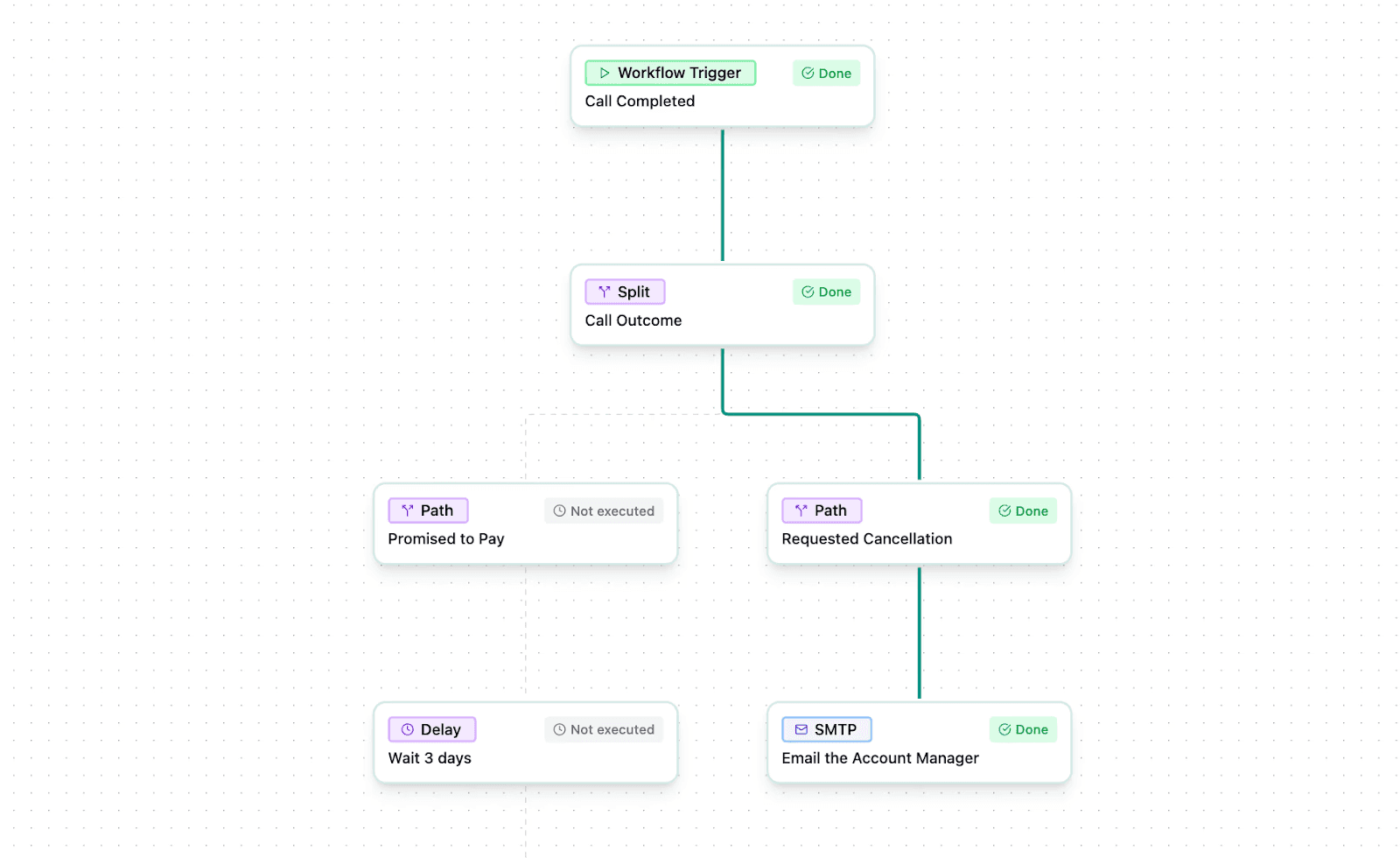
These automate post-call processes such as quote recovery, payment follow-ups, renewal risk flagging, and certificate issuance. They provide immediate benefits that build trust in AI-driven automation while smoothing out operational kinks.
Here’s how to get started effectively:
Start with one workflow → pick a high-impact use case like quote recovery or renewals to test first.
Map the process clearly → outline what should happen after each call – who’s notified, what tasks are created, and what data updates automatically.
Set automation triggers → use Strada’s smart rules to launch actions based on call outcomes or keywords (e.g., “shopping around” triggers a retention workflow).
Integrate your systems → connect Strada with your CRM or AMS so updates flow instantly without manual data entry.
Monitor and refine → track how quickly follow-ups happen and adjust your workflows to boost response time and accuracy.
Expand gradually → once your pilot runs smoothly, roll out automation to claims, payment reminders, and certificate issuance.
Starting small, learning fast, and scaling confidently helps your team trust automation and see measurable results right away.
Step 5: Implement KPI tracking with dashboards
To know if your digital strategy is working, set up clear KPIs. Measure what matters: efficiency, customer satisfaction, cost savings, and adoption rates. Dashboards built on analytics platforms such as Tableau, Power BI, or Looker make this easy.
Here’s a simple KPI list to start with:
KPI | What it measures | Why it matters | How to track it |
Average claims processing time | Time from claim submission to resolution | Reveals operational efficiency and identifies bottlenecks | Track through your claims system or CRM workflow reports |
Customer Net Promoter Score (NPS) | Customer loyalty and satisfaction | Indicates overall experience quality and retention likelihood | Gather via post-interaction or quarterly surveys |
Operational cost reduction (%) | Savings from automation and digital process improvements | Measures ROI of your digital investments | Compare pre- and post-implementation costs in finance reports |
Digital tool adoption rate | Percentage of employees actively using new platforms | Reflects engagement and readiness for digital change | Use platform analytics or employee usage dashboards |
First-contact resolution rate | Percentage of inquiries resolved on the first interaction | Improves service efficiency and customer trust | Track via call center or CRM ticket reports |
Renewal retention rate | Percentage of customers renewing policies | Measures customer satisfaction and loyalty over time | Monitor CRM or AMS renewal reports |
These provide real-time insights. When you see what succeeds or stalls, you can pivot quickly and confidently.
Step 6: Establish continuous feedback loops
Digital transformation isn’t a one-and-done project. Set up regular feedback channels with end users, partners, and your internal teams. Use surveys, focus groups, and direct conversations to gather input.
Combine these insights with your performance data. This lets you refine processes, adopt new technology advances, and stay ahead of market changes. It keeps your strategy agile, evolving with your business needs.
Don’t forget change management
Driving adoption is where many digital strategies falter. You need a solid change management plan. Models like ADKAR or Kotter’s 8-Step method provide proven roadmaps to help your teams embrace new ways of working. Here’s how you can put them into action:
Start with awareness → clearly explain why the change is happening and what’s in it for everyone.
Build desire and support → involve key influencers early to champion the change.
Provide knowledge and training → equip teams with the skills and tools they need to adapt.
Enable action → remove barriers and celebrate quick wins to keep momentum high.
Reinforce and sustain → recognize progress and bake new habits into daily workflows.
Focus on clear communication, training, and celebrating small wins. Engage leaders to champion the change so it penetrates your company culture. Change management isn’t just a side task. It’s the glue that holds your insurance digital strategy together.
Set up centers of excellence
To keep the momentum going, create Centers of Excellence (CoEs) for digital initiatives. These groups specialize in sharing best practices, standardizing processes, and spreading innovation across business units. CoEs become knowledge hubs, accelerating learning and scaling digital successes faster.
Even the best plans hit bumps along the way. Before you launch, it’s smart to anticipate common roadblocks and learn how to avoid them.
Common challenges in building a winning insurance digital strategy and how to avoid them
When crafting your insurance digital strategy, you’ll face some familiar hurdles. But knowing these challenges upfront helps you avoid the pitfalls and keeps your digital transformation strategy in insurance on track.
First, don’t let over-automation kill the human touch. While AI speeds things up, customers still want to feel understood. Balance AI tools with real people ready to step in. Set clear escalation paths so complex issues get personal attention.
This boosts trust and satisfaction.
Another common trap? Fragmented digital channels. If your messaging, branding, and customer data are scattered across different platforms, your customers get confused. Avoid this by unifying your efforts with a centralized CRM and marketing automation platform. This way, every interaction feels consistent and personalized.
For example, Strada’s built-in AI evaluation tools can support this integration and improve accuracy.
Also, never neglect regulatory compliance. Insurance is highly regulated, and missing even small rules can lead to fines and reputation damage. Stay ahead by setting up regular compliance checks, audits, and involving legal experts from the start.
Data silos are a silent growth killer too. When customer data and analytics sit in separate places, personalization suffers, and decision-making slows down. Combat this by implementing strong data governance frameworks like DAMA-DMBOK, and invest in Master Data Management (MDM) tools or data lakes to centralize your data and make it work for you.
Here’s how to start breaking down silos effectively:
Map your data sources → list every system where customer data lives: CRM, AMS, marketing tools, call logs, and spreadsheets.
Create a single source of truth → use MDM tools like Informatica or Talend to unify and clean your data.
Build a centralized data lake → store structured and unstructured data in one place for easy access and analysis.
Set clear data ownership → assign teams responsible for accuracy, updates, and compliance.
Automate syncing → use APIs or ETL pipelines to ensure data updates flow across systems in real time.
Monitor and audit regularly → review data quality dashboards monthly to catch gaps early.
When your data flows freely and consistently, your insights sharpen, personalization improves, and your entire organization moves faster.
People often resist adopting new tech, which can stall your progress. You’ll find success by communicating clearly, offering training, involving leadership to champion the change, and showing quick wins.
Lastly, watch out for vendor lock-in. Relying too much on one provider can limit your flexibility. Design your system with flexible, API-driven architecture and keep exit strategies ready, so you can switch providers without headaches.
And don’t forget about AI reliability. Mistakes from AI models can hurt your customers and raise legal risks. Using evaluation tools like those in Strada helps keep your AI accurate, lowering Errors & Omissions (E&O) risks and protecting trust.
Keep these practical steps in mind, and your road to a successful insurance digital strategy will be smoother and more rewarding.
Once your strategy is live, the work doesn’t stop. The best insurance companies treat digital transformation as a journey, not a one-time project. Let’s see how to keep learning, optimizing, and winning long-term.
How to keep improving your insurance digital strategy
You’ve built your insurance digital strategy. Now it’s time to make sure it delivers. Start by tracking a few key KPIs that tie directly to your goals, like:
Customer retention and NPS (to gauge satisfaction)
New leads and automation rates (to track growth and efficiency)
Claim settlement time and AI accuracy (to measure operational performance)
Use tools like Tableau, Power BI, or Google Analytics 4 to visualize results, and gather customer feedback through Qualtrics or Medallia to stay connected to real user experiences.
Your digital strategy should evolve constantly. This simple loop helps you stay agile and proactive.
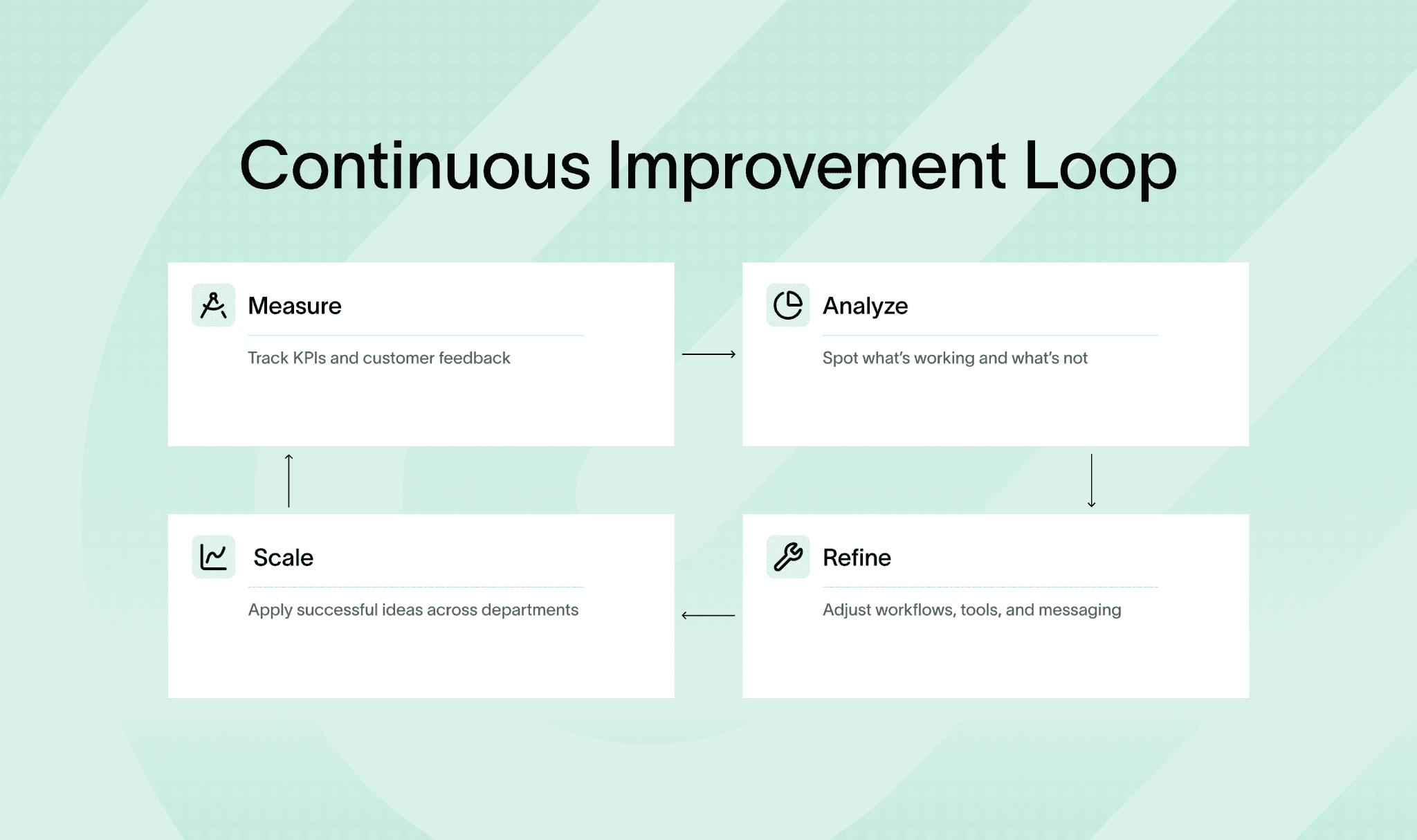
Plus, check progress monthly, refine your dashboards, and share results across teams. Keep testing new ideas (A/B tests, automation tweaks, or marketing experiments) and build a habit of small, consistent improvements.
Finally, don’t forget your call operations. Integrating Strada’s AI phone analytics and workflow automation gives you instant insight into what’s working, where delays happen, and how to reduce costs while improving customer satisfaction.
By tracking what matters, acting on insights fast, and keeping your team engaged, you’ll build a digital strategy that keeps getting smarter.
And if you are ready to see it in action, book a Strada demo and discover how AI-driven automation can help your insurance team scale smarter, serve faster, and grow confidently.
Frequently Asked Questions
What’s the first digital change an insurer should make if resources are limited?
Start with one high-friction workflow—like claims intake or renewals—and automate it. Small wins build momentum and prove ROI quickly.
How can insurers modernize without replacing all their legacy systems?
Framer is a design tool that allows you to design websites on a freeform canvas, and then publish them as websites with a single click.
How can a small agency start using AI without a technical team?
Framer is a design tool that allows you to design websites on a freeform canvas, and then publish them as websites with a single click.
What digital upgrades have the biggest impact on customer experience?
Framer is a design tool that allows you to design websites on a freeform canvas, and then publish them as websites with a single click.
What’s the best way to get internal teams to adopt new digital tools?
Framer is a design tool that allows you to design websites on a freeform canvas, and then publish them as websites with a single click.
Table of Contents
Carriers, MGAs, and brokers scale revenue-driving phone calls with Strada's conversational AI platform.
Start scaling with voice AI agents today
Join innovative carriers and MGAs transforming their calls with Strada.
How to Build a Winning Insurance Digital Strategy in 2026
Amir Prodensky
CEO
12 min read
Simple steps insurers can take to upgrade workflows and customer experience in 2026.
A few years ago, I sat across from an insurance agency owner who told me, “We’ve always done it this way. Why change now?” Six months later, half his clients had switched to competitors offering faster digital service.
That moment stuck with me.
The truth is, the insurance world isn’t just changing. It’s transforming. Technology, customer expectations, and new players are rewriting the rules. AI, data analytics, cloud tools, and new regulations are all reshaping how business gets done.
Even climate and demographic shifts are adding pressure.
Without digital tools, insurers risk falling behind. Studies show companies without strong digital systems are up to 30% more likely to lose customers who prefer quick, digital-first experiences.
Since the pandemic, SaaS adoption has exploded, pushing agencies to modernize faster than ever.
That’s why a solid insurance digital strategy isn’t optional anymore. it’s survival.
In this guide, you’ll learn how to build one that’s practical, future-ready, and built for real growth. You’ll also see how Strada, an AI-driven voice platform built for insurers, MGAs, and brokers, helps teams automate service, cut call wait times, and keep customers loyal, all while boosting revenue.
Now let’s get practical. Digital transformation can feel overwhelming, so the smartest move is to start small and focused.
Where should insurers start their digital transformation?
If you’re looking to build a winning insurance digital strategy, the first step is to understand where you stand before diving into big tech changes. Rushing into new technology without a clear view of your current state can lead to costly mistakes.
Instead, start with a thorough business, technology, and data assessment.
Begin by mapping your key business processes: claims, underwriting, and customer service are great starting points. This helps you spot pain points and inefficiencies that digital tools can fix. Use practical templates like SIPOC diagrams or value stream mapping to get a clear, visual understanding of the workflows.
Here’s a simple way to approach it:
List your core processes → start with claims, underwriting, customer onboarding, renewals, and support.
Identify key steps → note who does what at each stage, from intake to resolution.
Spot bottlenecks → look for manual data entry, duplicated tasks, or long approval loops.
Map supporting tools → write down which software or spreadsheets your team uses today.
Highlight opportunities → mark areas where automation, AI, or integrations could save time or reduce errors.
This quick exercise gives you a clear view of where digital transformation can make the biggest impact right away.
Next, audit your legacy systems and data quality. This is crucial because integration issues and poor data flow often block smooth digital transformation. But beware of the “rip and replace” trap. Don’t just throw out old systems without a solid plan.
Gradual modernization that blends new tech with legacy systems usually works best.
You can also lean on some proven frameworks and tools to guide your efforts and keep everything aligned with your goals. Here’s a quick cheat sheet to help you choose the right framework:
Framework / tool | What it does | Best for | How to use it practically |
Balanced scorecard | Links digital goals to business outcomes | Aligning strategy and execution | Define KPIs under four lenses: financial, customer, process, and learning |
SWOT analysis | Identifies strengths, weaknesses, opportunities, and threats | Planning and prioritization | List key internal/external factors before launching new initiatives |
Heat map | Visually ranks areas by risk or impact | Resource allocation | Color-code processes by urgency or business value |
Deloitte Digital Maturity Model | Assesses how digitally advanced your organization is | Benchmarking progress | Score each function (strategy, tech, operations, culture) from 1–5 |
Capgemini Digital Effectiveness Index | Evaluates effectiveness of digital programs | Continuous improvement | Use results to guide investment and training priorities |
To nail your technology choices, check out resources like Gartner’s Hype Cycle and Forrester’s Wave Reports. They provide great insights into technology maturity and the risks of adoption, helping you pick practical solutions that fit your situation.
One smart entry point for your digital transformation strategy in insurance is evaluating AI conversational platforms like Strada Workflows early.
These tools automate front-office tasks with zero engineering lift. That means you can run pilots that deliver immediate ROI and build your team’s digital skills quickly.
Starting this way makes your insurance digital strategy practical, manageable, and poised for success.
Once you know where to begin, the next step is making sure your business and tech teams move in sync. Without alignment, even the best tools can’t deliver results.
How to align business and technology for success in your insurance digital strategy
In this section, you’ll learn how to bring business leaders and IT teams together to make your insurance digital strategy work smoothly. The secret is partnership. When these groups don’t collaborate, digital initiatives can stall or miss the mark.
Use this alignment framework to keep everyone moving in the same direction.
So, where to start?
First, build joint governance structures that include members from both sides. Regular progress meetings help keep everyone on the same page. Cross-functional teams, made up of diverse experts, create a shared vision and drive success.
Clear goals are your roadmap. Use frameworks like SMART goals or OKRs (Objectives and Key Results) to set targets everyone understands and can measure. Here’s an ultra-practical list of KPIs tied directly to business value you can track:
Net Promoter Score (NPS) for customer satisfaction
Straight-through processing rate to speed up workflows
Customer retention ratio showing loyalty
Claim settlement cycle time to boost efficiency
Add a RACI matrix to clarify who’s Responsible, Accountable, Consulted, and Informed for each task. This cuts confusion and speeds decision-making.
Communication is the glue that holds your teams together. Here’s how to make communication and alignment stick:
Set clear channels → define where each type of conversation happens – sales in Teams, support in Slack, documentation in Confluence.
Share updates often → keep everyone in the loop with quick weekly check-ins or async updates.
Use visuals → diagrams, workflows, and dashboards make information easier to grasp.
Run alignment sessions → use Kotter or ADKAR workshops to connect leadership goals with day-to-day actions.
Celebrate progress → recognize small wins – momentum motivates change more than memos do.
These help ensure everyone’s motivated and ready for change.
With your teams aligned, it’s time to talk tools. The right technology stack turns your strategy from theory into action.
Let’s explore the essentials you’ll need to compete and grow in 2026.
Core technologies and tools for a winning insurance digital strategy in 2026
To build a winning insurance digital strategy in 2026, you need to focus on the right technologies and tools that will future-proof your business and delight your customers. It’s about creating a flexible, resilient, and intelligent digital ecosystem strategy for insurance that helps you respond quickly to market changes and customer expectations.
Here’s what a modern insurance tech stack looks like in practice: flexible, connected, and built for growth.
And let’s break down the must-haves for your tech stack and why each plays a crucial role.
Modernize your infrastructure with cloud
Start by modernizing your infrastructure with cloud platforms. These platforms offer the agility and scalability insurance businesses need today.
Yet, don’t just pick one.
Think about multi-cloud or hybrid cloud strategies. Multi-cloud means you avoid vendor lock-in and can optimize costs by choosing the best features from each provider. Here’s how to make the most of it:
Compare strengths → use AWS for storage, Azure for analytics, and Google Cloud for AI tools.
Distribute workloads → run different services across clouds to boost performance and reduce downtime.
Set clear integration rules → use APIs and management tools like Terraform or Kubernetes to keep systems talking smoothly.
Monitor costs in real time → track usage and pricing across platforms to avoid surprises.
Plan for failover → keep backups on a secondary cloud to stay online even if one provider goes down.
Hybrid cloud lets you balance security, compliance, and speed by combining on-premises and cloud resources. This setup gives you resilience, so your systems stay up and running no matter what.
Adopt an API-first architecture
Next, consider adopting an API-first architecture. Using tools like Apigee, Kong, or MuleSoft, you ensure your systems can talk to each other effortlessly. An API-first approach keeps your digital ecosystem strategy for insurance open and adaptable.
It makes it easier to integrate new partners, third-party services, or internal apps quickly, critical when you want to innovate without tearing everything apart.
Use AI and automation
For customer interactions, use generative AI models such as OpenAI’s ChatGPT API or Anthropic's Claude to automate responses and personalize experiences.
On the underwriting front, AI-driven platforms like Shift Technology or Lemonade’s AI tools speed up risk assessment, reducing manual errors.
And don’t forget robotic process automation (RPA) with platforms like UiPath, Blue Prism, or Automation Anywhere to automate repetitive tasks, freeing your team to focus on higher-value work.
Personalize experiences with data platforms
To serve customers better, harness Customer Data Platforms (CDPs) like Segment or Tealium, along with personalization engines such as Dynamic Yield or Adobe Target.
These tools gather and organize customer data into one place, empowering you to deliver tailored marketing messages and service experiences that feel personal and timely.
Adopt integrated insurance SaaS platforms
You’ll also want to pick integrated SaaS platforms designed for insurance operations.
Here’s a quick comparison of popular insurance SaaS platforms to help you choose the right fit:
Platform | Best for | Core features | Ideal for |
Guidewire Cloud | Enterprise scalability | Policy, claims, billing, analytics | Large insurers with complex workflows |
Duck Creek Technologies | Flexibility & modular setup | Product configuration, billing, claims | Mid-to-large carriers needing customization |
Insuresoft Diamond System | All-in-one insurance suite | Policy admin, claims, CRM, reporting | Agencies seeking simplicity and speed |
Sapiens IDIT | Global operations | Policy, claims, reinsurance, compliance | Insurers with multinational portfolios |
Majesco CloudInsurer | Speed to market | Digital policy management, billing, API integration | Growth-focused carriers and MGAs |
EIS Suite | Ecosystem integration | Core insurance, customer engagement, data insights | Carriers modernizing legacy systems |
Socotra | Modern, developer-friendly setup | Cloud-native policy core, APIs, open ecosystem | Digital-first insurers and insurtechs |
BriteCore | Cost-effective automation | Policy admin, claims, agent portal | Small to mid-size insurers and regional carriers |
Using these omni-capability platforms keeps your core business processes efficient and connected.
Drive smarter decisions with analytics
Data drives decisions, so don’t overlook analytics and visualization tools. Snowflake is excellent for cloud data warehousing, enabling you to gather massive amounts of data securely.
Tools like Tableau, Microsoft Power BI, or Acumen Analytics help your teams make sense of this data, uncover risks, and understand customer insights better.
Strengthen compliance with regtech
Compliance remains critical, so integrate regtech solutions such as OneTrust, TrustArc, or ComplyAdvantage. These tools automate consent management, privacy governance, and regulatory compliance, reducing risk and easing audit pressures.
Boost engagement with CRM and marketing tools
Customer engagement tools are another pillar. Marketing automation platforms like HubSpot, Salesforce Marketing Cloud, or Marketo make campaigns more efficient. AI chatbots powered by Strada, Drift, IBM Watson Assistant, or LivePerson deliver 24/7 support, improving response time and customer satisfaction.
CRM platforms with AI capabilities, like Salesforce or Microsoft Dynamics 365, tie it all together to give your sales and service teams a full customer view.
Protect your business with advanced cybersecurity
Cybersecurity can’t be an afterthought.
Use advanced tools like Palo Alto Networks Cortex XDR and CrowdStrike Falcon for threat detection and endpoint protection. Complement these with vulnerability scanners such as Qualys or Tenable to proactively identify and fix security gaps.
Bridge legacy and AI systems with Strada
Finally, let me introduce you to a standout technology that bridges legacy systems with AI-driven automation: Strada’s conversational AI platform.
Strada is built specifically for insurance, offering scalable inbound and outbound phone call automation, live action triggers like SMS, email, and appointment scheduling, plus seamless integrations with AMS, CRM, and policy systems.
What makes Strada unique is its AI models trained to understand insurance terminology and workflows. This means you can automate complex customer interactions while maintaining a natural, human-like experience. It acts as the perfect link between your old systems and new AI capabilities, powering seamless customer engagement and operational efficiency.
Getting started with Strada is easier than it sounds. You don’t need a huge IT team or months of setup, just a clear plan and a few smart steps:
Step 1: Define your goals
Start by identifying where you want automation to make the biggest impact.
Common starting points include quote intake, renewals, and customer service calls. Write down what success looks like – faster follow-ups, fewer missed calls, or better data capture.
Step 2: Connect your systems
Strada integrates seamlessly with CRMs like HubSpot, Salesforce, or AMS platforms such as Applied Epic and Vertafore. Use Strada’s API or prebuilt connectors to sync customer data, call outcomes, and follow-up tasks automatically.
Step 3: Design your call flows
Build your conversational scripts inside Strada’s dashboard.
These AI-driven flows capture key details like policy type, contact info, and renewal dates. You can also add live-action triggers to send texts, emails, or appointment reminders automatically.
Step 4: Test and train
Run internal tests before going live. Let your agents review call transcripts, flag unclear responses, and fine-tune the language to match your brand tone.
Step 5: Launch and monitor
Go live in phases: start with one use case, like renewals, and expand once results roll in. Track metrics such as response rates, call completion, and data accuracy.
Step 6: Optimize continuously
Strada’s analytics reveal what’s working and where to improve. Use this data to train your AI agents, refine workflows, and keep delivering a seamless customer experience.
Tech alone isn’t enough. It’s what you do with it that matters. Let’s look at how digital solutions can transform the customer journey and make every interaction feel effortless.
How to enhance the customer experience with digital
In 2026, building a winning insurance digital strategy means putting your customers front and center. You want every interaction to be smooth, helpful, and personalized, no matter if they’re browsing your website, chatting with an agent, or filing a claim.
Let’s walk through how to supercharge customer experience using digital tools and smart design.
Design around the user
First, start with user-centric design principles.
This means crafting digital experiences that feel natural and easy to use. Conduct UI/UX research by watching how real users navigate your website or app.
Here’s how to get started:
Run usability tests → ask real customers to complete simple tasks, like requesting a quote or filing a claim, and observe where they hesitate.
Use heatmaps → tools like Hotjar or Crazy Egg reveal where users click, scroll, or drop off most often.
Conduct quick interviews → talk to 5–10 users about what feels confusing or helpful. Real feedback beats assumptions.
Track user journeys → map the full path from homepage to policy purchase to spot friction points.
Iterate fast → fix one issue at a time, test again, and keep improving. Small tweaks add up to big wins.
Plus, don’t forget accessibility. Meeting WCAG 2.1 standards ensures everyone, including people with disabilities, can use your platforms without hassle. Make your design fully mobile responsive because a growing number of customers prefer managing their insurance on phones.
Tools like Figma, Adobe XD, Sketch, and Framer give you the flexibility to prototype and test responsive layouts quickly. When your design is clean, accessible, and mobile-friendly, customers stick around longer and get what they need faster.
Create seamless omnichannel experiences
Next up, enable omnichannel engagement. Your customers want to connect with you on their terms. That means blending websites, mobile apps, emails, social media, and call centers into one consistent experience.
Platforms like Strada, HubSpot, Zendesk, Oracle CX, and Adobe Experience Cloud help unify customer data across channels. With a single, real-time view of each customer, your team can offer relevant information no matter where the interaction happens.
For example, a customer might:
Start on social media → they ask a quick question about coverage or a quote.
Continue in your app chat → the conversation picks up where it left off; no need to repeat details.
Follow up with a call → your support team already has the full context and can resolve the issue fast.
These seamless handoffs across channels create a frictionless experience that builds loyalty and trust.
Personalize every interaction
Use customer segmentation techniques to understand who your customers are and what matters most to them.
Here’s a quick breakdown of common segmentation approaches you can use:
Segmentation approach | What it focuses on | How it helps in insurance | Example use case |
RFM analysis | Purchase recency, frequency, and value | Identifies your most loyal and high-value clients | Send special renewal offers to customers with high RFM scores |
Demographic segmentation | Age, gender, income, location | Targets messaging and products by group | Promote life insurance to young families or seniors differently |
Behavioral segmentation | Customer actions and engagement | Personalizes communication based on behavior | Trigger reminders when someone starts a quote but doesn’t complete it |
Psychographic profiling | Interests, values, and lifestyle | Builds emotional connections and brand loyalty | Tailor campaigns for eco-conscious or risk-averse customers |
Firmographic segmentation | Business size, industry, or revenue | Helps commercial insurance teams target better | Customize coverage options for small businesses vs. enterprises |
Automated email campaigns powered by platforms like HubSpot workflows can deliver timely, relevant messages based on customer behavior. Predictive analytics tools such as Salesforce Einstein AI go even further by anticipating what a customer might need next, whether that’s a policy renewal reminder or a claim status update.
Tailored experiences make customers feel valued and understood, increasing satisfaction and retention.
Use chatbots and AI assistants
You’ll also want to deploy chatbots and AI assistants to provide 24/7 intelligent support. These tools answer common questions instantly, freeing your human agents to focus on more complex issues.
Platforms like Strada, Google Dialogflow, and Microsoft Bot Framework build chatbots that understand natural language, making conversations feel human and helpful.
Build trust through transparency
Trust is everything in insurance, so build it by being transparent and educational. Create digital content that explains policies clearly using interactive explainer videos, FAQ chatbots, and blogs.
Use content management systems like Contentful or WordPress, paired with AI-driven content strategies, to keep this content fresh and easy to navigate. When customers feel informed, they’re more confident in your brand and less likely to shop around.
Keep optimizing what works
To keep improving, continuously optimize your conversion rates.
Tools like Google Optimize, Hotjar heatmaps, and Unbounce landing page builders help you test different web page versions through A/B and multivariate testing. Here’s how to start optimizing effectively:
Pick one goal → focus on a clear outcome, like more quote requests or faster form completions.
Start small → test one element at a time (headlines, CTAs, or form length) to isolate what works.
Use heatmaps and recordings → see where users click, scroll, or drop off to uncover friction points.
Run A/B tests → compare two versions of a page and let data (not opinions) decide the winner.
Act on insights fast → apply changes quickly and test again to keep improving results.
Document learnings → keep a simple log of what you tested, what worked, and why – it saves time later.
This way, you learn what drives actions like quote requests or policy purchases and can tweak your pages to work better over time.
Listen and learn from customers
Finally, listen to your customers directly. Gather feedback with platforms like Qualtrics, Medallia, or SurveyMonkey. Regular surveys and feedback loops let you spot pain points and make targeted improvements based on real user needs.
One standout example in this space is Strada’s AI phone agents. These agents transform traditional phone calls into seamless, zero-hold-time experiences. They handle renewals, FNOL claims, and policy servicing efficiently, boosting customer satisfaction by instantly answering questions with personalized support.
This approach removes friction from one of the most common but often frustrating insurance channels, showing how digital innovation can elevate the whole customer journey.
As you enhance customer experiences, you’ll also need to stay compliant. Let’s walk through how digital tools can help you manage regulations without slowing down innovation.
How to manage risk and compliance digitally
In your insurance digital strategy, managing risk and compliance efficiently is a must. You’ll learn practical steps to protect data, stay compliant, and respond quickly to threats.
First, focus on cybersecurity measures tailored to insurance data. Use trusted frameworks like the NIST Cybersecurity Framework, ISO 27001, and CIS Controls. These frameworks help you build a strong security foundation, covering everything from access controls to threat detection.
Next, automate compliance with regulatory technology tools.
Platforms like Compliance.ai, Ascent RegTech, and MetricStream let you monitor rules in real-time. They streamline reporting and help you keep up with regulatory changes without the headache of manual tracking. For instance, if new regulations affect your digital strategy insurance plans, these tools alert you instantly.
Data privacy is also critical.
Align your processes with GDPR, CCPA, and emerging laws. Use platforms like OneTrust, TrustArc, or BigID to manage consent, classify sensitive data, and handle breaches smoothly. These tools ensure your customers’ personal info stays safe and privacy rules are followed consistently.
Here’s a simple breakdown to keep your compliance on point:
Automate monitoring and reporting with RegTech platforms
Conduct continuous audits supported by automated tools
Run regular staff training including phishing simulations and certification tracking
Incorporate cyber risk assessment and insurance-specific risk models into governance frameworks
You should also have an incident response plan ready. Automate alerts and crisis communication using tools like PagerDuty and ServiceNow Security. This way, you’ll act fast and minimize damage if something goes wrong.
Lastly, consider partners like Strada. It offers enterprise-grade security with data isolation, no use of customer data in AI training, and regular penetration testing. Strada holds SOC 2 Type 2 certification, making it a trusted ally to securely automate sensitive insurance conversations and workflows – an ideal fit for any robust insurance digital strategy.
Now that you know the what and why, let’s dive into the how. Here’s a step-by-step plan to bring your insurance digital strategy to life – efficiently and confidently.
Practical steps to build your winning insurance digital strategy in 2026
You’re aiming to build a winning insurance digital strategy for 2026, but where do you start?
The key is breaking down the journey into clear, practical steps that guide your implementation smoothly while maximizing impact. You’ll learn exactly what to do from day one. No guesswork, just straightforward action.
Step 1: Conduct a comprehensive needs assessment
Begin by gathering input from the people who know the business best – your key stakeholders. Include teams from sales, claims, IT, customer service, and underwriting.
Don’t stop there. Get direct feedback from your customers to understand their pain points and expectations. Use detailed data analysis to identify bottlenecks, inefficiencies, and opportunities hiding in plain sight.
This step gives you a clear picture of where digital solutions can make the biggest difference. It sets a solid foundation by highlighting real problems and potential gains, so your strategy isn’t based on assumptions but on facts.
Step 2: Define clear business objectives
Once you know what needs fixing, set specific goals. Your objectives should be linked to measurable outcomes like increasing revenue, cutting costs, improving customer experience, or reducing risk.
Clear targets give you something concrete to work toward and make it easier to track progress. To help you focus, try this simple approach to your objectives:
Increase digital customer onboarding completion rate by 30% within 12 months
Reduce claims processing time by 25% to improve turnaround and satisfaction
Achieve 15% cost savings through automation and better workflow integration
Lower policy renewal risk by proactively flagging high-risk customers early
These targets will keep your digital strategy for insurance company focused and results-driven.
Step 3: Research and select the right technology solutions
Not every tech fits every insurer. You need to choose tools that match your company size, market segment, and strategic goals. Think long-term: look for scalable solutions that grow with you.
Compare SaaS products and on-premises options based on costs, flexibility, and security.
Vendor stability is also crucial. You want partners who’ll support you through thick and thin. Also, consider how different tools will fit together in your current ecosystem. Interoperability reduces headaches later. Take your time here – this decision influences your entire digital journey.
Step 4: Start small with pilot projects or phased rollouts
Implement your chosen tech through pilots or phased rollouts. Focus on high-impact processes like claims automation or customer onboarding. This approach gives you quick wins, showing tangible benefits fast.
Pilot projects help you test, learn, and adapt without risking the whole operation. Plus, early success boosts team confidence and makes it easier to get buy-in for broader changes.
One smart move is to incorporate tools like Strada Workflows early in pilots.
These automate post-call processes such as quote recovery, payment follow-ups, renewal risk flagging, and certificate issuance. They provide immediate benefits that build trust in AI-driven automation while smoothing out operational kinks.
Here’s how to get started effectively:
Start with one workflow → pick a high-impact use case like quote recovery or renewals to test first.
Map the process clearly → outline what should happen after each call – who’s notified, what tasks are created, and what data updates automatically.
Set automation triggers → use Strada’s smart rules to launch actions based on call outcomes or keywords (e.g., “shopping around” triggers a retention workflow).
Integrate your systems → connect Strada with your CRM or AMS so updates flow instantly without manual data entry.
Monitor and refine → track how quickly follow-ups happen and adjust your workflows to boost response time and accuracy.
Expand gradually → once your pilot runs smoothly, roll out automation to claims, payment reminders, and certificate issuance.
Starting small, learning fast, and scaling confidently helps your team trust automation and see measurable results right away.
Step 5: Implement KPI tracking with dashboards
To know if your digital strategy is working, set up clear KPIs. Measure what matters: efficiency, customer satisfaction, cost savings, and adoption rates. Dashboards built on analytics platforms such as Tableau, Power BI, or Looker make this easy.
Here’s a simple KPI list to start with:
KPI | What it measures | Why it matters | How to track it |
Average claims processing time | Time from claim submission to resolution | Reveals operational efficiency and identifies bottlenecks | Track through your claims system or CRM workflow reports |
Customer Net Promoter Score (NPS) | Customer loyalty and satisfaction | Indicates overall experience quality and retention likelihood | Gather via post-interaction or quarterly surveys |
Operational cost reduction (%) | Savings from automation and digital process improvements | Measures ROI of your digital investments | Compare pre- and post-implementation costs in finance reports |
Digital tool adoption rate | Percentage of employees actively using new platforms | Reflects engagement and readiness for digital change | Use platform analytics or employee usage dashboards |
First-contact resolution rate | Percentage of inquiries resolved on the first interaction | Improves service efficiency and customer trust | Track via call center or CRM ticket reports |
Renewal retention rate | Percentage of customers renewing policies | Measures customer satisfaction and loyalty over time | Monitor CRM or AMS renewal reports |
These provide real-time insights. When you see what succeeds or stalls, you can pivot quickly and confidently.
Step 6: Establish continuous feedback loops
Digital transformation isn’t a one-and-done project. Set up regular feedback channels with end users, partners, and your internal teams. Use surveys, focus groups, and direct conversations to gather input.
Combine these insights with your performance data. This lets you refine processes, adopt new technology advances, and stay ahead of market changes. It keeps your strategy agile, evolving with your business needs.
Don’t forget change management
Driving adoption is where many digital strategies falter. You need a solid change management plan. Models like ADKAR or Kotter’s 8-Step method provide proven roadmaps to help your teams embrace new ways of working. Here’s how you can put them into action:
Start with awareness → clearly explain why the change is happening and what’s in it for everyone.
Build desire and support → involve key influencers early to champion the change.
Provide knowledge and training → equip teams with the skills and tools they need to adapt.
Enable action → remove barriers and celebrate quick wins to keep momentum high.
Reinforce and sustain → recognize progress and bake new habits into daily workflows.
Focus on clear communication, training, and celebrating small wins. Engage leaders to champion the change so it penetrates your company culture. Change management isn’t just a side task. It’s the glue that holds your insurance digital strategy together.
Set up centers of excellence
To keep the momentum going, create Centers of Excellence (CoEs) for digital initiatives. These groups specialize in sharing best practices, standardizing processes, and spreading innovation across business units. CoEs become knowledge hubs, accelerating learning and scaling digital successes faster.
Even the best plans hit bumps along the way. Before you launch, it’s smart to anticipate common roadblocks and learn how to avoid them.
Common challenges in building a winning insurance digital strategy and how to avoid them
When crafting your insurance digital strategy, you’ll face some familiar hurdles. But knowing these challenges upfront helps you avoid the pitfalls and keeps your digital transformation strategy in insurance on track.
First, don’t let over-automation kill the human touch. While AI speeds things up, customers still want to feel understood. Balance AI tools with real people ready to step in. Set clear escalation paths so complex issues get personal attention.
This boosts trust and satisfaction.
Another common trap? Fragmented digital channels. If your messaging, branding, and customer data are scattered across different platforms, your customers get confused. Avoid this by unifying your efforts with a centralized CRM and marketing automation platform. This way, every interaction feels consistent and personalized.
For example, Strada’s built-in AI evaluation tools can support this integration and improve accuracy.
Also, never neglect regulatory compliance. Insurance is highly regulated, and missing even small rules can lead to fines and reputation damage. Stay ahead by setting up regular compliance checks, audits, and involving legal experts from the start.
Data silos are a silent growth killer too. When customer data and analytics sit in separate places, personalization suffers, and decision-making slows down. Combat this by implementing strong data governance frameworks like DAMA-DMBOK, and invest in Master Data Management (MDM) tools or data lakes to centralize your data and make it work for you.
Here’s how to start breaking down silos effectively:
Map your data sources → list every system where customer data lives: CRM, AMS, marketing tools, call logs, and spreadsheets.
Create a single source of truth → use MDM tools like Informatica or Talend to unify and clean your data.
Build a centralized data lake → store structured and unstructured data in one place for easy access and analysis.
Set clear data ownership → assign teams responsible for accuracy, updates, and compliance.
Automate syncing → use APIs or ETL pipelines to ensure data updates flow across systems in real time.
Monitor and audit regularly → review data quality dashboards monthly to catch gaps early.
When your data flows freely and consistently, your insights sharpen, personalization improves, and your entire organization moves faster.
People often resist adopting new tech, which can stall your progress. You’ll find success by communicating clearly, offering training, involving leadership to champion the change, and showing quick wins.
Lastly, watch out for vendor lock-in. Relying too much on one provider can limit your flexibility. Design your system with flexible, API-driven architecture and keep exit strategies ready, so you can switch providers without headaches.
And don’t forget about AI reliability. Mistakes from AI models can hurt your customers and raise legal risks. Using evaluation tools like those in Strada helps keep your AI accurate, lowering Errors & Omissions (E&O) risks and protecting trust.
Keep these practical steps in mind, and your road to a successful insurance digital strategy will be smoother and more rewarding.
Once your strategy is live, the work doesn’t stop. The best insurance companies treat digital transformation as a journey, not a one-time project. Let’s see how to keep learning, optimizing, and winning long-term.
How to keep improving your insurance digital strategy
You’ve built your insurance digital strategy. Now it’s time to make sure it delivers. Start by tracking a few key KPIs that tie directly to your goals, like:
Customer retention and NPS (to gauge satisfaction)
New leads and automation rates (to track growth and efficiency)
Claim settlement time and AI accuracy (to measure operational performance)
Use tools like Tableau, Power BI, or Google Analytics 4 to visualize results, and gather customer feedback through Qualtrics or Medallia to stay connected to real user experiences.
Your digital strategy should evolve constantly. This simple loop helps you stay agile and proactive.
Plus, check progress monthly, refine your dashboards, and share results across teams. Keep testing new ideas (A/B tests, automation tweaks, or marketing experiments) and build a habit of small, consistent improvements.
Finally, don’t forget your call operations. Integrating Strada’s AI phone analytics and workflow automation gives you instant insight into what’s working, where delays happen, and how to reduce costs while improving customer satisfaction.
By tracking what matters, acting on insights fast, and keeping your team engaged, you’ll build a digital strategy that keeps getting smarter.
And if you are ready to see it in action, book a Strada demo and discover how AI-driven automation can help your insurance team scale smarter, serve faster, and grow confidently.
Frequently Asked Questions
What’s the first digital change an insurer should make if resources are limited?
Start with one high-friction workflow—like claims intake or renewals—and automate it. Small wins build momentum and prove ROI quickly.
How can insurers modernize without replacing all their legacy systems?
Framer is a design tool that allows you to design websites on a freeform canvas, and then publish them as websites with a single click.
How can a small agency start using AI without a technical team?
Framer is a design tool that allows you to design websites on a freeform canvas, and then publish them as websites with a single click.
What digital upgrades have the biggest impact on customer experience?
Framer is a design tool that allows you to design websites on a freeform canvas, and then publish them as websites with a single click.
What’s the best way to get internal teams to adopt new digital tools?
Framer is a design tool that allows you to design websites on a freeform canvas, and then publish them as websites with a single click.
Table of Contents
Carriers, MGAs, and brokers scale revenue-driving phone calls with Strada's conversational AI platform.
Start scaling with voice AI agents today
Join innovative carriers and MGAs transforming their calls with Strada.
How to Build a Winning Insurance Digital Strategy in 2026
Amir Prodensky
CEO
12 min read
Simple steps insurers can take to upgrade workflows and customer experience in 2026.
A few years ago, I sat across from an insurance agency owner who told me, “We’ve always done it this way. Why change now?” Six months later, half his clients had switched to competitors offering faster digital service.
That moment stuck with me.
The truth is, the insurance world isn’t just changing. It’s transforming. Technology, customer expectations, and new players are rewriting the rules. AI, data analytics, cloud tools, and new regulations are all reshaping how business gets done.
Even climate and demographic shifts are adding pressure.
Without digital tools, insurers risk falling behind. Studies show companies without strong digital systems are up to 30% more likely to lose customers who prefer quick, digital-first experiences.
Since the pandemic, SaaS adoption has exploded, pushing agencies to modernize faster than ever.
That’s why a solid insurance digital strategy isn’t optional anymore. it’s survival.
In this guide, you’ll learn how to build one that’s practical, future-ready, and built for real growth. You’ll also see how Strada, an AI-driven voice platform built for insurers, MGAs, and brokers, helps teams automate service, cut call wait times, and keep customers loyal, all while boosting revenue.
Now let’s get practical. Digital transformation can feel overwhelming, so the smartest move is to start small and focused.
Where should insurers start their digital transformation?
If you’re looking to build a winning insurance digital strategy, the first step is to understand where you stand before diving into big tech changes. Rushing into new technology without a clear view of your current state can lead to costly mistakes.
Instead, start with a thorough business, technology, and data assessment.
Begin by mapping your key business processes: claims, underwriting, and customer service are great starting points. This helps you spot pain points and inefficiencies that digital tools can fix. Use practical templates like SIPOC diagrams or value stream mapping to get a clear, visual understanding of the workflows.
Here’s a simple way to approach it:
List your core processes → start with claims, underwriting, customer onboarding, renewals, and support.
Identify key steps → note who does what at each stage, from intake to resolution.
Spot bottlenecks → look for manual data entry, duplicated tasks, or long approval loops.
Map supporting tools → write down which software or spreadsheets your team uses today.
Highlight opportunities → mark areas where automation, AI, or integrations could save time or reduce errors.
This quick exercise gives you a clear view of where digital transformation can make the biggest impact right away.
Next, audit your legacy systems and data quality. This is crucial because integration issues and poor data flow often block smooth digital transformation. But beware of the “rip and replace” trap. Don’t just throw out old systems without a solid plan.
Gradual modernization that blends new tech with legacy systems usually works best.
You can also lean on some proven frameworks and tools to guide your efforts and keep everything aligned with your goals. Here’s a quick cheat sheet to help you choose the right framework:
Framework / tool | What it does | Best for | How to use it practically |
Balanced scorecard | Links digital goals to business outcomes | Aligning strategy and execution | Define KPIs under four lenses: financial, customer, process, and learning |
SWOT analysis | Identifies strengths, weaknesses, opportunities, and threats | Planning and prioritization | List key internal/external factors before launching new initiatives |
Heat map | Visually ranks areas by risk or impact | Resource allocation | Color-code processes by urgency or business value |
Deloitte Digital Maturity Model | Assesses how digitally advanced your organization is | Benchmarking progress | Score each function (strategy, tech, operations, culture) from 1–5 |
Capgemini Digital Effectiveness Index | Evaluates effectiveness of digital programs | Continuous improvement | Use results to guide investment and training priorities |
To nail your technology choices, check out resources like Gartner’s Hype Cycle and Forrester’s Wave Reports. They provide great insights into technology maturity and the risks of adoption, helping you pick practical solutions that fit your situation.
One smart entry point for your digital transformation strategy in insurance is evaluating AI conversational platforms like Strada Workflows early.
These tools automate front-office tasks with zero engineering lift. That means you can run pilots that deliver immediate ROI and build your team’s digital skills quickly.
Starting this way makes your insurance digital strategy practical, manageable, and poised for success.
Once you know where to begin, the next step is making sure your business and tech teams move in sync. Without alignment, even the best tools can’t deliver results.
How to align business and technology for success in your insurance digital strategy
In this section, you’ll learn how to bring business leaders and IT teams together to make your insurance digital strategy work smoothly. The secret is partnership. When these groups don’t collaborate, digital initiatives can stall or miss the mark.
Use this alignment framework to keep everyone moving in the same direction.
So, where to start?
First, build joint governance structures that include members from both sides. Regular progress meetings help keep everyone on the same page. Cross-functional teams, made up of diverse experts, create a shared vision and drive success.
Clear goals are your roadmap. Use frameworks like SMART goals or OKRs (Objectives and Key Results) to set targets everyone understands and can measure. Here’s an ultra-practical list of KPIs tied directly to business value you can track:
Net Promoter Score (NPS) for customer satisfaction
Straight-through processing rate to speed up workflows
Customer retention ratio showing loyalty
Claim settlement cycle time to boost efficiency
Add a RACI matrix to clarify who’s Responsible, Accountable, Consulted, and Informed for each task. This cuts confusion and speeds decision-making.
Communication is the glue that holds your teams together. Here’s how to make communication and alignment stick:
Set clear channels → define where each type of conversation happens – sales in Teams, support in Slack, documentation in Confluence.
Share updates often → keep everyone in the loop with quick weekly check-ins or async updates.
Use visuals → diagrams, workflows, and dashboards make information easier to grasp.
Run alignment sessions → use Kotter or ADKAR workshops to connect leadership goals with day-to-day actions.
Celebrate progress → recognize small wins – momentum motivates change more than memos do.
These help ensure everyone’s motivated and ready for change.
With your teams aligned, it’s time to talk tools. The right technology stack turns your strategy from theory into action.
Let’s explore the essentials you’ll need to compete and grow in 2026.
Core technologies and tools for a winning insurance digital strategy in 2026
To build a winning insurance digital strategy in 2026, you need to focus on the right technologies and tools that will future-proof your business and delight your customers. It’s about creating a flexible, resilient, and intelligent digital ecosystem strategy for insurance that helps you respond quickly to market changes and customer expectations.
Here’s what a modern insurance tech stack looks like in practice: flexible, connected, and built for growth.
And let’s break down the must-haves for your tech stack and why each plays a crucial role.
Modernize your infrastructure with cloud
Start by modernizing your infrastructure with cloud platforms. These platforms offer the agility and scalability insurance businesses need today.
Yet, don’t just pick one.
Think about multi-cloud or hybrid cloud strategies. Multi-cloud means you avoid vendor lock-in and can optimize costs by choosing the best features from each provider. Here’s how to make the most of it:
Compare strengths → use AWS for storage, Azure for analytics, and Google Cloud for AI tools.
Distribute workloads → run different services across clouds to boost performance and reduce downtime.
Set clear integration rules → use APIs and management tools like Terraform or Kubernetes to keep systems talking smoothly.
Monitor costs in real time → track usage and pricing across platforms to avoid surprises.
Plan for failover → keep backups on a secondary cloud to stay online even if one provider goes down.
Hybrid cloud lets you balance security, compliance, and speed by combining on-premises and cloud resources. This setup gives you resilience, so your systems stay up and running no matter what.
Adopt an API-first architecture
Next, consider adopting an API-first architecture. Using tools like Apigee, Kong, or MuleSoft, you ensure your systems can talk to each other effortlessly. An API-first approach keeps your digital ecosystem strategy for insurance open and adaptable.
It makes it easier to integrate new partners, third-party services, or internal apps quickly, critical when you want to innovate without tearing everything apart.
Use AI and automation
For customer interactions, use generative AI models such as OpenAI’s ChatGPT API or Anthropic's Claude to automate responses and personalize experiences.
On the underwriting front, AI-driven platforms like Shift Technology or Lemonade’s AI tools speed up risk assessment, reducing manual errors.
And don’t forget robotic process automation (RPA) with platforms like UiPath, Blue Prism, or Automation Anywhere to automate repetitive tasks, freeing your team to focus on higher-value work.
Personalize experiences with data platforms
To serve customers better, harness Customer Data Platforms (CDPs) like Segment or Tealium, along with personalization engines such as Dynamic Yield or Adobe Target.
These tools gather and organize customer data into one place, empowering you to deliver tailored marketing messages and service experiences that feel personal and timely.
Adopt integrated insurance SaaS platforms
You’ll also want to pick integrated SaaS platforms designed for insurance operations.
Here’s a quick comparison of popular insurance SaaS platforms to help you choose the right fit:
Platform | Best for | Core features | Ideal for |
Guidewire Cloud | Enterprise scalability | Policy, claims, billing, analytics | Large insurers with complex workflows |
Duck Creek Technologies | Flexibility & modular setup | Product configuration, billing, claims | Mid-to-large carriers needing customization |
Insuresoft Diamond System | All-in-one insurance suite | Policy admin, claims, CRM, reporting | Agencies seeking simplicity and speed |
Sapiens IDIT | Global operations | Policy, claims, reinsurance, compliance | Insurers with multinational portfolios |
Majesco CloudInsurer | Speed to market | Digital policy management, billing, API integration | Growth-focused carriers and MGAs |
EIS Suite | Ecosystem integration | Core insurance, customer engagement, data insights | Carriers modernizing legacy systems |
Socotra | Modern, developer-friendly setup | Cloud-native policy core, APIs, open ecosystem | Digital-first insurers and insurtechs |
BriteCore | Cost-effective automation | Policy admin, claims, agent portal | Small to mid-size insurers and regional carriers |
Using these omni-capability platforms keeps your core business processes efficient and connected.
Drive smarter decisions with analytics
Data drives decisions, so don’t overlook analytics and visualization tools. Snowflake is excellent for cloud data warehousing, enabling you to gather massive amounts of data securely.
Tools like Tableau, Microsoft Power BI, or Acumen Analytics help your teams make sense of this data, uncover risks, and understand customer insights better.
Strengthen compliance with regtech
Compliance remains critical, so integrate regtech solutions such as OneTrust, TrustArc, or ComplyAdvantage. These tools automate consent management, privacy governance, and regulatory compliance, reducing risk and easing audit pressures.
Boost engagement with CRM and marketing tools
Customer engagement tools are another pillar. Marketing automation platforms like HubSpot, Salesforce Marketing Cloud, or Marketo make campaigns more efficient. AI chatbots powered by Strada, Drift, IBM Watson Assistant, or LivePerson deliver 24/7 support, improving response time and customer satisfaction.
CRM platforms with AI capabilities, like Salesforce or Microsoft Dynamics 365, tie it all together to give your sales and service teams a full customer view.
Protect your business with advanced cybersecurity
Cybersecurity can’t be an afterthought.
Use advanced tools like Palo Alto Networks Cortex XDR and CrowdStrike Falcon for threat detection and endpoint protection. Complement these with vulnerability scanners such as Qualys or Tenable to proactively identify and fix security gaps.
Bridge legacy and AI systems with Strada
Finally, let me introduce you to a standout technology that bridges legacy systems with AI-driven automation: Strada’s conversational AI platform.
Strada is built specifically for insurance, offering scalable inbound and outbound phone call automation, live action triggers like SMS, email, and appointment scheduling, plus seamless integrations with AMS, CRM, and policy systems.
What makes Strada unique is its AI models trained to understand insurance terminology and workflows. This means you can automate complex customer interactions while maintaining a natural, human-like experience. It acts as the perfect link between your old systems and new AI capabilities, powering seamless customer engagement and operational efficiency.
Getting started with Strada is easier than it sounds. You don’t need a huge IT team or months of setup, just a clear plan and a few smart steps:
Step 1: Define your goals
Start by identifying where you want automation to make the biggest impact.
Common starting points include quote intake, renewals, and customer service calls. Write down what success looks like – faster follow-ups, fewer missed calls, or better data capture.
Step 2: Connect your systems
Strada integrates seamlessly with CRMs like HubSpot, Salesforce, or AMS platforms such as Applied Epic and Vertafore. Use Strada’s API or prebuilt connectors to sync customer data, call outcomes, and follow-up tasks automatically.
Step 3: Design your call flows
Build your conversational scripts inside Strada’s dashboard.
These AI-driven flows capture key details like policy type, contact info, and renewal dates. You can also add live-action triggers to send texts, emails, or appointment reminders automatically.
Step 4: Test and train
Run internal tests before going live. Let your agents review call transcripts, flag unclear responses, and fine-tune the language to match your brand tone.
Step 5: Launch and monitor
Go live in phases: start with one use case, like renewals, and expand once results roll in. Track metrics such as response rates, call completion, and data accuracy.
Step 6: Optimize continuously
Strada’s analytics reveal what’s working and where to improve. Use this data to train your AI agents, refine workflows, and keep delivering a seamless customer experience.
Tech alone isn’t enough. It’s what you do with it that matters. Let’s look at how digital solutions can transform the customer journey and make every interaction feel effortless.
How to enhance the customer experience with digital
In 2026, building a winning insurance digital strategy means putting your customers front and center. You want every interaction to be smooth, helpful, and personalized, no matter if they’re browsing your website, chatting with an agent, or filing a claim.
Let’s walk through how to supercharge customer experience using digital tools and smart design.
Design around the user
First, start with user-centric design principles.
This means crafting digital experiences that feel natural and easy to use. Conduct UI/UX research by watching how real users navigate your website or app.
Here’s how to get started:
Run usability tests → ask real customers to complete simple tasks, like requesting a quote or filing a claim, and observe where they hesitate.
Use heatmaps → tools like Hotjar or Crazy Egg reveal where users click, scroll, or drop off most often.
Conduct quick interviews → talk to 5–10 users about what feels confusing or helpful. Real feedback beats assumptions.
Track user journeys → map the full path from homepage to policy purchase to spot friction points.
Iterate fast → fix one issue at a time, test again, and keep improving. Small tweaks add up to big wins.
Plus, don’t forget accessibility. Meeting WCAG 2.1 standards ensures everyone, including people with disabilities, can use your platforms without hassle. Make your design fully mobile responsive because a growing number of customers prefer managing their insurance on phones.
Tools like Figma, Adobe XD, Sketch, and Framer give you the flexibility to prototype and test responsive layouts quickly. When your design is clean, accessible, and mobile-friendly, customers stick around longer and get what they need faster.
Create seamless omnichannel experiences
Next up, enable omnichannel engagement. Your customers want to connect with you on their terms. That means blending websites, mobile apps, emails, social media, and call centers into one consistent experience.
Platforms like Strada, HubSpot, Zendesk, Oracle CX, and Adobe Experience Cloud help unify customer data across channels. With a single, real-time view of each customer, your team can offer relevant information no matter where the interaction happens.
For example, a customer might:
Start on social media → they ask a quick question about coverage or a quote.
Continue in your app chat → the conversation picks up where it left off; no need to repeat details.
Follow up with a call → your support team already has the full context and can resolve the issue fast.
These seamless handoffs across channels create a frictionless experience that builds loyalty and trust.
Personalize every interaction
Use customer segmentation techniques to understand who your customers are and what matters most to them.
Here’s a quick breakdown of common segmentation approaches you can use:
Segmentation approach | What it focuses on | How it helps in insurance | Example use case |
RFM analysis | Purchase recency, frequency, and value | Identifies your most loyal and high-value clients | Send special renewal offers to customers with high RFM scores |
Demographic segmentation | Age, gender, income, location | Targets messaging and products by group | Promote life insurance to young families or seniors differently |
Behavioral segmentation | Customer actions and engagement | Personalizes communication based on behavior | Trigger reminders when someone starts a quote but doesn’t complete it |
Psychographic profiling | Interests, values, and lifestyle | Builds emotional connections and brand loyalty | Tailor campaigns for eco-conscious or risk-averse customers |
Firmographic segmentation | Business size, industry, or revenue | Helps commercial insurance teams target better | Customize coverage options for small businesses vs. enterprises |
Automated email campaigns powered by platforms like HubSpot workflows can deliver timely, relevant messages based on customer behavior. Predictive analytics tools such as Salesforce Einstein AI go even further by anticipating what a customer might need next, whether that’s a policy renewal reminder or a claim status update.
Tailored experiences make customers feel valued and understood, increasing satisfaction and retention.
Use chatbots and AI assistants
You’ll also want to deploy chatbots and AI assistants to provide 24/7 intelligent support. These tools answer common questions instantly, freeing your human agents to focus on more complex issues.
Platforms like Strada, Google Dialogflow, and Microsoft Bot Framework build chatbots that understand natural language, making conversations feel human and helpful.
Build trust through transparency
Trust is everything in insurance, so build it by being transparent and educational. Create digital content that explains policies clearly using interactive explainer videos, FAQ chatbots, and blogs.
Use content management systems like Contentful or WordPress, paired with AI-driven content strategies, to keep this content fresh and easy to navigate. When customers feel informed, they’re more confident in your brand and less likely to shop around.
Keep optimizing what works
To keep improving, continuously optimize your conversion rates.
Tools like Google Optimize, Hotjar heatmaps, and Unbounce landing page builders help you test different web page versions through A/B and multivariate testing. Here’s how to start optimizing effectively:
Pick one goal → focus on a clear outcome, like more quote requests or faster form completions.
Start small → test one element at a time (headlines, CTAs, or form length) to isolate what works.
Use heatmaps and recordings → see where users click, scroll, or drop off to uncover friction points.
Run A/B tests → compare two versions of a page and let data (not opinions) decide the winner.
Act on insights fast → apply changes quickly and test again to keep improving results.
Document learnings → keep a simple log of what you tested, what worked, and why – it saves time later.
This way, you learn what drives actions like quote requests or policy purchases and can tweak your pages to work better over time.
Listen and learn from customers
Finally, listen to your customers directly. Gather feedback with platforms like Qualtrics, Medallia, or SurveyMonkey. Regular surveys and feedback loops let you spot pain points and make targeted improvements based on real user needs.
One standout example in this space is Strada’s AI phone agents. These agents transform traditional phone calls into seamless, zero-hold-time experiences. They handle renewals, FNOL claims, and policy servicing efficiently, boosting customer satisfaction by instantly answering questions with personalized support.
This approach removes friction from one of the most common but often frustrating insurance channels, showing how digital innovation can elevate the whole customer journey.
As you enhance customer experiences, you’ll also need to stay compliant. Let’s walk through how digital tools can help you manage regulations without slowing down innovation.
How to manage risk and compliance digitally
In your insurance digital strategy, managing risk and compliance efficiently is a must. You’ll learn practical steps to protect data, stay compliant, and respond quickly to threats.
First, focus on cybersecurity measures tailored to insurance data. Use trusted frameworks like the NIST Cybersecurity Framework, ISO 27001, and CIS Controls. These frameworks help you build a strong security foundation, covering everything from access controls to threat detection.
Next, automate compliance with regulatory technology tools.
Platforms like Compliance.ai, Ascent RegTech, and MetricStream let you monitor rules in real-time. They streamline reporting and help you keep up with regulatory changes without the headache of manual tracking. For instance, if new regulations affect your digital strategy insurance plans, these tools alert you instantly.
Data privacy is also critical.
Align your processes with GDPR, CCPA, and emerging laws. Use platforms like OneTrust, TrustArc, or BigID to manage consent, classify sensitive data, and handle breaches smoothly. These tools ensure your customers’ personal info stays safe and privacy rules are followed consistently.
Here’s a simple breakdown to keep your compliance on point:
Automate monitoring and reporting with RegTech platforms
Conduct continuous audits supported by automated tools
Run regular staff training including phishing simulations and certification tracking
Incorporate cyber risk assessment and insurance-specific risk models into governance frameworks
You should also have an incident response plan ready. Automate alerts and crisis communication using tools like PagerDuty and ServiceNow Security. This way, you’ll act fast and minimize damage if something goes wrong.
Lastly, consider partners like Strada. It offers enterprise-grade security with data isolation, no use of customer data in AI training, and regular penetration testing. Strada holds SOC 2 Type 2 certification, making it a trusted ally to securely automate sensitive insurance conversations and workflows – an ideal fit for any robust insurance digital strategy.
Now that you know the what and why, let’s dive into the how. Here’s a step-by-step plan to bring your insurance digital strategy to life – efficiently and confidently.
Practical steps to build your winning insurance digital strategy in 2026
You’re aiming to build a winning insurance digital strategy for 2026, but where do you start?
The key is breaking down the journey into clear, practical steps that guide your implementation smoothly while maximizing impact. You’ll learn exactly what to do from day one. No guesswork, just straightforward action.
Step 1: Conduct a comprehensive needs assessment
Begin by gathering input from the people who know the business best – your key stakeholders. Include teams from sales, claims, IT, customer service, and underwriting.
Don’t stop there. Get direct feedback from your customers to understand their pain points and expectations. Use detailed data analysis to identify bottlenecks, inefficiencies, and opportunities hiding in plain sight.
This step gives you a clear picture of where digital solutions can make the biggest difference. It sets a solid foundation by highlighting real problems and potential gains, so your strategy isn’t based on assumptions but on facts.
Step 2: Define clear business objectives
Once you know what needs fixing, set specific goals. Your objectives should be linked to measurable outcomes like increasing revenue, cutting costs, improving customer experience, or reducing risk.
Clear targets give you something concrete to work toward and make it easier to track progress. To help you focus, try this simple approach to your objectives:
Increase digital customer onboarding completion rate by 30% within 12 months
Reduce claims processing time by 25% to improve turnaround and satisfaction
Achieve 15% cost savings through automation and better workflow integration
Lower policy renewal risk by proactively flagging high-risk customers early
These targets will keep your digital strategy for insurance company focused and results-driven.
Step 3: Research and select the right technology solutions
Not every tech fits every insurer. You need to choose tools that match your company size, market segment, and strategic goals. Think long-term: look for scalable solutions that grow with you.
Compare SaaS products and on-premises options based on costs, flexibility, and security.
Vendor stability is also crucial. You want partners who’ll support you through thick and thin. Also, consider how different tools will fit together in your current ecosystem. Interoperability reduces headaches later. Take your time here – this decision influences your entire digital journey.
Step 4: Start small with pilot projects or phased rollouts
Implement your chosen tech through pilots or phased rollouts. Focus on high-impact processes like claims automation or customer onboarding. This approach gives you quick wins, showing tangible benefits fast.
Pilot projects help you test, learn, and adapt without risking the whole operation. Plus, early success boosts team confidence and makes it easier to get buy-in for broader changes.
One smart move is to incorporate tools like Strada Workflows early in pilots.
These automate post-call processes such as quote recovery, payment follow-ups, renewal risk flagging, and certificate issuance. They provide immediate benefits that build trust in AI-driven automation while smoothing out operational kinks.
Here’s how to get started effectively:
Start with one workflow → pick a high-impact use case like quote recovery or renewals to test first.
Map the process clearly → outline what should happen after each call – who’s notified, what tasks are created, and what data updates automatically.
Set automation triggers → use Strada’s smart rules to launch actions based on call outcomes or keywords (e.g., “shopping around” triggers a retention workflow).
Integrate your systems → connect Strada with your CRM or AMS so updates flow instantly without manual data entry.
Monitor and refine → track how quickly follow-ups happen and adjust your workflows to boost response time and accuracy.
Expand gradually → once your pilot runs smoothly, roll out automation to claims, payment reminders, and certificate issuance.
Starting small, learning fast, and scaling confidently helps your team trust automation and see measurable results right away.
Step 5: Implement KPI tracking with dashboards
To know if your digital strategy is working, set up clear KPIs. Measure what matters: efficiency, customer satisfaction, cost savings, and adoption rates. Dashboards built on analytics platforms such as Tableau, Power BI, or Looker make this easy.
Here’s a simple KPI list to start with:
KPI | What it measures | Why it matters | How to track it |
Average claims processing time | Time from claim submission to resolution | Reveals operational efficiency and identifies bottlenecks | Track through your claims system or CRM workflow reports |
Customer Net Promoter Score (NPS) | Customer loyalty and satisfaction | Indicates overall experience quality and retention likelihood | Gather via post-interaction or quarterly surveys |
Operational cost reduction (%) | Savings from automation and digital process improvements | Measures ROI of your digital investments | Compare pre- and post-implementation costs in finance reports |
Digital tool adoption rate | Percentage of employees actively using new platforms | Reflects engagement and readiness for digital change | Use platform analytics or employee usage dashboards |
First-contact resolution rate | Percentage of inquiries resolved on the first interaction | Improves service efficiency and customer trust | Track via call center or CRM ticket reports |
Renewal retention rate | Percentage of customers renewing policies | Measures customer satisfaction and loyalty over time | Monitor CRM or AMS renewal reports |
These provide real-time insights. When you see what succeeds or stalls, you can pivot quickly and confidently.
Step 6: Establish continuous feedback loops
Digital transformation isn’t a one-and-done project. Set up regular feedback channels with end users, partners, and your internal teams. Use surveys, focus groups, and direct conversations to gather input.
Combine these insights with your performance data. This lets you refine processes, adopt new technology advances, and stay ahead of market changes. It keeps your strategy agile, evolving with your business needs.
Don’t forget change management
Driving adoption is where many digital strategies falter. You need a solid change management plan. Models like ADKAR or Kotter’s 8-Step method provide proven roadmaps to help your teams embrace new ways of working. Here’s how you can put them into action:
Start with awareness → clearly explain why the change is happening and what’s in it for everyone.
Build desire and support → involve key influencers early to champion the change.
Provide knowledge and training → equip teams with the skills and tools they need to adapt.
Enable action → remove barriers and celebrate quick wins to keep momentum high.
Reinforce and sustain → recognize progress and bake new habits into daily workflows.
Focus on clear communication, training, and celebrating small wins. Engage leaders to champion the change so it penetrates your company culture. Change management isn’t just a side task. It’s the glue that holds your insurance digital strategy together.
Set up centers of excellence
To keep the momentum going, create Centers of Excellence (CoEs) for digital initiatives. These groups specialize in sharing best practices, standardizing processes, and spreading innovation across business units. CoEs become knowledge hubs, accelerating learning and scaling digital successes faster.
Even the best plans hit bumps along the way. Before you launch, it’s smart to anticipate common roadblocks and learn how to avoid them.
Common challenges in building a winning insurance digital strategy and how to avoid them
When crafting your insurance digital strategy, you’ll face some familiar hurdles. But knowing these challenges upfront helps you avoid the pitfalls and keeps your digital transformation strategy in insurance on track.
First, don’t let over-automation kill the human touch. While AI speeds things up, customers still want to feel understood. Balance AI tools with real people ready to step in. Set clear escalation paths so complex issues get personal attention.
This boosts trust and satisfaction.
Another common trap? Fragmented digital channels. If your messaging, branding, and customer data are scattered across different platforms, your customers get confused. Avoid this by unifying your efforts with a centralized CRM and marketing automation platform. This way, every interaction feels consistent and personalized.
For example, Strada’s built-in AI evaluation tools can support this integration and improve accuracy.
Also, never neglect regulatory compliance. Insurance is highly regulated, and missing even small rules can lead to fines and reputation damage. Stay ahead by setting up regular compliance checks, audits, and involving legal experts from the start.
Data silos are a silent growth killer too. When customer data and analytics sit in separate places, personalization suffers, and decision-making slows down. Combat this by implementing strong data governance frameworks like DAMA-DMBOK, and invest in Master Data Management (MDM) tools or data lakes to centralize your data and make it work for you.
Here’s how to start breaking down silos effectively:
Map your data sources → list every system where customer data lives: CRM, AMS, marketing tools, call logs, and spreadsheets.
Create a single source of truth → use MDM tools like Informatica or Talend to unify and clean your data.
Build a centralized data lake → store structured and unstructured data in one place for easy access and analysis.
Set clear data ownership → assign teams responsible for accuracy, updates, and compliance.
Automate syncing → use APIs or ETL pipelines to ensure data updates flow across systems in real time.
Monitor and audit regularly → review data quality dashboards monthly to catch gaps early.
When your data flows freely and consistently, your insights sharpen, personalization improves, and your entire organization moves faster.
People often resist adopting new tech, which can stall your progress. You’ll find success by communicating clearly, offering training, involving leadership to champion the change, and showing quick wins.
Lastly, watch out for vendor lock-in. Relying too much on one provider can limit your flexibility. Design your system with flexible, API-driven architecture and keep exit strategies ready, so you can switch providers without headaches.
And don’t forget about AI reliability. Mistakes from AI models can hurt your customers and raise legal risks. Using evaluation tools like those in Strada helps keep your AI accurate, lowering Errors & Omissions (E&O) risks and protecting trust.
Keep these practical steps in mind, and your road to a successful insurance digital strategy will be smoother and more rewarding.
Once your strategy is live, the work doesn’t stop. The best insurance companies treat digital transformation as a journey, not a one-time project. Let’s see how to keep learning, optimizing, and winning long-term.
How to keep improving your insurance digital strategy
You’ve built your insurance digital strategy. Now it’s time to make sure it delivers. Start by tracking a few key KPIs that tie directly to your goals, like:
Customer retention and NPS (to gauge satisfaction)
New leads and automation rates (to track growth and efficiency)
Claim settlement time and AI accuracy (to measure operational performance)
Use tools like Tableau, Power BI, or Google Analytics 4 to visualize results, and gather customer feedback through Qualtrics or Medallia to stay connected to real user experiences.
Your digital strategy should evolve constantly. This simple loop helps you stay agile and proactive.
Plus, check progress monthly, refine your dashboards, and share results across teams. Keep testing new ideas (A/B tests, automation tweaks, or marketing experiments) and build a habit of small, consistent improvements.
Finally, don’t forget your call operations. Integrating Strada’s AI phone analytics and workflow automation gives you instant insight into what’s working, where delays happen, and how to reduce costs while improving customer satisfaction.
By tracking what matters, acting on insights fast, and keeping your team engaged, you’ll build a digital strategy that keeps getting smarter.
And if you are ready to see it in action, book a Strada demo and discover how AI-driven automation can help your insurance team scale smarter, serve faster, and grow confidently.
Frequently Asked Questions
What’s the first digital change an insurer should make if resources are limited?
Start with one high-friction workflow—like claims intake or renewals—and automate it. Small wins build momentum and prove ROI quickly.
How can insurers modernize without replacing all their legacy systems?
Framer is a design tool that allows you to design websites on a freeform canvas, and then publish them as websites with a single click.
How can a small agency start using AI without a technical team?
Framer is a design tool that allows you to design websites on a freeform canvas, and then publish them as websites with a single click.
What digital upgrades have the biggest impact on customer experience?
Framer is a design tool that allows you to design websites on a freeform canvas, and then publish them as websites with a single click.
What’s the best way to get internal teams to adopt new digital tools?
Framer is a design tool that allows you to design websites on a freeform canvas, and then publish them as websites with a single click.
Table of Contents
Carriers, MGAs, and brokers scale revenue-driving phone calls with Strada's conversational AI platform.
Start scaling with voice AI agents today
Join innovative carriers and MGAs transforming their calls with Strada.

Agentic AI for insurance operations
© 2026 Strada API, Inc.
Agentic AI for insurance operations
© 2026 Strada API, Inc.
Agentic AI for insurance operations
© 2026 Strada API, Inc.