Introducing Strada Signals, our new report series on AI for insurance operations. Read our whitepaper →
Introducing Strada Signals, our new report series on AI for insurance operations.
Read our whitepaper →
Introducing Strada Signals, our new report series on AI for insurance operations. Read our whitepaper →
How Voice AI Protects Insurance Customer Data in 2026

Amri Prodensky
CEO
8 min read
How voice AI transforms customer interactions into actionable insurance data.
Key takeaways:
Reducing average handle time requires capturing accurate insurance customer data during service interactions, eliminating repeated verification steps and manual data entry.
Higher first contact resolution occurs when structured customer data from conversations gives agents complete policy and claims context during the initial interaction.
Converting service conversations into structured records enables insurance customer service center data analytics that reveal why policyholders call and where operational friction exists.
Insurance carriers depend on insurance customer data to deliver fast service, resolve claims, and retain policyholders. Yet the largest volume of that data is captured in the most operational part of the business: the customer service center.
For CX leaders responsible for hundreds of agents, the challenge is not collecting more information. It is capturing accurate data at the moment of interaction and turning it into operational insight. Voice AI platforms like Strada change how insurers collect, structure, and activate customer data from everyday policyholder conversations.
Strada turns customer conversations into structured insurance customer data
Customer service interactions contain the richest operational signals in insurance: claim updates, coverage questions, billing issues, policy changes, and renewal concerns.
Here’s the easiest way to picture how conversational data becomes usable insurance customer data. Think of it as a simple flow from conversation to insight.
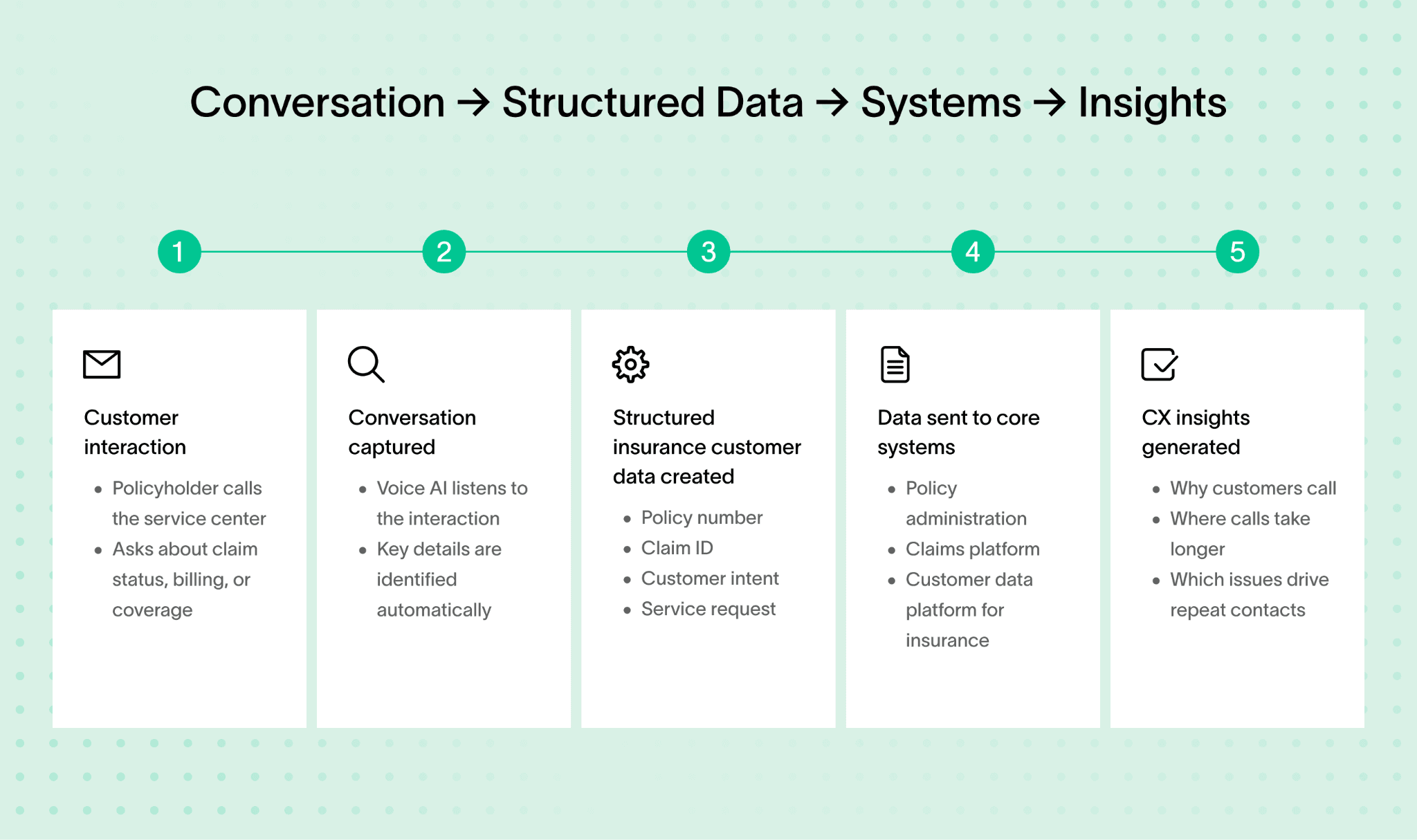
Yet historically, most of that information disappears inside call recordings and agent notes.
Strada converts those conversations into structured insurance customer data that can immediately improve CX performance metrics.
For a VP or Director of Customer Experience managing 50–500+ agents, the impact shows up in the metrics they are measured on daily:
CX metric | Why customer data matters | Typical impact from structured data |
Average handle time | Agents spend time collecting or confirming information | 30–55% reduction in time spent gathering details |
First contact resolution | Missing data forces repeat calls or transfers | Higher resolution rates on first interaction |
Customer satisfaction | Faster, accurate responses improve policyholder experience | Consistent improvement in post-interaction surveys |
Call volume per policyholder | Repeated interactions often stem from missing context | Reduced repeat inquiries |
Agent utilization | Manual intake slows service operations | Increased capacity without increasing headcount |
These outcomes come from improving the front door of insurance customer data collection: the service conversation itself.
Strada automatically captures policyholder information during voice interactions and converts it into structured records that feed downstream systems such as policy administration, claims platforms, and analytics environments. Instead of treating calls as isolated events, insurers create a continuous customer data stream across every interaction.
Why customer data quality drives CX performance
For customer experience leaders, the real risk is not simply missing data. It is fragmented data.
When customer information lives across policy systems, claims tools, and call recordings, agents lack a unified picture of the policyholder. That fragmentation drives operational inefficiency in several ways:
Agents repeat identity verification steps across interactions
Customers must restate policy information repeatedly
Claims updates require manual follow-ups
Supervisors lack visibility into service drivers
The result is predictable: longer calls, frustrated policyholders, and rising service costs.
Strada solves this problem by creating consistent insurance customer data collection during the interaction itself, capturing policy numbers, claim identifiers, coverage questions, and intent signals in real time.
Instead of relying on post-call notes, insurers build a structured data foundation directly from conversations.
A modern customer data platform for insurance starts with the service center
Many insurers have invested in data platforms, warehouses, and analytics environments. Yet the most important input source often remains unstructured: the customer service center.
A customer data platform for insurance is only as valuable as the quality of the data entering it.
Strada improves the accuracy and completeness of customer data before it reaches analytics systems.
Where insurance customer data actually comes from
Most insurers assume policy administration systems are the primary source of truth. In reality, critical operational information originates in customer conversations.
Common data captured during service interactions includes:
Interaction type | Data captured |
First notice of loss | Loss date, location, damage description |
Policy servicing | Coverage adjustments, address changes |
Billing inquiries | Payment status, installment plans |
Renewal questions | Coverage comparisons, premium concerns |
Claims follow-ups | Repair status, documentation requests |
When captured manually, this information becomes inconsistent across systems. When captured through structured conversational workflows, it becomes reliable insurance customer data management.
Strada structures these interactions into standardized data fields that integrate directly into policy and claims environments.
Enabling insurance customer service center data analytics
Once service conversations generate structured records, CX leaders gain access to insurance customer service center data analytics that were previously impossible.
Instead of analyzing only call volumes, insurers can evaluate:
Which policy types generate the most service inquiries
Which claim stages trigger repeat calls
Which coverage questions correlate with policy cancellations
Which billing issues drive low CSAT scores
These insights allow CX leaders to move from operational reporting to proactive experience management.
For example:
Data insight | Operational action |
High call volume after claim inspections | Improve adjuster communication |
Frequent renewal inquiries about deductibles | Adjust renewal communication strategy |
Repeat billing calls for the same issue | Improve payment reminder processes |
Claims status inquiries after FNOL | Automate proactive updates |
This is where customer data becomes strategic. It reveals the operational friction that affects retention, service cost, and policyholder loyalty.
Strada improves insurance customer data collection without increasing agent workload
The traditional approach to customer data collection in insurance relies on agents manually asking structured questions.
This method creates two problems for CX leaders:
Longer calls
Inconsistent data capture
Voice AI eliminates both issues by guiding interactions through intelligent conversational flows.
Strada captures required information naturally during the interaction, reducing the need for rigid scripts while ensuring complete insurance customer data collection.
How conversational data capture reduces handle time
In traditional service environments, agents perform several repetitive tasks:
Identity verification
Policy lookup
Claim status confirmation
Documentation requests
Each step introduces delays if the information is missing or inconsistent.
Strada automates much of this process while still maintaining agent escalation paths when needed.
Operational improvements typically include:
Operational area | Traditional process | With Strada |
Identity verification | Agent asks multiple questions | Automated verification during conversation |
Policy lookup | Agent searches policy systems | Data captured and retrieved automatically |
Claim status inquiries | Manual status explanation | Real-time updates integrated into interaction |
Documentation requests | Agent instructs customer | Automated workflows triggered |
For CX executives measured on average handle time, agent utilization, and service backlog, these improvements translate directly into operational capacity gains.
Improving data consistency across channels
Insurance carriers now interact with policyholders across multiple channels:
Phone
Email
Chat
SMS
Mobile apps
Without unified systems, each channel collects customer information differently.
Strada ensures consistent insurance customer data management across channels, meaning the same information captured during a phone call is structured identically to data collected through digital channels.
This consistency enables insurers to maintain complete customer histories, which improves agent effectiveness during follow-up interactions.
Turning insurance customer data into CX performance insights
Capturing customer data is only valuable if it improves operational decisions. The real advantage of structured service interactions is that they create measurable insight.
Strada enables insurers to transform everyday service interactions into operational intelligence for CX leadership.
Metrics that matter to CX leaders
Customer experience executives in insurance typically manage large service organizations and are measured on operational efficiency and policyholder satisfaction.
Key performance indicators include:
CX metric | How customer data drives improvement |
Average handle time | Structured intake reduces time spent gathering information |
First contact resolution | Complete data prevents follow-up calls |
Call deflection | Automated workflows resolve routine inquiries |
Customer satisfaction | Faster service improves perceived experience |
Agent productivity | Reduced manual work increases interaction capacity |
Strada’s conversational data layer enables insurers to track these metrics in more granular ways.
For example, CX leaders can identify:
Which policy servicing requests create the longest calls
Which claim scenarios require supervisor escalation
Which billing issues generate the lowest CSAT scores
Instead of reviewing recordings or anecdotal feedback, leaders gain data-driven insight into service drivers.
From call center reporting to experience intelligence
Traditional call center analytics focus on volume and duration.
But insurance customer service center data analytics should answer deeper questions about policyholder behavior and service demand.
Structured conversational data enables insurers to understand patterns such as:
The service interactions most likely to result in policy cancellation
Claim types that generate repeated policyholder anxiety
Coverage misunderstandings that drive renewal questions
With these insights, CX leaders can coordinate improvements across underwriting, claims, and policy servicing teams.
The result is a shift from reactive service management to proactive customer experience strategy.
Why CX leaders prioritize secure insurance customer data management
Security and compliance remain top priorities for insurers handling sensitive information. Voice interactions often include personally identifiable information, policy details, and claim data.
For CX executives evaluating new technology, the key question is simple: Can conversational systems safely handle insurance customer data?
The answer depends on architecture and governance.
Modern conversational platforms like Strada are designed specifically for secure insurance customer data management, with controls that align with enterprise compliance standards.
Key security considerations for Voice AI in insurance
Insurers evaluating conversational data systems typically review the following areas:
Security area | Why it matters |
Data isolation | Prevents cross-customer data exposure |
Encryption | Protects customer data in transit and at rest |
Access control | Limits who can view interaction data |
Audit logging | Enables compliance reporting |
Data retention policies | Ensures regulatory alignment |
Because Strada structures conversational data rather than storing raw voice recordings as the primary artifact, insurers gain better governance over how customer information is stored and accessed.
This architecture reduces compliance risk while improving the usability of customer data.
Balancing automation with human oversight
Insurance service operations cannot rely entirely on automation. Certain interactions require licensed agents, adjusters, or supervisors.
Strada maintains clear escalation paths to human agents while still capturing structured interaction data.
For CX leaders, this ensures that automation supports service teams rather than replacing them. The result is a hybrid model where:
Routine inquiries are handled automatically
Complex policy or claims questions reach agents faster
Every interaction contributes to insurance customer data collection
This balance improves both operational efficiency and policyholder trust.
Conclusion
Insurance customer experience leaders are under constant pressure to reduce service costs while improving policyholder satisfaction. The challenge is not simply answering more calls. It is capturing better information during every interaction.
Strada transforms customer conversations into structured insurance customer data that powers service operations, analytics, and decision-making. By improving how insurers collect and manage data at the moment of interaction, CX leaders can reduce handle times, increase resolution rates, and gain deeper visibility into the drivers of customer experience.
The service center becomes more than a cost center. It becomes the primary intelligence engine for the insurance organization.
If you want to see how conversational AI can improve your insurance customer data strategy and service center performance, request a Strada demo tailored to your CX organization.
Frequently Asked Questions
How can voice AI help reduce average handle time in an insurance customer service center?
Voice AI collects policyholder information during the conversation, reducing time spent on identity verification and policy lookups. Agents receive structured data before joining the interaction and can focus immediately on resolving the issue.
Why does fragmented insurance customer data make it harder for my agents to resolve issues on the first call?
Framer is a design tool that allows you to design websites on a freeform canvas, and then publish them as websites with a single click.
How can voice AI improve first contact resolution for policy servicing and claims inquiries?
Framer is a design tool that allows you to design websites on a freeform canvas, and then publish them as websites with a single click.
How does capturing structured customer data from conversations improve customer service center analytics?
Framer is a design tool that allows you to design websites on a freeform canvas, and then publish them as websites with a single click.
Why should CX leaders view the contact center as a major source of insurance customer data?
Framer is a design tool that allows you to design websites on a freeform canvas, and then publish them as websites with a single click.
Table of Contents
Carriers, MGAs, and brokers scale revenue-driving phone calls with Strada's conversational AI platform.
Start scaling with voice AI agents today
Join innovative carriers and MGAs transforming their calls with Strada.
How Voice AI Protects Insurance Customer Data in 2026
Amri Prodensky
CEO
8 min read
How voice AI transforms customer interactions into actionable insurance data.
Key takeaways:
Reducing average handle time requires capturing accurate insurance customer data during service interactions, eliminating repeated verification steps and manual data entry.
Higher first contact resolution occurs when structured customer data from conversations gives agents complete policy and claims context during the initial interaction.
Converting service conversations into structured records enables insurance customer service center data analytics that reveal why policyholders call and where operational friction exists.
Insurance carriers depend on insurance customer data to deliver fast service, resolve claims, and retain policyholders. Yet the largest volume of that data is captured in the most operational part of the business: the customer service center.
For CX leaders responsible for hundreds of agents, the challenge is not collecting more information. It is capturing accurate data at the moment of interaction and turning it into operational insight. Voice AI platforms like Strada change how insurers collect, structure, and activate customer data from everyday policyholder conversations.
Strada turns customer conversations into structured insurance customer data
Customer service interactions contain the richest operational signals in insurance: claim updates, coverage questions, billing issues, policy changes, and renewal concerns.
Here’s the easiest way to picture how conversational data becomes usable insurance customer data. Think of it as a simple flow from conversation to insight.
Yet historically, most of that information disappears inside call recordings and agent notes.
Strada converts those conversations into structured insurance customer data that can immediately improve CX performance metrics.
For a VP or Director of Customer Experience managing 50–500+ agents, the impact shows up in the metrics they are measured on daily:
CX metric | Why customer data matters | Typical impact from structured data |
Average handle time | Agents spend time collecting or confirming information | 30–55% reduction in time spent gathering details |
First contact resolution | Missing data forces repeat calls or transfers | Higher resolution rates on first interaction |
Customer satisfaction | Faster, accurate responses improve policyholder experience | Consistent improvement in post-interaction surveys |
Call volume per policyholder | Repeated interactions often stem from missing context | Reduced repeat inquiries |
Agent utilization | Manual intake slows service operations | Increased capacity without increasing headcount |
These outcomes come from improving the front door of insurance customer data collection: the service conversation itself.
Strada automatically captures policyholder information during voice interactions and converts it into structured records that feed downstream systems such as policy administration, claims platforms, and analytics environments. Instead of treating calls as isolated events, insurers create a continuous customer data stream across every interaction.
Why customer data quality drives CX performance
For customer experience leaders, the real risk is not simply missing data. It is fragmented data.
When customer information lives across policy systems, claims tools, and call recordings, agents lack a unified picture of the policyholder. That fragmentation drives operational inefficiency in several ways:
Agents repeat identity verification steps across interactions
Customers must restate policy information repeatedly
Claims updates require manual follow-ups
Supervisors lack visibility into service drivers
The result is predictable: longer calls, frustrated policyholders, and rising service costs.
Strada solves this problem by creating consistent insurance customer data collection during the interaction itself, capturing policy numbers, claim identifiers, coverage questions, and intent signals in real time.
Instead of relying on post-call notes, insurers build a structured data foundation directly from conversations.
A modern customer data platform for insurance starts with the service center
Many insurers have invested in data platforms, warehouses, and analytics environments. Yet the most important input source often remains unstructured: the customer service center.
A customer data platform for insurance is only as valuable as the quality of the data entering it.
Strada improves the accuracy and completeness of customer data before it reaches analytics systems.
Where insurance customer data actually comes from
Most insurers assume policy administration systems are the primary source of truth. In reality, critical operational information originates in customer conversations.
Common data captured during service interactions includes:
Interaction type | Data captured |
First notice of loss | Loss date, location, damage description |
Policy servicing | Coverage adjustments, address changes |
Billing inquiries | Payment status, installment plans |
Renewal questions | Coverage comparisons, premium concerns |
Claims follow-ups | Repair status, documentation requests |
When captured manually, this information becomes inconsistent across systems. When captured through structured conversational workflows, it becomes reliable insurance customer data management.
Strada structures these interactions into standardized data fields that integrate directly into policy and claims environments.
Enabling insurance customer service center data analytics
Once service conversations generate structured records, CX leaders gain access to insurance customer service center data analytics that were previously impossible.
Instead of analyzing only call volumes, insurers can evaluate:
Which policy types generate the most service inquiries
Which claim stages trigger repeat calls
Which coverage questions correlate with policy cancellations
Which billing issues drive low CSAT scores
These insights allow CX leaders to move from operational reporting to proactive experience management.
For example:
Data insight | Operational action |
High call volume after claim inspections | Improve adjuster communication |
Frequent renewal inquiries about deductibles | Adjust renewal communication strategy |
Repeat billing calls for the same issue | Improve payment reminder processes |
Claims status inquiries after FNOL | Automate proactive updates |
This is where customer data becomes strategic. It reveals the operational friction that affects retention, service cost, and policyholder loyalty.
Strada improves insurance customer data collection without increasing agent workload
The traditional approach to customer data collection in insurance relies on agents manually asking structured questions.
This method creates two problems for CX leaders:
Longer calls
Inconsistent data capture
Voice AI eliminates both issues by guiding interactions through intelligent conversational flows.
Strada captures required information naturally during the interaction, reducing the need for rigid scripts while ensuring complete insurance customer data collection.
How conversational data capture reduces handle time
In traditional service environments, agents perform several repetitive tasks:
Identity verification
Policy lookup
Claim status confirmation
Documentation requests
Each step introduces delays if the information is missing or inconsistent.
Strada automates much of this process while still maintaining agent escalation paths when needed.
Operational improvements typically include:
Operational area | Traditional process | With Strada |
Identity verification | Agent asks multiple questions | Automated verification during conversation |
Policy lookup | Agent searches policy systems | Data captured and retrieved automatically |
Claim status inquiries | Manual status explanation | Real-time updates integrated into interaction |
Documentation requests | Agent instructs customer | Automated workflows triggered |
For CX executives measured on average handle time, agent utilization, and service backlog, these improvements translate directly into operational capacity gains.
Improving data consistency across channels
Insurance carriers now interact with policyholders across multiple channels:
Phone
Email
Chat
SMS
Mobile apps
Without unified systems, each channel collects customer information differently.
Strada ensures consistent insurance customer data management across channels, meaning the same information captured during a phone call is structured identically to data collected through digital channels.
This consistency enables insurers to maintain complete customer histories, which improves agent effectiveness during follow-up interactions.
Turning insurance customer data into CX performance insights
Capturing customer data is only valuable if it improves operational decisions. The real advantage of structured service interactions is that they create measurable insight.
Strada enables insurers to transform everyday service interactions into operational intelligence for CX leadership.
Metrics that matter to CX leaders
Customer experience executives in insurance typically manage large service organizations and are measured on operational efficiency and policyholder satisfaction.
Key performance indicators include:
CX metric | How customer data drives improvement |
Average handle time | Structured intake reduces time spent gathering information |
First contact resolution | Complete data prevents follow-up calls |
Call deflection | Automated workflows resolve routine inquiries |
Customer satisfaction | Faster service improves perceived experience |
Agent productivity | Reduced manual work increases interaction capacity |
Strada’s conversational data layer enables insurers to track these metrics in more granular ways.
For example, CX leaders can identify:
Which policy servicing requests create the longest calls
Which claim scenarios require supervisor escalation
Which billing issues generate the lowest CSAT scores
Instead of reviewing recordings or anecdotal feedback, leaders gain data-driven insight into service drivers.
From call center reporting to experience intelligence
Traditional call center analytics focus on volume and duration.
But insurance customer service center data analytics should answer deeper questions about policyholder behavior and service demand.
Structured conversational data enables insurers to understand patterns such as:
The service interactions most likely to result in policy cancellation
Claim types that generate repeated policyholder anxiety
Coverage misunderstandings that drive renewal questions
With these insights, CX leaders can coordinate improvements across underwriting, claims, and policy servicing teams.
The result is a shift from reactive service management to proactive customer experience strategy.
Why CX leaders prioritize secure insurance customer data management
Security and compliance remain top priorities for insurers handling sensitive information. Voice interactions often include personally identifiable information, policy details, and claim data.
For CX executives evaluating new technology, the key question is simple: Can conversational systems safely handle insurance customer data?
The answer depends on architecture and governance.
Modern conversational platforms like Strada are designed specifically for secure insurance customer data management, with controls that align with enterprise compliance standards.
Key security considerations for Voice AI in insurance
Insurers evaluating conversational data systems typically review the following areas:
Security area | Why it matters |
Data isolation | Prevents cross-customer data exposure |
Encryption | Protects customer data in transit and at rest |
Access control | Limits who can view interaction data |
Audit logging | Enables compliance reporting |
Data retention policies | Ensures regulatory alignment |
Because Strada structures conversational data rather than storing raw voice recordings as the primary artifact, insurers gain better governance over how customer information is stored and accessed.
This architecture reduces compliance risk while improving the usability of customer data.
Balancing automation with human oversight
Insurance service operations cannot rely entirely on automation. Certain interactions require licensed agents, adjusters, or supervisors.
Strada maintains clear escalation paths to human agents while still capturing structured interaction data.
For CX leaders, this ensures that automation supports service teams rather than replacing them. The result is a hybrid model where:
Routine inquiries are handled automatically
Complex policy or claims questions reach agents faster
Every interaction contributes to insurance customer data collection
This balance improves both operational efficiency and policyholder trust.
Conclusion
Insurance customer experience leaders are under constant pressure to reduce service costs while improving policyholder satisfaction. The challenge is not simply answering more calls. It is capturing better information during every interaction.
Strada transforms customer conversations into structured insurance customer data that powers service operations, analytics, and decision-making. By improving how insurers collect and manage data at the moment of interaction, CX leaders can reduce handle times, increase resolution rates, and gain deeper visibility into the drivers of customer experience.
The service center becomes more than a cost center. It becomes the primary intelligence engine for the insurance organization.
If you want to see how conversational AI can improve your insurance customer data strategy and service center performance, request a Strada demo tailored to your CX organization.
Frequently Asked Questions
How can voice AI help reduce average handle time in an insurance customer service center?
Voice AI collects policyholder information during the conversation, reducing time spent on identity verification and policy lookups. Agents receive structured data before joining the interaction and can focus immediately on resolving the issue.
Why does fragmented insurance customer data make it harder for my agents to resolve issues on the first call?
Framer is a design tool that allows you to design websites on a freeform canvas, and then publish them as websites with a single click.
How can voice AI improve first contact resolution for policy servicing and claims inquiries?
Framer is a design tool that allows you to design websites on a freeform canvas, and then publish them as websites with a single click.
How does capturing structured customer data from conversations improve customer service center analytics?
Framer is a design tool that allows you to design websites on a freeform canvas, and then publish them as websites with a single click.
Why should CX leaders view the contact center as a major source of insurance customer data?
Framer is a design tool that allows you to design websites on a freeform canvas, and then publish them as websites with a single click.
Table of Contents
Carriers, MGAs, and brokers scale revenue-driving phone calls with Strada's conversational AI platform.
Start scaling with voice AI agents today
Join innovative carriers and MGAs transforming their calls with Strada.
How Voice AI Protects Insurance Customer Data in 2026
Amri Prodensky
CEO
8 min read
How voice AI transforms customer interactions into actionable insurance data.
Key takeaways:
Reducing average handle time requires capturing accurate insurance customer data during service interactions, eliminating repeated verification steps and manual data entry.
Higher first contact resolution occurs when structured customer data from conversations gives agents complete policy and claims context during the initial interaction.
Converting service conversations into structured records enables insurance customer service center data analytics that reveal why policyholders call and where operational friction exists.
Insurance carriers depend on insurance customer data to deliver fast service, resolve claims, and retain policyholders. Yet the largest volume of that data is captured in the most operational part of the business: the customer service center.
For CX leaders responsible for hundreds of agents, the challenge is not collecting more information. It is capturing accurate data at the moment of interaction and turning it into operational insight. Voice AI platforms like Strada change how insurers collect, structure, and activate customer data from everyday policyholder conversations.
Strada turns customer conversations into structured insurance customer data
Customer service interactions contain the richest operational signals in insurance: claim updates, coverage questions, billing issues, policy changes, and renewal concerns.
Here’s the easiest way to picture how conversational data becomes usable insurance customer data. Think of it as a simple flow from conversation to insight.
Yet historically, most of that information disappears inside call recordings and agent notes.
Strada converts those conversations into structured insurance customer data that can immediately improve CX performance metrics.
For a VP or Director of Customer Experience managing 50–500+ agents, the impact shows up in the metrics they are measured on daily:
CX metric | Why customer data matters | Typical impact from structured data |
Average handle time | Agents spend time collecting or confirming information | 30–55% reduction in time spent gathering details |
First contact resolution | Missing data forces repeat calls or transfers | Higher resolution rates on first interaction |
Customer satisfaction | Faster, accurate responses improve policyholder experience | Consistent improvement in post-interaction surveys |
Call volume per policyholder | Repeated interactions often stem from missing context | Reduced repeat inquiries |
Agent utilization | Manual intake slows service operations | Increased capacity without increasing headcount |
These outcomes come from improving the front door of insurance customer data collection: the service conversation itself.
Strada automatically captures policyholder information during voice interactions and converts it into structured records that feed downstream systems such as policy administration, claims platforms, and analytics environments. Instead of treating calls as isolated events, insurers create a continuous customer data stream across every interaction.
Why customer data quality drives CX performance
For customer experience leaders, the real risk is not simply missing data. It is fragmented data.
When customer information lives across policy systems, claims tools, and call recordings, agents lack a unified picture of the policyholder. That fragmentation drives operational inefficiency in several ways:
Agents repeat identity verification steps across interactions
Customers must restate policy information repeatedly
Claims updates require manual follow-ups
Supervisors lack visibility into service drivers
The result is predictable: longer calls, frustrated policyholders, and rising service costs.
Strada solves this problem by creating consistent insurance customer data collection during the interaction itself, capturing policy numbers, claim identifiers, coverage questions, and intent signals in real time.
Instead of relying on post-call notes, insurers build a structured data foundation directly from conversations.
A modern customer data platform for insurance starts with the service center
Many insurers have invested in data platforms, warehouses, and analytics environments. Yet the most important input source often remains unstructured: the customer service center.
A customer data platform for insurance is only as valuable as the quality of the data entering it.
Strada improves the accuracy and completeness of customer data before it reaches analytics systems.
Where insurance customer data actually comes from
Most insurers assume policy administration systems are the primary source of truth. In reality, critical operational information originates in customer conversations.
Common data captured during service interactions includes:
Interaction type | Data captured |
First notice of loss | Loss date, location, damage description |
Policy servicing | Coverage adjustments, address changes |
Billing inquiries | Payment status, installment plans |
Renewal questions | Coverage comparisons, premium concerns |
Claims follow-ups | Repair status, documentation requests |
When captured manually, this information becomes inconsistent across systems. When captured through structured conversational workflows, it becomes reliable insurance customer data management.
Strada structures these interactions into standardized data fields that integrate directly into policy and claims environments.
Enabling insurance customer service center data analytics
Once service conversations generate structured records, CX leaders gain access to insurance customer service center data analytics that were previously impossible.
Instead of analyzing only call volumes, insurers can evaluate:
Which policy types generate the most service inquiries
Which claim stages trigger repeat calls
Which coverage questions correlate with policy cancellations
Which billing issues drive low CSAT scores
These insights allow CX leaders to move from operational reporting to proactive experience management.
For example:
Data insight | Operational action |
High call volume after claim inspections | Improve adjuster communication |
Frequent renewal inquiries about deductibles | Adjust renewal communication strategy |
Repeat billing calls for the same issue | Improve payment reminder processes |
Claims status inquiries after FNOL | Automate proactive updates |
This is where customer data becomes strategic. It reveals the operational friction that affects retention, service cost, and policyholder loyalty.
Strada improves insurance customer data collection without increasing agent workload
The traditional approach to customer data collection in insurance relies on agents manually asking structured questions.
This method creates two problems for CX leaders:
Longer calls
Inconsistent data capture
Voice AI eliminates both issues by guiding interactions through intelligent conversational flows.
Strada captures required information naturally during the interaction, reducing the need for rigid scripts while ensuring complete insurance customer data collection.
How conversational data capture reduces handle time
In traditional service environments, agents perform several repetitive tasks:
Identity verification
Policy lookup
Claim status confirmation
Documentation requests
Each step introduces delays if the information is missing or inconsistent.
Strada automates much of this process while still maintaining agent escalation paths when needed.
Operational improvements typically include:
Operational area | Traditional process | With Strada |
Identity verification | Agent asks multiple questions | Automated verification during conversation |
Policy lookup | Agent searches policy systems | Data captured and retrieved automatically |
Claim status inquiries | Manual status explanation | Real-time updates integrated into interaction |
Documentation requests | Agent instructs customer | Automated workflows triggered |
For CX executives measured on average handle time, agent utilization, and service backlog, these improvements translate directly into operational capacity gains.
Improving data consistency across channels
Insurance carriers now interact with policyholders across multiple channels:
Phone
Email
Chat
SMS
Mobile apps
Without unified systems, each channel collects customer information differently.
Strada ensures consistent insurance customer data management across channels, meaning the same information captured during a phone call is structured identically to data collected through digital channels.
This consistency enables insurers to maintain complete customer histories, which improves agent effectiveness during follow-up interactions.
Turning insurance customer data into CX performance insights
Capturing customer data is only valuable if it improves operational decisions. The real advantage of structured service interactions is that they create measurable insight.
Strada enables insurers to transform everyday service interactions into operational intelligence for CX leadership.
Metrics that matter to CX leaders
Customer experience executives in insurance typically manage large service organizations and are measured on operational efficiency and policyholder satisfaction.
Key performance indicators include:
CX metric | How customer data drives improvement |
Average handle time | Structured intake reduces time spent gathering information |
First contact resolution | Complete data prevents follow-up calls |
Call deflection | Automated workflows resolve routine inquiries |
Customer satisfaction | Faster service improves perceived experience |
Agent productivity | Reduced manual work increases interaction capacity |
Strada’s conversational data layer enables insurers to track these metrics in more granular ways.
For example, CX leaders can identify:
Which policy servicing requests create the longest calls
Which claim scenarios require supervisor escalation
Which billing issues generate the lowest CSAT scores
Instead of reviewing recordings or anecdotal feedback, leaders gain data-driven insight into service drivers.
From call center reporting to experience intelligence
Traditional call center analytics focus on volume and duration.
But insurance customer service center data analytics should answer deeper questions about policyholder behavior and service demand.
Structured conversational data enables insurers to understand patterns such as:
The service interactions most likely to result in policy cancellation
Claim types that generate repeated policyholder anxiety
Coverage misunderstandings that drive renewal questions
With these insights, CX leaders can coordinate improvements across underwriting, claims, and policy servicing teams.
The result is a shift from reactive service management to proactive customer experience strategy.
Why CX leaders prioritize secure insurance customer data management
Security and compliance remain top priorities for insurers handling sensitive information. Voice interactions often include personally identifiable information, policy details, and claim data.
For CX executives evaluating new technology, the key question is simple: Can conversational systems safely handle insurance customer data?
The answer depends on architecture and governance.
Modern conversational platforms like Strada are designed specifically for secure insurance customer data management, with controls that align with enterprise compliance standards.
Key security considerations for Voice AI in insurance
Insurers evaluating conversational data systems typically review the following areas:
Security area | Why it matters |
Data isolation | Prevents cross-customer data exposure |
Encryption | Protects customer data in transit and at rest |
Access control | Limits who can view interaction data |
Audit logging | Enables compliance reporting |
Data retention policies | Ensures regulatory alignment |
Because Strada structures conversational data rather than storing raw voice recordings as the primary artifact, insurers gain better governance over how customer information is stored and accessed.
This architecture reduces compliance risk while improving the usability of customer data.
Balancing automation with human oversight
Insurance service operations cannot rely entirely on automation. Certain interactions require licensed agents, adjusters, or supervisors.
Strada maintains clear escalation paths to human agents while still capturing structured interaction data.
For CX leaders, this ensures that automation supports service teams rather than replacing them. The result is a hybrid model where:
Routine inquiries are handled automatically
Complex policy or claims questions reach agents faster
Every interaction contributes to insurance customer data collection
This balance improves both operational efficiency and policyholder trust.
Conclusion
Insurance customer experience leaders are under constant pressure to reduce service costs while improving policyholder satisfaction. The challenge is not simply answering more calls. It is capturing better information during every interaction.
Strada transforms customer conversations into structured insurance customer data that powers service operations, analytics, and decision-making. By improving how insurers collect and manage data at the moment of interaction, CX leaders can reduce handle times, increase resolution rates, and gain deeper visibility into the drivers of customer experience.
The service center becomes more than a cost center. It becomes the primary intelligence engine for the insurance organization.
If you want to see how conversational AI can improve your insurance customer data strategy and service center performance, request a Strada demo tailored to your CX organization.
Frequently Asked Questions
How can voice AI help reduce average handle time in an insurance customer service center?
Voice AI collects policyholder information during the conversation, reducing time spent on identity verification and policy lookups. Agents receive structured data before joining the interaction and can focus immediately on resolving the issue.
Why does fragmented insurance customer data make it harder for my agents to resolve issues on the first call?
Framer is a design tool that allows you to design websites on a freeform canvas, and then publish them as websites with a single click.
How can voice AI improve first contact resolution for policy servicing and claims inquiries?
Framer is a design tool that allows you to design websites on a freeform canvas, and then publish them as websites with a single click.
How does capturing structured customer data from conversations improve customer service center analytics?
Framer is a design tool that allows you to design websites on a freeform canvas, and then publish them as websites with a single click.
Why should CX leaders view the contact center as a major source of insurance customer data?
Framer is a design tool that allows you to design websites on a freeform canvas, and then publish them as websites with a single click.
Table of Contents
Carriers, MGAs, and brokers scale revenue-driving phone calls with Strada's conversational AI platform.
Start scaling with voice AI agents today
Join innovative carriers and MGAs transforming their calls with Strada.

Agentic AI for insurance operations
© 2026 Strada API, Inc.
Agentic AI for insurance operations
© 2026 Strada API, Inc.
Agentic AI for insurance operations
© 2026 Strada API, Inc.