How Follow Up Calls Scale With Voice AI in 2026

Amir Prodensky
CEO
Feb 23, 2026
9 min read
Scaling insurance customer outreach with conversational AI follow-ups
Key takeaways:
Improved renewal rates and reduced passive churn by deploying structured pre-renewal follow-up programs that deliver 2 to 5 percentage points of retention lift.
Reduced inbound claim status calls by 10 to 20 percent through proactive post-claim outreach that clarifies next steps and prevents escalations.
Lowered cost-to-serve and stabilized service levels by automating 20 to 35 percent of routine call volume without increasing headcount.
Increased task completion and digital engagement by triggering follow-up calls based on customer behavior signals across email, billing, and policy workflows.
Reduced regulatory exposure while improving executive visibility through consent tracking, audit trails, and reporting that links outreach to retention, CSAT, and FCR outcomes.
Insurance follow up calls determine whether policies renew, claims close smoothly, and customers stay loyal after a critical moment. Yet most carriers still rely on manual outreach that is inconsistent, difficult to measure, and expensive to scale.
Strada reframes follow up calls as a strategic CX lever. By deploying insurance-trained Voice AI across retention, claims, and service workflows, carriers convert routine outreach into measurable improvements in CSAT, renewal rate, first-call resolution, and cost-to-serve.
Follow up calls as a core driver of insurance CX outcomes
Strada treats follow up calls as a performance engine, not an administrative task. In enterprise insurance environments, every outbound interaction influences retention, NPS, complaint ratios, and agent utilization. The question is not whether to call. It is how to do it in a way that directly impacts executive-level metrics.
In most carriers, follow up calls to customers occur at predictable pressure points: post-quote, pre-renewal, post-claim, policy servicing, billing issues, and complaint recovery. These moments disproportionately influence churn risk and brand perception.
When unmanaged, follow-up volume overwhelms front-line teams. A 200-agent service center handling 40,000 policies may generate:
8,000–12,000 renewal reminder calls per month
3,000+ post-claim check-ins
5,000 billing and documentation reminders
Thousands of customer service follow up calls tied to open tickets
For a VP of Customer Experience, this volume directly affects:
Metric | How follow up calls influence it |
Renewal rate | Timely pre-renewal outreach reduces passive churn |
CSAT | Proactive post-claim check-ins improve perceived care |
First call resolution (FCR) | Structured follow-ups close open loops |
Average handle time (AHT) | Offloading routine calls lowers blended AHT |
Cost per policy serviced | Automation reduces agent labor hours |
Complaint ratio | Early outreach prevents escalations |
Strada operationalizes this at scale. Instead of agents manually tracking callbacks, Strada deploys automated follow-up calls that execute against predefined CX objectives.
For example:
Renewal reminder programs improve retention lift by 2–5 percentage points in large books of business.
Post-claim follow-ups reduce repeat inbound calls by clarifying next steps.
Billing reminder campaigns lower delinquency rates without increasing call center headcount.
Strada’s impact is strategic because it moves the metrics CX executives are measured on, not just call volume.
Using automated follow up calls to protect retention and service levels
Strada does not automate for efficiency alone. It automates to protect retention, stabilize service levels, and reduce operational volatility.
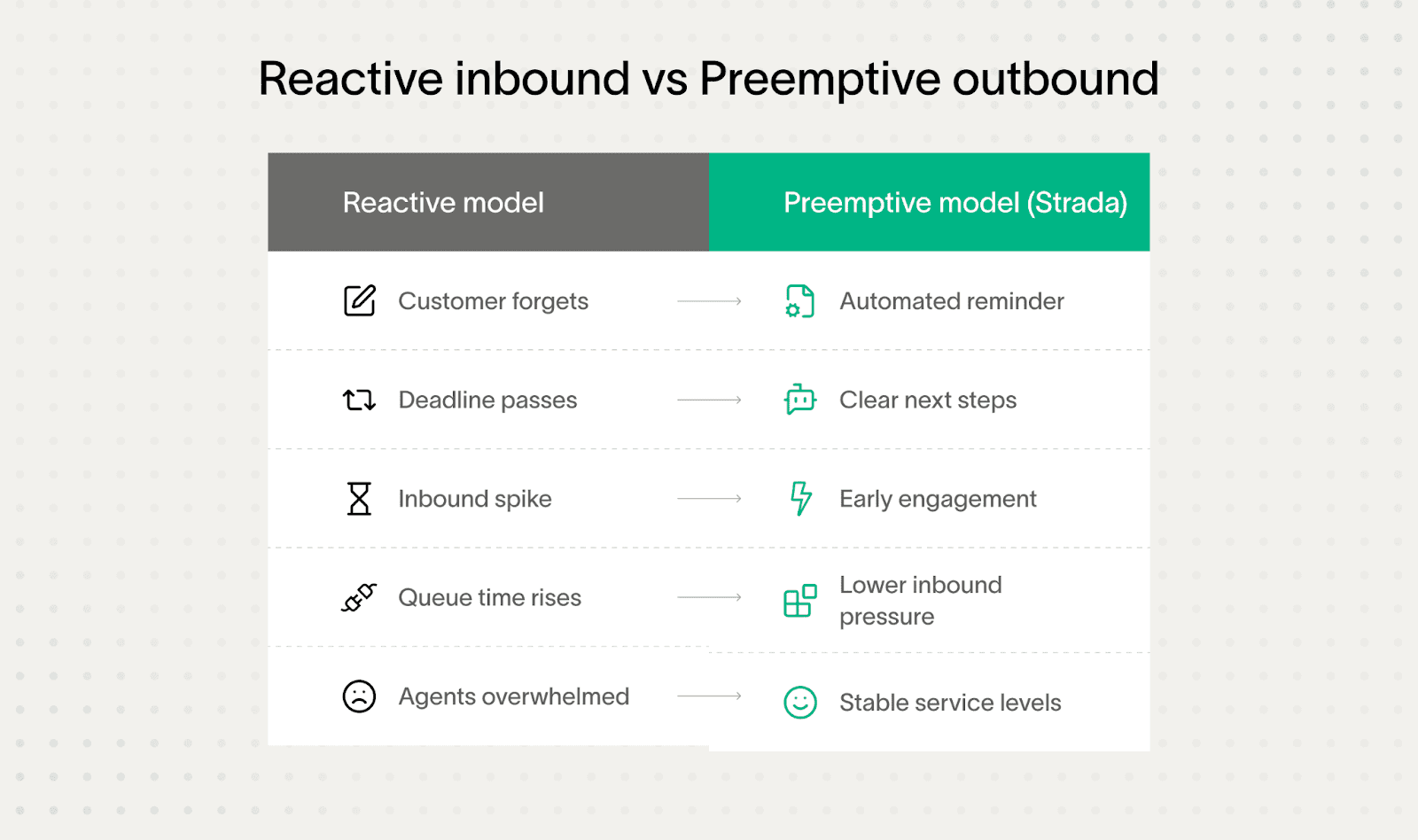
In a 300-agent service organization, unplanned inbound spikes can increase queue times by 30–50 percent. Most spikes are predictable: renewal cycles, CAT events, billing runs. Yet outbound follow-ups are still handled manually.
Strada deploys automated follow-up calls that absorb predictable workload before it becomes an inbound burden.
Here’s the operational difference between waiting and acting early.
Renewal and policy retention
Renewals are rarely lost in a single dramatic moment. They lapse because no one followed up at the right time.
Strada schedules structured follow up calls to customers 30, 14, and 7 days before renewal, adjusting cadence based on engagement signals. If a policyholder expresses price sensitivity, Strada flags the account for a licensed retention specialist.
This approach drives:
Higher renewal contact rates
Earlier objection surfacing
Reduced last-week renewal firefighting
For a carrier with 250,000 policies and a 78 percent baseline retention rate, even a 2-point improvement represents millions in preserved premium.
Claims and post-event outreach
Claims represent the most emotionally charged touchpoint in insurance. Silence during this period damages trust.
Strada executes structured customer service follow up calls after:
FNOL intake
Adjuster assignment
Payment issuance
Claim closure
This reduces inbound “status check” calls, improves CSAT, and prevents escalation to supervisors or regulators.
Carriers using structured post-claim outreach often see:
10–20 percent reduction in repeat inbound claim status calls
Higher post-claim survey completion rates
Lower supervisor intervention rates
Strada transforms reactive service into proactive communication.
Scaling customer service follow up calls without adding headcount
Strada enables enterprise carriers to scale follow up calls without scaling payroll. The strategic value lies in rebalancing human labor toward high-complexity interactions.
A 500-agent contact center typically spends 20–35 percent of total talk time on routine reminders and simple check-ins. These interactions are predictable, scriptable, and repeatable.
Strada automates this layer while preserving escalation pathways for licensed or complex scenarios.
Workforce reallocation model
When automated follow-up calls absorb routine volume, the impact is measurable:
Operational area | Pre-automation | With Strada |
Routine reminder calls | 100% human | Majority automated |
Complex policy questions | Competing for capacity | Prioritized human handling |
Supervisor escalations | Reactive | Reduced via proactive outreach |
Overtime hours | Seasonal spikes | Stabilized workload |
Instead of hiring 40 additional agents during peak renewal season, a CX leader can maintain service levels with existing staff.
This affects:
Blended cost per call
Overtime spend
Agent burnout and attrition
Strada supports hybrid escalation. When a policyholder raises underwriting, compliance, or complex claims issues, calls transfer seamlessly to human representatives with full conversational context.
The result is not replacement. It is reallocation.
Follow up calls as a strategic automation layer across the policy lifecycle
Strada operates as a lifecycle orchestration engine for follow up calls, not as a stand-alone dialer.
Insurance interactions are rarely single-channel. Policyholders receive emails, portal notifications, SMS reminders, and outbound calls. The gap between channels is where drop-off occurs.
Strada closes that gap by connecting conversational AI to CRM and policy systems.
Automate follow-up calls after email and digital touchpoints
Email reminders frequently go unopened. Portal notifications are often ignored.
Strada can automate follow-up calls after email when:
A renewal notice is not opened within 5 days
A billing reminder is not acknowledged
A requested document upload is incomplete
A policy endorsement form remains unsigned
This escalation model improves completion rates without forcing agents to manually monitor dashboards.
For CX executives, this directly improves:
Task closure rates
Digital-to-voice conversion visibility
Operational compliance adherence
The difference is orchestration. Strada reacts to customer behavior signals, not just static call lists.
Insurance-specific intelligence
Strada is built for insurance workflows. It understands:
Policy terms
Claims milestones
Coverage endorsements
Renewal timelines
Billing cycles
This domain specificity differentiates it from generic contact center automation. It also positions Strada among the top voice ai for post-discharge follow-up calls, particularly for carriers offering accident, disability, or ancillary health products where policyholder reassurance post-event is critical.
Insurance-trained AI improves conversational accuracy, reducing misinformation risk and protecting compliance.
Governance, compliance, and performance visibility in automated follow-up calls
For enterprise carriers, compliance risk is non-negotiable. Automated outreach must align with TCPA, HIPAA (where applicable), state insurance regulations, and internal audit requirements.
Strada embeds governance into automated follow-up calls.
Compliance safeguards
Strada supports:
Consent management tracking
Automated opt-out handling
Call recording controls
Audit trails linked to CRM records
Role-based access controls
Every follow up call is documented with timestamp, transcript, and outcome classification.
For CX executives, this reduces regulatory exposure while increasing operational transparency.
Performance management and executive reporting
Automation without visibility creates blind spots. Strada surfaces structured reporting across:
Executive metric | How Strada contributes |
CSAT trends | Tracks sentiment shifts post-follow-up |
FCR improvement | Closes open loops proactively |
Contact rate | Optimizes timing and retry logic |
Renewal lift | Links outreach to policy outcomes |
Cost-to-serve | Quantifies automation savings |
Instead of anecdotal improvement, CX leaders can measure:
Incremental retention tied to outreach cohorts
Reduction in inbound volume after structured follow-up programs
Agent hours redeployed to high-value tasks
This is the foundation of board-level storytelling.
Conclusion
Insurance follow up calls are not a tactical afterthought. They are a strategic control point for retention, satisfaction, and operational stability.
Strada transforms manual outreach into structured, measurable, and compliant automated follow-up calls across renewals, claims, billing, and service workflows. By reallocating routine volume, protecting retention, and improving CX visibility, Strada allows enterprise carriers to scale without sacrificing personalization or governance.
For CX leaders measured on renewal rate, CSAT, FCR, cost-to-serve, and complaint ratios, follow up calls are no longer overhead. They are leverage.
If you lead CX for an enterprise carrier and want to quantify the retention and service impact of automated follow-up calls, request a strategic review with Strada’s insurance team.
Frequently Asked Questions
How can automated follow-up calls help protect retention during renewal cycles?
Structured outreach at 30, 14, and 7 days before renewal increases contact rates and surfaces objections earlier in the cycle. Engagement signals can trigger escalation to licensed retention specialists, reducing last-minute renewal volatility and preserving premium that would otherwise lapse.
How does proactive post-claim outreach reduce inbound volume and improve satisfaction?
Framer is a design tool that allows you to design websites on a freeform canvas, and then publish them as websites with a single click.
When inbound spikes hit during renewal cycles or CAT events, how can voice AI stabilize service levels?
Framer is a design tool that allows you to design websites on a freeform canvas, and then publish them as websites with a single click.
How would automating routine reminders affect my agent workforce model?
Framer is a design tool that allows you to design websites on a freeform canvas, and then publish them as websites with a single click.
How can voice AI close the gap between digital notifications and completed customer actions?
Framer is a design tool that allows you to design websites on a freeform canvas, and then publish them as websites with a single click.
Table of Contents
Carriers, MGAs, and brokers scale revenue-driving phone calls with Strada's conversational AI platform.
Start scaling with voice AI agents today
Join innovative carriers and MGAs transforming their calls with Strada.
How Follow Up Calls Scale With Voice AI in 2026

Amir Prodensky
CEO
Feb 23, 2026
9 min read
Scaling insurance customer outreach with conversational AI follow-ups
Key takeaways:
Improved renewal rates and reduced passive churn by deploying structured pre-renewal follow-up programs that deliver 2 to 5 percentage points of retention lift.
Reduced inbound claim status calls by 10 to 20 percent through proactive post-claim outreach that clarifies next steps and prevents escalations.
Lowered cost-to-serve and stabilized service levels by automating 20 to 35 percent of routine call volume without increasing headcount.
Increased task completion and digital engagement by triggering follow-up calls based on customer behavior signals across email, billing, and policy workflows.
Reduced regulatory exposure while improving executive visibility through consent tracking, audit trails, and reporting that links outreach to retention, CSAT, and FCR outcomes.
Insurance follow up calls determine whether policies renew, claims close smoothly, and customers stay loyal after a critical moment. Yet most carriers still rely on manual outreach that is inconsistent, difficult to measure, and expensive to scale.
Strada reframes follow up calls as a strategic CX lever. By deploying insurance-trained Voice AI across retention, claims, and service workflows, carriers convert routine outreach into measurable improvements in CSAT, renewal rate, first-call resolution, and cost-to-serve.
Follow up calls as a core driver of insurance CX outcomes
Strada treats follow up calls as a performance engine, not an administrative task. In enterprise insurance environments, every outbound interaction influences retention, NPS, complaint ratios, and agent utilization. The question is not whether to call. It is how to do it in a way that directly impacts executive-level metrics.
In most carriers, follow up calls to customers occur at predictable pressure points: post-quote, pre-renewal, post-claim, policy servicing, billing issues, and complaint recovery. These moments disproportionately influence churn risk and brand perception.
When unmanaged, follow-up volume overwhelms front-line teams. A 200-agent service center handling 40,000 policies may generate:
8,000–12,000 renewal reminder calls per month
3,000+ post-claim check-ins
5,000 billing and documentation reminders
Thousands of customer service follow up calls tied to open tickets
For a VP of Customer Experience, this volume directly affects:
Metric | How follow up calls influence it |
Renewal rate | Timely pre-renewal outreach reduces passive churn |
CSAT | Proactive post-claim check-ins improve perceived care |
First call resolution (FCR) | Structured follow-ups close open loops |
Average handle time (AHT) | Offloading routine calls lowers blended AHT |
Cost per policy serviced | Automation reduces agent labor hours |
Complaint ratio | Early outreach prevents escalations |
Strada operationalizes this at scale. Instead of agents manually tracking callbacks, Strada deploys automated follow-up calls that execute against predefined CX objectives.
For example:
Renewal reminder programs improve retention lift by 2–5 percentage points in large books of business.
Post-claim follow-ups reduce repeat inbound calls by clarifying next steps.
Billing reminder campaigns lower delinquency rates without increasing call center headcount.
Strada’s impact is strategic because it moves the metrics CX executives are measured on, not just call volume.
Using automated follow up calls to protect retention and service levels
Strada does not automate for efficiency alone. It automates to protect retention, stabilize service levels, and reduce operational volatility.
In a 300-agent service organization, unplanned inbound spikes can increase queue times by 30–50 percent. Most spikes are predictable: renewal cycles, CAT events, billing runs. Yet outbound follow-ups are still handled manually.
Strada deploys automated follow-up calls that absorb predictable workload before it becomes an inbound burden.
Here’s the operational difference between waiting and acting early.

Renewal and policy retention
Renewals are rarely lost in a single dramatic moment. They lapse because no one followed up at the right time.
Strada schedules structured follow up calls to customers 30, 14, and 7 days before renewal, adjusting cadence based on engagement signals. If a policyholder expresses price sensitivity, Strada flags the account for a licensed retention specialist.
This approach drives:
Higher renewal contact rates
Earlier objection surfacing
Reduced last-week renewal firefighting
For a carrier with 250,000 policies and a 78 percent baseline retention rate, even a 2-point improvement represents millions in preserved premium.
Claims and post-event outreach
Claims represent the most emotionally charged touchpoint in insurance. Silence during this period damages trust.
Strada executes structured customer service follow up calls after:
FNOL intake
Adjuster assignment
Payment issuance
Claim closure
This reduces inbound “status check” calls, improves CSAT, and prevents escalation to supervisors or regulators.
Carriers using structured post-claim outreach often see:
10–20 percent reduction in repeat inbound claim status calls
Higher post-claim survey completion rates
Lower supervisor intervention rates
Strada transforms reactive service into proactive communication.
Scaling customer service follow up calls without adding headcount
Strada enables enterprise carriers to scale follow up calls without scaling payroll. The strategic value lies in rebalancing human labor toward high-complexity interactions.
A 500-agent contact center typically spends 20–35 percent of total talk time on routine reminders and simple check-ins. These interactions are predictable, scriptable, and repeatable.
Strada automates this layer while preserving escalation pathways for licensed or complex scenarios.
Workforce reallocation model
When automated follow-up calls absorb routine volume, the impact is measurable:
Operational area | Pre-automation | With Strada |
Routine reminder calls | 100% human | Majority automated |
Complex policy questions | Competing for capacity | Prioritized human handling |
Supervisor escalations | Reactive | Reduced via proactive outreach |
Overtime hours | Seasonal spikes | Stabilized workload |
Instead of hiring 40 additional agents during peak renewal season, a CX leader can maintain service levels with existing staff.
This affects:
Blended cost per call
Overtime spend
Agent burnout and attrition
Strada supports hybrid escalation. When a policyholder raises underwriting, compliance, or complex claims issues, calls transfer seamlessly to human representatives with full conversational context.
The result is not replacement. It is reallocation.
Follow up calls as a strategic automation layer across the policy lifecycle
Strada operates as a lifecycle orchestration engine for follow up calls, not as a stand-alone dialer.
Insurance interactions are rarely single-channel. Policyholders receive emails, portal notifications, SMS reminders, and outbound calls. The gap between channels is where drop-off occurs.
Strada closes that gap by connecting conversational AI to CRM and policy systems.
Automate follow-up calls after email and digital touchpoints
Email reminders frequently go unopened. Portal notifications are often ignored.
Strada can automate follow-up calls after email when:
A renewal notice is not opened within 5 days
A billing reminder is not acknowledged
A requested document upload is incomplete
A policy endorsement form remains unsigned
This escalation model improves completion rates without forcing agents to manually monitor dashboards.
For CX executives, this directly improves:
Task closure rates
Digital-to-voice conversion visibility
Operational compliance adherence
The difference is orchestration. Strada reacts to customer behavior signals, not just static call lists.
Insurance-specific intelligence
Strada is built for insurance workflows. It understands:
Policy terms
Claims milestones
Coverage endorsements
Renewal timelines
Billing cycles
This domain specificity differentiates it from generic contact center automation. It also positions Strada among the top voice ai for post-discharge follow-up calls, particularly for carriers offering accident, disability, or ancillary health products where policyholder reassurance post-event is critical.
Insurance-trained AI improves conversational accuracy, reducing misinformation risk and protecting compliance.
Governance, compliance, and performance visibility in automated follow-up calls
For enterprise carriers, compliance risk is non-negotiable. Automated outreach must align with TCPA, HIPAA (where applicable), state insurance regulations, and internal audit requirements.
Strada embeds governance into automated follow-up calls.
Compliance safeguards
Strada supports:
Consent management tracking
Automated opt-out handling
Call recording controls
Audit trails linked to CRM records
Role-based access controls
Every follow up call is documented with timestamp, transcript, and outcome classification.
For CX executives, this reduces regulatory exposure while increasing operational transparency.
Performance management and executive reporting
Automation without visibility creates blind spots. Strada surfaces structured reporting across:
Executive metric | How Strada contributes |
CSAT trends | Tracks sentiment shifts post-follow-up |
FCR improvement | Closes open loops proactively |
Contact rate | Optimizes timing and retry logic |
Renewal lift | Links outreach to policy outcomes |
Cost-to-serve | Quantifies automation savings |
Instead of anecdotal improvement, CX leaders can measure:
Incremental retention tied to outreach cohorts
Reduction in inbound volume after structured follow-up programs
Agent hours redeployed to high-value tasks
This is the foundation of board-level storytelling.
Conclusion
Insurance follow up calls are not a tactical afterthought. They are a strategic control point for retention, satisfaction, and operational stability.
Strada transforms manual outreach into structured, measurable, and compliant automated follow-up calls across renewals, claims, billing, and service workflows. By reallocating routine volume, protecting retention, and improving CX visibility, Strada allows enterprise carriers to scale without sacrificing personalization or governance.
For CX leaders measured on renewal rate, CSAT, FCR, cost-to-serve, and complaint ratios, follow up calls are no longer overhead. They are leverage.
If you lead CX for an enterprise carrier and want to quantify the retention and service impact of automated follow-up calls, request a strategic review with Strada’s insurance team.
Frequently Asked Questions
How can automated follow-up calls help protect retention during renewal cycles?
Structured outreach at 30, 14, and 7 days before renewal increases contact rates and surfaces objections earlier in the cycle. Engagement signals can trigger escalation to licensed retention specialists, reducing last-minute renewal volatility and preserving premium that would otherwise lapse.
How does proactive post-claim outreach reduce inbound volume and improve satisfaction?
Framer is a design tool that allows you to design websites on a freeform canvas, and then publish them as websites with a single click.
When inbound spikes hit during renewal cycles or CAT events, how can voice AI stabilize service levels?
Framer is a design tool that allows you to design websites on a freeform canvas, and then publish them as websites with a single click.
How would automating routine reminders affect my agent workforce model?
Framer is a design tool that allows you to design websites on a freeform canvas, and then publish them as websites with a single click.
How can voice AI close the gap between digital notifications and completed customer actions?
Framer is a design tool that allows you to design websites on a freeform canvas, and then publish them as websites with a single click.
Table of Contents
Carriers, MGAs, and brokers scale revenue-driving phone calls with Strada's conversational AI platform.
Start scaling with voice AI agents today
Join innovative carriers and MGAs transforming their calls with Strada.
How Follow Up Calls Scale With Voice AI in 2026

Amir Prodensky
CEO
Feb 23, 2026
9 min read
Scaling insurance customer outreach with conversational AI follow-ups
Key takeaways:
Improved renewal rates and reduced passive churn by deploying structured pre-renewal follow-up programs that deliver 2 to 5 percentage points of retention lift.
Reduced inbound claim status calls by 10 to 20 percent through proactive post-claim outreach that clarifies next steps and prevents escalations.
Lowered cost-to-serve and stabilized service levels by automating 20 to 35 percent of routine call volume without increasing headcount.
Increased task completion and digital engagement by triggering follow-up calls based on customer behavior signals across email, billing, and policy workflows.
Reduced regulatory exposure while improving executive visibility through consent tracking, audit trails, and reporting that links outreach to retention, CSAT, and FCR outcomes.
Insurance follow up calls determine whether policies renew, claims close smoothly, and customers stay loyal after a critical moment. Yet most carriers still rely on manual outreach that is inconsistent, difficult to measure, and expensive to scale.
Strada reframes follow up calls as a strategic CX lever. By deploying insurance-trained Voice AI across retention, claims, and service workflows, carriers convert routine outreach into measurable improvements in CSAT, renewal rate, first-call resolution, and cost-to-serve.
Follow up calls as a core driver of insurance CX outcomes
Strada treats follow up calls as a performance engine, not an administrative task. In enterprise insurance environments, every outbound interaction influences retention, NPS, complaint ratios, and agent utilization. The question is not whether to call. It is how to do it in a way that directly impacts executive-level metrics.
In most carriers, follow up calls to customers occur at predictable pressure points: post-quote, pre-renewal, post-claim, policy servicing, billing issues, and complaint recovery. These moments disproportionately influence churn risk and brand perception.
When unmanaged, follow-up volume overwhelms front-line teams. A 200-agent service center handling 40,000 policies may generate:
8,000–12,000 renewal reminder calls per month
3,000+ post-claim check-ins
5,000 billing and documentation reminders
Thousands of customer service follow up calls tied to open tickets
For a VP of Customer Experience, this volume directly affects:
Metric | How follow up calls influence it |
Renewal rate | Timely pre-renewal outreach reduces passive churn |
CSAT | Proactive post-claim check-ins improve perceived care |
First call resolution (FCR) | Structured follow-ups close open loops |
Average handle time (AHT) | Offloading routine calls lowers blended AHT |
Cost per policy serviced | Automation reduces agent labor hours |
Complaint ratio | Early outreach prevents escalations |
Strada operationalizes this at scale. Instead of agents manually tracking callbacks, Strada deploys automated follow-up calls that execute against predefined CX objectives.
For example:
Renewal reminder programs improve retention lift by 2–5 percentage points in large books of business.
Post-claim follow-ups reduce repeat inbound calls by clarifying next steps.
Billing reminder campaigns lower delinquency rates without increasing call center headcount.
Strada’s impact is strategic because it moves the metrics CX executives are measured on, not just call volume.
Using automated follow up calls to protect retention and service levels
Strada does not automate for efficiency alone. It automates to protect retention, stabilize service levels, and reduce operational volatility.
In a 300-agent service organization, unplanned inbound spikes can increase queue times by 30–50 percent. Most spikes are predictable: renewal cycles, CAT events, billing runs. Yet outbound follow-ups are still handled manually.
Strada deploys automated follow-up calls that absorb predictable workload before it becomes an inbound burden.
Here’s the operational difference between waiting and acting early.

Renewal and policy retention
Renewals are rarely lost in a single dramatic moment. They lapse because no one followed up at the right time.
Strada schedules structured follow up calls to customers 30, 14, and 7 days before renewal, adjusting cadence based on engagement signals. If a policyholder expresses price sensitivity, Strada flags the account for a licensed retention specialist.
This approach drives:
Higher renewal contact rates
Earlier objection surfacing
Reduced last-week renewal firefighting
For a carrier with 250,000 policies and a 78 percent baseline retention rate, even a 2-point improvement represents millions in preserved premium.
Claims and post-event outreach
Claims represent the most emotionally charged touchpoint in insurance. Silence during this period damages trust.
Strada executes structured customer service follow up calls after:
FNOL intake
Adjuster assignment
Payment issuance
Claim closure
This reduces inbound “status check” calls, improves CSAT, and prevents escalation to supervisors or regulators.
Carriers using structured post-claim outreach often see:
10–20 percent reduction in repeat inbound claim status calls
Higher post-claim survey completion rates
Lower supervisor intervention rates
Strada transforms reactive service into proactive communication.
Scaling customer service follow up calls without adding headcount
Strada enables enterprise carriers to scale follow up calls without scaling payroll. The strategic value lies in rebalancing human labor toward high-complexity interactions.
A 500-agent contact center typically spends 20–35 percent of total talk time on routine reminders and simple check-ins. These interactions are predictable, scriptable, and repeatable.
Strada automates this layer while preserving escalation pathways for licensed or complex scenarios.
Workforce reallocation model
When automated follow-up calls absorb routine volume, the impact is measurable:
Operational area | Pre-automation | With Strada |
Routine reminder calls | 100% human | Majority automated |
Complex policy questions | Competing for capacity | Prioritized human handling |
Supervisor escalations | Reactive | Reduced via proactive outreach |
Overtime hours | Seasonal spikes | Stabilized workload |
Instead of hiring 40 additional agents during peak renewal season, a CX leader can maintain service levels with existing staff.
This affects:
Blended cost per call
Overtime spend
Agent burnout and attrition
Strada supports hybrid escalation. When a policyholder raises underwriting, compliance, or complex claims issues, calls transfer seamlessly to human representatives with full conversational context.
The result is not replacement. It is reallocation.
Follow up calls as a strategic automation layer across the policy lifecycle
Strada operates as a lifecycle orchestration engine for follow up calls, not as a stand-alone dialer.
Insurance interactions are rarely single-channel. Policyholders receive emails, portal notifications, SMS reminders, and outbound calls. The gap between channels is where drop-off occurs.
Strada closes that gap by connecting conversational AI to CRM and policy systems.
Automate follow-up calls after email and digital touchpoints
Email reminders frequently go unopened. Portal notifications are often ignored.
Strada can automate follow-up calls after email when:
A renewal notice is not opened within 5 days
A billing reminder is not acknowledged
A requested document upload is incomplete
A policy endorsement form remains unsigned
This escalation model improves completion rates without forcing agents to manually monitor dashboards.
For CX executives, this directly improves:
Task closure rates
Digital-to-voice conversion visibility
Operational compliance adherence
The difference is orchestration. Strada reacts to customer behavior signals, not just static call lists.
Insurance-specific intelligence
Strada is built for insurance workflows. It understands:
Policy terms
Claims milestones
Coverage endorsements
Renewal timelines
Billing cycles
This domain specificity differentiates it from generic contact center automation. It also positions Strada among the top voice ai for post-discharge follow-up calls, particularly for carriers offering accident, disability, or ancillary health products where policyholder reassurance post-event is critical.
Insurance-trained AI improves conversational accuracy, reducing misinformation risk and protecting compliance.
Governance, compliance, and performance visibility in automated follow-up calls
For enterprise carriers, compliance risk is non-negotiable. Automated outreach must align with TCPA, HIPAA (where applicable), state insurance regulations, and internal audit requirements.
Strada embeds governance into automated follow-up calls.
Compliance safeguards
Strada supports:
Consent management tracking
Automated opt-out handling
Call recording controls
Audit trails linked to CRM records
Role-based access controls
Every follow up call is documented with timestamp, transcript, and outcome classification.
For CX executives, this reduces regulatory exposure while increasing operational transparency.
Performance management and executive reporting
Automation without visibility creates blind spots. Strada surfaces structured reporting across:
Executive metric | How Strada contributes |
CSAT trends | Tracks sentiment shifts post-follow-up |
FCR improvement | Closes open loops proactively |
Contact rate | Optimizes timing and retry logic |
Renewal lift | Links outreach to policy outcomes |
Cost-to-serve | Quantifies automation savings |
Instead of anecdotal improvement, CX leaders can measure:
Incremental retention tied to outreach cohorts
Reduction in inbound volume after structured follow-up programs
Agent hours redeployed to high-value tasks
This is the foundation of board-level storytelling.
Conclusion
Insurance follow up calls are not a tactical afterthought. They are a strategic control point for retention, satisfaction, and operational stability.
Strada transforms manual outreach into structured, measurable, and compliant automated follow-up calls across renewals, claims, billing, and service workflows. By reallocating routine volume, protecting retention, and improving CX visibility, Strada allows enterprise carriers to scale without sacrificing personalization or governance.
For CX leaders measured on renewal rate, CSAT, FCR, cost-to-serve, and complaint ratios, follow up calls are no longer overhead. They are leverage.
If you lead CX for an enterprise carrier and want to quantify the retention and service impact of automated follow-up calls, request a strategic review with Strada’s insurance team.
Frequently Asked Questions
How can automated follow-up calls help protect retention during renewal cycles?
Structured outreach at 30, 14, and 7 days before renewal increases contact rates and surfaces objections earlier in the cycle. Engagement signals can trigger escalation to licensed retention specialists, reducing last-minute renewal volatility and preserving premium that would otherwise lapse.
How does proactive post-claim outreach reduce inbound volume and improve satisfaction?
Framer is a design tool that allows you to design websites on a freeform canvas, and then publish them as websites with a single click.
When inbound spikes hit during renewal cycles or CAT events, how can voice AI stabilize service levels?
Framer is a design tool that allows you to design websites on a freeform canvas, and then publish them as websites with a single click.
How would automating routine reminders affect my agent workforce model?
Framer is a design tool that allows you to design websites on a freeform canvas, and then publish them as websites with a single click.
How can voice AI close the gap between digital notifications and completed customer actions?
Framer is a design tool that allows you to design websites on a freeform canvas, and then publish them as websites with a single click.
Table of Contents
Carriers, MGAs, and brokers scale revenue-driving phone calls with Strada's conversational AI platform.
Start scaling with voice AI agents today
Join innovative carriers and MGAs transforming their calls with Strada.
© 2026 Strada API, Inc.
