80%+ First Call Resolution: How Voice AI Transforms Insurance Service Centers

Amir Prodensky
CEO
Dec 22, 2025
13 min read
How insurers reduce repeat calls and improve service with voice AI
You’ve probably heard about first call resolution, or FCR, which means solving a customer’s issue during their first call. First contact resolution is similar but covers all channels: calls, emails, chats.
For insurance service centers, hitting 80%+ first call resolution is a big deal. It means happier customers and smoother operations.
Here’s why it matters: hitting this benchmark cuts costs, boosts agent morale, and raises your Net Promoter Score (NPS). According to industry research, improving FCR by just 1% can save centers around $286,000 annually (SQM Group).
Voice AI plays a huge role here. Platforms like Strada use AI trained specifically on insurance terms and tasks, like renewals, claims, and policy servicing, to handle routine tasks quickly and accurately.
In the next few minutes, you’ll learn how this setup turns your first call resolution call center into a well-oiled machine, scaling revenue-driving calls and boosting satisfaction.
Let’s define FCR clearly first, because every metric and improvement tactic depends on it.
What is first call resolution and why does it matter?
First call resolution is the percentage of customer issues solved during the first interaction without needing a callback or follow-up. It’s a key measure of how well service teams handle problems right away.
While FCR focuses on phone calls, first contact resolution covers all channels: phone, chat, email, and social media.
Understanding the difference helps you track performance accurately across your service center and sets the groundwork for how to measure first call resolution correctly.
Why is FCR so important? It’s a vital first call resolution KPI that links customer satisfaction, loyalty, reduced operational costs, and agent efficiency. Higher FCR means happier customers and fewer repeated contacts, saving time and resources.
You can calculate your first call resolution rate like this:
(Resolved cases on first call / total cases handled) x 100 = FCR rate (%)
Defining what “resolved” means clearly (and setting a timeframe for repeat contacts, usually 7-14 days) is crucial to accurate first call resolution metrics.
So what does a “resolved” call actually look like in real life?
Let’s walk through a single insurance call from start to finish.
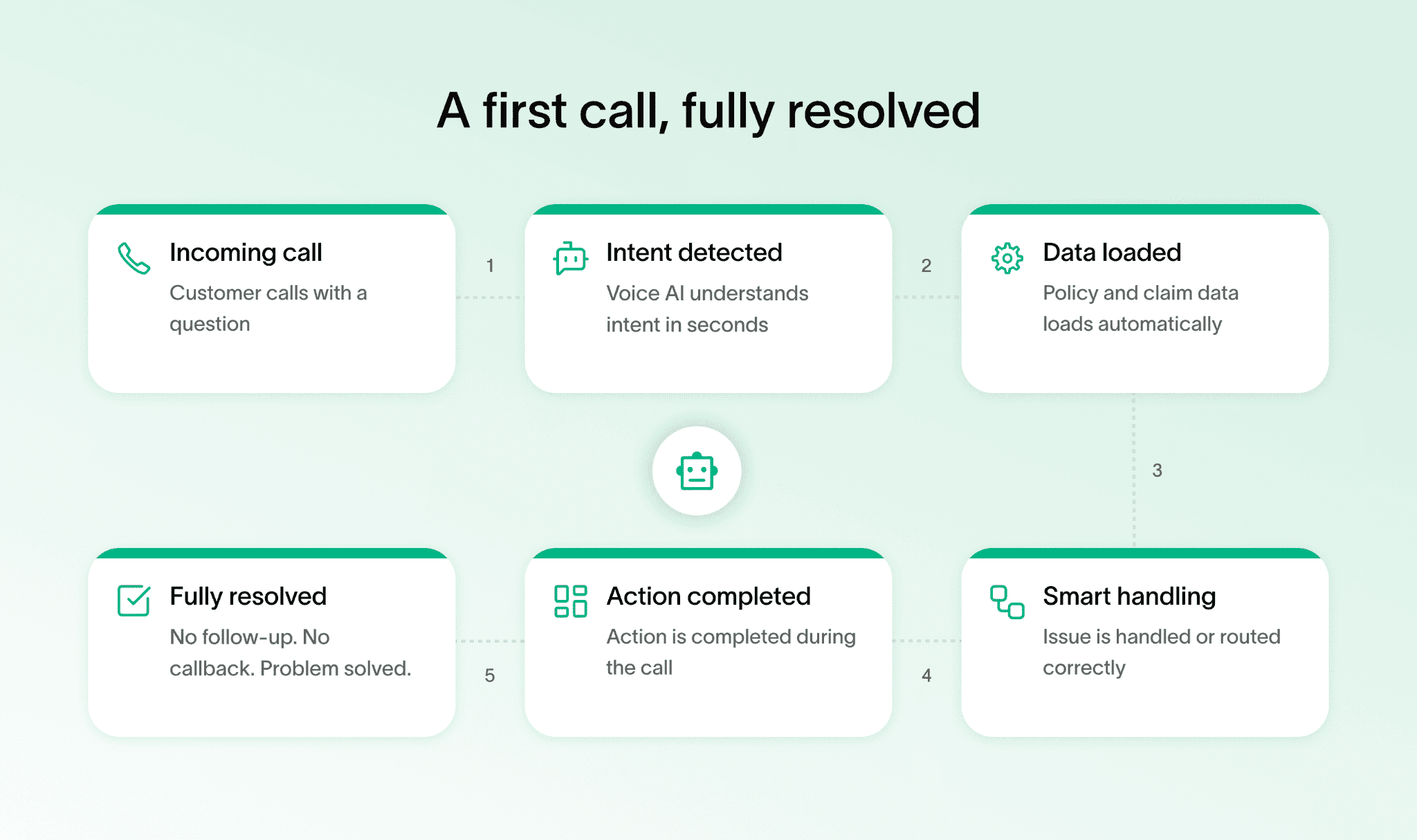
Typical FCR averages vary by channel:
Phone → 70-75%.
Chat → 55-65%.
Email → 60-70%.
Self-service → 30-50%.
Hitting 80% or more is world-class. Insurance calls can be complex, with detailed claims and policies, which often lower FCR.
That’s where Strada’s AI shines.
It understands complex insurance conversations and handles them efficiently at scale. Plus, it works 24/7 with consistent quality, so no call goes unanswered, pushing your FCR closer to or even beyond 80%.
Knowing why FCR matters is only half the story. The next step is figuring out how to measure it accurately, and avoid misleading numbers.
How to measure and track first call resolution effectively
You’re probably wondering how to measure first call resolution in a way that’s clear, reliable, and actionable. It starts with defining what counts as a resolved call.
Simply put, a resolved call means the customer’s issue is fully fixed during that first interaction, with no need for follow-up.
Repeat contacts happen when the same customer reaches out again about the original problem within a certain time frame. Usually 7 to 30 days.
To get the full picture, combine system data from your contact center software, like call logs and CRM entries, with feedback from customers through CSAT and NPS surveys. This gives you a balanced view of resolution rates and actual satisfaction.
In practice, FCR doesn’t live in one system. Different signals come from different places, and each plays a role.
Data source | What you get | Why it matters for FCR |
Call logs | Call outcomes, repeat contacts | Shows if issues resurface |
CRM records | Case status, customer history | Confirms true resolution |
CSAT surveys | Immediate feedback | Validates call quality |
NPS surveys | Long-term sentiment | Links FCR to loyalty |
QA scores | Compliance and quality flags | Catches rushed resolutions |
For example, Strada provides powerful analytics and conversational intelligence dashboards that help capture detailed call outcomes and customer sentiment, which directly ties FCR to key business goals.
You also want to track FCR alongside other KPIs to avoid missing important nuances. Here are some to include:
Average handle time (AHT).
Customer effort score (CES).
Customer satisfaction score (CSAT).
Net promoter score (NPS).
Quality scores (QS).
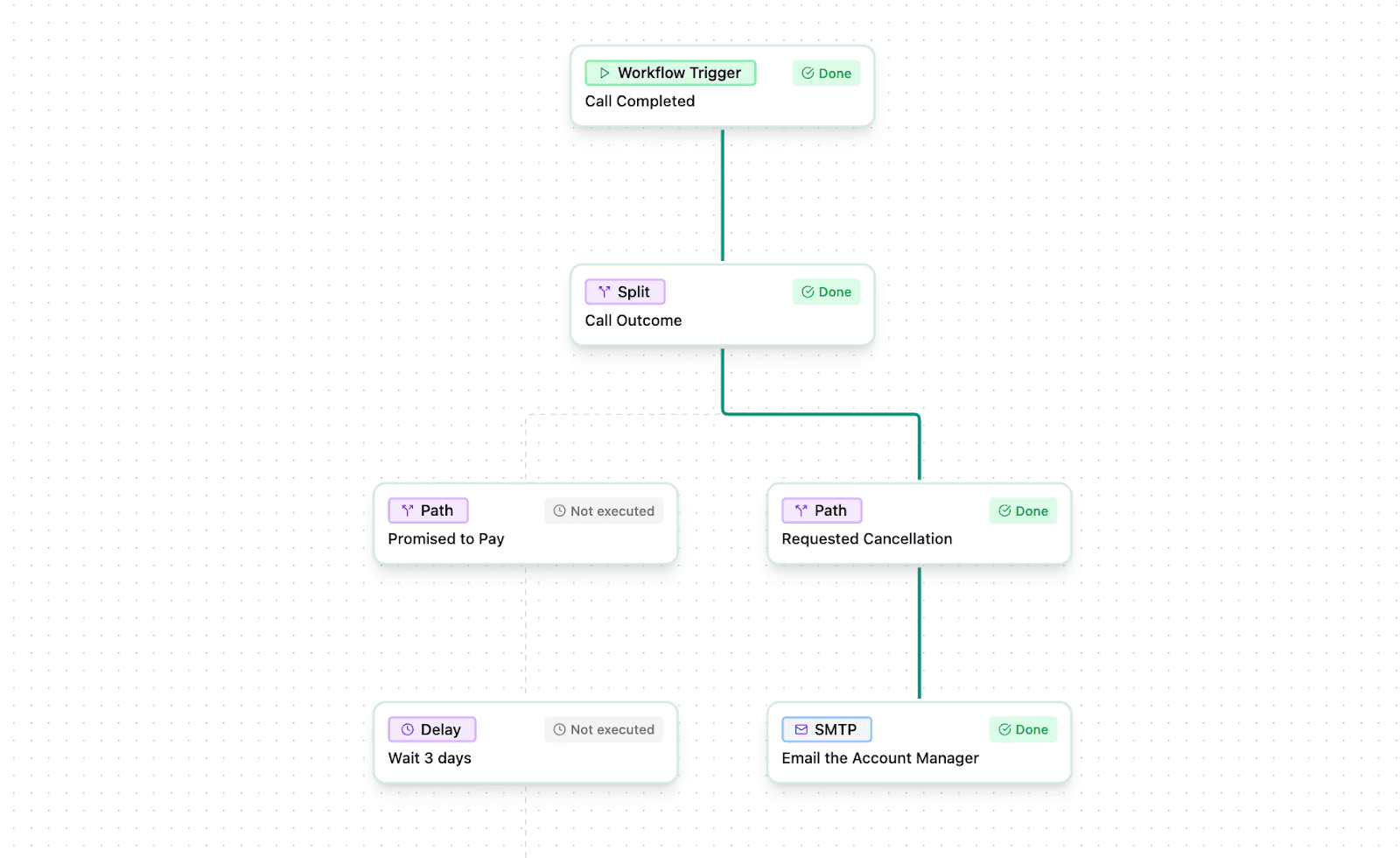
Focusing only on FCR risks pushing agents to rush calls, which can lower service quality. Strada’s Workflows feature helps prevent this by turning call insights into automated follow-ups and actions.
This reduces repeat contacts and boosts your ability to track true resolution and improve responsiveness.
Even with the right metrics in place, results don’t always improve. That’s usually because real-world constraints get in the way.
Common challenges to achieving high FCR in insurance service centers
You want to boost first call resolution rates, but there are plenty of hurdles in the way.
Information silos
One big issue is information silos. When agents can’t easily access customer and policy data, it slows down problem-solving.
Insurance inquiries aren’t simple either – they often involve multi-step claims, detailed policy checks, and strict regulatory requirements. This complexity makes it tough to wrap things up in one call.
Agents also face challenges from inadequate training and a lack of authority to fully resolve issues. On top of that, there’s pressure to keep calls short, which can cause agents to rush and leave problems unfinished.
Then, there’s the mess of multi-channel communication – data isn’t always consistent across phone, email, or chat platforms, creating confusion.
Operational bottlenecks that reduce FCR
Organizational issues don’t help either. High agent turnover means constant retraining and inconsistent processes, both of which hurt resolution rates.
To help you get a handle on these challenges, here’s a practical look at the key barriers to first call resolution:
Limited access to full customer data.
Complex, multi-step insurance inquiries.
Inconsistent agent training and limited decision-making power.
Pressure to reduce call times at the expense of resolution.
Disconnected data across communication channels.
High turnover and uneven processes.
Taken together, these challenges don’t exist in isolation. They compound each other, making it increasingly difficult for traditional service models to consistently resolve issues on the first call.
Moving beyond traditional service models
Now, here’s where Strada’s AI agents come in and make a real difference. Strada handles routine calls on its own, freeing human agents to focus on complex cases. It pulls data from AMS, CRM, and policy systems into one unified platform, breaking down those silos and giving agents a full picture during every call.
That means faster, more accurate resolutions. It also makes it easier to apply first call resolution best practices consistently across every interaction.
Plus, Strada’s AI scales easily to cover peak call times 24/7. This helps service centers keep quality high without overloading agents or driving turnover.
Modern tools help, but tools alone aren’t enough. The real gains come from applying the right best practices the right way.
What best practices improve FCR without sacrificing customer experience?
You want to hit high marks on FCR without making your customers feel rushed or frustrated. It’s about balancing quick problem-solving with a smooth, friendly experience.
To do this, you’ll want to monitor multiple KPIs together, think NPS, CES, CSAT, and AHT, which is a core part of sustainable first call resolution best practices.
These metrics give you a full picture of how your team is performing. For example, keeping an eye on average handle time alone might speed calls but hurt satisfaction, so pairing it with CSAT and NPS helps keep customer experience front and center.
Getting direct customer feedback is another secret weapon. Running automated surveys like Dialpad AI CSAT and NPS surveys right after calls lets you know instantly how you’re doing. This quick feedback helps you fix issues before they snowball.
Empower your agents with tools that make their jobs easier. Platforms that combine CRM, knowledge bases, and analytics, such as Dialpad Contact Center Analytics paired with Zendesk integrations, give agents everything they need at their fingertips.
Real-time transcription and AI coaching via tools like Dialpad AI Live Coach Cards ensure calls stay on track with quality advice delivered right when it’s needed.
Call routing also plays a huge role. Smart IVR systems that route based on language, inquiry type, and agent skills (thankfully, features included in Dialpad’s call routing) minimize wait times and annoying transfers that make customers call back.
Here’s a quick, practical checklist to boost your first call resolution best practices:
Train agents to ask if the issue is resolved before ending calls. This simple step cuts down repeat calls.
Encourage detailed note-taking in CRM or ticketing systems. Integrations like Dialpad with Zendesk make this seamless.
Maintain a searchable knowledge base accessible to both agents and customers. Helpjuice is a great option to reduce repeat questions.
Automate routine interactions and post-call actions with Strada’s conversational AI and Workflows. That means automatic updates like policy statuses, issuing certificates, and CRM record updates. No manual steps missed, fewer errors, and less repeat contact.
You can also use Strada’s real-time AI call transcription to coach agents live. This helps improve call quality without dragging out handle time.
Putting these first call resolution call center tips into practice creates a more efficient, customer-friendly environment.
Many of these best practices become much easier to scale with the right technology in place. That’s where voice AI starts to change the game.
How voice AI transforms insurance service centers to reach 80%+ first call resolution
You’re probably wondering how to improve first call resolution in insurance service centers. Voice AI is changing the game by handling routine and repetitive questions through conversational AI.
This frees up human agents to tackle more complex issues, boosting the first call resolution rate quickly and efficiently. And Voice AI doesn’t just speed things up. It changes the entire shape of the call.
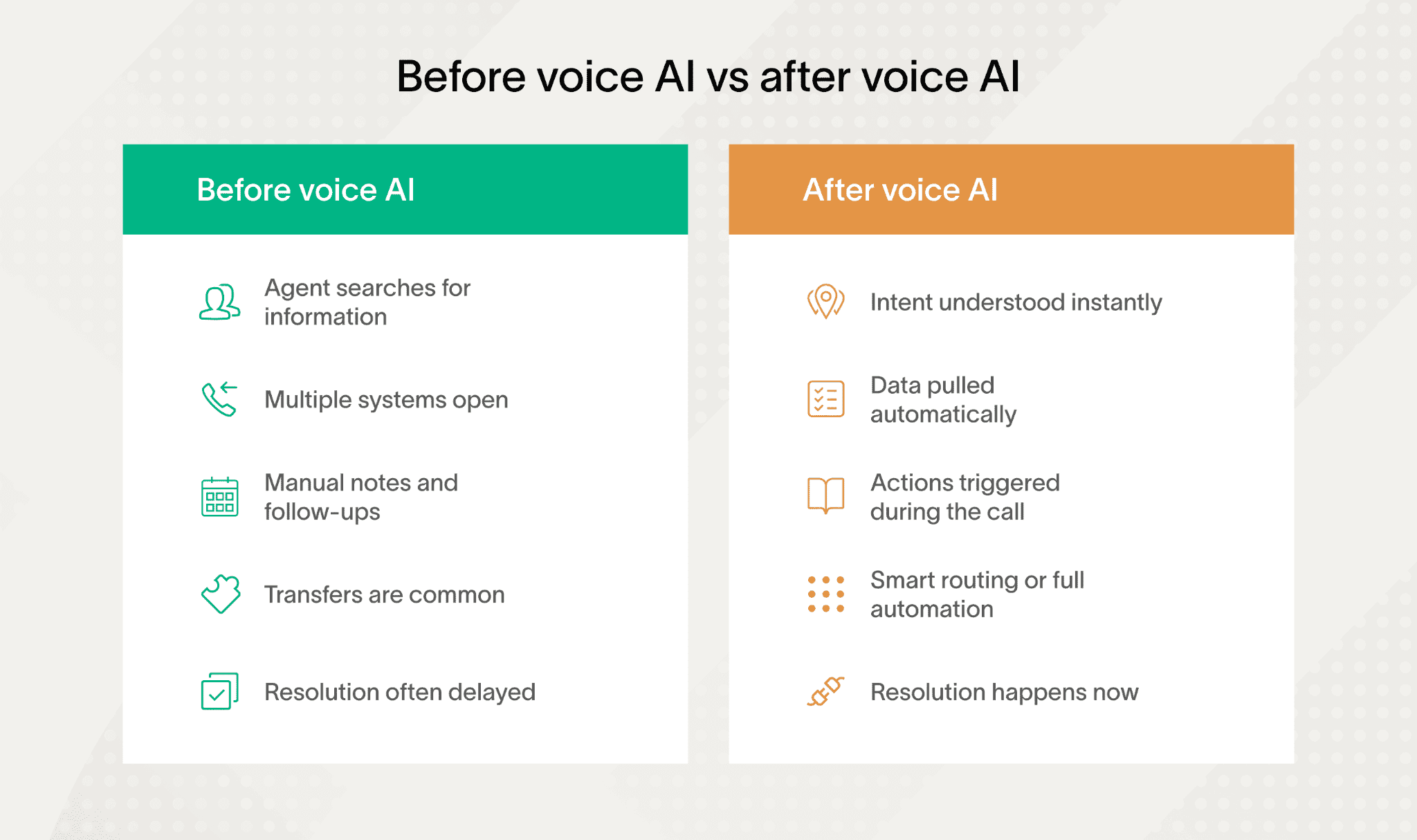
Here’s how voice AI makes that happen:
It uses natural language processing (NLP) and speech recognition tech like Google Dialogflow or Amazon Lex. This means calls get accurately transcribed, and the system understands what customers need right away.
AI-powered call routing and intelligent IVR reduce hold times and unnecessary transfers, so callers reach the right agent faster.
Real-time data from CRM and knowledge bases pops up during calls. This helps agents give faster, spot-on answers without wasting time digging for info.
AI-driven real-time coaching tools, such as Dialpad AI Live Coach Cards, listen in for keywords and suggest the best next steps to agents as conversations unfold.
Sentiment analysis monitors caller emotions and priorities, letting agents adapt their tone and focus based on how customers feel.
24/7 availability is now doable with AI receptionists like Nextiva AI Receptionist. These virtual assistants handle pre-screening and fix simple problems anytime, no matter the hour.
Integrations with claim processing and policy systems smooth out the entire customer journey, cutting down delays and errors.
A real game-changer is Strada. Their AI phone agents truly "get" insurance talk and can manage inbound or outbound calls at scale with near human accuracy.
Plus, Strada Workflows instantly turn conversation insights into business actions. Think setting up retention tasks, kicking off claims, or issuing certificates right after the call ends.
This speeds up resolutions and pushes that first call resolution rate well beyond average.
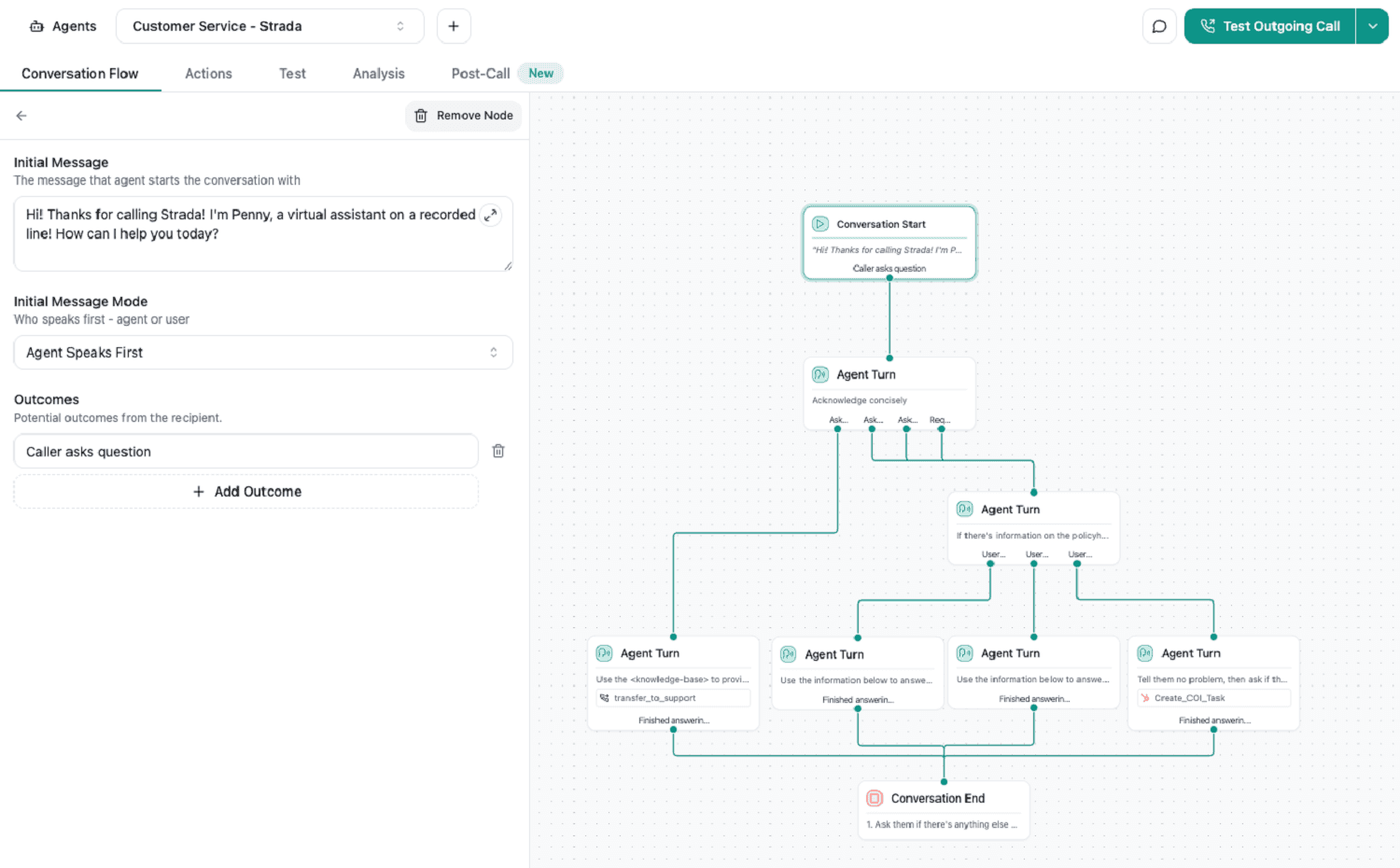
Strada also makes deployment easy with no engineering lift needed. Their AI agents slide right in alongside human teams, combining automation with expert help to hit and even exceed your FCR goals.
Understanding the impact of voice AI is useful. Now let’s break down how to actually put it to work.
Practical steps to boost first call resolution with voice AI
You want to improve your insurance service center’s first call resolution rate, aiming for that 80%+ mark. The good news? Voice AI is a game-changer when it comes to reducing repeat calls and speeding up issue resolution.
But how do you put it all together if your goal is how to improve first call resolution at scale? Let’s walk through step-by-step how you can implement voice AI and improve FCR with practical tools and proven strategies.
Assess your current FCR and pinpoint pain points
Start by understanding where your service fails to resolve issues on the first call. At this stage, the focus is not on fixing problems yet, but on identifying why customers need to call back and where the resolution process breaks down.
Speech analytics tools like CallMiner Eureka or NICE Enlighten help analyze call recordings and surface the most common drivers of repeat contacts, including:
Unclear or inconsistent information about policy status.
Delays or gaps in claims follow-ups.
Missing context during the initial interaction.
Handoffs between agents that interrupt resolution.
By combining call data with direct call reviews, you can clearly see which issues frustrate customers most and which gaps have the biggest impact on repeat calls.
Pilot voice AI on repeat-heavy call types
Once you’ve found those repeat call triggers, pick specific call types to pilot voice AI. Routine inquiries like checking policy status or updating personal info are perfect candidates. Use platforms like Strada, Google Dialogflow, or Amazon Lex to build conversational AI bots.
Make sure these voice AI tools integrate smoothly with your existing CRM systems such as Salesforce or Microsoft Dynamics 365. This way, the AI pulls real-time customer data, speeding responses and reducing the need for callbacks.
Train agents and embrace AI-augmented workflows
Introducing new technology works best when your team is ready and willing. Train your agents on how AI will support them, not replace them.
Tools like Strada, Dialpad AI Live Coach Cards, and Gong.io provide real-time feedback based on conversations, helping agents improve on the spot.
Encourage your team to view these coaching tools as partners that help them solve customer issues faster and more confidently, paving the way for better first call resolution strategies.
Roll out AI gradually with continuous monitoring
Don’t rush the rollout. Start small, then expand as you learn what works. Use dashboard tools like Strada Analytics, Zendesk Explore, or Freshdesk Analytics to track how your AI implementation is affecting call metrics and customer feedback.
This ongoing monitoring helps you tweak AI workflows and quickly resolve any glitches.
Here’s a quick list of what to monitor continuously:
FCR rates.
Customer satisfaction scores.
Speed to answer.
Repeat call volume.
For example, contact center platforms like Five9, Talkdesk, or NICE CXone offer real-time dashboards showing these KPIs.
Watching these numbers closely keeps your AI tuned to your customers’ needs.
Invest in workforce engagement and training tools
Great AI is nothing without great people behind it. Use tools like Lessonly or Cornerstone OnDemand to train and engage your workforce continuously.
These platforms help you maintain high-quality service, ensuring your agents’ skills evolve alongside AI enhancements.
Leverage cloud IVR and intelligent routing integrated with CRM
Upgrade your call routing systems to cloud-based IVR solutions that integrate with your CRM and workforce management platforms. Options like Strada Workflows, Nextiva Unified-CXM or Genesys Cloud help direct calls to the best agent or AI bot based on customer information.
This reduces wait times and avoids transferring calls multiple times – a big win for first call resolution.
Maintain and update AI-augmented knowledge bases
Agents and AI both need quick access to accurate information. Use knowledge base tools like Helpjuice or Guru to maintain up-to-date resources.
Adding multimedia such as videos and flowcharts makes it easier for everyone to find answers fast, directly supporting higher FCR rates.
Enable multichannel support for a seamless experience
Customers don’t just call anymore. They chat, email, and message on social channels.
Conversational AI platforms like Zendesk Sunshine or Freshchat help you handle these interactions alongside calls, creating a unified experience that reduces follow-up contacts.
Adopt the Strada deployment strategy for rapid, low-effort implementation
If speed and minimal engineering effort are priorities, the Strada deployment strategy enables insurance service centers to move quickly without disrupting existing systems.
It focuses on low-lift integration with policy platforms and CRM tools, using pre-built workflows designed specifically for insurance operations.
Teams can validate impact early by piloting automation in high-volume, repeat-heavy scenarios, such as:
Renewal risk management and outbound retention calls.
Claims intake and status inquiries.
Certificate issuance and policy document requests.
These targeted pilots reduce manual busywork and repeat contacts, delivering measurable improvements in first call resolution without requiring large-scale system changes.
Strada’s analytics suite supports this rollout by tracking FCR, customer satisfaction, and call outcomes while automating routine post-call actions.
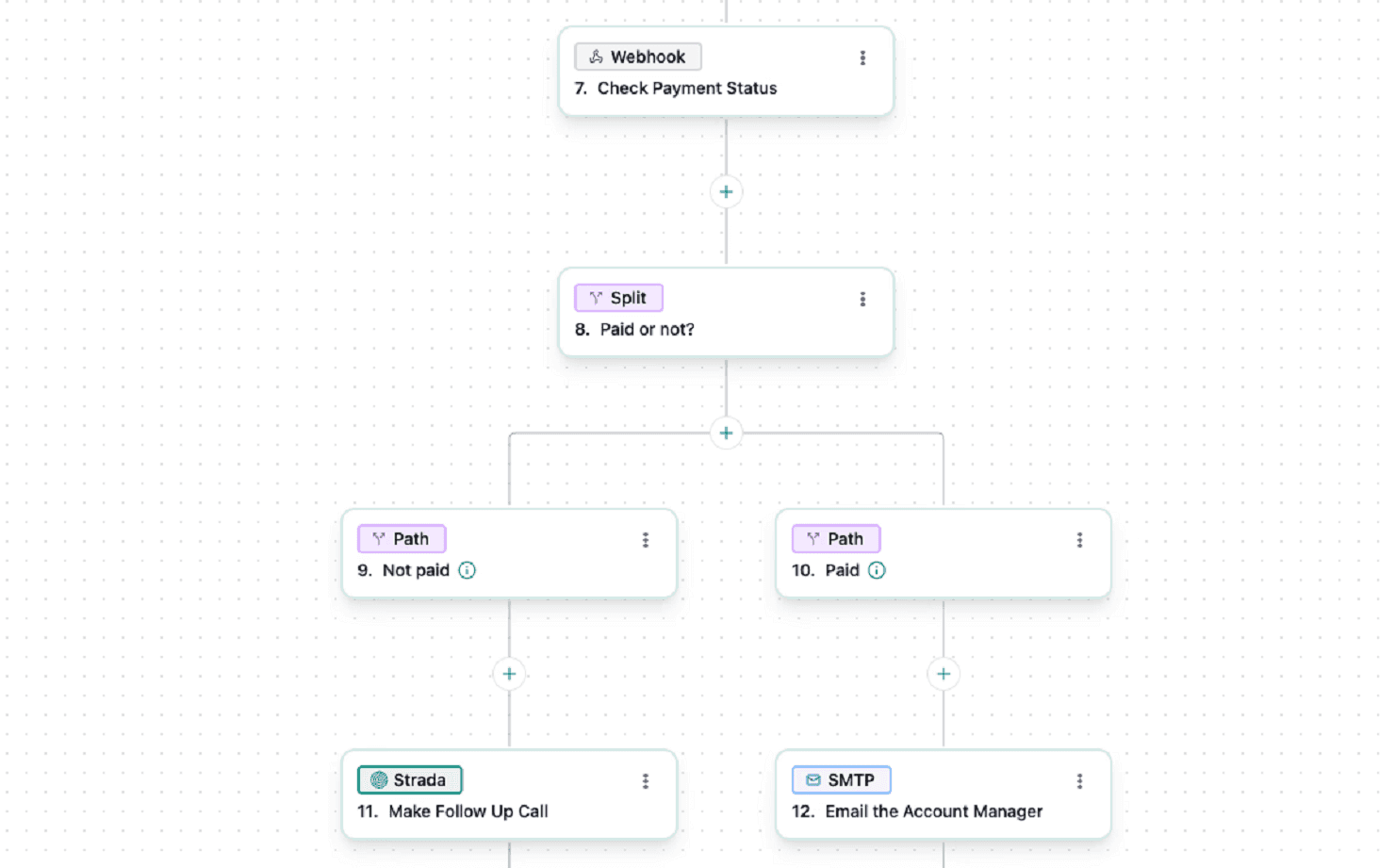
This deployment model allows service centers to scale voice AI confidently and efficiently, keeping issues resolved on the first call as volumes grow.
As automation increases, the human role becomes even more important. Motivated agents are what turn efficiency into great service.
How insurance service centers can motivate and empower agents in an AI-driven environment
Start by giving agents more decision-making power within clear policies. When agents can solve issues quickly on their own, customers get answers faster and agents feel more in control.
Empowering agents through autonomy and accountability
Next, use AI-driven quality management tools like Observe.AI or CallMiner. These platforms provide real-time feedback on sentiment and compliance, turning every call into a coaching moment.
Combine this with continuous learning programs that use call recordings and AI sentiment insights. Integrate these into LMS platforms such as Docebo or SAP Litmos so agents can keep sharpening their skills.
Continuous coaching and performance development
Use AI-driven analytics tools like Ambition or Playvox to support ongoing coaching tied directly to resolution quality, not call volume:
Connect gamification and rewards to FCR and CSAT.
Recognize top performers to reinforce effective behaviors.
Use real call data for timely, objective feedback.
Dashboards in tools like Tableau or Power BI help keep performance visible and aligned with quality-driven outcomes.
Tools and workflows that remove friction
A unified agent desktop (UAD) streamlines everything by showing customer history and AI recommendations in one place. Tools like Five9 Agent Desktop or Zendesk Unified Interface help agents make faster, informed decisions.
Strada plays a key role here by handling routine calls autonomously. This frees agents to focus on complex cases armed with the right data. Agents also benefit from Strada Workflows that automate follow-ups, letting them spend more time building strong customer relationships.
Once the system is running, the focus shifts to improvement. That means turning everyday data into long-term gains.
How do you measure and optimise FCR for continuous improvement?
Measuring FCR starts with regularly monitoring first call resolution metrics at both the individual agent and team levels.
And high FCR isn’t a one-time win. It’s a loop that keeps getting stronger.
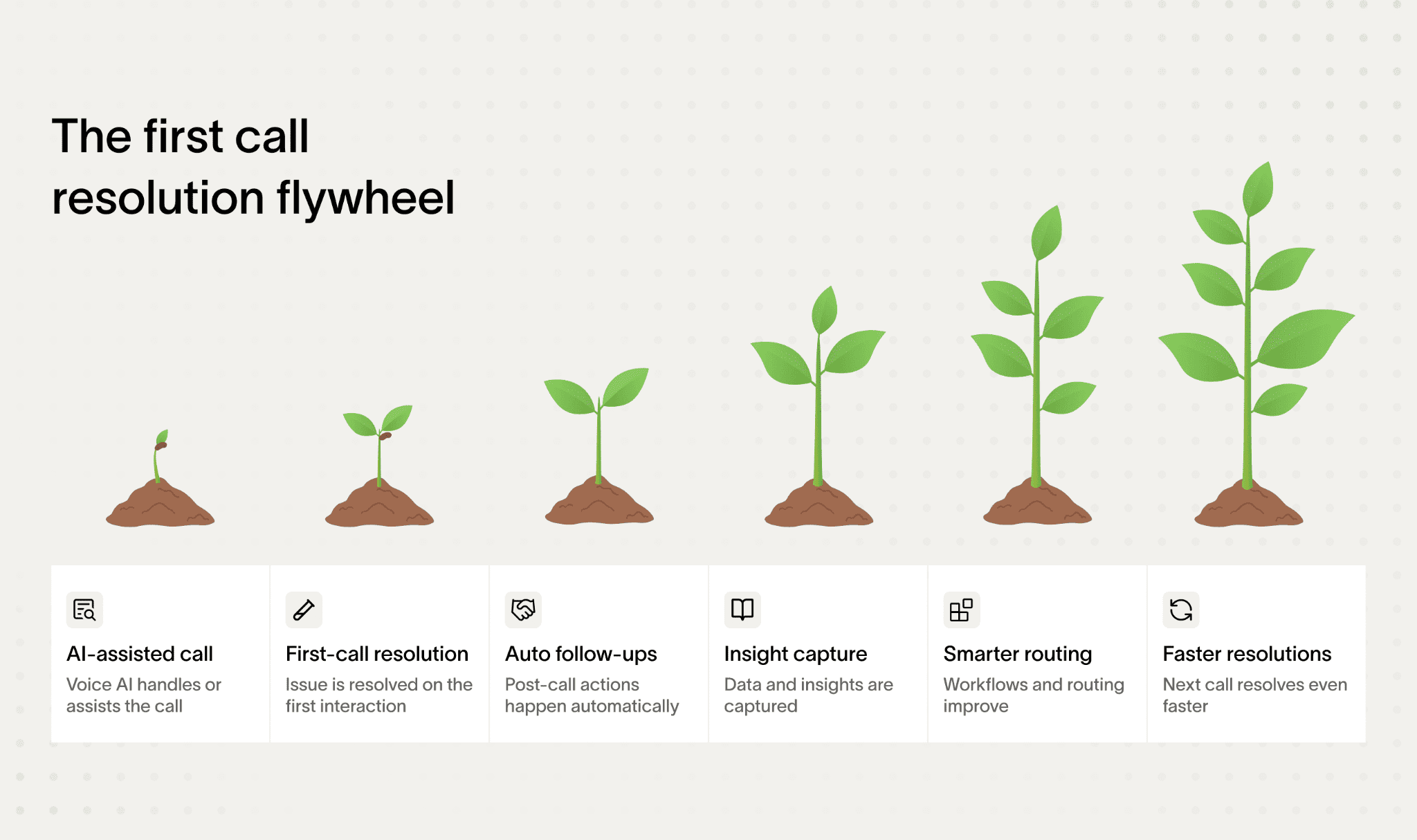
Use system reports alongside customer survey data to spot trends. Tools like Strada Analytics, NICE CXone, or Talkdesk Analytics help you set up alerts for sudden increases in repeat contacts, so you can react quickly when issues pop up.
Identifying resolution gaps and root causes
Next, bring AI into the mix.
AI-powered sentiment and interaction analytics, think Strada, Observe.AI, or Gong.io, spot common customer frustrations and friction points. These tools help identify exactly where agents might need targeted coaching before problems escalate.
To dig deeper, perform root cause analysis using call data, customer feedback, and CRM records. Applying methods like Six Sigma or DMAIC, tailored for service centers, can reveal systemic issues causing repeat calls. This helps you solve problems instead of just treating symptoms.
At this stage, the challenge is not collecting more data. It’s knowing how to turn different signals into the right actions.
Signal you observe | What it usually indicates | What to improve next |
Rising repeat call volume | Issues aren’t fully resolved | Strengthen post-call workflows |
Stable FCR, declining CSAT | Calls closed too quickly | Improve agent guidance and QA |
Long AHT with low FCR | Agents lack real-time context | Surface CRM and policy data live |
FCR drops during peak hours | Capacity or routing issues | Add AI handling for routine calls |
Strong CSAT, weak NPS | Short-term fixes, low trust | Improve consistency across channels |
The key is not reacting to individual signals, but understanding how they connect.
Turning FCR insights into continuous improvement actions
Balancing speed with quality matters. Adjust your first call resolution KPI and agent incentives to encourage thorough, not rushed, resolutions. Performance management frameworks like Balanced Scorecard or OKRs keep everyone aligned on the bigger picture.
To keep your goals realistic, benchmark your performance against industry standards using reports from groups like Gartner. Seeing where you stand helps set clear improvement targets.
Transparency fuels teamwork. Real-time dashboards from platforms like Geckoboard or Klipfolio give your team live updates on FCR progress and customer outcomes. Everyone stays motivated and accountable.
Strada’s ongoing conversational intelligence and call outcome automation take this further by reducing manual errors and ensuring best practices stick with every call.
Strada also delivers actionable insights from call analytics, pinpointing bottlenecks or frequently unresolved issues for smarter, data-driven continuous improvement cycles.
By combining these strategies, you turn first call resolution metrics into a powerful tool that keeps raising the bar for customer satisfaction and operational efficiency.
Improvement can’t come at the cost of trust. Data privacy and compliance need to be built into every step.
How to ensure data privacy and compliance when using voice AI in insurance service centers
When using voice AI to boost first call resolution in insurance service centers, protecting customer data and staying compliant is a must.
You’ll want to follow practical steps that keep privacy front and center while supporting first call resolution strategies.
Building a secure and compliant AI infrastructure
Start with secure cloud solutions that offer end-to-end encryption and data anonymization.
Platforms like AWS KMS or Microsoft Azure Security help keep data locked down safely. It’s just as important to use AI tools that have compliance certifications like SOC 2 and ISO 27001.
These platforms support role-based access controls with systems such as Okta or CyberArk, ensuring only authorized agents and AI components can access sensitive info.
Operational compliance and risk management practices
Next, implement regular audits and review recordings to catch any issues. Sensitive info should be redacted during transcription and analysis to avoid leaks.
Educate your agents on compliance policies and provide AI tools, like Observe.AI’s compliance modules, that flag risky language or possible privacy breaches in real-time.
Maintain clear records of consent and interaction logs using CRM features from solutions like Salesforce Shield. This helps build trust and keeps you audit-ready.
Strada’s security-first design ties it all together. With SOC 2 Type 2 certification, strict data isolation, and no cross-customer training data sharing, Strada ensures AI voice interactions meet insurance industry regulations fully.
Plus, regular penetration testing and security audits keep things solid.
By combining these practical actions, you’ll protect customer data and make your voice AI-driven first call resolution strategies work smoothly and safely.
With the right safeguards in place, scaling becomes much easier. Now it’s about growing without adding complexity.
How insurance service centers can scale voice AI solutions as they grow
Start with modular AI components like IVR, transcription, and coaching. These let you add new features bit by bit, guided by ROI and agent feedback. No need to overhaul the whole system at once.
Then, move to cloud-native, scalable platforms such as Google Cloud Contact Center AI or Amazon Connect. They handle rising call volumes and complex interactions without slowing down.
Next, integrate voice AI with your CRM and ERP tools (think HubSpot, Salesforce or Microsoft Dynamics 365 Finance & Operations). This keeps your data flowing seamlessly across teams, improving efficiency and accuracy.
To make this work, build cross-functional teams with IT, compliance, and customer service reps. They’ll manage updates, training, and your AI roadmap together.
Here’s a quick checklist to keep your scaling on track:
Monitor system performance and customer impact KPIs regularly.
Use AI analytics and capacity planning tools like Dynatrace or New Relic.
Anticipate bottlenecks before they slow you down.
Strada’s conversational AI offers an infinitely scalable platform that supports thousands of simultaneous inbound and outbound calls. It adapts easily as you grow, without extra human costs.
Their no-engineering-lift integrations and automation workflows mean you can expand fast without IT slowdowns or operational disruptions. Plus, Strada’s forward-deployed customer success and engineering teams partner closely with you to ensure smooth scaling and adaptation.
If you want practical insights on how to improve first call resolution, consider booking a demo with Strada. It’s a simple step toward transforming your service center.
Frequently Asked Questions
What is a good first call resolution rate for insurance service centers?
A strong benchmark is 70–75%. Reaching 80%+ is considered best-in-class and usually requires automation, AI-assisted workflows, and better access to real-time policy data.
How long does it take to improve first call resolution with voice AI?
Framer is a design tool that allows you to design websites on a freeform canvas, and then publish them as websites with a single click.
Does improving FCR mean agents have to rush calls?
Framer is a design tool that allows you to design websites on a freeform canvas, and then publish them as websites with a single click.
What types of calls should be automated first to improve FCR?
Framer is a design tool that allows you to design websites on a freeform canvas, and then publish them as websites with a single click.
How do you know if a call was truly resolved?
Framer is a design tool that allows you to design websites on a freeform canvas, and then publish them as websites with a single click.
Table of Contents
Carriers, MGAs, and brokers scale revenue-driving phone calls with Strada's conversational AI platform.
Start scaling with voice AI agents today
Join innovative carriers and MGAs transforming their calls with Strada.
80%+ First Call Resolution: How Voice AI Transforms Insurance Service Centers

Amir Prodensky
CEO
Dec 22, 2025
13 min read
How insurers reduce repeat calls and improve service with voice AI
You’ve probably heard about first call resolution, or FCR, which means solving a customer’s issue during their first call. First contact resolution is similar but covers all channels: calls, emails, chats.
For insurance service centers, hitting 80%+ first call resolution is a big deal. It means happier customers and smoother operations.
Here’s why it matters: hitting this benchmark cuts costs, boosts agent morale, and raises your Net Promoter Score (NPS). According to industry research, improving FCR by just 1% can save centers around $286,000 annually (SQM Group).
Voice AI plays a huge role here. Platforms like Strada use AI trained specifically on insurance terms and tasks, like renewals, claims, and policy servicing, to handle routine tasks quickly and accurately.
In the next few minutes, you’ll learn how this setup turns your first call resolution call center into a well-oiled machine, scaling revenue-driving calls and boosting satisfaction.
Let’s define FCR clearly first, because every metric and improvement tactic depends on it.
What is first call resolution and why does it matter?
First call resolution is the percentage of customer issues solved during the first interaction without needing a callback or follow-up. It’s a key measure of how well service teams handle problems right away.
While FCR focuses on phone calls, first contact resolution covers all channels: phone, chat, email, and social media.
Understanding the difference helps you track performance accurately across your service center and sets the groundwork for how to measure first call resolution correctly.
Why is FCR so important? It’s a vital first call resolution KPI that links customer satisfaction, loyalty, reduced operational costs, and agent efficiency. Higher FCR means happier customers and fewer repeated contacts, saving time and resources.
You can calculate your first call resolution rate like this:
(Resolved cases on first call / total cases handled) x 100 = FCR rate (%)
Defining what “resolved” means clearly (and setting a timeframe for repeat contacts, usually 7-14 days) is crucial to accurate first call resolution metrics.
So what does a “resolved” call actually look like in real life?
Let’s walk through a single insurance call from start to finish.

Typical FCR averages vary by channel:
Phone → 70-75%.
Chat → 55-65%.
Email → 60-70%.
Self-service → 30-50%.
Hitting 80% or more is world-class. Insurance calls can be complex, with detailed claims and policies, which often lower FCR.
That’s where Strada’s AI shines.
It understands complex insurance conversations and handles them efficiently at scale. Plus, it works 24/7 with consistent quality, so no call goes unanswered, pushing your FCR closer to or even beyond 80%.
Knowing why FCR matters is only half the story. The next step is figuring out how to measure it accurately, and avoid misleading numbers.
How to measure and track first call resolution effectively
You’re probably wondering how to measure first call resolution in a way that’s clear, reliable, and actionable. It starts with defining what counts as a resolved call.
Simply put, a resolved call means the customer’s issue is fully fixed during that first interaction, with no need for follow-up.
Repeat contacts happen when the same customer reaches out again about the original problem within a certain time frame. Usually 7 to 30 days.
To get the full picture, combine system data from your contact center software, like call logs and CRM entries, with feedback from customers through CSAT and NPS surveys. This gives you a balanced view of resolution rates and actual satisfaction.
In practice, FCR doesn’t live in one system. Different signals come from different places, and each plays a role.
Data source | What you get | Why it matters for FCR |
Call logs | Call outcomes, repeat contacts | Shows if issues resurface |
CRM records | Case status, customer history | Confirms true resolution |
CSAT surveys | Immediate feedback | Validates call quality |
NPS surveys | Long-term sentiment | Links FCR to loyalty |
QA scores | Compliance and quality flags | Catches rushed resolutions |
For example, Strada provides powerful analytics and conversational intelligence dashboards that help capture detailed call outcomes and customer sentiment, which directly ties FCR to key business goals.
You also want to track FCR alongside other KPIs to avoid missing important nuances. Here are some to include:
Average handle time (AHT).
Customer effort score (CES).
Customer satisfaction score (CSAT).
Net promoter score (NPS).
Quality scores (QS).
Focusing only on FCR risks pushing agents to rush calls, which can lower service quality. Strada’s Workflows feature helps prevent this by turning call insights into automated follow-ups and actions.
This reduces repeat contacts and boosts your ability to track true resolution and improve responsiveness.
Even with the right metrics in place, results don’t always improve. That’s usually because real-world constraints get in the way.
Common challenges to achieving high FCR in insurance service centers
You want to boost first call resolution rates, but there are plenty of hurdles in the way.
Information silos
One big issue is information silos. When agents can’t easily access customer and policy data, it slows down problem-solving.
Insurance inquiries aren’t simple either – they often involve multi-step claims, detailed policy checks, and strict regulatory requirements. This complexity makes it tough to wrap things up in one call.
Agents also face challenges from inadequate training and a lack of authority to fully resolve issues. On top of that, there’s pressure to keep calls short, which can cause agents to rush and leave problems unfinished.
Then, there’s the mess of multi-channel communication – data isn’t always consistent across phone, email, or chat platforms, creating confusion.
Operational bottlenecks that reduce FCR
Organizational issues don’t help either. High agent turnover means constant retraining and inconsistent processes, both of which hurt resolution rates.
To help you get a handle on these challenges, here’s a practical look at the key barriers to first call resolution:
Limited access to full customer data.
Complex, multi-step insurance inquiries.
Inconsistent agent training and limited decision-making power.
Pressure to reduce call times at the expense of resolution.
Disconnected data across communication channels.
High turnover and uneven processes.
Taken together, these challenges don’t exist in isolation. They compound each other, making it increasingly difficult for traditional service models to consistently resolve issues on the first call.
Moving beyond traditional service models
Now, here’s where Strada’s AI agents come in and make a real difference. Strada handles routine calls on its own, freeing human agents to focus on complex cases. It pulls data from AMS, CRM, and policy systems into one unified platform, breaking down those silos and giving agents a full picture during every call.
That means faster, more accurate resolutions. It also makes it easier to apply first call resolution best practices consistently across every interaction.
Plus, Strada’s AI scales easily to cover peak call times 24/7. This helps service centers keep quality high without overloading agents or driving turnover.
Modern tools help, but tools alone aren’t enough. The real gains come from applying the right best practices the right way.
What best practices improve FCR without sacrificing customer experience?
You want to hit high marks on FCR without making your customers feel rushed or frustrated. It’s about balancing quick problem-solving with a smooth, friendly experience.
To do this, you’ll want to monitor multiple KPIs together, think NPS, CES, CSAT, and AHT, which is a core part of sustainable first call resolution best practices.
These metrics give you a full picture of how your team is performing. For example, keeping an eye on average handle time alone might speed calls but hurt satisfaction, so pairing it with CSAT and NPS helps keep customer experience front and center.
Getting direct customer feedback is another secret weapon. Running automated surveys like Dialpad AI CSAT and NPS surveys right after calls lets you know instantly how you’re doing. This quick feedback helps you fix issues before they snowball.
Empower your agents with tools that make their jobs easier. Platforms that combine CRM, knowledge bases, and analytics, such as Dialpad Contact Center Analytics paired with Zendesk integrations, give agents everything they need at their fingertips.
Real-time transcription and AI coaching via tools like Dialpad AI Live Coach Cards ensure calls stay on track with quality advice delivered right when it’s needed.
Call routing also plays a huge role. Smart IVR systems that route based on language, inquiry type, and agent skills (thankfully, features included in Dialpad’s call routing) minimize wait times and annoying transfers that make customers call back.
Here’s a quick, practical checklist to boost your first call resolution best practices:
Train agents to ask if the issue is resolved before ending calls. This simple step cuts down repeat calls.
Encourage detailed note-taking in CRM or ticketing systems. Integrations like Dialpad with Zendesk make this seamless.
Maintain a searchable knowledge base accessible to both agents and customers. Helpjuice is a great option to reduce repeat questions.
Automate routine interactions and post-call actions with Strada’s conversational AI and Workflows. That means automatic updates like policy statuses, issuing certificates, and CRM record updates. No manual steps missed, fewer errors, and less repeat contact.
You can also use Strada’s real-time AI call transcription to coach agents live. This helps improve call quality without dragging out handle time.
Putting these first call resolution call center tips into practice creates a more efficient, customer-friendly environment.
Many of these best practices become much easier to scale with the right technology in place. That’s where voice AI starts to change the game.
How voice AI transforms insurance service centers to reach 80%+ first call resolution
You’re probably wondering how to improve first call resolution in insurance service centers. Voice AI is changing the game by handling routine and repetitive questions through conversational AI.
This frees up human agents to tackle more complex issues, boosting the first call resolution rate quickly and efficiently. And Voice AI doesn’t just speed things up. It changes the entire shape of the call.

Here’s how voice AI makes that happen:
It uses natural language processing (NLP) and speech recognition tech like Google Dialogflow or Amazon Lex. This means calls get accurately transcribed, and the system understands what customers need right away.
AI-powered call routing and intelligent IVR reduce hold times and unnecessary transfers, so callers reach the right agent faster.
Real-time data from CRM and knowledge bases pops up during calls. This helps agents give faster, spot-on answers without wasting time digging for info.
AI-driven real-time coaching tools, such as Dialpad AI Live Coach Cards, listen in for keywords and suggest the best next steps to agents as conversations unfold.
Sentiment analysis monitors caller emotions and priorities, letting agents adapt their tone and focus based on how customers feel.
24/7 availability is now doable with AI receptionists like Nextiva AI Receptionist. These virtual assistants handle pre-screening and fix simple problems anytime, no matter the hour.
Integrations with claim processing and policy systems smooth out the entire customer journey, cutting down delays and errors.
A real game-changer is Strada. Their AI phone agents truly "get" insurance talk and can manage inbound or outbound calls at scale with near human accuracy.
Plus, Strada Workflows instantly turn conversation insights into business actions. Think setting up retention tasks, kicking off claims, or issuing certificates right after the call ends.
This speeds up resolutions and pushes that first call resolution rate well beyond average.

Strada also makes deployment easy with no engineering lift needed. Their AI agents slide right in alongside human teams, combining automation with expert help to hit and even exceed your FCR goals.
Understanding the impact of voice AI is useful. Now let’s break down how to actually put it to work.
Practical steps to boost first call resolution with voice AI
You want to improve your insurance service center’s first call resolution rate, aiming for that 80%+ mark. The good news? Voice AI is a game-changer when it comes to reducing repeat calls and speeding up issue resolution.
But how do you put it all together if your goal is how to improve first call resolution at scale? Let’s walk through step-by-step how you can implement voice AI and improve FCR with practical tools and proven strategies.
Assess your current FCR and pinpoint pain points
Start by understanding where your service fails to resolve issues on the first call. At this stage, the focus is not on fixing problems yet, but on identifying why customers need to call back and where the resolution process breaks down.
Speech analytics tools like CallMiner Eureka or NICE Enlighten help analyze call recordings and surface the most common drivers of repeat contacts, including:
Unclear or inconsistent information about policy status.
Delays or gaps in claims follow-ups.
Missing context during the initial interaction.
Handoffs between agents that interrupt resolution.
By combining call data with direct call reviews, you can clearly see which issues frustrate customers most and which gaps have the biggest impact on repeat calls.
Pilot voice AI on repeat-heavy call types
Once you’ve found those repeat call triggers, pick specific call types to pilot voice AI. Routine inquiries like checking policy status or updating personal info are perfect candidates. Use platforms like Strada, Google Dialogflow, or Amazon Lex to build conversational AI bots.
Make sure these voice AI tools integrate smoothly with your existing CRM systems such as Salesforce or Microsoft Dynamics 365. This way, the AI pulls real-time customer data, speeding responses and reducing the need for callbacks.
Train agents and embrace AI-augmented workflows
Introducing new technology works best when your team is ready and willing. Train your agents on how AI will support them, not replace them.
Tools like Strada, Dialpad AI Live Coach Cards, and Gong.io provide real-time feedback based on conversations, helping agents improve on the spot.
Encourage your team to view these coaching tools as partners that help them solve customer issues faster and more confidently, paving the way for better first call resolution strategies.
Roll out AI gradually with continuous monitoring
Don’t rush the rollout. Start small, then expand as you learn what works. Use dashboard tools like Strada Analytics, Zendesk Explore, or Freshdesk Analytics to track how your AI implementation is affecting call metrics and customer feedback.
This ongoing monitoring helps you tweak AI workflows and quickly resolve any glitches.
Here’s a quick list of what to monitor continuously:
FCR rates.
Customer satisfaction scores.
Speed to answer.
Repeat call volume.
For example, contact center platforms like Five9, Talkdesk, or NICE CXone offer real-time dashboards showing these KPIs.
Watching these numbers closely keeps your AI tuned to your customers’ needs.
Invest in workforce engagement and training tools
Great AI is nothing without great people behind it. Use tools like Lessonly or Cornerstone OnDemand to train and engage your workforce continuously.
These platforms help you maintain high-quality service, ensuring your agents’ skills evolve alongside AI enhancements.
Leverage cloud IVR and intelligent routing integrated with CRM
Upgrade your call routing systems to cloud-based IVR solutions that integrate with your CRM and workforce management platforms. Options like Strada Workflows, Nextiva Unified-CXM or Genesys Cloud help direct calls to the best agent or AI bot based on customer information.
This reduces wait times and avoids transferring calls multiple times – a big win for first call resolution.
Maintain and update AI-augmented knowledge bases
Agents and AI both need quick access to accurate information. Use knowledge base tools like Helpjuice or Guru to maintain up-to-date resources.
Adding multimedia such as videos and flowcharts makes it easier for everyone to find answers fast, directly supporting higher FCR rates.
Enable multichannel support for a seamless experience
Customers don’t just call anymore. They chat, email, and message on social channels.
Conversational AI platforms like Zendesk Sunshine or Freshchat help you handle these interactions alongside calls, creating a unified experience that reduces follow-up contacts.
Adopt the Strada deployment strategy for rapid, low-effort implementation
If speed and minimal engineering effort are priorities, the Strada deployment strategy enables insurance service centers to move quickly without disrupting existing systems.
It focuses on low-lift integration with policy platforms and CRM tools, using pre-built workflows designed specifically for insurance operations.
Teams can validate impact early by piloting automation in high-volume, repeat-heavy scenarios, such as:
Renewal risk management and outbound retention calls.
Claims intake and status inquiries.
Certificate issuance and policy document requests.
These targeted pilots reduce manual busywork and repeat contacts, delivering measurable improvements in first call resolution without requiring large-scale system changes.
Strada’s analytics suite supports this rollout by tracking FCR, customer satisfaction, and call outcomes while automating routine post-call actions.

This deployment model allows service centers to scale voice AI confidently and efficiently, keeping issues resolved on the first call as volumes grow.
As automation increases, the human role becomes even more important. Motivated agents are what turn efficiency into great service.
How insurance service centers can motivate and empower agents in an AI-driven environment
Start by giving agents more decision-making power within clear policies. When agents can solve issues quickly on their own, customers get answers faster and agents feel more in control.
Empowering agents through autonomy and accountability
Next, use AI-driven quality management tools like Observe.AI or CallMiner. These platforms provide real-time feedback on sentiment and compliance, turning every call into a coaching moment.
Combine this with continuous learning programs that use call recordings and AI sentiment insights. Integrate these into LMS platforms such as Docebo or SAP Litmos so agents can keep sharpening their skills.
Continuous coaching and performance development
Use AI-driven analytics tools like Ambition or Playvox to support ongoing coaching tied directly to resolution quality, not call volume:
Connect gamification and rewards to FCR and CSAT.
Recognize top performers to reinforce effective behaviors.
Use real call data for timely, objective feedback.
Dashboards in tools like Tableau or Power BI help keep performance visible and aligned with quality-driven outcomes.
Tools and workflows that remove friction
A unified agent desktop (UAD) streamlines everything by showing customer history and AI recommendations in one place. Tools like Five9 Agent Desktop or Zendesk Unified Interface help agents make faster, informed decisions.
Strada plays a key role here by handling routine calls autonomously. This frees agents to focus on complex cases armed with the right data. Agents also benefit from Strada Workflows that automate follow-ups, letting them spend more time building strong customer relationships.

Once the system is running, the focus shifts to improvement. That means turning everyday data into long-term gains.
How do you measure and optimise FCR for continuous improvement?
Measuring FCR starts with regularly monitoring first call resolution metrics at both the individual agent and team levels.
And high FCR isn’t a one-time win. It’s a loop that keeps getting stronger.

Use system reports alongside customer survey data to spot trends. Tools like Strada Analytics, NICE CXone, or Talkdesk Analytics help you set up alerts for sudden increases in repeat contacts, so you can react quickly when issues pop up.
Identifying resolution gaps and root causes
Next, bring AI into the mix.
AI-powered sentiment and interaction analytics, think Strada, Observe.AI, or Gong.io, spot common customer frustrations and friction points. These tools help identify exactly where agents might need targeted coaching before problems escalate.
To dig deeper, perform root cause analysis using call data, customer feedback, and CRM records. Applying methods like Six Sigma or DMAIC, tailored for service centers, can reveal systemic issues causing repeat calls. This helps you solve problems instead of just treating symptoms.
At this stage, the challenge is not collecting more data. It’s knowing how to turn different signals into the right actions.
Signal you observe | What it usually indicates | What to improve next |
Rising repeat call volume | Issues aren’t fully resolved | Strengthen post-call workflows |
Stable FCR, declining CSAT | Calls closed too quickly | Improve agent guidance and QA |
Long AHT with low FCR | Agents lack real-time context | Surface CRM and policy data live |
FCR drops during peak hours | Capacity or routing issues | Add AI handling for routine calls |
Strong CSAT, weak NPS | Short-term fixes, low trust | Improve consistency across channels |
The key is not reacting to individual signals, but understanding how they connect.
Turning FCR insights into continuous improvement actions
Balancing speed with quality matters. Adjust your first call resolution KPI and agent incentives to encourage thorough, not rushed, resolutions. Performance management frameworks like Balanced Scorecard or OKRs keep everyone aligned on the bigger picture.
To keep your goals realistic, benchmark your performance against industry standards using reports from groups like Gartner. Seeing where you stand helps set clear improvement targets.
Transparency fuels teamwork. Real-time dashboards from platforms like Geckoboard or Klipfolio give your team live updates on FCR progress and customer outcomes. Everyone stays motivated and accountable.
Strada’s ongoing conversational intelligence and call outcome automation take this further by reducing manual errors and ensuring best practices stick with every call.
Strada also delivers actionable insights from call analytics, pinpointing bottlenecks or frequently unresolved issues for smarter, data-driven continuous improvement cycles.
By combining these strategies, you turn first call resolution metrics into a powerful tool that keeps raising the bar for customer satisfaction and operational efficiency.
Improvement can’t come at the cost of trust. Data privacy and compliance need to be built into every step.
How to ensure data privacy and compliance when using voice AI in insurance service centers
When using voice AI to boost first call resolution in insurance service centers, protecting customer data and staying compliant is a must.
You’ll want to follow practical steps that keep privacy front and center while supporting first call resolution strategies.
Building a secure and compliant AI infrastructure
Start with secure cloud solutions that offer end-to-end encryption and data anonymization.
Platforms like AWS KMS or Microsoft Azure Security help keep data locked down safely. It’s just as important to use AI tools that have compliance certifications like SOC 2 and ISO 27001.
These platforms support role-based access controls with systems such as Okta or CyberArk, ensuring only authorized agents and AI components can access sensitive info.
Operational compliance and risk management practices
Next, implement regular audits and review recordings to catch any issues. Sensitive info should be redacted during transcription and analysis to avoid leaks.
Educate your agents on compliance policies and provide AI tools, like Observe.AI’s compliance modules, that flag risky language or possible privacy breaches in real-time.
Maintain clear records of consent and interaction logs using CRM features from solutions like Salesforce Shield. This helps build trust and keeps you audit-ready.
Strada’s security-first design ties it all together. With SOC 2 Type 2 certification, strict data isolation, and no cross-customer training data sharing, Strada ensures AI voice interactions meet insurance industry regulations fully.
Plus, regular penetration testing and security audits keep things solid.
By combining these practical actions, you’ll protect customer data and make your voice AI-driven first call resolution strategies work smoothly and safely.
With the right safeguards in place, scaling becomes much easier. Now it’s about growing without adding complexity.
How insurance service centers can scale voice AI solutions as they grow
Start with modular AI components like IVR, transcription, and coaching. These let you add new features bit by bit, guided by ROI and agent feedback. No need to overhaul the whole system at once.
Then, move to cloud-native, scalable platforms such as Google Cloud Contact Center AI or Amazon Connect. They handle rising call volumes and complex interactions without slowing down.
Next, integrate voice AI with your CRM and ERP tools (think HubSpot, Salesforce or Microsoft Dynamics 365 Finance & Operations). This keeps your data flowing seamlessly across teams, improving efficiency and accuracy.
To make this work, build cross-functional teams with IT, compliance, and customer service reps. They’ll manage updates, training, and your AI roadmap together.
Here’s a quick checklist to keep your scaling on track:
Monitor system performance and customer impact KPIs regularly.
Use AI analytics and capacity planning tools like Dynatrace or New Relic.
Anticipate bottlenecks before they slow you down.
Strada’s conversational AI offers an infinitely scalable platform that supports thousands of simultaneous inbound and outbound calls. It adapts easily as you grow, without extra human costs.
Their no-engineering-lift integrations and automation workflows mean you can expand fast without IT slowdowns or operational disruptions. Plus, Strada’s forward-deployed customer success and engineering teams partner closely with you to ensure smooth scaling and adaptation.
If you want practical insights on how to improve first call resolution, consider booking a demo with Strada. It’s a simple step toward transforming your service center.
Frequently Asked Questions
What is a good first call resolution rate for insurance service centers?
A strong benchmark is 70–75%. Reaching 80%+ is considered best-in-class and usually requires automation, AI-assisted workflows, and better access to real-time policy data.
How long does it take to improve first call resolution with voice AI?
Framer is a design tool that allows you to design websites on a freeform canvas, and then publish them as websites with a single click.
Does improving FCR mean agents have to rush calls?
Framer is a design tool that allows you to design websites on a freeform canvas, and then publish them as websites with a single click.
What types of calls should be automated first to improve FCR?
Framer is a design tool that allows you to design websites on a freeform canvas, and then publish them as websites with a single click.
How do you know if a call was truly resolved?
Framer is a design tool that allows you to design websites on a freeform canvas, and then publish them as websites with a single click.
Table of Contents
Carriers, MGAs, and brokers scale revenue-driving phone calls with Strada's conversational AI platform.
Start scaling with voice AI agents today
Join innovative carriers and MGAs transforming their calls with Strada.
80%+ First Call Resolution: How Voice AI Transforms Insurance Service Centers

Amir Prodensky
CEO
Dec 22, 2025
13 min read
How insurers reduce repeat calls and improve service with voice AI
You’ve probably heard about first call resolution, or FCR, which means solving a customer’s issue during their first call. First contact resolution is similar but covers all channels: calls, emails, chats.
For insurance service centers, hitting 80%+ first call resolution is a big deal. It means happier customers and smoother operations.
Here’s why it matters: hitting this benchmark cuts costs, boosts agent morale, and raises your Net Promoter Score (NPS). According to industry research, improving FCR by just 1% can save centers around $286,000 annually (SQM Group).
Voice AI plays a huge role here. Platforms like Strada use AI trained specifically on insurance terms and tasks, like renewals, claims, and policy servicing, to handle routine tasks quickly and accurately.
In the next few minutes, you’ll learn how this setup turns your first call resolution call center into a well-oiled machine, scaling revenue-driving calls and boosting satisfaction.
Let’s define FCR clearly first, because every metric and improvement tactic depends on it.
What is first call resolution and why does it matter?
First call resolution is the percentage of customer issues solved during the first interaction without needing a callback or follow-up. It’s a key measure of how well service teams handle problems right away.
While FCR focuses on phone calls, first contact resolution covers all channels: phone, chat, email, and social media.
Understanding the difference helps you track performance accurately across your service center and sets the groundwork for how to measure first call resolution correctly.
Why is FCR so important? It’s a vital first call resolution KPI that links customer satisfaction, loyalty, reduced operational costs, and agent efficiency. Higher FCR means happier customers and fewer repeated contacts, saving time and resources.
You can calculate your first call resolution rate like this:
(Resolved cases on first call / total cases handled) x 100 = FCR rate (%)
Defining what “resolved” means clearly (and setting a timeframe for repeat contacts, usually 7-14 days) is crucial to accurate first call resolution metrics.
So what does a “resolved” call actually look like in real life?
Let’s walk through a single insurance call from start to finish.

Typical FCR averages vary by channel:
Phone → 70-75%.
Chat → 55-65%.
Email → 60-70%.
Self-service → 30-50%.
Hitting 80% or more is world-class. Insurance calls can be complex, with detailed claims and policies, which often lower FCR.
That’s where Strada’s AI shines.
It understands complex insurance conversations and handles them efficiently at scale. Plus, it works 24/7 with consistent quality, so no call goes unanswered, pushing your FCR closer to or even beyond 80%.
Knowing why FCR matters is only half the story. The next step is figuring out how to measure it accurately, and avoid misleading numbers.
How to measure and track first call resolution effectively
You’re probably wondering how to measure first call resolution in a way that’s clear, reliable, and actionable. It starts with defining what counts as a resolved call.
Simply put, a resolved call means the customer’s issue is fully fixed during that first interaction, with no need for follow-up.
Repeat contacts happen when the same customer reaches out again about the original problem within a certain time frame. Usually 7 to 30 days.
To get the full picture, combine system data from your contact center software, like call logs and CRM entries, with feedback from customers through CSAT and NPS surveys. This gives you a balanced view of resolution rates and actual satisfaction.
In practice, FCR doesn’t live in one system. Different signals come from different places, and each plays a role.
Data source | What you get | Why it matters for FCR |
Call logs | Call outcomes, repeat contacts | Shows if issues resurface |
CRM records | Case status, customer history | Confirms true resolution |
CSAT surveys | Immediate feedback | Validates call quality |
NPS surveys | Long-term sentiment | Links FCR to loyalty |
QA scores | Compliance and quality flags | Catches rushed resolutions |
For example, Strada provides powerful analytics and conversational intelligence dashboards that help capture detailed call outcomes and customer sentiment, which directly ties FCR to key business goals.
You also want to track FCR alongside other KPIs to avoid missing important nuances. Here are some to include:
Average handle time (AHT).
Customer effort score (CES).
Customer satisfaction score (CSAT).
Net promoter score (NPS).
Quality scores (QS).
Focusing only on FCR risks pushing agents to rush calls, which can lower service quality. Strada’s Workflows feature helps prevent this by turning call insights into automated follow-ups and actions.
This reduces repeat contacts and boosts your ability to track true resolution and improve responsiveness.
Even with the right metrics in place, results don’t always improve. That’s usually because real-world constraints get in the way.
Common challenges to achieving high FCR in insurance service centers
You want to boost first call resolution rates, but there are plenty of hurdles in the way.
Information silos
One big issue is information silos. When agents can’t easily access customer and policy data, it slows down problem-solving.
Insurance inquiries aren’t simple either – they often involve multi-step claims, detailed policy checks, and strict regulatory requirements. This complexity makes it tough to wrap things up in one call.
Agents also face challenges from inadequate training and a lack of authority to fully resolve issues. On top of that, there’s pressure to keep calls short, which can cause agents to rush and leave problems unfinished.
Then, there’s the mess of multi-channel communication – data isn’t always consistent across phone, email, or chat platforms, creating confusion.
Operational bottlenecks that reduce FCR
Organizational issues don’t help either. High agent turnover means constant retraining and inconsistent processes, both of which hurt resolution rates.
To help you get a handle on these challenges, here’s a practical look at the key barriers to first call resolution:
Limited access to full customer data.
Complex, multi-step insurance inquiries.
Inconsistent agent training and limited decision-making power.
Pressure to reduce call times at the expense of resolution.
Disconnected data across communication channels.
High turnover and uneven processes.
Taken together, these challenges don’t exist in isolation. They compound each other, making it increasingly difficult for traditional service models to consistently resolve issues on the first call.
Moving beyond traditional service models
Now, here’s where Strada’s AI agents come in and make a real difference. Strada handles routine calls on its own, freeing human agents to focus on complex cases. It pulls data from AMS, CRM, and policy systems into one unified platform, breaking down those silos and giving agents a full picture during every call.
That means faster, more accurate resolutions. It also makes it easier to apply first call resolution best practices consistently across every interaction.
Plus, Strada’s AI scales easily to cover peak call times 24/7. This helps service centers keep quality high without overloading agents or driving turnover.
Modern tools help, but tools alone aren’t enough. The real gains come from applying the right best practices the right way.
What best practices improve FCR without sacrificing customer experience?
You want to hit high marks on FCR without making your customers feel rushed or frustrated. It’s about balancing quick problem-solving with a smooth, friendly experience.
To do this, you’ll want to monitor multiple KPIs together, think NPS, CES, CSAT, and AHT, which is a core part of sustainable first call resolution best practices.
These metrics give you a full picture of how your team is performing. For example, keeping an eye on average handle time alone might speed calls but hurt satisfaction, so pairing it with CSAT and NPS helps keep customer experience front and center.
Getting direct customer feedback is another secret weapon. Running automated surveys like Dialpad AI CSAT and NPS surveys right after calls lets you know instantly how you’re doing. This quick feedback helps you fix issues before they snowball.
Empower your agents with tools that make their jobs easier. Platforms that combine CRM, knowledge bases, and analytics, such as Dialpad Contact Center Analytics paired with Zendesk integrations, give agents everything they need at their fingertips.
Real-time transcription and AI coaching via tools like Dialpad AI Live Coach Cards ensure calls stay on track with quality advice delivered right when it’s needed.
Call routing also plays a huge role. Smart IVR systems that route based on language, inquiry type, and agent skills (thankfully, features included in Dialpad’s call routing) minimize wait times and annoying transfers that make customers call back.
Here’s a quick, practical checklist to boost your first call resolution best practices:
Train agents to ask if the issue is resolved before ending calls. This simple step cuts down repeat calls.
Encourage detailed note-taking in CRM or ticketing systems. Integrations like Dialpad with Zendesk make this seamless.
Maintain a searchable knowledge base accessible to both agents and customers. Helpjuice is a great option to reduce repeat questions.
Automate routine interactions and post-call actions with Strada’s conversational AI and Workflows. That means automatic updates like policy statuses, issuing certificates, and CRM record updates. No manual steps missed, fewer errors, and less repeat contact.
You can also use Strada’s real-time AI call transcription to coach agents live. This helps improve call quality without dragging out handle time.
Putting these first call resolution call center tips into practice creates a more efficient, customer-friendly environment.
Many of these best practices become much easier to scale with the right technology in place. That’s where voice AI starts to change the game.
How voice AI transforms insurance service centers to reach 80%+ first call resolution
You’re probably wondering how to improve first call resolution in insurance service centers. Voice AI is changing the game by handling routine and repetitive questions through conversational AI.
This frees up human agents to tackle more complex issues, boosting the first call resolution rate quickly and efficiently. And Voice AI doesn’t just speed things up. It changes the entire shape of the call.

Here’s how voice AI makes that happen:
It uses natural language processing (NLP) and speech recognition tech like Google Dialogflow or Amazon Lex. This means calls get accurately transcribed, and the system understands what customers need right away.
AI-powered call routing and intelligent IVR reduce hold times and unnecessary transfers, so callers reach the right agent faster.
Real-time data from CRM and knowledge bases pops up during calls. This helps agents give faster, spot-on answers without wasting time digging for info.
AI-driven real-time coaching tools, such as Dialpad AI Live Coach Cards, listen in for keywords and suggest the best next steps to agents as conversations unfold.
Sentiment analysis monitors caller emotions and priorities, letting agents adapt their tone and focus based on how customers feel.
24/7 availability is now doable with AI receptionists like Nextiva AI Receptionist. These virtual assistants handle pre-screening and fix simple problems anytime, no matter the hour.
Integrations with claim processing and policy systems smooth out the entire customer journey, cutting down delays and errors.
A real game-changer is Strada. Their AI phone agents truly "get" insurance talk and can manage inbound or outbound calls at scale with near human accuracy.
Plus, Strada Workflows instantly turn conversation insights into business actions. Think setting up retention tasks, kicking off claims, or issuing certificates right after the call ends.
This speeds up resolutions and pushes that first call resolution rate well beyond average.

Strada also makes deployment easy with no engineering lift needed. Their AI agents slide right in alongside human teams, combining automation with expert help to hit and even exceed your FCR goals.
Understanding the impact of voice AI is useful. Now let’s break down how to actually put it to work.
Practical steps to boost first call resolution with voice AI
You want to improve your insurance service center’s first call resolution rate, aiming for that 80%+ mark. The good news? Voice AI is a game-changer when it comes to reducing repeat calls and speeding up issue resolution.
But how do you put it all together if your goal is how to improve first call resolution at scale? Let’s walk through step-by-step how you can implement voice AI and improve FCR with practical tools and proven strategies.
Assess your current FCR and pinpoint pain points
Start by understanding where your service fails to resolve issues on the first call. At this stage, the focus is not on fixing problems yet, but on identifying why customers need to call back and where the resolution process breaks down.
Speech analytics tools like CallMiner Eureka or NICE Enlighten help analyze call recordings and surface the most common drivers of repeat contacts, including:
Unclear or inconsistent information about policy status.
Delays or gaps in claims follow-ups.
Missing context during the initial interaction.
Handoffs between agents that interrupt resolution.
By combining call data with direct call reviews, you can clearly see which issues frustrate customers most and which gaps have the biggest impact on repeat calls.
Pilot voice AI on repeat-heavy call types
Once you’ve found those repeat call triggers, pick specific call types to pilot voice AI. Routine inquiries like checking policy status or updating personal info are perfect candidates. Use platforms like Strada, Google Dialogflow, or Amazon Lex to build conversational AI bots.
Make sure these voice AI tools integrate smoothly with your existing CRM systems such as Salesforce or Microsoft Dynamics 365. This way, the AI pulls real-time customer data, speeding responses and reducing the need for callbacks.
Train agents and embrace AI-augmented workflows
Introducing new technology works best when your team is ready and willing. Train your agents on how AI will support them, not replace them.
Tools like Strada, Dialpad AI Live Coach Cards, and Gong.io provide real-time feedback based on conversations, helping agents improve on the spot.
Encourage your team to view these coaching tools as partners that help them solve customer issues faster and more confidently, paving the way for better first call resolution strategies.
Roll out AI gradually with continuous monitoring
Don’t rush the rollout. Start small, then expand as you learn what works. Use dashboard tools like Strada Analytics, Zendesk Explore, or Freshdesk Analytics to track how your AI implementation is affecting call metrics and customer feedback.
This ongoing monitoring helps you tweak AI workflows and quickly resolve any glitches.
Here’s a quick list of what to monitor continuously:
FCR rates.
Customer satisfaction scores.
Speed to answer.
Repeat call volume.
For example, contact center platforms like Five9, Talkdesk, or NICE CXone offer real-time dashboards showing these KPIs.
Watching these numbers closely keeps your AI tuned to your customers’ needs.
Invest in workforce engagement and training tools
Great AI is nothing without great people behind it. Use tools like Lessonly or Cornerstone OnDemand to train and engage your workforce continuously.
These platforms help you maintain high-quality service, ensuring your agents’ skills evolve alongside AI enhancements.
Leverage cloud IVR and intelligent routing integrated with CRM
Upgrade your call routing systems to cloud-based IVR solutions that integrate with your CRM and workforce management platforms. Options like Strada Workflows, Nextiva Unified-CXM or Genesys Cloud help direct calls to the best agent or AI bot based on customer information.
This reduces wait times and avoids transferring calls multiple times – a big win for first call resolution.
Maintain and update AI-augmented knowledge bases
Agents and AI both need quick access to accurate information. Use knowledge base tools like Helpjuice or Guru to maintain up-to-date resources.
Adding multimedia such as videos and flowcharts makes it easier for everyone to find answers fast, directly supporting higher FCR rates.
Enable multichannel support for a seamless experience
Customers don’t just call anymore. They chat, email, and message on social channels.
Conversational AI platforms like Zendesk Sunshine or Freshchat help you handle these interactions alongside calls, creating a unified experience that reduces follow-up contacts.
Adopt the Strada deployment strategy for rapid, low-effort implementation
If speed and minimal engineering effort are priorities, the Strada deployment strategy enables insurance service centers to move quickly without disrupting existing systems.
It focuses on low-lift integration with policy platforms and CRM tools, using pre-built workflows designed specifically for insurance operations.
Teams can validate impact early by piloting automation in high-volume, repeat-heavy scenarios, such as:
Renewal risk management and outbound retention calls.
Claims intake and status inquiries.
Certificate issuance and policy document requests.
These targeted pilots reduce manual busywork and repeat contacts, delivering measurable improvements in first call resolution without requiring large-scale system changes.
Strada’s analytics suite supports this rollout by tracking FCR, customer satisfaction, and call outcomes while automating routine post-call actions.

This deployment model allows service centers to scale voice AI confidently and efficiently, keeping issues resolved on the first call as volumes grow.
As automation increases, the human role becomes even more important. Motivated agents are what turn efficiency into great service.
How insurance service centers can motivate and empower agents in an AI-driven environment
Start by giving agents more decision-making power within clear policies. When agents can solve issues quickly on their own, customers get answers faster and agents feel more in control.
Empowering agents through autonomy and accountability
Next, use AI-driven quality management tools like Observe.AI or CallMiner. These platforms provide real-time feedback on sentiment and compliance, turning every call into a coaching moment.
Combine this with continuous learning programs that use call recordings and AI sentiment insights. Integrate these into LMS platforms such as Docebo or SAP Litmos so agents can keep sharpening their skills.
Continuous coaching and performance development
Use AI-driven analytics tools like Ambition or Playvox to support ongoing coaching tied directly to resolution quality, not call volume:
Connect gamification and rewards to FCR and CSAT.
Recognize top performers to reinforce effective behaviors.
Use real call data for timely, objective feedback.
Dashboards in tools like Tableau or Power BI help keep performance visible and aligned with quality-driven outcomes.
Tools and workflows that remove friction
A unified agent desktop (UAD) streamlines everything by showing customer history and AI recommendations in one place. Tools like Five9 Agent Desktop or Zendesk Unified Interface help agents make faster, informed decisions.
Strada plays a key role here by handling routine calls autonomously. This frees agents to focus on complex cases armed with the right data. Agents also benefit from Strada Workflows that automate follow-ups, letting them spend more time building strong customer relationships.

Once the system is running, the focus shifts to improvement. That means turning everyday data into long-term gains.
How do you measure and optimise FCR for continuous improvement?
Measuring FCR starts with regularly monitoring first call resolution metrics at both the individual agent and team levels.
And high FCR isn’t a one-time win. It’s a loop that keeps getting stronger.

Use system reports alongside customer survey data to spot trends. Tools like Strada Analytics, NICE CXone, or Talkdesk Analytics help you set up alerts for sudden increases in repeat contacts, so you can react quickly when issues pop up.
Identifying resolution gaps and root causes
Next, bring AI into the mix.
AI-powered sentiment and interaction analytics, think Strada, Observe.AI, or Gong.io, spot common customer frustrations and friction points. These tools help identify exactly where agents might need targeted coaching before problems escalate.
To dig deeper, perform root cause analysis using call data, customer feedback, and CRM records. Applying methods like Six Sigma or DMAIC, tailored for service centers, can reveal systemic issues causing repeat calls. This helps you solve problems instead of just treating symptoms.
At this stage, the challenge is not collecting more data. It’s knowing how to turn different signals into the right actions.
Signal you observe | What it usually indicates | What to improve next |
Rising repeat call volume | Issues aren’t fully resolved | Strengthen post-call workflows |
Stable FCR, declining CSAT | Calls closed too quickly | Improve agent guidance and QA |
Long AHT with low FCR | Agents lack real-time context | Surface CRM and policy data live |
FCR drops during peak hours | Capacity or routing issues | Add AI handling for routine calls |
Strong CSAT, weak NPS | Short-term fixes, low trust | Improve consistency across channels |
The key is not reacting to individual signals, but understanding how they connect.
Turning FCR insights into continuous improvement actions
Balancing speed with quality matters. Adjust your first call resolution KPI and agent incentives to encourage thorough, not rushed, resolutions. Performance management frameworks like Balanced Scorecard or OKRs keep everyone aligned on the bigger picture.
To keep your goals realistic, benchmark your performance against industry standards using reports from groups like Gartner. Seeing where you stand helps set clear improvement targets.
Transparency fuels teamwork. Real-time dashboards from platforms like Geckoboard or Klipfolio give your team live updates on FCR progress and customer outcomes. Everyone stays motivated and accountable.
Strada’s ongoing conversational intelligence and call outcome automation take this further by reducing manual errors and ensuring best practices stick with every call.
Strada also delivers actionable insights from call analytics, pinpointing bottlenecks or frequently unresolved issues for smarter, data-driven continuous improvement cycles.
By combining these strategies, you turn first call resolution metrics into a powerful tool that keeps raising the bar for customer satisfaction and operational efficiency.
Improvement can’t come at the cost of trust. Data privacy and compliance need to be built into every step.
How to ensure data privacy and compliance when using voice AI in insurance service centers
When using voice AI to boost first call resolution in insurance service centers, protecting customer data and staying compliant is a must.
You’ll want to follow practical steps that keep privacy front and center while supporting first call resolution strategies.
Building a secure and compliant AI infrastructure
Start with secure cloud solutions that offer end-to-end encryption and data anonymization.
Platforms like AWS KMS or Microsoft Azure Security help keep data locked down safely. It’s just as important to use AI tools that have compliance certifications like SOC 2 and ISO 27001.
These platforms support role-based access controls with systems such as Okta or CyberArk, ensuring only authorized agents and AI components can access sensitive info.
Operational compliance and risk management practices
Next, implement regular audits and review recordings to catch any issues. Sensitive info should be redacted during transcription and analysis to avoid leaks.
Educate your agents on compliance policies and provide AI tools, like Observe.AI’s compliance modules, that flag risky language or possible privacy breaches in real-time.
Maintain clear records of consent and interaction logs using CRM features from solutions like Salesforce Shield. This helps build trust and keeps you audit-ready.
Strada’s security-first design ties it all together. With SOC 2 Type 2 certification, strict data isolation, and no cross-customer training data sharing, Strada ensures AI voice interactions meet insurance industry regulations fully.
Plus, regular penetration testing and security audits keep things solid.
By combining these practical actions, you’ll protect customer data and make your voice AI-driven first call resolution strategies work smoothly and safely.
With the right safeguards in place, scaling becomes much easier. Now it’s about growing without adding complexity.
How insurance service centers can scale voice AI solutions as they grow
Start with modular AI components like IVR, transcription, and coaching. These let you add new features bit by bit, guided by ROI and agent feedback. No need to overhaul the whole system at once.
Then, move to cloud-native, scalable platforms such as Google Cloud Contact Center AI or Amazon Connect. They handle rising call volumes and complex interactions without slowing down.
Next, integrate voice AI with your CRM and ERP tools (think HubSpot, Salesforce or Microsoft Dynamics 365 Finance & Operations). This keeps your data flowing seamlessly across teams, improving efficiency and accuracy.
To make this work, build cross-functional teams with IT, compliance, and customer service reps. They’ll manage updates, training, and your AI roadmap together.
Here’s a quick checklist to keep your scaling on track:
Monitor system performance and customer impact KPIs regularly.
Use AI analytics and capacity planning tools like Dynatrace or New Relic.
Anticipate bottlenecks before they slow you down.
Strada’s conversational AI offers an infinitely scalable platform that supports thousands of simultaneous inbound and outbound calls. It adapts easily as you grow, without extra human costs.
Their no-engineering-lift integrations and automation workflows mean you can expand fast without IT slowdowns or operational disruptions. Plus, Strada’s forward-deployed customer success and engineering teams partner closely with you to ensure smooth scaling and adaptation.
If you want practical insights on how to improve first call resolution, consider booking a demo with Strada. It’s a simple step toward transforming your service center.
Frequently Asked Questions
What is a good first call resolution rate for insurance service centers?
A strong benchmark is 70–75%. Reaching 80%+ is considered best-in-class and usually requires automation, AI-assisted workflows, and better access to real-time policy data.
How long does it take to improve first call resolution with voice AI?
Framer is a design tool that allows you to design websites on a freeform canvas, and then publish them as websites with a single click.
Does improving FCR mean agents have to rush calls?
Framer is a design tool that allows you to design websites on a freeform canvas, and then publish them as websites with a single click.
What types of calls should be automated first to improve FCR?
Framer is a design tool that allows you to design websites on a freeform canvas, and then publish them as websites with a single click.
How do you know if a call was truly resolved?
Framer is a design tool that allows you to design websites on a freeform canvas, and then publish them as websites with a single click.
Table of Contents
Carriers, MGAs, and brokers scale revenue-driving phone calls with Strada's conversational AI platform.
Start scaling with voice AI agents today
Join innovative carriers and MGAs transforming their calls with Strada.
© 2026 Strada API, Inc.
