Clearcover selects Strada to automate its customer-facing operations
Watch their story →
2026’s Smart Escalation Tracking for CX Leaders in Insurance

Amir Prodensky
CEO
Apr 8, 2026
6 min read
Reducing repeat contacts and SLA breaches at scale
Key takeaways:
Reducing escalation rates improves CSAT, FCR, and retention by minimizing friction during high-stress insurance interactions like claims and billing disputes.
Real-time voice agent escalation rate tracking enables earlier intervention, preventing unresolved interactions from degrading customer experience and increasing handle time.
Linking escalation tracking with SLA tracking and incident escalation solutions exposes root causes of delays, improving resolution speed and compliance performance.
In 2026, leaders who outperform are not resolving escalations faster, they are reducing the need for escalation in the first place through structured, AI-driven systems like Strada.
Escalation tracking as a driver of CX outcomes in insurance
Strada turns escalation tracking into a proactive performance system.
Insurance organizations operate under unique pressure. Every escalation is not just a service delay, it is a moment of heightened customer vulnerability: a claim dispute, a billing error, a coverage clarification during loss. These moments disproportionately influence retention, NPS, and regulatory exposure.
Where escalations break CX performance
Across carriers, MGAs, and brokers, escalation failures tend to cluster around a few structural issues:
Lack of ownership across FNOL, claims, and servicing workflows
Context loss between voice, email, and claims systems
Delayed escalation recognition during live calls
Repeat escalations on the same policy or claim
These are not workflow problems. They are visibility problems. Let’s make this more concrete.
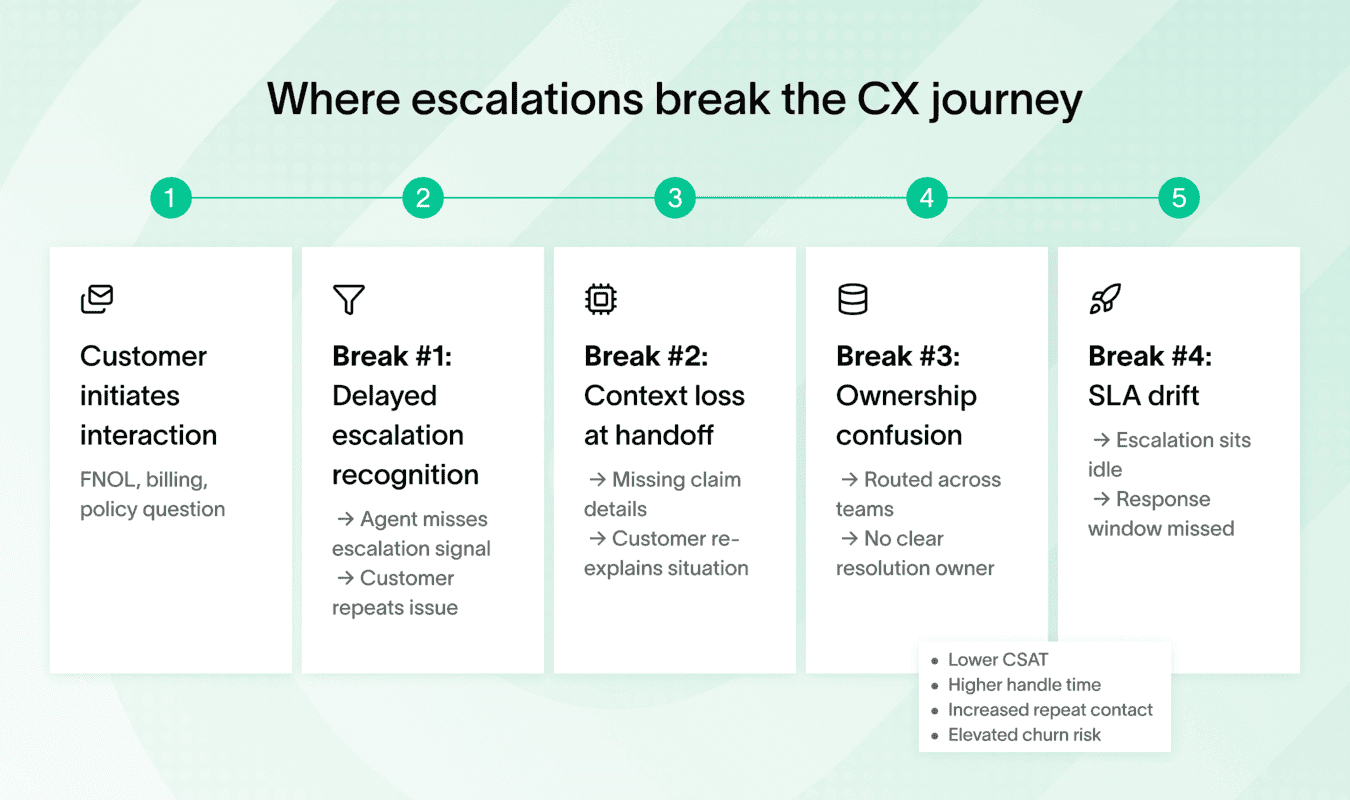
When escalation tracking is incomplete, CX leaders cannot answer critical questions:
Which claims types drive the highest escalation rates?
Which agents or queues generate repeat escalations?
Where do SLA breaches originate, intake or handoff?
Without this visibility, escalation tracking becomes a reporting exercise instead of a control system.
The business impact of poor escalation tracking
In insurance environments with 50 to 500+ agents, escalation inefficiencies compound quickly:
Metric impact area | Typical degradation without structured tracking |
CSAT | -8 to -15 points on escalated interactions |
FCR | Drops below 60% on claims-related contacts |
Handle time | +20–35% due to rework and context gathering |
Retention risk | 2–3x higher after unresolved escalation |
Strada’s approach to escalation tracking addresses this by linking escalation behavior directly to CX outcomes, not just operational throughput.
This is where voice agent escalation rate tracking becomes critical.
Escalation tracking: How Strada reduces escalations at the source
Strada does not treat escalation tracking as a downstream reporting layer. It embeds escalation intelligence directly into customer interactions across voice, chat, email, and SMS.
Voice agent escalation rate tracking as a control metric
In traditional environments, escalation rates are reviewed after the fact. By then, the customer experience has already degraded.
Strada operationalizes voice agent escalation rate tracking in real time by:
Detecting escalation triggers during live conversations (sentiment, compliance risk, claim complexity)
Intervening before escalation is required through AI-guided responses or automated resolution paths
Routing high-risk interactions to the correct specialist immediately with full context
Instead of asking “how many escalations occurred,” you can ask:
Which interaction types are trending toward escalation?
Which agents require intervention or coaching?
Which workflows generate preventable escalations?
This level of visibility directly improves FCR and reduces handle time variability.
From escalation events to escalation prevention
Strada’s impact is most visible in high-friction insurance workflows:
First Notice of Loss (FNOL)
Claims status inquiries
Billing disputes
Policy endorsements
In these scenarios, escalation is often caused by missing context or delayed system access, not agent capability.
Strada eliminates these triggers by:
Maintaining full interaction context across channels
Integrating directly with claims and policy systems
Automating routine resolution paths before escalation is needed
The result is measurable:
Outcome | Typical Improvement with Strada |
Escalation rate | Reduced by 20–40% |
FCR | Increased by 10–18 points |
Average handle time | Reduced by 15–25% |
Repeat contacts | Reduced by up to 30% |
SLA tracking and incident escalation solutions in insurance operations
Strada connects escalation tracking with SLA tracking and incident escalation solutions, creating a unified system that governs both speed and quality of resolution.
In insurance, SLAs are not abstract targets. They are tied to regulatory compliance, claim cycle expectations, and customer trust.
Aligning escalation tracking with SLA performance
Most organizations track SLA adherence separately from escalation behavior. This creates blind spots.
Strada links these systems directly:
Every escalation is mapped to SLA impact
Every SLA breach is traceable to a specific escalation failure point
Every delay is categorized by root cause (handoff, routing, context loss)
This enables precise diagnosis of SLA performance. For example:
Scenario | Traditional view | Strada view |
SLA breach on claim | “Missed 24-hour response target” | “Escalation delayed 42 minutes at L2 due to routing mismatch” |
Repeat contact | “Customer called twice” | “Initial escalation lacked claim context, triggering re-contact” |
This level of granularity transforms SLA tracking and incident escalation solutions into actionable systems.
Escalation tracking tool as a governance layer
Strada functions as a centralized escalation tracking tool that governs:
Escalation timing
Ownership transitions
Context continuity
SLA compliance
Rather than relying on manual updates or fragmented systems, CX leaders gain a single source of truth for escalation performance.
This is particularly critical in regulated workflows such as:
Claims escalation involving liability disputes
Compliance-related inquiries
High-value policyholder servicing
In these scenarios, escalation tracking is not just operational. It is audit-critical.
Strada ensures every escalation is:
Time-stamped
Context-complete
SLA-aligned
Fully traceable
This reduces compliance risk while improving customer outcomes.
Using escalation tracking data to improve CX metrics
Strada turns escalation tracking into a continuous improvement engine for CX leaders managing large agent teams.
Core metrics that matter to CX leaders
Effective escalation tracking should directly influence the metrics CX leaders are measured on:
Metric | Target range | Role of escalation tracking |
CSAT | 85%+ | Reduced friction in high-stress interactions |
FCR | 70–80% | Fewer escalations needed to resolve issues |
Average handle time | Optimized, not minimized | Less rework and repetition |
Escalation rate | 10–15% (context dependent) | Indicator of upstream resolution quality |
Repeat contact rate | <15% | Signal of escalation effectiveness |
Identifying root causes, not just symptoms
Traditional escalation reporting focuses on what happened. Strada focuses on why.
Through structured escalation tracking, leaders can identify:
Which claim types generate the most escalations
Which queues experience the highest SLA breaches
Which agents trigger repeat escalations
Which workflows consistently lose context
This enables targeted interventions:
Adjusting routing logic
Updating knowledge bases
Refining automation thresholds
Coaching specific agent groups
Each action ties directly back to measurable CX improvements.
Reducing variability across large agent teams
In teams of 50–500+ agents, inconsistency is the hidden cost driver.
Strada reduces variability by standardizing escalation handling:
Consistent escalation triggers
Uniform context transfer
Predictable SLA adherence
This ensures that customer experience does not depend on which agent answers the call.
Escalation tracking as a strategic advantage in 2026
Strada positions escalation tracking as a competitive differentiator for insurance CX organizations.
As customer expectations rise, the ability to manage high-stakes interactions consistently becomes a defining capability.
From reactive support to predictive CX
The next evolution of escalation tracking is predictive.
Strada enables organizations to:
Anticipate escalation risk based on interaction patterns
Intervene before customer frustration escalates
Allocate resources dynamically based on predicted demand
This shifts CX from reactive resolution to proactive experience management.
Why this matters for insurance leaders
Insurance customers do not evaluate service based on routine interactions. They evaluate it during moments of stress.
Organizations that manage these moments effectively see:
Higher policy retention
Lower claims-related churn
Stronger customer trust
Reduced operational cost per interaction
Escalation tracking, when executed correctly, becomes the control system for these outcomes.
Conclusion
Escalation tracking is no longer about managing exceptions. It is about controlling the most important moments in the customer journey.
Strada enables insurance CX leaders to move from fragmented escalation processes to a unified system that connects voice agent escalation rate tracking, SLA tracking and incident escalation solutions, and real-time intervention.
The result is measurable: fewer escalations, faster resolutions, higher CSAT, and more predictable operations.
If escalation tracking is still a reporting function in your organization, it is time to upgrade it into a performance system. Strada can show you how to reduce escalation volume while improving every CX metric you are measured on.
Frequently Asked Questions
How does escalation tracking impact core CX metrics like CSAT and retention in insurance contact centers?
It directly influences high-stress customer moments, where poor escalation handling can significantly lower satisfaction and increase churn risk.
Why should voice agent escalation rate tracking be treated as a leading indicator rather than a lagging metric?
Framer is a design tool that allows you to design websites on a freeform canvas, and then publish them as websites with a single click.
How does Strada reduce escalations during FNOL and claims-related interactions?
Framer is a design tool that allows you to design websites on a freeform canvas, and then publish them as websites with a single click.
What should CX leaders look for when connecting escalation tracking to SLA performance?
Framer is a design tool that allows you to design websites on a freeform canvas, and then publish them as websites with a single click.
How does an escalation tracking tool improve consistency across large agent teams?
Framer is a design tool that allows you to design websites on a freeform canvas, and then publish them as websites with a single click.
Table of Contents
Carriers, MGAs, and brokers scale revenue-driving phone calls with Strada's conversational AI platform.
Start scaling with voice AI agents today
Join innovative carriers and MGAs transforming their calls with Strada.
2026’s Smart Escalation Tracking for CX Leaders in Insurance

Amir Prodensky
CEO
Apr 8, 2026
6 min read
Reducing repeat contacts and SLA breaches at scale
Key takeaways:
Reducing escalation rates improves CSAT, FCR, and retention by minimizing friction during high-stress insurance interactions like claims and billing disputes.
Real-time voice agent escalation rate tracking enables earlier intervention, preventing unresolved interactions from degrading customer experience and increasing handle time.
Linking escalation tracking with SLA tracking and incident escalation solutions exposes root causes of delays, improving resolution speed and compliance performance.
In 2026, leaders who outperform are not resolving escalations faster, they are reducing the need for escalation in the first place through structured, AI-driven systems like Strada.
Escalation tracking as a driver of CX outcomes in insurance
Strada turns escalation tracking into a proactive performance system.
Insurance organizations operate under unique pressure. Every escalation is not just a service delay, it is a moment of heightened customer vulnerability: a claim dispute, a billing error, a coverage clarification during loss. These moments disproportionately influence retention, NPS, and regulatory exposure.
Where escalations break CX performance
Across carriers, MGAs, and brokers, escalation failures tend to cluster around a few structural issues:
Lack of ownership across FNOL, claims, and servicing workflows
Context loss between voice, email, and claims systems
Delayed escalation recognition during live calls
Repeat escalations on the same policy or claim
These are not workflow problems. They are visibility problems. Let’s make this more concrete.

When escalation tracking is incomplete, CX leaders cannot answer critical questions:
Which claims types drive the highest escalation rates?
Which agents or queues generate repeat escalations?
Where do SLA breaches originate, intake or handoff?
Without this visibility, escalation tracking becomes a reporting exercise instead of a control system.
The business impact of poor escalation tracking
In insurance environments with 50 to 500+ agents, escalation inefficiencies compound quickly:
Metric impact area | Typical degradation without structured tracking |
CSAT | -8 to -15 points on escalated interactions |
FCR | Drops below 60% on claims-related contacts |
Handle time | +20–35% due to rework and context gathering |
Retention risk | 2–3x higher after unresolved escalation |
Strada’s approach to escalation tracking addresses this by linking escalation behavior directly to CX outcomes, not just operational throughput.
This is where voice agent escalation rate tracking becomes critical.
Escalation tracking: How Strada reduces escalations at the source
Strada does not treat escalation tracking as a downstream reporting layer. It embeds escalation intelligence directly into customer interactions across voice, chat, email, and SMS.
Voice agent escalation rate tracking as a control metric
In traditional environments, escalation rates are reviewed after the fact. By then, the customer experience has already degraded.
Strada operationalizes voice agent escalation rate tracking in real time by:
Detecting escalation triggers during live conversations (sentiment, compliance risk, claim complexity)
Intervening before escalation is required through AI-guided responses or automated resolution paths
Routing high-risk interactions to the correct specialist immediately with full context
Instead of asking “how many escalations occurred,” you can ask:
Which interaction types are trending toward escalation?
Which agents require intervention or coaching?
Which workflows generate preventable escalations?
This level of visibility directly improves FCR and reduces handle time variability.
From escalation events to escalation prevention
Strada’s impact is most visible in high-friction insurance workflows:
First Notice of Loss (FNOL)
Claims status inquiries
Billing disputes
Policy endorsements
In these scenarios, escalation is often caused by missing context or delayed system access, not agent capability.
Strada eliminates these triggers by:
Maintaining full interaction context across channels
Integrating directly with claims and policy systems
Automating routine resolution paths before escalation is needed
The result is measurable:
Outcome | Typical Improvement with Strada |
Escalation rate | Reduced by 20–40% |
FCR | Increased by 10–18 points |
Average handle time | Reduced by 15–25% |
Repeat contacts | Reduced by up to 30% |
SLA tracking and incident escalation solutions in insurance operations
Strada connects escalation tracking with SLA tracking and incident escalation solutions, creating a unified system that governs both speed and quality of resolution.
In insurance, SLAs are not abstract targets. They are tied to regulatory compliance, claim cycle expectations, and customer trust.
Aligning escalation tracking with SLA performance
Most organizations track SLA adherence separately from escalation behavior. This creates blind spots.
Strada links these systems directly:
Every escalation is mapped to SLA impact
Every SLA breach is traceable to a specific escalation failure point
Every delay is categorized by root cause (handoff, routing, context loss)
This enables precise diagnosis of SLA performance. For example:
Scenario | Traditional view | Strada view |
SLA breach on claim | “Missed 24-hour response target” | “Escalation delayed 42 minutes at L2 due to routing mismatch” |
Repeat contact | “Customer called twice” | “Initial escalation lacked claim context, triggering re-contact” |
This level of granularity transforms SLA tracking and incident escalation solutions into actionable systems.
Escalation tracking tool as a governance layer
Strada functions as a centralized escalation tracking tool that governs:
Escalation timing
Ownership transitions
Context continuity
SLA compliance
Rather than relying on manual updates or fragmented systems, CX leaders gain a single source of truth for escalation performance.
This is particularly critical in regulated workflows such as:
Claims escalation involving liability disputes
Compliance-related inquiries
High-value policyholder servicing
In these scenarios, escalation tracking is not just operational. It is audit-critical.
Strada ensures every escalation is:
Time-stamped
Context-complete
SLA-aligned
Fully traceable
This reduces compliance risk while improving customer outcomes.
Using escalation tracking data to improve CX metrics
Strada turns escalation tracking into a continuous improvement engine for CX leaders managing large agent teams.
Core metrics that matter to CX leaders
Effective escalation tracking should directly influence the metrics CX leaders are measured on:
Metric | Target range | Role of escalation tracking |
CSAT | 85%+ | Reduced friction in high-stress interactions |
FCR | 70–80% | Fewer escalations needed to resolve issues |
Average handle time | Optimized, not minimized | Less rework and repetition |
Escalation rate | 10–15% (context dependent) | Indicator of upstream resolution quality |
Repeat contact rate | <15% | Signal of escalation effectiveness |
Identifying root causes, not just symptoms
Traditional escalation reporting focuses on what happened. Strada focuses on why.
Through structured escalation tracking, leaders can identify:
Which claim types generate the most escalations
Which queues experience the highest SLA breaches
Which agents trigger repeat escalations
Which workflows consistently lose context
This enables targeted interventions:
Adjusting routing logic
Updating knowledge bases
Refining automation thresholds
Coaching specific agent groups
Each action ties directly back to measurable CX improvements.
Reducing variability across large agent teams
In teams of 50–500+ agents, inconsistency is the hidden cost driver.
Strada reduces variability by standardizing escalation handling:
Consistent escalation triggers
Uniform context transfer
Predictable SLA adherence
This ensures that customer experience does not depend on which agent answers the call.
Escalation tracking as a strategic advantage in 2026
Strada positions escalation tracking as a competitive differentiator for insurance CX organizations.
As customer expectations rise, the ability to manage high-stakes interactions consistently becomes a defining capability.
From reactive support to predictive CX
The next evolution of escalation tracking is predictive.
Strada enables organizations to:
Anticipate escalation risk based on interaction patterns
Intervene before customer frustration escalates
Allocate resources dynamically based on predicted demand
This shifts CX from reactive resolution to proactive experience management.
Why this matters for insurance leaders
Insurance customers do not evaluate service based on routine interactions. They evaluate it during moments of stress.
Organizations that manage these moments effectively see:
Higher policy retention
Lower claims-related churn
Stronger customer trust
Reduced operational cost per interaction
Escalation tracking, when executed correctly, becomes the control system for these outcomes.
Conclusion
Escalation tracking is no longer about managing exceptions. It is about controlling the most important moments in the customer journey.
Strada enables insurance CX leaders to move from fragmented escalation processes to a unified system that connects voice agent escalation rate tracking, SLA tracking and incident escalation solutions, and real-time intervention.
The result is measurable: fewer escalations, faster resolutions, higher CSAT, and more predictable operations.
If escalation tracking is still a reporting function in your organization, it is time to upgrade it into a performance system. Strada can show you how to reduce escalation volume while improving every CX metric you are measured on.
Frequently Asked Questions
How does escalation tracking impact core CX metrics like CSAT and retention in insurance contact centers?
It directly influences high-stress customer moments, where poor escalation handling can significantly lower satisfaction and increase churn risk.
Why should voice agent escalation rate tracking be treated as a leading indicator rather than a lagging metric?
Framer is a design tool that allows you to design websites on a freeform canvas, and then publish them as websites with a single click.
How does Strada reduce escalations during FNOL and claims-related interactions?
Framer is a design tool that allows you to design websites on a freeform canvas, and then publish them as websites with a single click.
What should CX leaders look for when connecting escalation tracking to SLA performance?
Framer is a design tool that allows you to design websites on a freeform canvas, and then publish them as websites with a single click.
How does an escalation tracking tool improve consistency across large agent teams?
Framer is a design tool that allows you to design websites on a freeform canvas, and then publish them as websites with a single click.
Table of Contents
Carriers, MGAs, and brokers scale revenue-driving phone calls with Strada's conversational AI platform.
Start scaling with voice AI agents today
Join innovative carriers and MGAs transforming their calls with Strada.
2026’s Smart Escalation Tracking for CX Leaders in Insurance

Amir Prodensky
CEO
Apr 8, 2026
6 min read
Reducing repeat contacts and SLA breaches at scale
Key takeaways:
Reducing escalation rates improves CSAT, FCR, and retention by minimizing friction during high-stress insurance interactions like claims and billing disputes.
Real-time voice agent escalation rate tracking enables earlier intervention, preventing unresolved interactions from degrading customer experience and increasing handle time.
Linking escalation tracking with SLA tracking and incident escalation solutions exposes root causes of delays, improving resolution speed and compliance performance.
In 2026, leaders who outperform are not resolving escalations faster, they are reducing the need for escalation in the first place through structured, AI-driven systems like Strada.
Escalation tracking as a driver of CX outcomes in insurance
Strada turns escalation tracking into a proactive performance system.
Insurance organizations operate under unique pressure. Every escalation is not just a service delay, it is a moment of heightened customer vulnerability: a claim dispute, a billing error, a coverage clarification during loss. These moments disproportionately influence retention, NPS, and regulatory exposure.
Where escalations break CX performance
Across carriers, MGAs, and brokers, escalation failures tend to cluster around a few structural issues:
Lack of ownership across FNOL, claims, and servicing workflows
Context loss between voice, email, and claims systems
Delayed escalation recognition during live calls
Repeat escalations on the same policy or claim
These are not workflow problems. They are visibility problems. Let’s make this more concrete.

When escalation tracking is incomplete, CX leaders cannot answer critical questions:
Which claims types drive the highest escalation rates?
Which agents or queues generate repeat escalations?
Where do SLA breaches originate, intake or handoff?
Without this visibility, escalation tracking becomes a reporting exercise instead of a control system.
The business impact of poor escalation tracking
In insurance environments with 50 to 500+ agents, escalation inefficiencies compound quickly:
Metric impact area | Typical degradation without structured tracking |
CSAT | -8 to -15 points on escalated interactions |
FCR | Drops below 60% on claims-related contacts |
Handle time | +20–35% due to rework and context gathering |
Retention risk | 2–3x higher after unresolved escalation |
Strada’s approach to escalation tracking addresses this by linking escalation behavior directly to CX outcomes, not just operational throughput.
This is where voice agent escalation rate tracking becomes critical.
Escalation tracking: How Strada reduces escalations at the source
Strada does not treat escalation tracking as a downstream reporting layer. It embeds escalation intelligence directly into customer interactions across voice, chat, email, and SMS.
Voice agent escalation rate tracking as a control metric
In traditional environments, escalation rates are reviewed after the fact. By then, the customer experience has already degraded.
Strada operationalizes voice agent escalation rate tracking in real time by:
Detecting escalation triggers during live conversations (sentiment, compliance risk, claim complexity)
Intervening before escalation is required through AI-guided responses or automated resolution paths
Routing high-risk interactions to the correct specialist immediately with full context
Instead of asking “how many escalations occurred,” you can ask:
Which interaction types are trending toward escalation?
Which agents require intervention or coaching?
Which workflows generate preventable escalations?
This level of visibility directly improves FCR and reduces handle time variability.
From escalation events to escalation prevention
Strada’s impact is most visible in high-friction insurance workflows:
First Notice of Loss (FNOL)
Claims status inquiries
Billing disputes
Policy endorsements
In these scenarios, escalation is often caused by missing context or delayed system access, not agent capability.
Strada eliminates these triggers by:
Maintaining full interaction context across channels
Integrating directly with claims and policy systems
Automating routine resolution paths before escalation is needed
The result is measurable:
Outcome | Typical Improvement with Strada |
Escalation rate | Reduced by 20–40% |
FCR | Increased by 10–18 points |
Average handle time | Reduced by 15–25% |
Repeat contacts | Reduced by up to 30% |
SLA tracking and incident escalation solutions in insurance operations
Strada connects escalation tracking with SLA tracking and incident escalation solutions, creating a unified system that governs both speed and quality of resolution.
In insurance, SLAs are not abstract targets. They are tied to regulatory compliance, claim cycle expectations, and customer trust.
Aligning escalation tracking with SLA performance
Most organizations track SLA adherence separately from escalation behavior. This creates blind spots.
Strada links these systems directly:
Every escalation is mapped to SLA impact
Every SLA breach is traceable to a specific escalation failure point
Every delay is categorized by root cause (handoff, routing, context loss)
This enables precise diagnosis of SLA performance. For example:
Scenario | Traditional view | Strada view |
SLA breach on claim | “Missed 24-hour response target” | “Escalation delayed 42 minutes at L2 due to routing mismatch” |
Repeat contact | “Customer called twice” | “Initial escalation lacked claim context, triggering re-contact” |
This level of granularity transforms SLA tracking and incident escalation solutions into actionable systems.
Escalation tracking tool as a governance layer
Strada functions as a centralized escalation tracking tool that governs:
Escalation timing
Ownership transitions
Context continuity
SLA compliance
Rather than relying on manual updates or fragmented systems, CX leaders gain a single source of truth for escalation performance.
This is particularly critical in regulated workflows such as:
Claims escalation involving liability disputes
Compliance-related inquiries
High-value policyholder servicing
In these scenarios, escalation tracking is not just operational. It is audit-critical.
Strada ensures every escalation is:
Time-stamped
Context-complete
SLA-aligned
Fully traceable
This reduces compliance risk while improving customer outcomes.
Using escalation tracking data to improve CX metrics
Strada turns escalation tracking into a continuous improvement engine for CX leaders managing large agent teams.
Core metrics that matter to CX leaders
Effective escalation tracking should directly influence the metrics CX leaders are measured on:
Metric | Target range | Role of escalation tracking |
CSAT | 85%+ | Reduced friction in high-stress interactions |
FCR | 70–80% | Fewer escalations needed to resolve issues |
Average handle time | Optimized, not minimized | Less rework and repetition |
Escalation rate | 10–15% (context dependent) | Indicator of upstream resolution quality |
Repeat contact rate | <15% | Signal of escalation effectiveness |
Identifying root causes, not just symptoms
Traditional escalation reporting focuses on what happened. Strada focuses on why.
Through structured escalation tracking, leaders can identify:
Which claim types generate the most escalations
Which queues experience the highest SLA breaches
Which agents trigger repeat escalations
Which workflows consistently lose context
This enables targeted interventions:
Adjusting routing logic
Updating knowledge bases
Refining automation thresholds
Coaching specific agent groups
Each action ties directly back to measurable CX improvements.
Reducing variability across large agent teams
In teams of 50–500+ agents, inconsistency is the hidden cost driver.
Strada reduces variability by standardizing escalation handling:
Consistent escalation triggers
Uniform context transfer
Predictable SLA adherence
This ensures that customer experience does not depend on which agent answers the call.
Escalation tracking as a strategic advantage in 2026
Strada positions escalation tracking as a competitive differentiator for insurance CX organizations.
As customer expectations rise, the ability to manage high-stakes interactions consistently becomes a defining capability.
From reactive support to predictive CX
The next evolution of escalation tracking is predictive.
Strada enables organizations to:
Anticipate escalation risk based on interaction patterns
Intervene before customer frustration escalates
Allocate resources dynamically based on predicted demand
This shifts CX from reactive resolution to proactive experience management.
Why this matters for insurance leaders
Insurance customers do not evaluate service based on routine interactions. They evaluate it during moments of stress.
Organizations that manage these moments effectively see:
Higher policy retention
Lower claims-related churn
Stronger customer trust
Reduced operational cost per interaction
Escalation tracking, when executed correctly, becomes the control system for these outcomes.
Conclusion
Escalation tracking is no longer about managing exceptions. It is about controlling the most important moments in the customer journey.
Strada enables insurance CX leaders to move from fragmented escalation processes to a unified system that connects voice agent escalation rate tracking, SLA tracking and incident escalation solutions, and real-time intervention.
The result is measurable: fewer escalations, faster resolutions, higher CSAT, and more predictable operations.
If escalation tracking is still a reporting function in your organization, it is time to upgrade it into a performance system. Strada can show you how to reduce escalation volume while improving every CX metric you are measured on.
Frequently Asked Questions
How does escalation tracking impact core CX metrics like CSAT and retention in insurance contact centers?
It directly influences high-stress customer moments, where poor escalation handling can significantly lower satisfaction and increase churn risk.
Why should voice agent escalation rate tracking be treated as a leading indicator rather than a lagging metric?
Framer is a design tool that allows you to design websites on a freeform canvas, and then publish them as websites with a single click.
How does Strada reduce escalations during FNOL and claims-related interactions?
Framer is a design tool that allows you to design websites on a freeform canvas, and then publish them as websites with a single click.
What should CX leaders look for when connecting escalation tracking to SLA performance?
Framer is a design tool that allows you to design websites on a freeform canvas, and then publish them as websites with a single click.
How does an escalation tracking tool improve consistency across large agent teams?
Framer is a design tool that allows you to design websites on a freeform canvas, and then publish them as websites with a single click.
Table of Contents
Carriers, MGAs, and brokers scale revenue-driving phone calls with Strada's conversational AI platform.
Start scaling with voice AI agents today
Join innovative carriers and MGAs transforming their calls with Strada.
© 2026 Strada API, Inc.
