Introducing Strada Signals, our new report series on AI for insurance operations. Read our whitepaper →
Introducing Strada Signals, our new report series on AI for insurance operations.
Read our whitepaper →
Introducing Strada Signals, our new report series on AI for insurance operations. Read our whitepaper →
Best 21 Digital Insurance Solutions to Transform Your Business Fast

Amir Prodensky
CEO
21 min read
Tools insurers use today to speed operations and cut workload.
The insurance world’s moving fast, and customers expect speed, clarity, and self-service. If you’re still relying on manual processes or slow systems, it’s tough to keep up.
That’s why digital transformation isn’t a “someday” project.
It’s a competitive must.
The good news? You don’t need to overhaul everything at once. You can start small, see quick wins, and build momentum.
In this guide, you’ll learn how modern tech can streamline workflows, cut delays, and create a smoother experience for both your team and your customers. You’ll also see how digital insurance tools can help you launch improvements faster and grow with confidence.
Before you dive in, it helps to know where the biggest wins are. Let’s look at the digital solutions that move the needle fastest, so you can see real results sooner.
What types of digital insurance solutions transform insurance the fastest?
When you’re looking for speed, the right technologies can transform insurance faster than you’d expect. The most impactful areas all remove delays, cut manual work, and help customers get what they need instantly.
Technology / Tool | What it does | Why it matters (speed & impact) |
Core insurance platforms | Centralize products, data, and workflows | Launch new offerings faster |
Policy administration systems | Manage policy creation, updates, renewals | Fewer errors and less back-and-forth |
Claims automation | Automates claim processing and payouts | Faster resolutions with less manual work |
Underwriting automation | Uses rules/data to make decisions | Decisions in minutes instead of days |
Customer self-service & engagement apps | Let customers file claims, view policies, get answers | 24/7 access, less support demand, higher satisfaction |
Digital payments & billing | Automate premium collection and reimbursements | Instant, accurate transactions with less paperwork |
AI analytics | Identify patterns, price accurately, act early | Better decisions and quicker responses |
Fraud detection systems | Flag suspicious activity early | Prevent losses before they escalate |
API gateways & integration hubs | Connect systems and partners for real-time data flow | Faster operations through seamless connectivity |
Put together, these technologies help you modernize fast, boost efficiency, and deliver a smoother customer experience. They show how digital insurance solutions become real business results.
And when you combine these capabilities strategically, you get a powerful set of digital insurance tools to fuel growth.
Core digital insurance software
Core digital insurance software is the central system that runs policies, claims, billing, and customer data in one place. It keeps everything organized and connected so your team doesn’t juggle multiple tools or manual steps.
You use it to work faster, reduce errors, and launch changes without chaos. It also gives customers quicker answers and smoother service.
When combined with digital automation solutions insurance can scale faster, cut delays, and help you grow with confidence. In practical terms, this shows up in tools like...
Guidewire InsuranceSuite
The website: guidewire.com
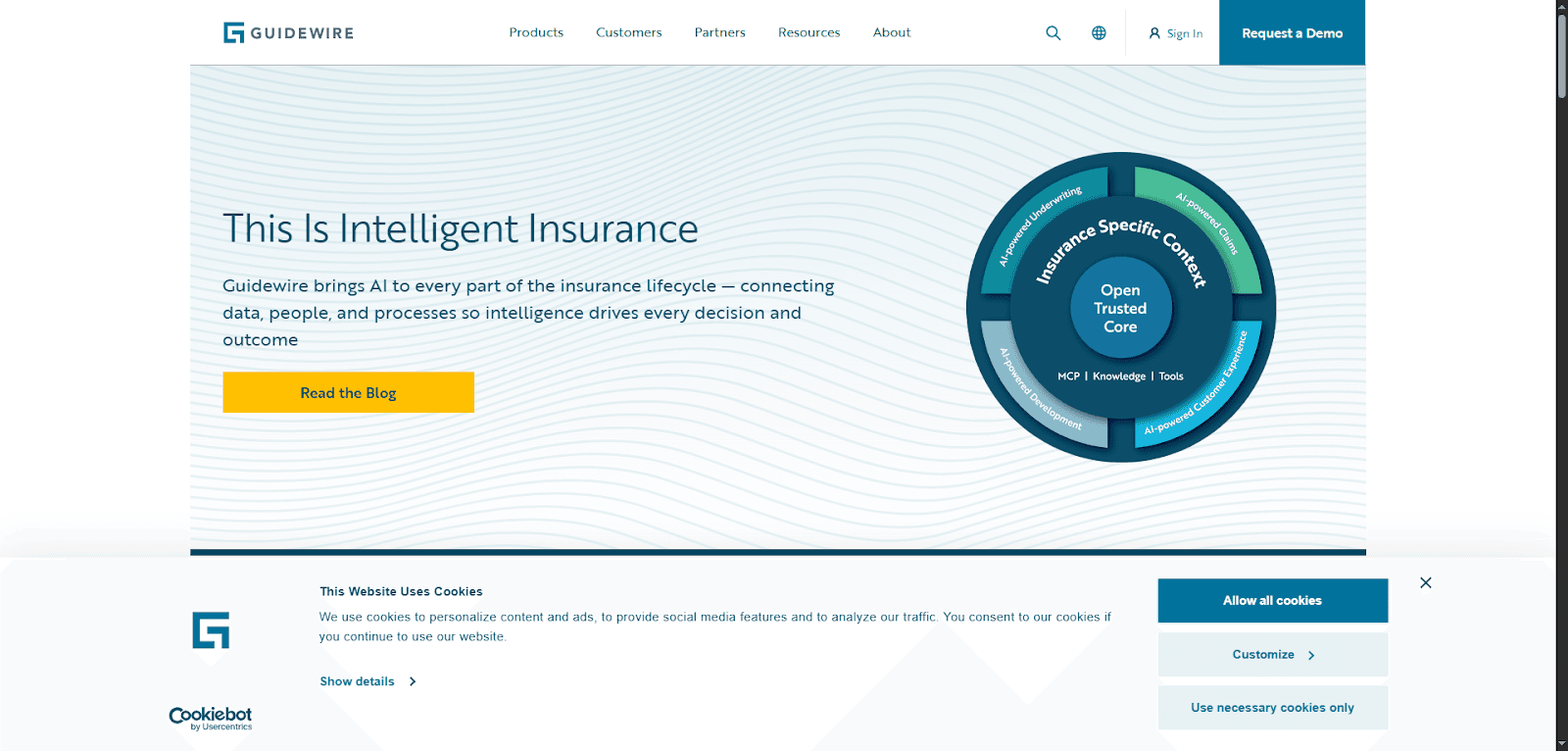
Guidewire InsuranceSuite gives you a fast, proven way to modernize core P&C operations. It focuses on three essentials (policy, billing, and claims), so you can digitize the heart of your insurance business without complexity.
You’ll see quick wins. Instead of juggling disconnected systems, you work on one platform that keeps data consistent and processes streamlined. That means fewer errors, faster decisions, and happier customers.
Here’s where it helps most:
Policy administration → launch products faster, update rates quickly, and handle quotes and renewals with less manual work.
Claims management → speed up claims intake, routing, and payments so teams resolve issues sooner.
Billing → automate invoicing, collections, and payments to improve cash flow and reduce admin time.
Because InsuranceSuite integrates easily with analytics and third-party tools, you can scale confidently. You’re not just digitizing. You’re setting up a flexible foundation for growth, innovation, and better customer experiences.
Duck Creek Suite
The website: duckcreek.com

Duck Creek Suite helps you move fast.
It’s a low-code, cloud-based platform built for P&C insurers who need to launch products quickly and serve customers better. You don’t wait months for changes. You configure, test, and go live faster.
The real value is simplicity. Instead of complex custom builds, you use reusable modules and smart tools to adapt to market needs. That means quicker updates, fewer bottlenecks, and less IT stress.
Here’s what it makes easier:
Speed-to-market → build and update products fast without heavy coding.
Customer experience → deliver smoother, more personalized interactions that build trust.
Distribution growth → support agents and brokers with tools that help them sell more.
Because Duck Creek integrates with a large partner ecosystem, payments, and APIs, you can plug into new capabilities without ripping out old systems. You stay agile, scale confidently, and keep your business ready for whatever’s next.
BriteCore
The website: britecore.com
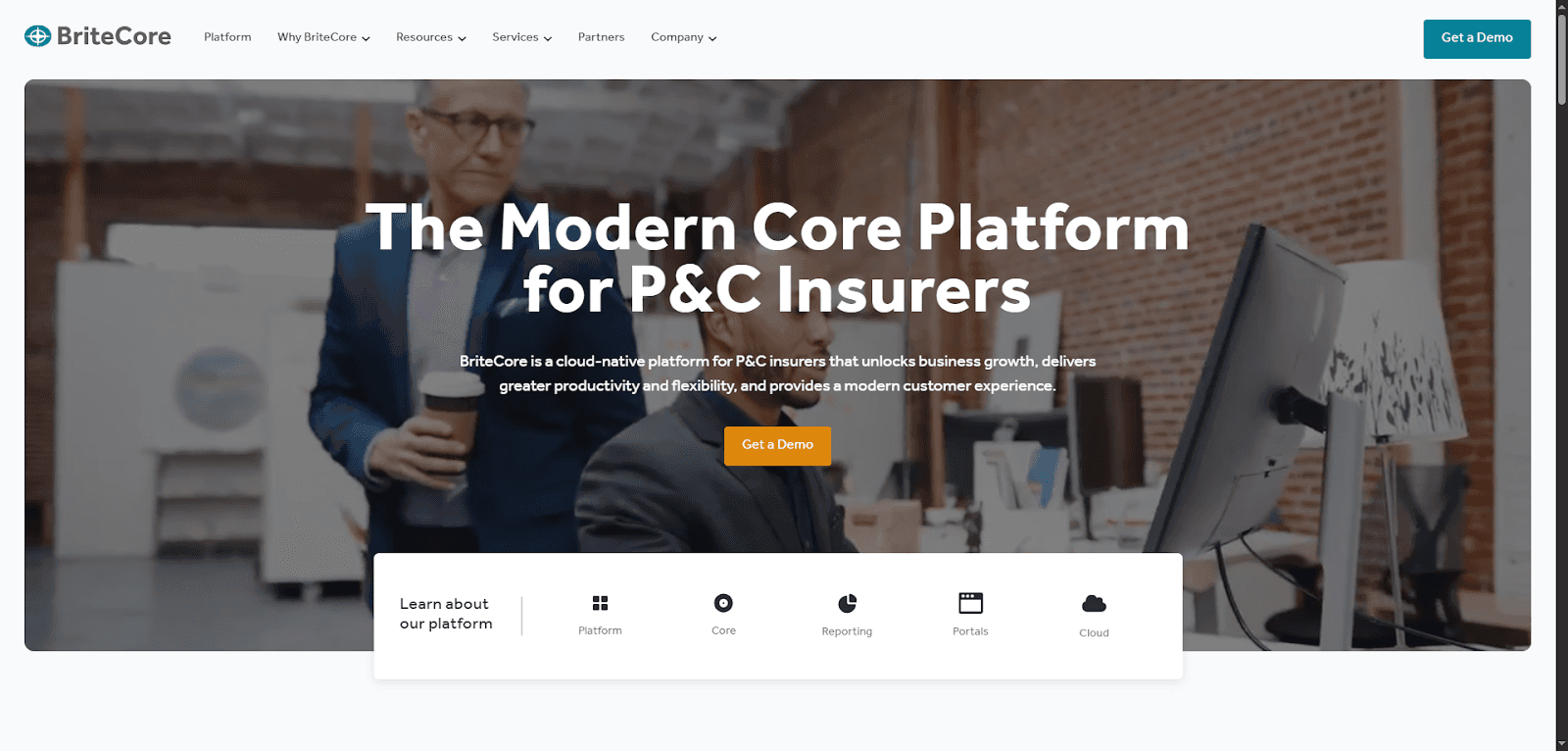
BriteCore gives P&C insurers a modern, cloud-native core platform that helps you move faster and work smarter. Everything runs in one place, so you don’t juggle multiple systems or deal with messy handoffs.
Your team can work from anywhere, stay productive, and keep operations running smoothly.
You’ll see practical benefits quickly. The platform offers low-code tools and templates, so product changes and updates don’t drag on for weeks. You adjust rates, launch new products, and test ideas without heavy IT work.
Here’s where it helps most:
Product speed → use simple point-and-click tools to modify rules and roll out new products fast.
Customer and agent experience → give users easy digital portals and mobile access.
Data insights → use built-in dashboards and reporting to spot opportunities and cut waste.
Because BriteCore integrates with APIs and third-party solutions, you can add new capabilities as you grow. You stay flexible, competitive, and ready for what’s next.
Insurity Sure Suite
The website: insurity.com
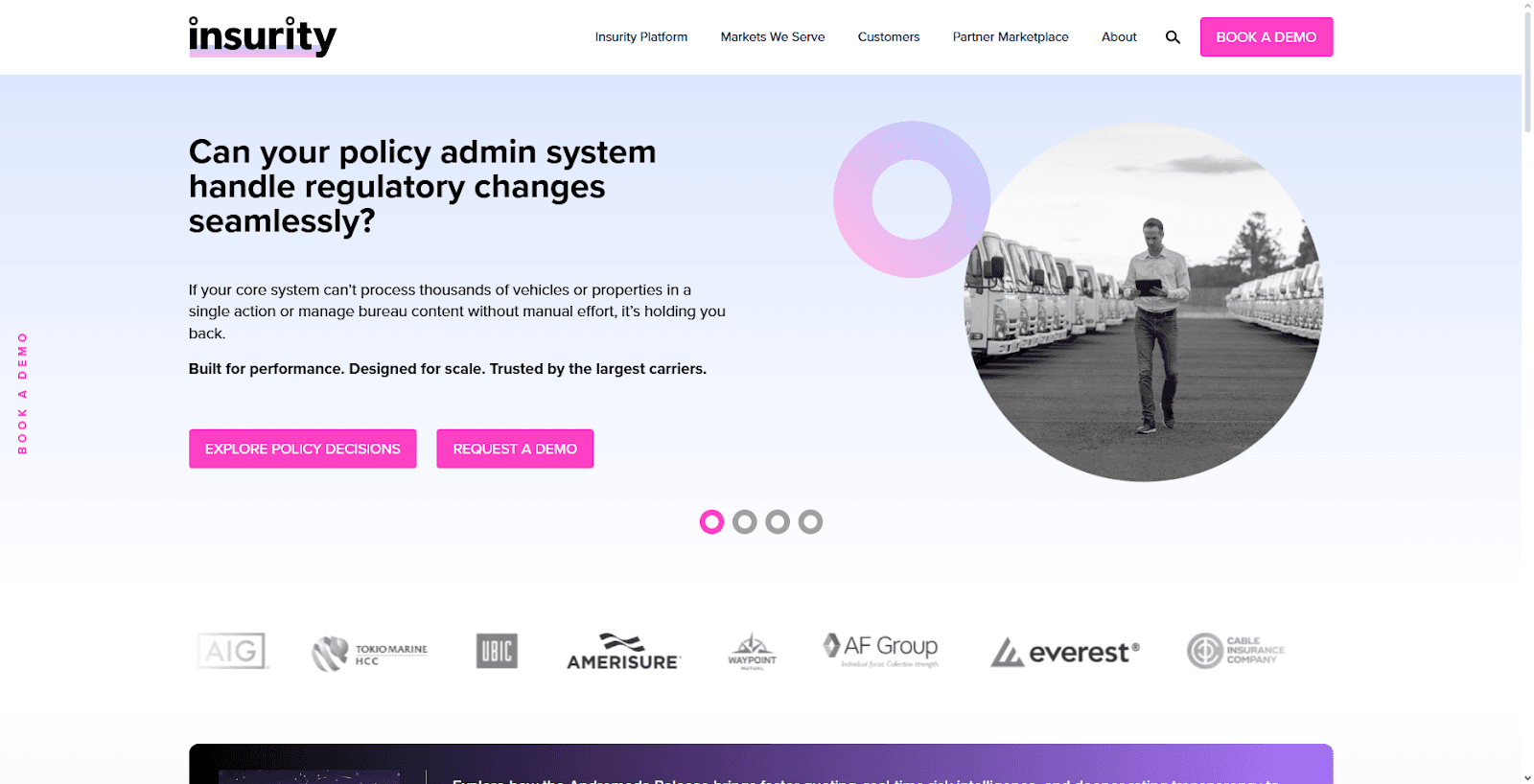
Insurity Sure Suite helps you replace slow, outdated systems with a modern platform that actually scales. It’s built for P&C insurers, MGAs, and agencies that need speed, flexibility, and smarter decision-making.
You don’t wait weeks for processes to move. You streamline work and respond faster.
The platform focuses on real productivity gains. Tasks that once took days or weeks can drop to minutes or seconds. That means quicker underwriting, smoother policy handling, and less manual effort across teams.
Here’s where Sure Suite makes a big impact:
Policy administration → simplify rating, quoting, and issuing policies so teams move faster.
Billing and audits → automate key steps to reduce paperwork and improve accuracy.
Analytics → use data-driven insights to price better, expand into new markets, and improve performance.
With cloud delivery and proven scalability, you can grow without hitting system limits. You stay agile, boost service quality, and keep your business ready for rapid change.
Policy administration systems
A policy administration system manages policy creation, changes, renewals, and cancellations in one streamlined workflow. It keeps everything accurate and up to date, so you don’t rely on manual steps or scattered spreadsheets.
When supported by digital process automation tools insurance teams can move faster, reduce errors, and deliver a smoother customer experience.
To make this real, companies rely on solutions such as…
Equisoft Manage
The website: equisoft.com
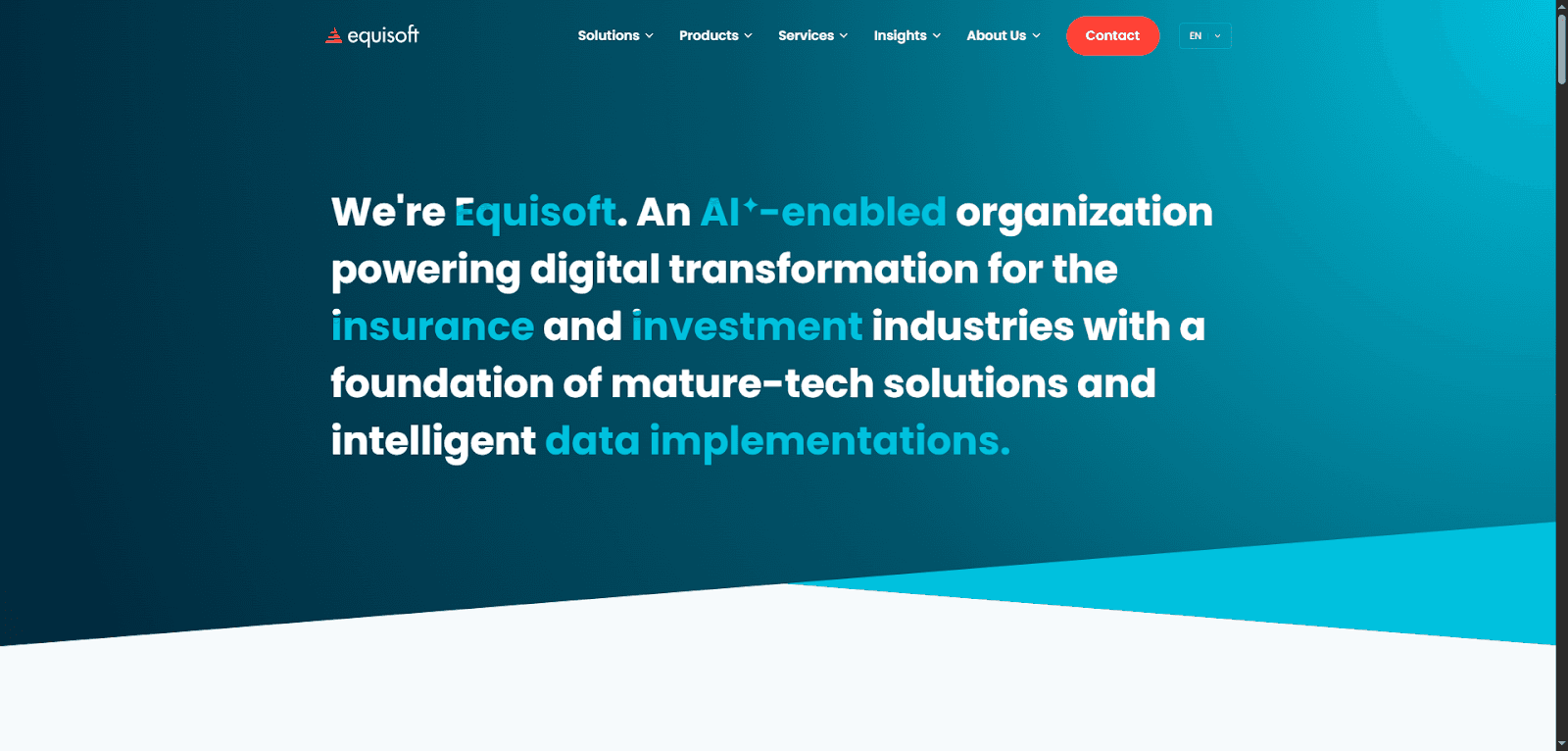
Equisoft Manage helps insurers simplify policy administration and move faster in a digital-first world. It’s designed to take complex, time-consuming processes and turn them into smooth, automated workflows. You don’t chase paperwork or rely on outdated systems. You manage policies in one modern platform.
You’ll see real impact quickly. Equisoft combines mature technology with AI-enabled tools to speed up policy changes, improve accuracy, and reduce manual work. Your teams get more time to focus on customers instead of administration.
Here’s where it makes a difference:
Faster policy processing → handle new business, updates, and renewals with fewer steps.
Better advisor and distributor support → empower partners with comprehensive distribution management software and the tools they need to serve clients efficiently.
Lower risk during modernization → use expert implementation and proven methods to transition safely.
Because Equisoft integrates easily with existing systems and data, you can modernize without disruption. You stay agile, boost service quality, and set a strong foundation for future growth.
Practo Insura
The website: practoinsura.com
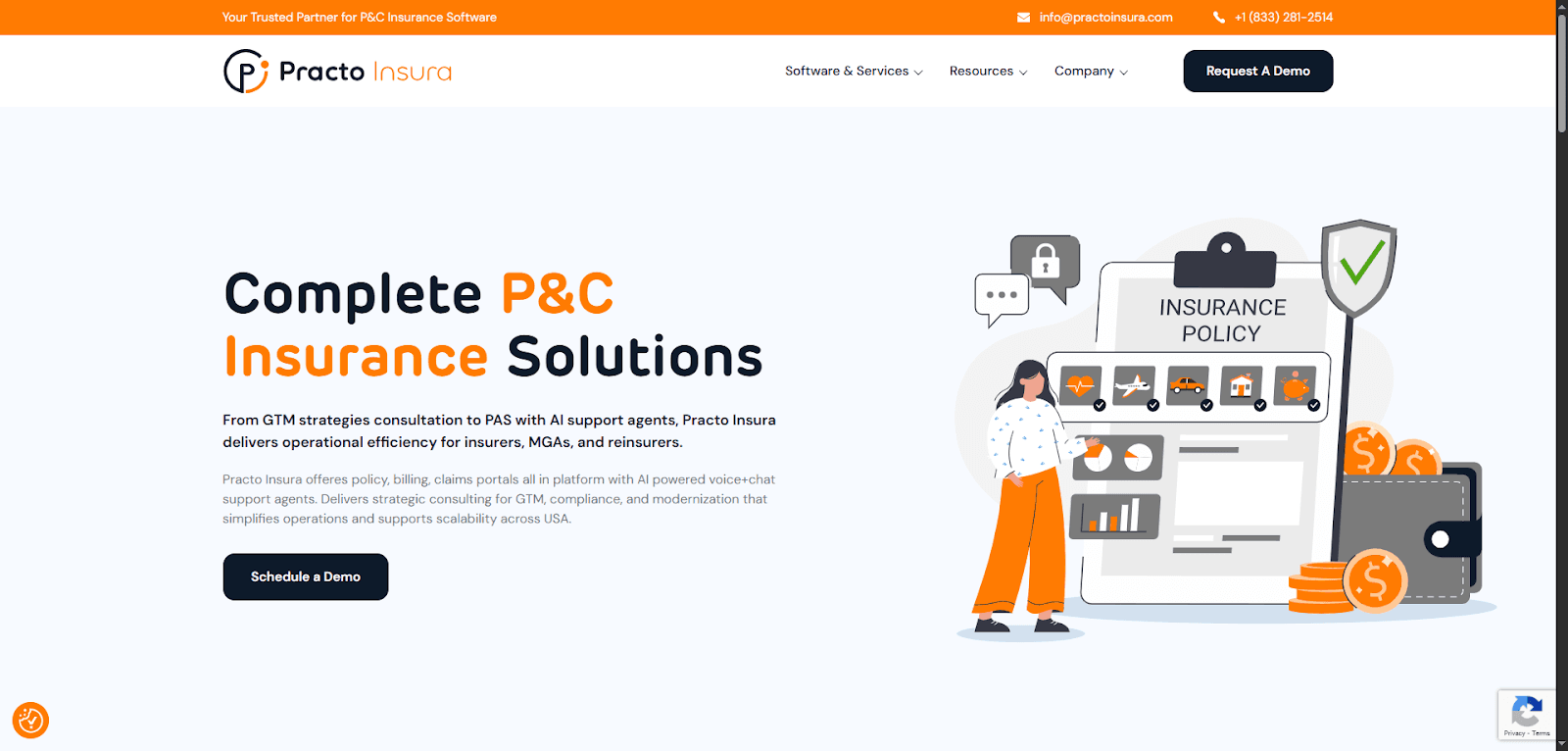
Practo Insura gives insurers a fast, practical way to manage policies without slowing down operations.
It’s built for P&C carriers, MGAs, and reinsurers who want a modern system that’s easy to use and quick to update. You don’t wait months for changes. You move fast and stay competitive.
The platform focuses on real efficiency. It combines policy, billing, and claims in one place and supports everything with AI-powered voice and chat agents, so your team spends less time on manual tasks and more time serving customers.
Here’s where Practo Insura stands out:
Rapid rate updates → go live with new rates in as little as seven days.
Smooth migration → switch systems without long downtime or painful transitions.
Paperless workflows → use built-in e-sign tools to eliminate delays.
With its user-friendly design and strategic support, Practo Insura feels more like a partner than just software. You scale confidently, simplify operations, and deliver a better experience for everyone.
Origami Risk
The website: origamirisk.com
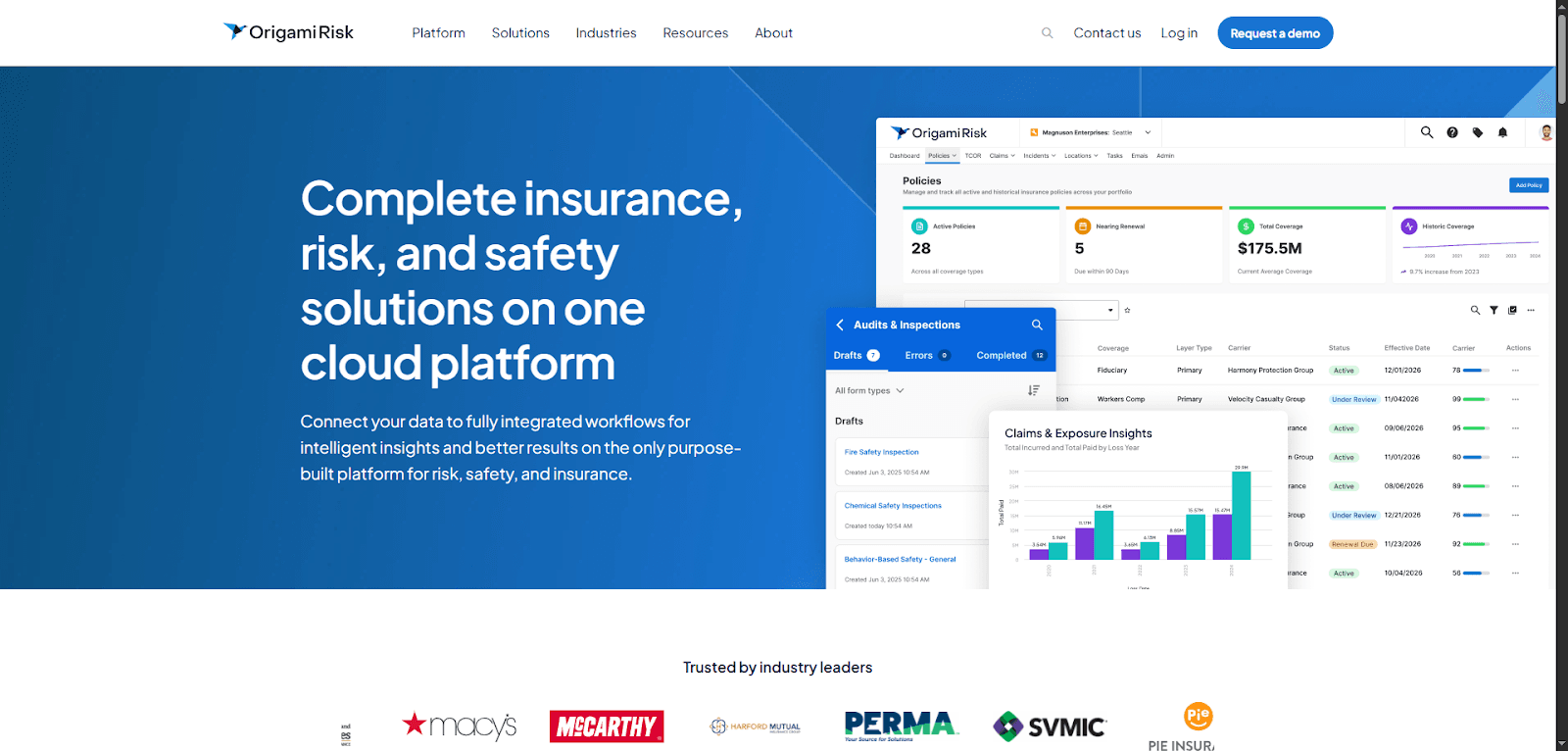
Origami Risk gives insurers a single cloud platform to manage policies, claims, and risk programs without juggling multiple systems. It’s built to streamline work, improve accuracy, and help teams move faster.
You don’t waste time on manual steps. You automate them and keep everything connected.
What makes it powerful is the combination of policy administration and real-time data. You get one source of truth, smarter workflows, and better visibility into performance. That means quicker decisions and fewer bottlenecks.
Here’s where Origami Risk delivers value:
End-to-end policy management → quote, bind, issue, and update policies in one place.
Automation → use built-in workflows and AI tools to reduce repetitive tasks.
Analytics → spot trends, track results, and improve pricing and underwriting.
With secure architecture and easy integrations, you connect to other systems without heavy IT work. You stay scalable, compliant, and ready to support growth, even across multiple lines of business or complex programs.
Claims automation tools
Claims automation tools handle claim intake, validation, routing, and payouts with minimal manual work. They pull data, check rules, and move each claim to the right step automatically.
You use them to speed up decisions, cut errors, and give customers faster answers. They also free your team to focus on complex cases instead of routine tasks.
As part of digital insurance solutions, claims automation helps you boost efficiency, improve service, and scale without adding extra workload.
This category typically includes platforms like…
Strada Workflows
Handling claims is one of the most time-consuming parts of insurance.
Calls come in, details get captured, and then the real work starts: assigning adjusters, updating systems, sending documents, and notifying teams. It’s easy for tasks to pile up or fall through the cracks.
Strada Workflows solves this problem by turning claim conversations into instant, automated action.
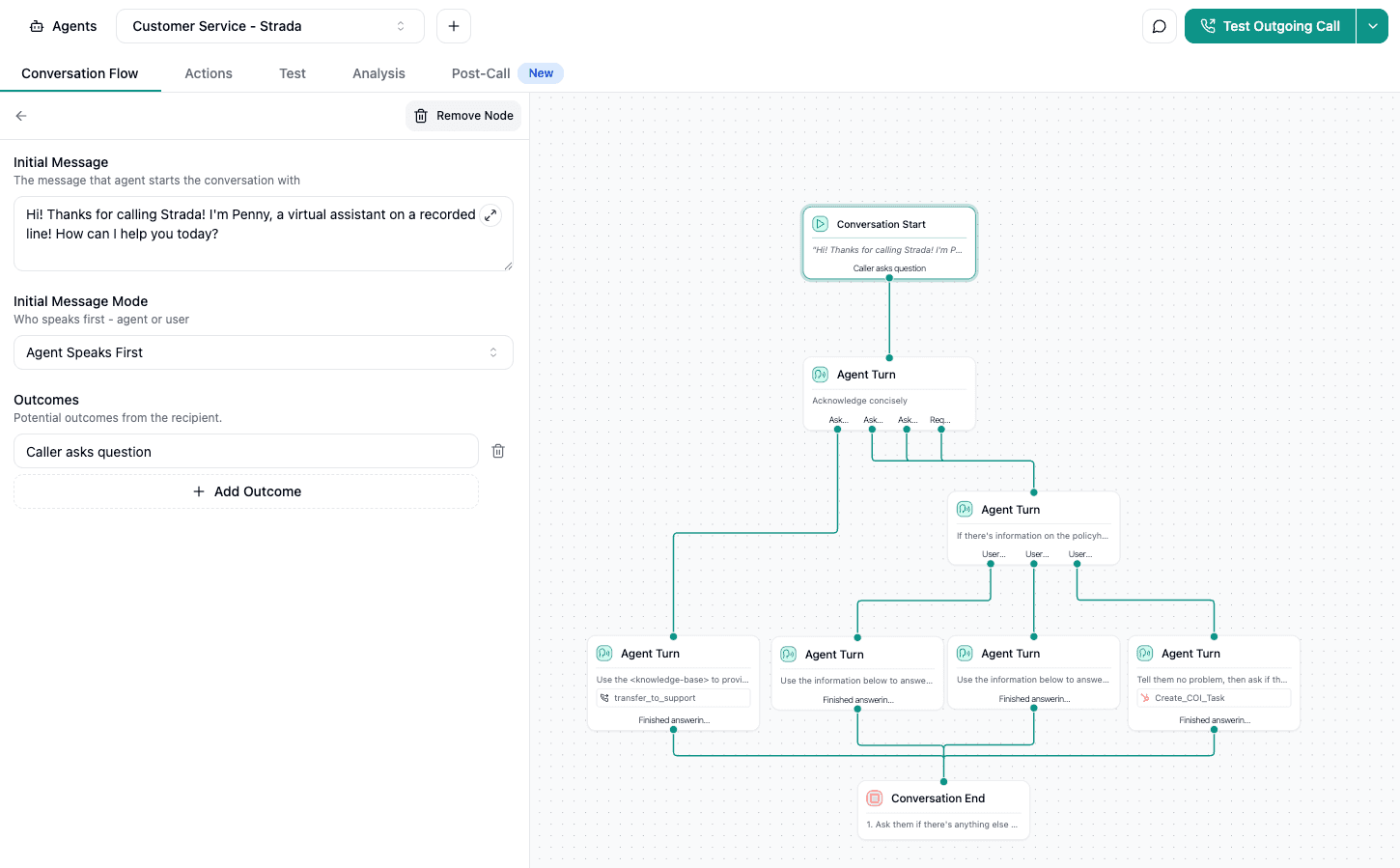
Strada started with AI phone agents, but Workflows takes it further. Instead of just capturing information, it acts on it the moment a call ends. That means less manual follow-up, faster resolutions, and a smoother experience for customers and teams.
Here’s the simple idea: every claims call becomes a trigger for automation. No waiting. No data entry. No chasing information across platforms.
You get three big benefits right away:
Faster processing. Calls that used to lead to hours of follow-up become automated tasks completed in minutes.
Fewer mistakes. Built-in accuracy checks reduce errors and protect against E&O risk.
Happier customers. With 24/7 availability and no hold times, claims move forward even when your team’s offline.
To make this happen, Strada Workflows connects directly to your core systems: claims platforms, CRMs, policy systems, and even custom live data enrichment APIs. There’s no heavy engineering lift, and you don’t need to write code. You set the rules, and Workflows runs them automatically.
For claims teams, this plays out in practical ways:
When a customer reports a new claim, the system creates a file, assigns an adjuster, sends required documents, and alerts the right people, automatically.
If someone requests a certificate of insurance during a call, Workflows pushes the request to your AMS, generates the correct form, and sends it by email or SMS.
If a claim signals higher risk or urgency, the workflow flags it instantly and updates your CRM so nothing stalls.
All of this scales effortlessly. No matter if you're handling 10 claims or 10,000, the process stays consistent and fast. And because Strada is purpose-built for insurance, its AI understands industry terminology and real-world scenarios.
The result? Your team spends less time shuffling data and more time solving problems. Claims move faster, customers stay informed, and your business runs smarter, not harder.
If you want claims work to feel less reactive and more automated, Strada Workflows offers a clear path forward. It’s a simple way to unlock speed, accuracy, and efficiency, starting on day one.
FlowForma
The website: flowforma.com
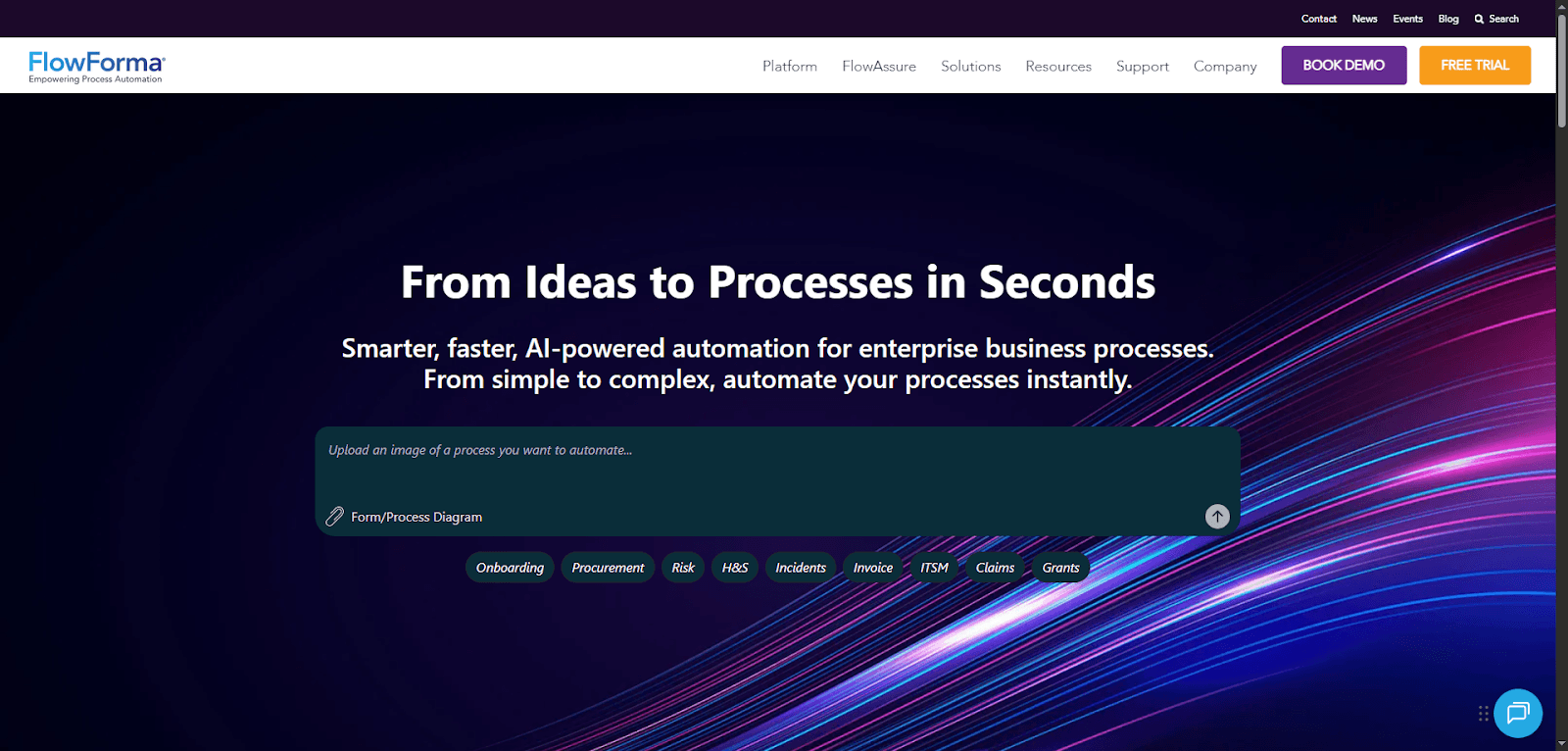
FlowForma helps insurers automate claims processes quickly, without heavy IT work or coding. It’s an AI-powered platform that turns manual steps into digital workflows, so you don’t rely on email, spreadsheets, or slow handoffs. You move faster, make fewer mistakes, and keep claims on track from start to finish.
The big advantage is speed. With FlowForma Copilot, you can describe your process (or upload a diagram) and the platform builds the workflow for you. That means you can streamline claims intake, approvals, and documentation in minutes instead of weeks.
Here’s where FlowForma delivers value:
Faster workflows → automate repetitive steps like data entry and routing.
Better visibility → track claim progress in real time with dashboards and reports.
Accurate documentation → generate and store documents automatically.
FlowForma integrates with tools you already use, including Microsoft 365 and SharePoint. You scale easily, reduce admin costs, and create a smoother claims experience for both teams and customers.
Underwriting automation
Underwriting automation uses software to collect data, apply rules, and score risk so decisions happen faster and with fewer manual steps. It evaluates applications, flags issues, and routes only complex cases to underwriters.
You use it to speed up approvals, improve accuracy, and deliver quotes in minutes instead of days. It also reduces bias and keeps decisions consistent.
When supported by digital insurance tools, underwriting becomes scalable, efficient, and easier for both teams and customers.
You’ll see this executed through tools like…
Verisk A-PLUS
The website: verisk.com
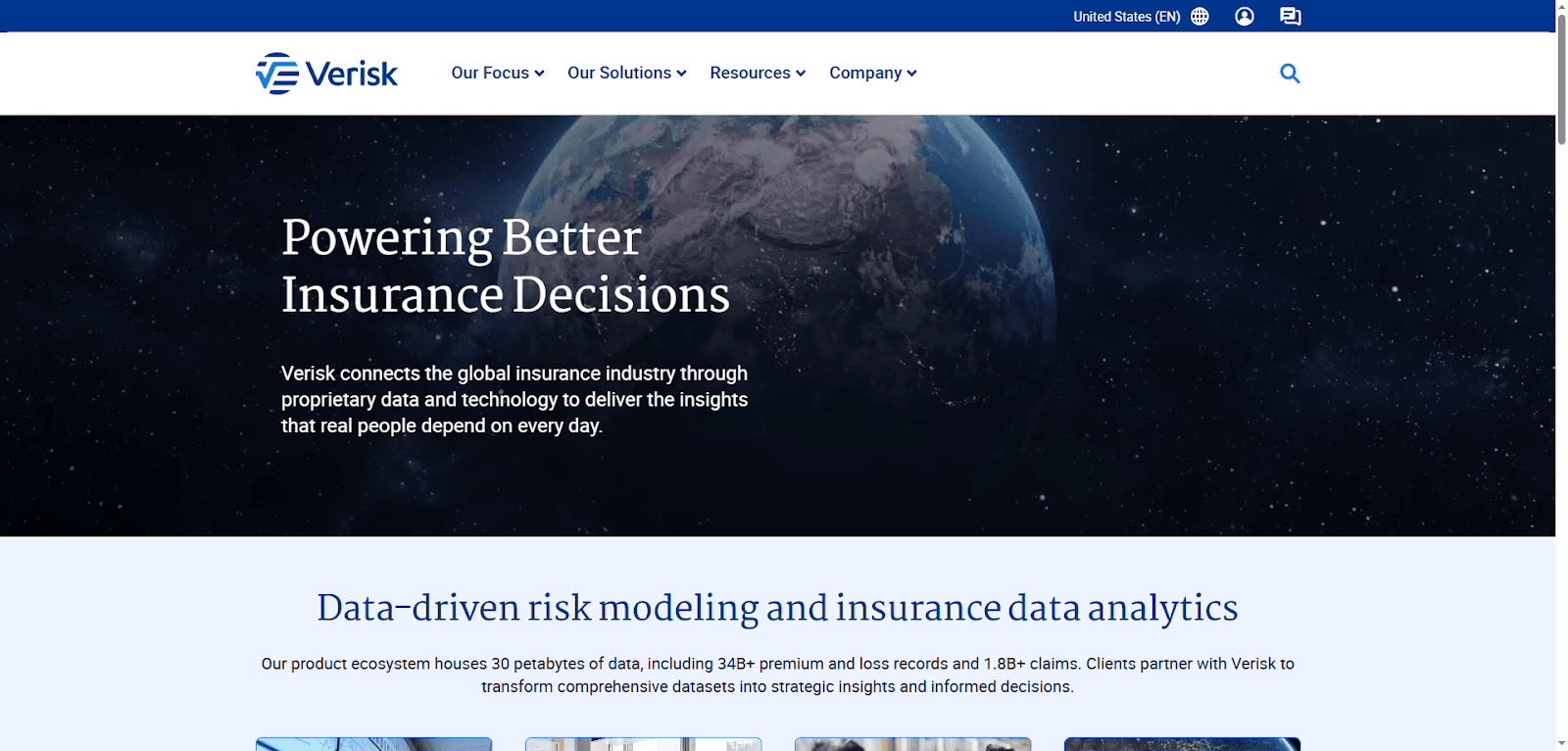
Verisk A-PLUS helps you make smarter underwriting decisions, faster. Instead of digging through scattered data or relying on guesswork, you get quick access to loss history and insights that reveal real risk.
That means you can price policies confidently and reduce surprises down the road.
The power of A-PLUS comes from data. Verisk connects massive industry datasets, giving you a clearer picture of past claims and behaviors so you can assess risk in seconds, not days.
Here’s how it helps you move faster:
Better risk selection → spot red flags early and avoid underpriced policies.
More accurate pricing → use real historical data to set fair, profitable rates.
Less manual work → automate data retrieval and reduce back-and-forth.
You’ll improve underwriting consistency, cut processing time, and boost customer confidence with quicker decisions. If you’re looking to modernize underwriting without adding complexity, A-PLUS gives you a fast, data-driven way to do it.
Expert.ai
The website: expert.ai
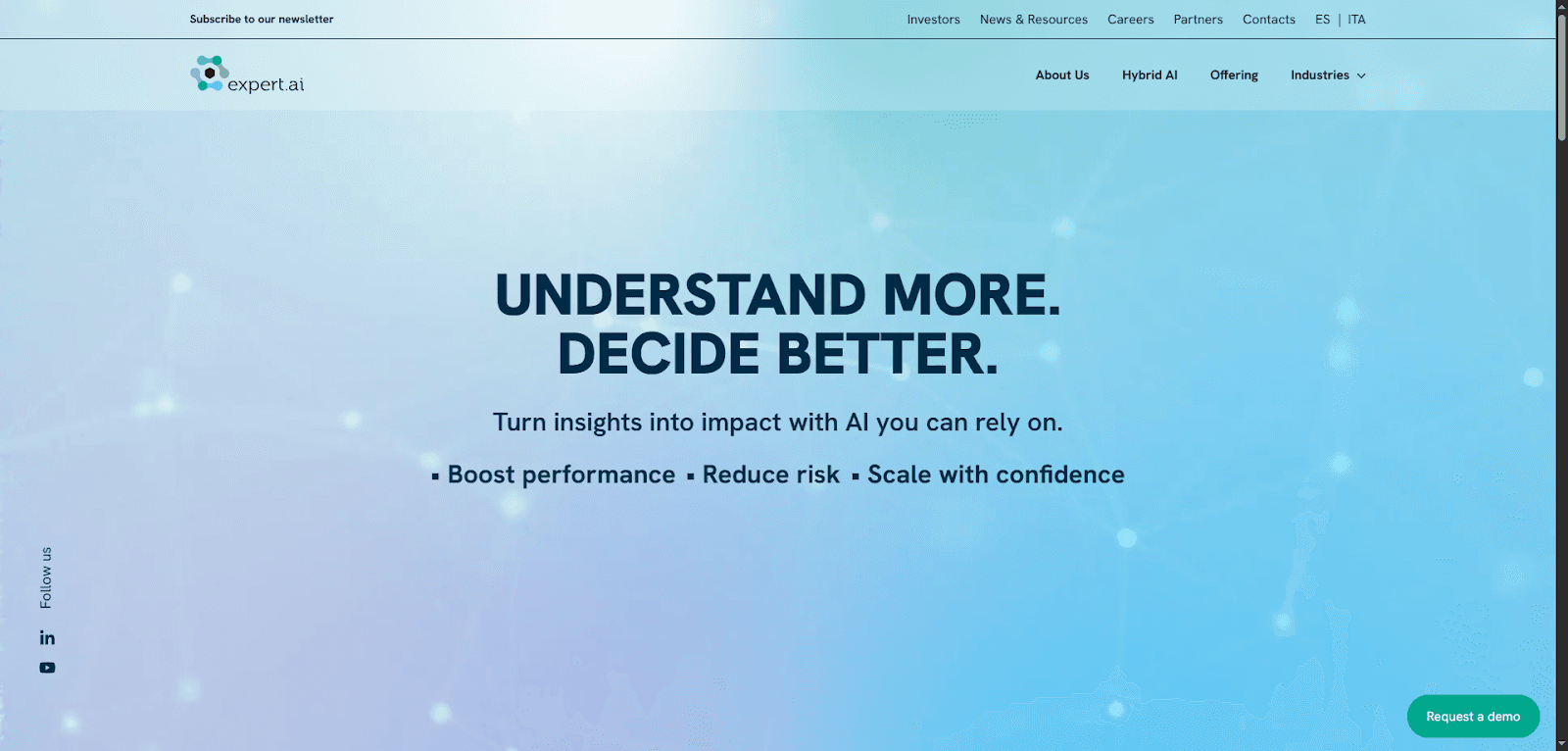
Expert.ai helps insurers speed up underwriting by turning unstructured information, like documents, reports, and text, into clear, usable insights. Instead of spending hours reviewing data, you can quickly understand risk and make confident decisions.
Its strength comes from “hybrid AI,” which simply means it combines smart machine learning with industry knowledge. You get speed and accuracy, without guessing.
Here’s how it helps you move faster:
Automates document analysis → instantly extracts key risk details from applications, emails, and reports.
Reduces manual review → cuts repetitive work so underwriters can focus on complex cases.
Improves risk assessment → highlights patterns, red flags, and exposure you might otherwise miss.
The result? Faster quotes, more consistent decisions, and better capacity to handle higher volumes without adding headcount. Plus, it scales as your business grows.
If you want underwriting that’s quicker, smarter, and less manual, Expert.ai gives you a practical way to get there, without overwhelming your team.
EZLynx
The website: ezlynx.com
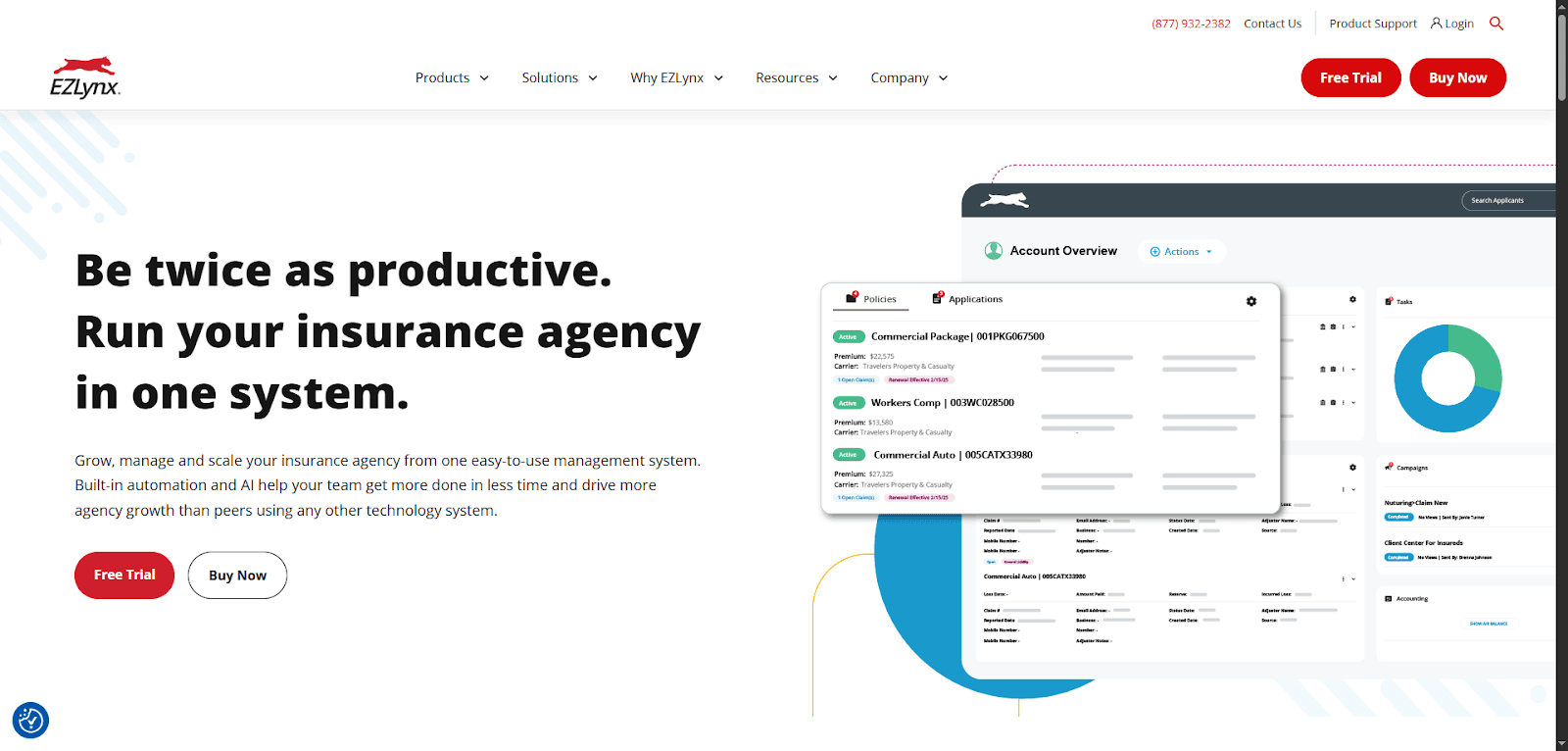
EZLynx helps agencies speed up quoting and underwriting by bringing everything into one easy-to-use system. Instead of jumping between tools or retyping the same information, you enter data once and get real-time quotes from multiple carriers. That means faster decisions, less manual work, and more chances to win business.
The built-in automation and AI features help your team handle new quotes, renewals, and service requests without slowing down. You stay organized, respond quickly, and avoid paperwork overload.
Here’s what makes EZLynx powerful for underwriting:
Instant comparative quotes → one submission, multiple carrier options.
Fewer errors → centralized data keeps everything consistent.
More productivity → automation takes on repetitive tasks so your team doesn’t have to.
You’ll move deals forward faster, serve more clients, and grow without adding extra staff. Whether you’re a new agency or scaling up, EZLynx gives you a simple, automated way to boost underwriting speed and efficiency.
Customer engagement
Customer engagement and self-service apps let customers manage policies, file claims, pay bills, and get answers anytime without calling support. They offer easy dashboards, chat support, and quick updates in one place.
You use them to cut wait times, boost satisfaction, and reduce routine workload for your team. They also give agents clearer customer insights, especially when paired with digital tools for insurance agents, helping everyone respond faster, personalize service, and build stronger long-term relationships.
On the ground, that means using systems such as…
Strada (Voice AI + Chat + Workflow)
If you want faster, smarter customer engagement in insurance, Strada makes it simple. Instead of juggling phone calls, emails, and portal requests, Strada uses AI to engage customers instantly – anytime, on any channel.
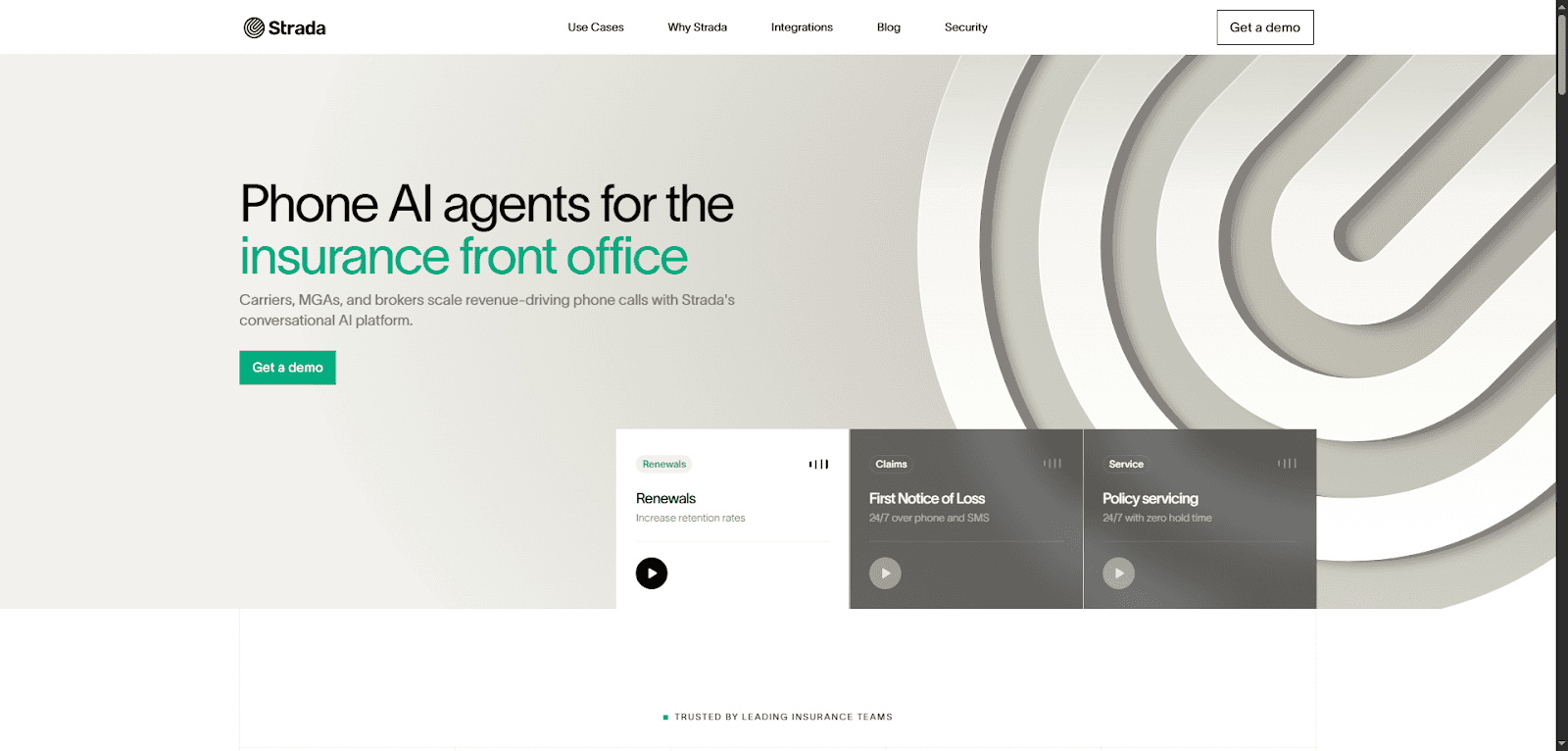
Strada started with voice AI, but today it’s become a full engagement platform. It doesn’t just answer questions: it listens, understands intent, and triggers the right actions automatically. That means less waiting, fewer handoffs, and happier customers.
At its core, Strada does one powerful thing: it meets customers where they are. Phone. Chat. SMS. Soon, email too.
No matter how someone reaches out, they get fast, accurate help.
Here’s why this matters. Customers expect real-time responses. They want clarity about policies, claims, renewals, and payments without sitting on hold or waiting for business hours.
Strada delivers that.
You’ll see three big advantages right away:
Instant responses. Customers get answers 24/7, even on weekends and late nights.
Consistent service. Whether they call or chat, the information stays accurate and aligned.
Scalable support. You can handle more inquiries without hiring more staff.
Strada uses your own knowledge base, FAQs, and SOPs to power these conversations. That means customers receive trustworthy, policy-specific answers, not generic scripts.
And when something requires human help, Strada hands it off seamlessly with full context, so your team doesn’t start from scratch.
To make engagement even stronger, Strada automates actions after conversations. For example:
A renewal concern triggers a retention task.
A policy change request updates core systems.
A claims question pulls real-time status.
A certificate request gets delivered instantly.
Everything happens behind the scenes, so your team stays focused on higher-value work.
Strada also supports agent engagement. It can qualify leads in under a minute, set appointments automatically, and run outreach sequences that keep agents informed and active.
You stay top-of-mind without endless emails and follow-ups.
And there’s no long setup. You can go live fast, thanks to native integrations with CRM, policy, billing, and claims systems.
The result? Customer engagement that feels personal, fast, and effortless. Your customers stay informed. Your agents stay productive. Your business stays ahead.
If you’re looking for a simple way to boost satisfaction and accelerate growth, Strada gives you a clear path, one conversation at a time.
Digital payments and billing
Digital payments and billing let customers pay premiums, set up auto-pay, receive invoices, and get refunds online without paperwork or phone calls.
Everything moves through secure, real-time transactions. You use it to speed up cash flow, reduce manual billing tasks, and cut late payments. It also gives customers a smoother, faster experience with clearer reminders and instant confirmations.
When you adopt digital payment solutions for insurance, you make collections easier, improve accuracy, and support growth without adding extra admin work.
A few common tools that deliver this are…
Sapiens BillingPro
The website: sapiens.com/
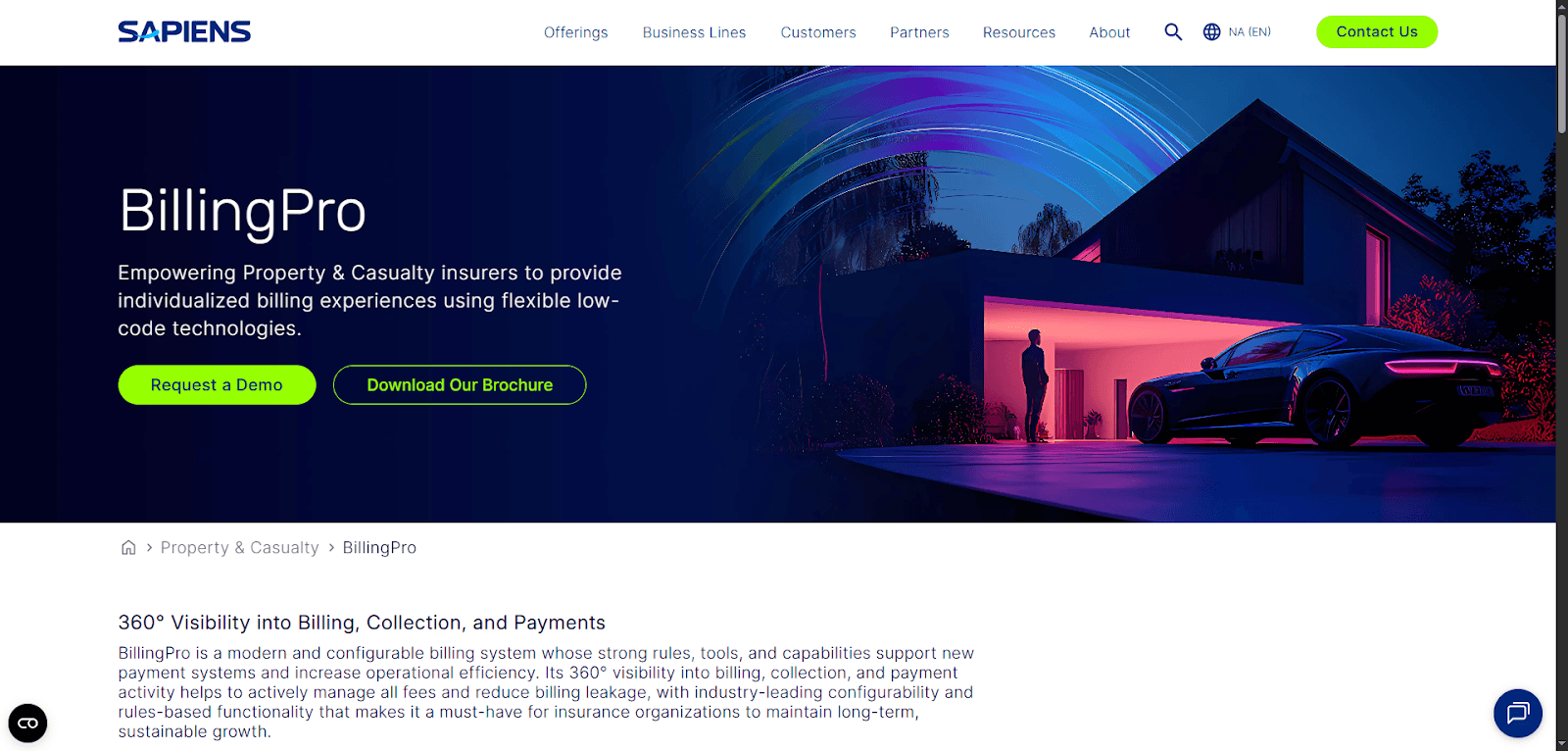
Sapiens BillingPro helps P&C insurers simplify billing, payments, and collections so you can move money faster and serve customers better. Instead of juggling spreadsheets, manual updates, or outdated systems, you get one modern platform with full visibility into every billing activity.
It’s designed to cut workload, prevent billing errors, and support flexible payment options – something today’s customers expect. And because it’s low-code, you can adapt workflows quickly without heavy IT work.
Here’s where BillingPro makes a difference:
Automated billing management → spend less time on manual tasks and more time on high-value work.
Flexible payment plans → update arrangements easily when customers need changes.
Omni-channel payments → let people pay anytime, on any device.
Full 360° insight → track billing, collections, and payments in one place.
You’ll reduce leakage, boost efficiency, and deliver a smoother billing experience. If you want faster cash flow and happier policyholders, BillingPro gives you a simple, scalable way to get there.
BriteCore Billing
The website: britecore.com/
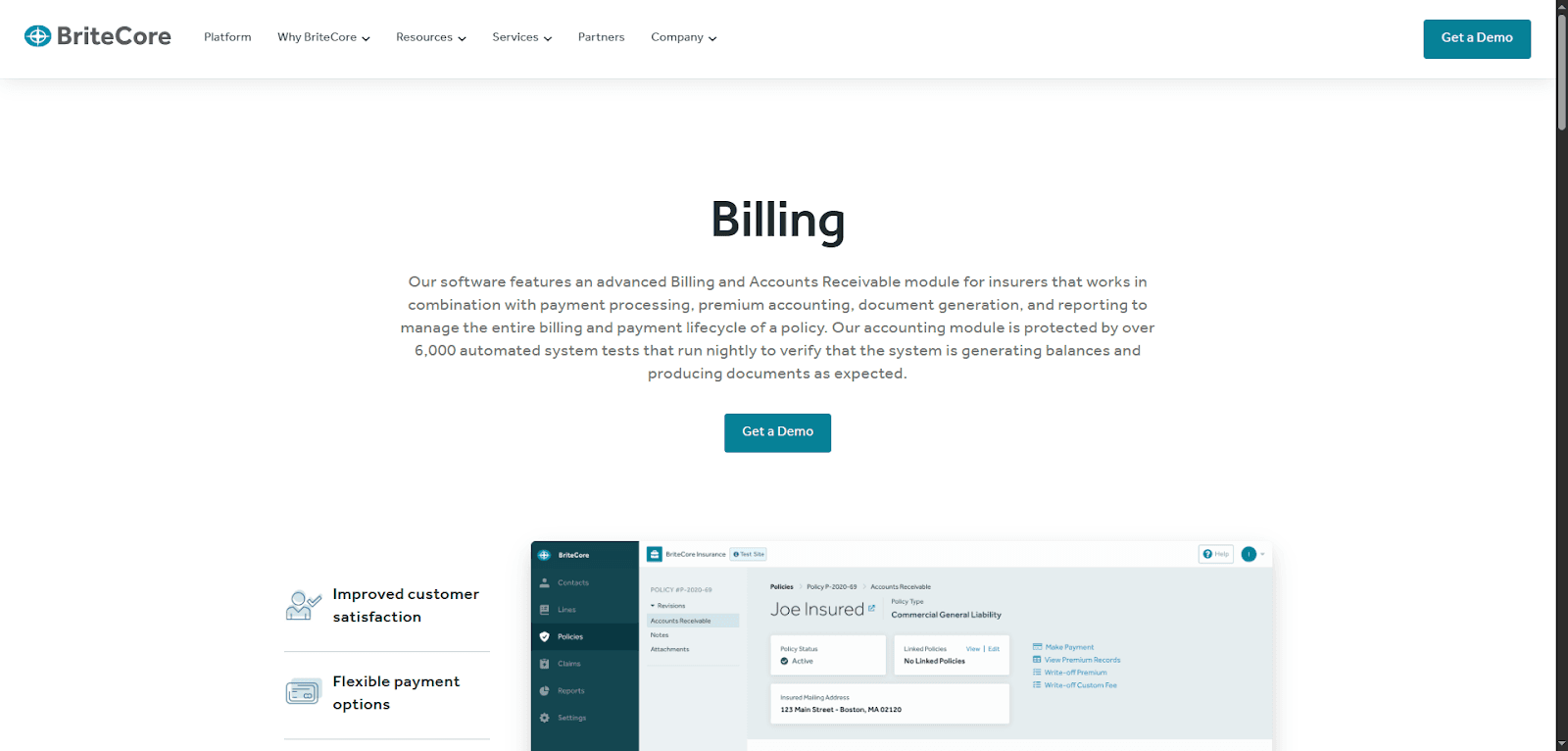
BriteCore Billing gives insurers a simple, automated way to manage the entire billing and payment lifecycle. Instead of chasing paperwork or juggling multiple tools, everything (from invoices to payments to reporting) runs in one system.
That means faster cycles, fewer mistakes, and happier customers.
The platform automates key tasks like invoices, cancellations, renewals, and reinstatements, so your team doesn’t waste time on manual work. It also supports common billing models, including direct bill, agency bill, and split payments, which makes it easy to fit different business needs.
Here’s where BriteCore Billing really helps:
Flexible payment methods → credit card, ACH, check, cash, money order, or auto-pay.
Online payments and e-billing → customers pay anytime, which boosts satisfaction.
Real-time visibility → track balances, schedules, and documents instantly.
You’ll reduce operational costs, accelerate cash flow, and deliver a smoother billing experience. If you want billing that feels modern, fast, and customer-friendly, BriteCore Billing makes it easy to get there.
AI-powered analytics
AI-powered analytics use machine learning to analyze customer data, behavior, and history to predict risk and spot patterns faster than manual reviews.
The system scores applications, flags unusual activity, and guides smarter decisions. You use it to price policies accurately, reduce losses, and act sooner instead of reacting later. It also helps teams focus on higher-value work.
When built into digital insurance software, it makes underwriting, claims, and customer insights faster, clearer, and more consistent.
Organizations usually enable this with tools such as…
Strada Analytics
If you’ve ever struggled to get clear insights from your customer or call data, you’re not alone. Most insurance teams want better analytics, but dashboards take time, money, and engineering resources.
Strada tackles this problem with a simple idea: give you the power to analyze your data instantly, without waiting on developers.

Strada’s analytics engine turns raw call data into insights you can explore on your own. Instead of static charts or limited filters, you get a flexible, browser-based analytics experience powered by SQL.
Don’t worry! You don’t need to be a data expert. The platform makes it easy to filter, drill down, and visualize information in a way that actually makes sense.

Here’s why this matters.
Customer conversations reveal tons of valuable signals: renewal intent, churn risk, claim trends, service issues, and agent performance. But most systems only capture the data. They don’t help you turn it into answers.
Strada closes that gap by letting you ask better questions and get results instantly.
You’ll benefit in three practical ways:
Full visibility. See how calls, renewals, claims, and service outcomes impact your business.
Custom reporting. Build the exact dashboards you need, not just the ones you’re given.
Faster decisions. Spot trends and act before issues turn into losses.
Strada handles the heavy lifting behind the scenes. It pulls call summaries, transcripts, and outcomes into a secure in-browser database.
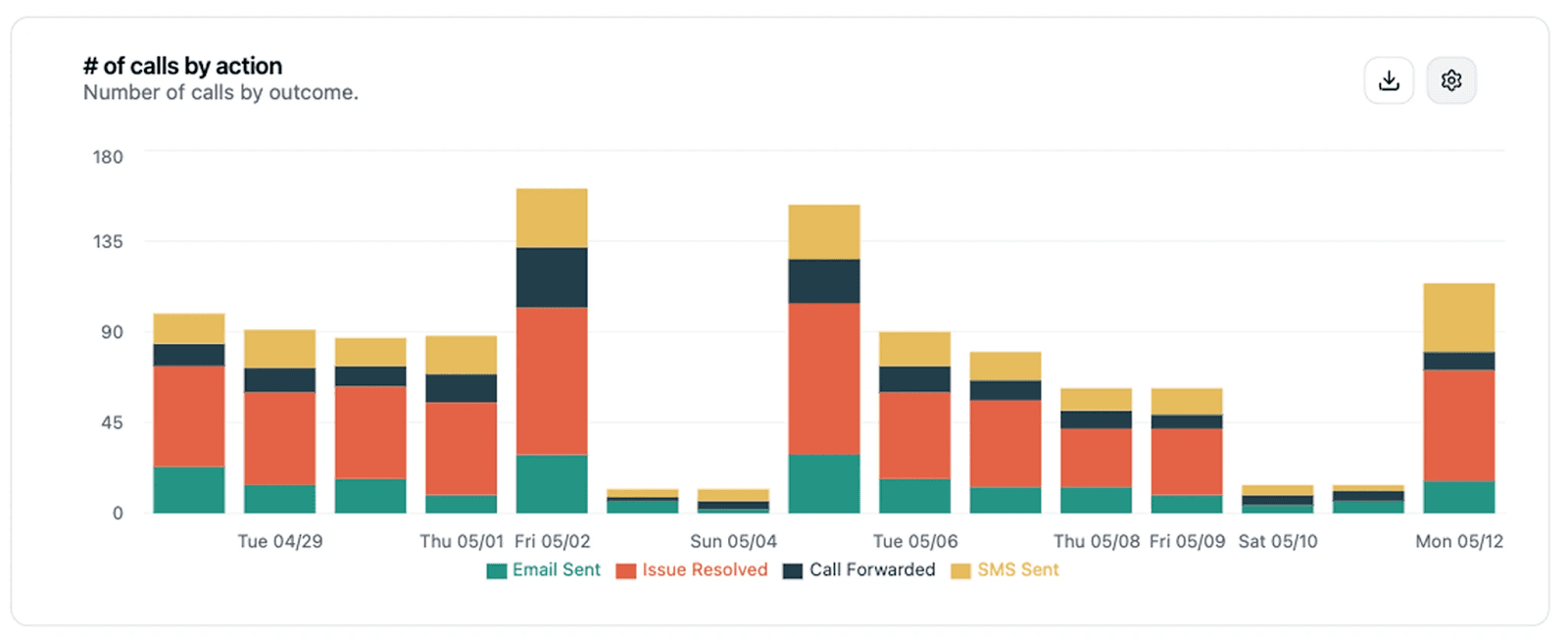
From there, you can slice the data however you want: by product, agent, state, performance metric, and more. You’re not stuck with rigid filters or canned reports.
For insurance teams, this opens the door to practical use cases:
Track renewal rates and identify accounts at risk.
Measure claim handling time and bottlenecks.
Analyze quote conversion by region or program.
Monitor agent performance and call quality.
Surface patterns that signal churn or growth opportunities.
The best part? You can do all of this without filing a ticket or waiting weeks for a dashboard update. Business users take the lead, and engineering stays focused on core work.
As you create more insights, your team gets smarter. You learn what drives outcomes, what slows you down, and where to invest next. That feedback loop strengthens operations, boosts performance, and builds confidence in your decisions.
If you want analytics that keep up with your business (not slow it down), Strada gives you a fast, flexible, and truly self-service approach. It turns data into action, and action into results.
Fraud detection systems
Fraud detection systems use software to scan claims, documents, and behavior patterns to spot suspicious activity in real time. They flag mismatched data, unusual trends, and high-risk claims before money goes out.
You use them to prevent losses, speed up honest claims, and protect customers. They also reduce manual reviews and give teams clearer insights.
When paired with other insurance digital solutions, fraud detection becomes faster, smarter, and a powerful way to keep costs low and trust high.
To put it into action, teams turn to solutions like…
Resistant AI
The website: resistant.ai
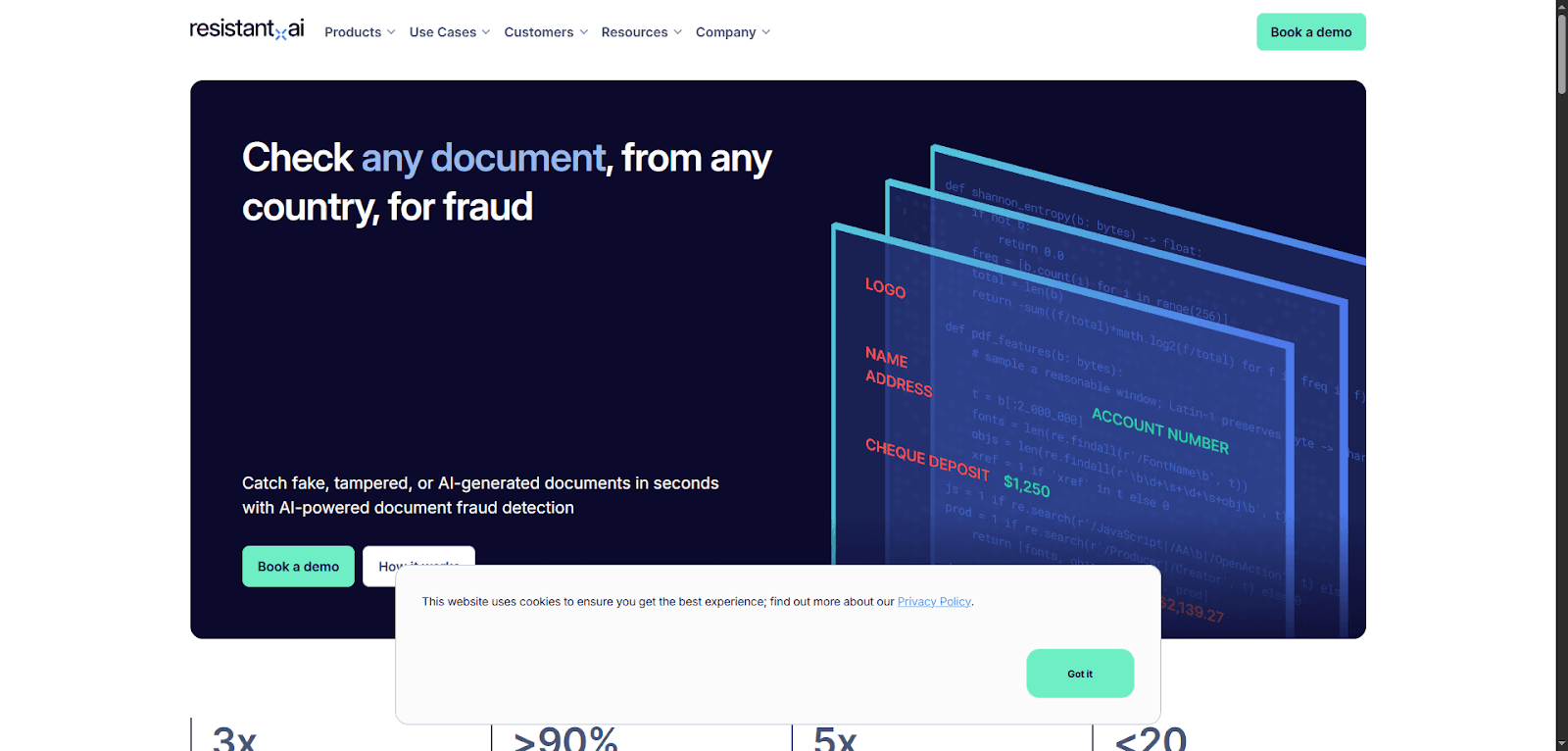
Resistant AI helps insurers stop fraud fast by using advanced AI to detect fake or tampered documents and suspicious behaviors. Instead of relying on slow manual reviews, the system spots issues in seconds, so you catch more fraud while reducing workload.
It’s built to plug into your existing processes, which means you don’t have to replace your current tech. You simply add smarter fraud checks on top.
Here’s what you’ll gain:
Faster detection → results in under 20 seconds.
More fraud caught → up to 3x improvement.
Fewer manual reviews → over 90% reduction, so your team focuses on real risks.
You can use Resistant AI across underwriting, claims, and onboarding to verify documents, filter out fakes, and stop bad actors early. It also analyzes transactions to flag risky patterns and prevent fraud before it spreads.
If you want stronger protection without slowing down your customer experience, Resistant AI gives you a fast, scalable, and proactive defense.
Case IQ (insurance investigation)
The website: caseiq.com
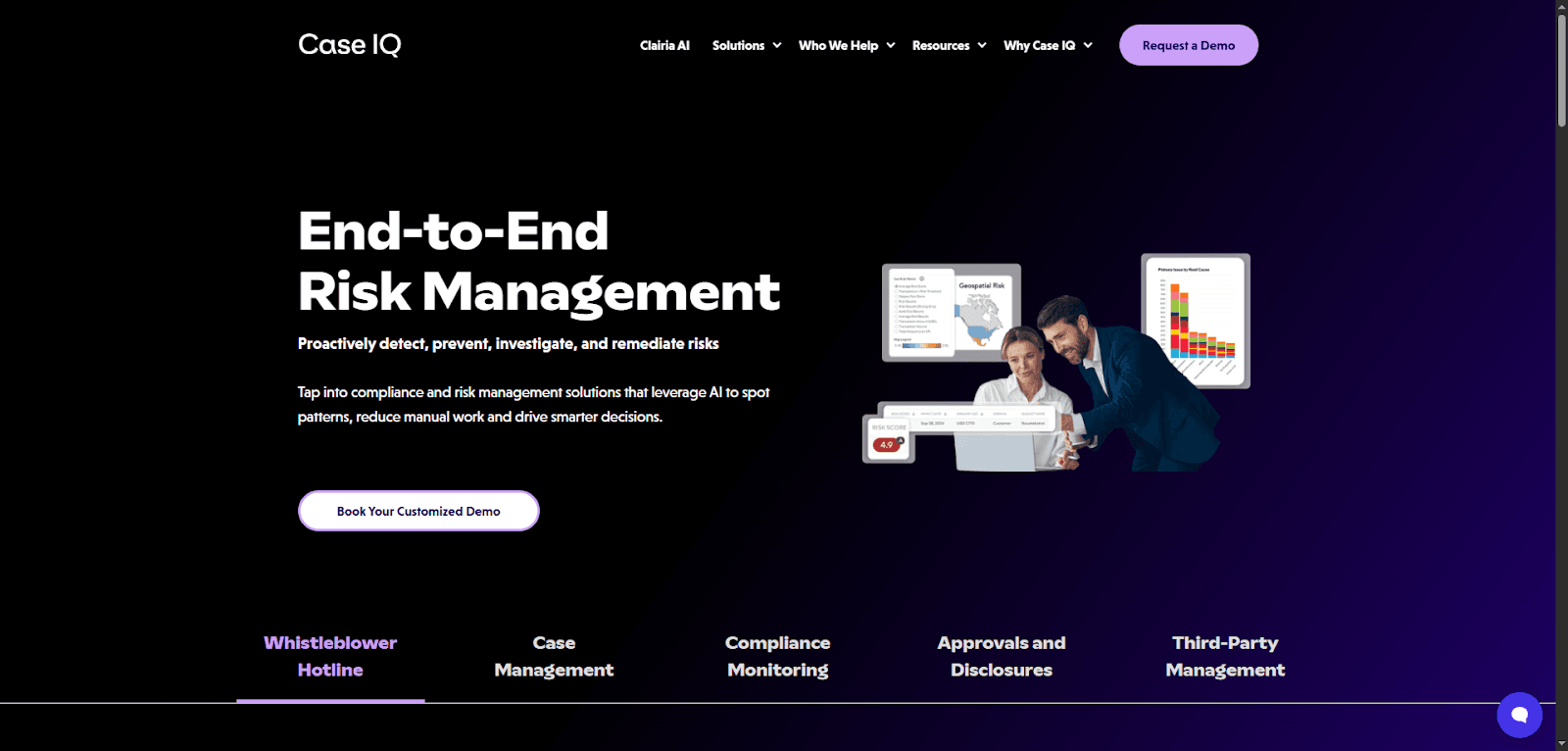
Case IQ helps insurers spot, manage, and resolve fraud-related incidents faster and with less complexity. Instead of digging through spreadsheets or using scattered tools, you get one centralized platform to detect risks, investigate cases, and take action confidently.
The system uses AI to highlight patterns, automate manual tasks, and surface issues before they escalate. That means you’re not just reacting. You’re preventing problems.
Here’s what stands out:
Secure reporting → a confidential hotline lets people report concerns anytime, helping you catch early warning signs.
Smart case management → AI-powered workflows guide investigations, cut admin work, and improve accuracy.
Clear visibility → dashboards and trend tracking make it easy to spot recurring issues and strengthen fraud prevention strategies.
You’ll reduce response times, boost accountability, and make better decisions with all data in one place. If you want a proactive, structured way to manage fraud and compliance risks, Case IQ gives you the tools to do it smoothly and efficiently.
Kount
The website: kount.com
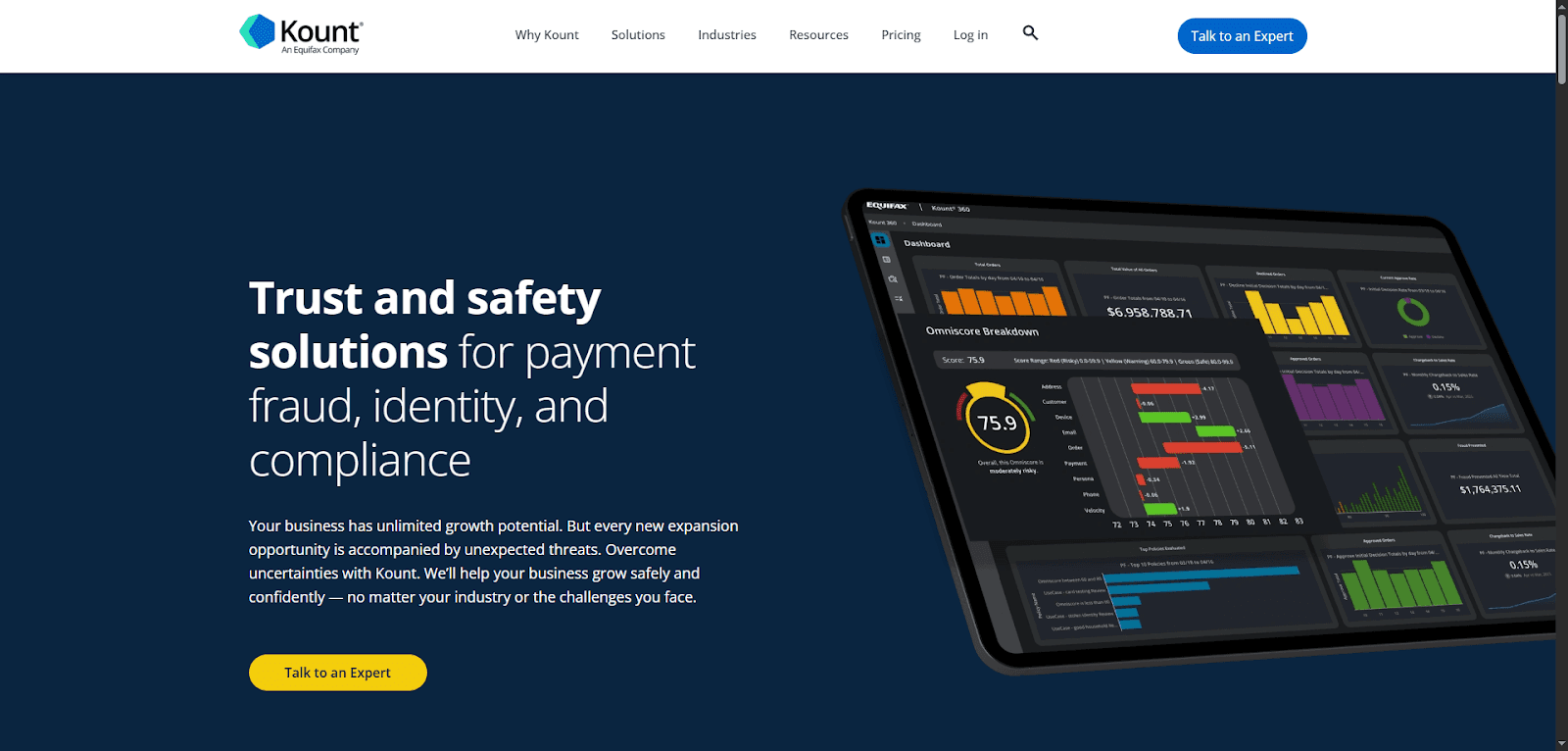
Kount helps insurers stop fraud fast while keeping customers’ experiences smooth. Instead of juggling multiple tools, you get one platform to manage fraud, identity verification, and compliancem all working together to protect every step of the customer journey.
You’ll benefit from decades of global data and advanced AI, so decisions are smarter and faster. The platform learns over time, helping you stay ahead of new fraud tactics without adding extra workload.
Here’s where Kount delivers real value:
Prevent payment fraud and chargebacks → you keep more revenue.
Verify identities in real time → without slowing down good customers.
Block account takeovers and new account fraud → before damage happens.
Automate reviews and workflows → to cut manual effort and errors.
Because it’s flexible and customizable, you can tailor rules to your risk level and business goals. If you want stronger protection with less friction, Kount lets you grow confidently while keeping threats in check.
API gateways and integration hubs
API gateways and integration hubs connect your systems, apps, partners, and data sources so everything can share information in real time. They act like a central bridge, moving data smoothly between tools without manual uploads or duplicate entry.
You use them to speed up workflows, reduce errors, and launch new features faster. They also make it easier to plug in third-party services.
When built into digital insurance platforms, integrations become simpler, more scalable, and ready for future growth.
In day-to-day operations, this looks like…
Buddy Insurance API Gateway
The website: buddy.insure
Buddy makes insurance integration fast and painless. Instead of long IT projects and complex custom builds, Buddy turns your product into a single, clean data model that you can plug into almost any digital experience. You’re able to launch insurance offerings on a website, mobile app, or checkout flow in minutes, not months.
That means you can move quickly, test new channels, and reach customers right where they’re already buying.
Here’s how Buddy helps you win faster:
Instant deployment → you can go live without heavy development.
Simple configuration → instead of costly, slow digitization work.
Flexible embedding → into any platform or customer touchpoint.
This API-first approach eliminates delays and helps you scale without bottlenecks. If you want to expand distribution, shorten launch cycles, and unlock new revenue fast, Buddy gives you a straightforward way to do it.
You don’t wait. You start shipping insurance immediately.
Draivn API platform
The website: draivn.com
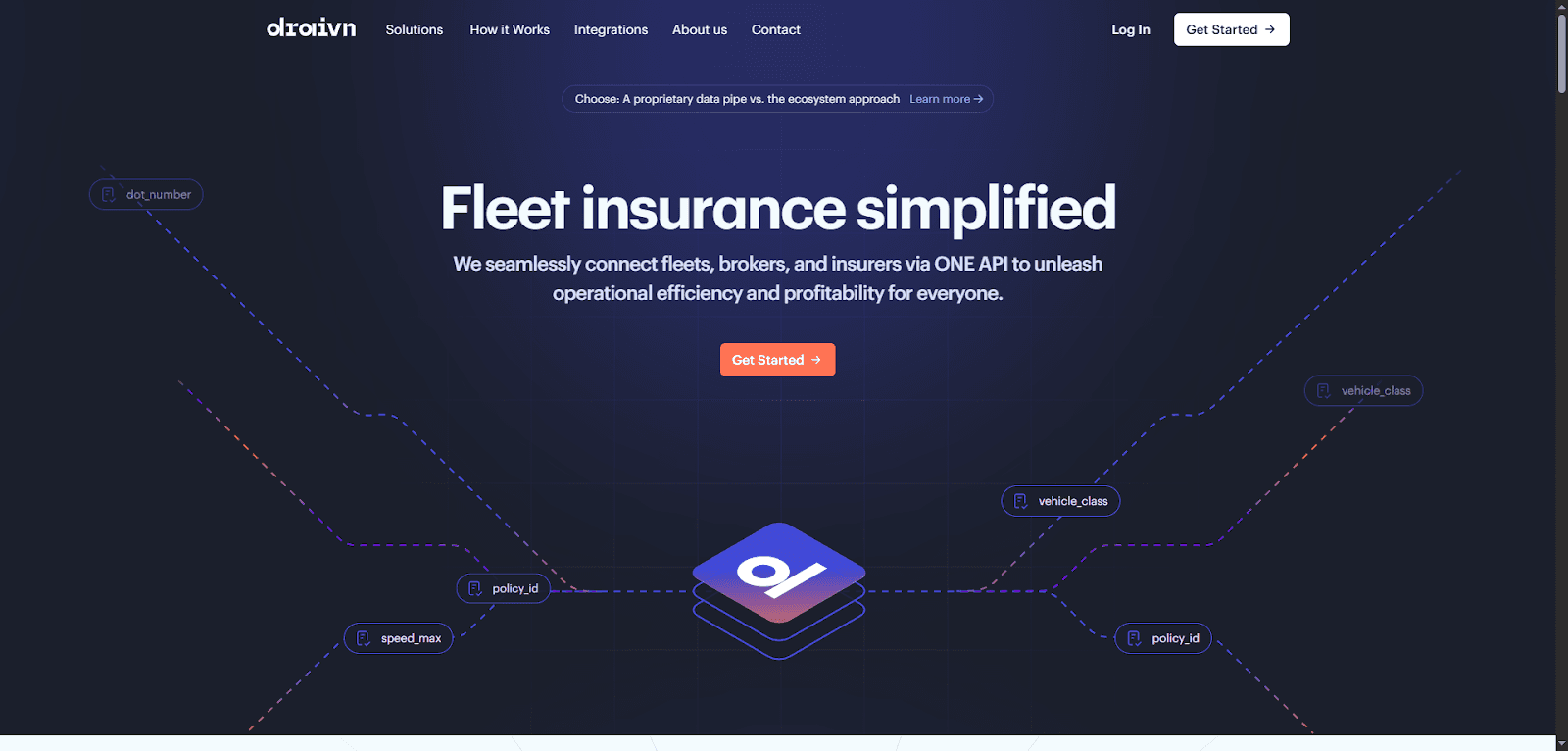
Draivn makes commercial fleet insurance easier by connecting fleets, brokers, and insurers through one powerful API. Instead of chasing spreadsheets, manual updates, or incomplete data, you get a clean, consistent data flow that everyone can use instantly. That means faster quoting, smarter underwriting, and smoother operations.
You’ll like Draivn if you want to reduce friction and boost accuracy. The platform processes fleet data (vehicles, drivers, mileage, exposure) and turns it into clear, ready-to-use information.
Here’s where Draivn delivers real wins:
One API connection → instead of multiple systems and integrations.
High-quality, processed data → consistent and complete.
Secure data sharing → strong consent and encryption controls.
Faster decisions → quoting, renewals, and risk selection.
Because fleets that perform well can finally prove it, insurers can reward safer operations, and brokers can make confident recommendations. If you want fleet insurance workflows that move in hours (not weeks!), Draivn helps everyone work faster, smarter, and more profitably.
Once you know what works, the next question is simple: How do you launch it fast without chaos? Here’s a clear path to putting these solutions in place quickly and confidently.
How do you implement these insurance digital solutions quickly?
Rolling out new technology doesn’t have to drag on for months.
You can move fast, stay focused, and keep your team confident the whole way. The key is to break the process into simple steps that reduce disruption and build momentum.
Start with steps for digital transformation with low disruption. Keep it small and intentional:
Pick one high-impact process, like claims or billing.
Map how it works today, then define the simplest improvements.
Set a clear goal, timeline, and owner.
Connect the new tool alongside your current system so nothing stops.
This approach keeps business running while you upgrade in the background.
Next, shift into an agile rollout strategy. Instead of waiting for a massive launch, move in short cycles. Release updates every few weeks. Gather real feedback. Fix issues quickly. You’ll stay flexible and avoid big surprises. Teams also feel progress right away, which builds excitement instead of resistance.
To move even faster, use MVPs to reduce risk. An MVP (or “minimum viable product”) is a basic version of a solution that solves one core problem. For example, start with automated claim intake before automating the entire workflow.
If it works, expand. If not, you’ve learned cheaply. MVPs help you test ideas with real users, prove value early, and avoid costly rework.
Finally, don’t skip people. Strong training and adoption best practices make or break speed. Keep training short and hands-on. Use simple videos or live demos. Assign “champions” inside each team to answer questions.
Celebrate quick wins so everyone sees the benefits. When people feel supported, they adopt faster and stay engaged.
When you put these pieces together, you’ll launch insurance digital solutions quickly without chaos. You’ll deliver value sooner, boost confidence across the business, and create a foundation you can scale over time.
Even smart teams hit roadblocks. Before you leap ahead, it’s worth seeing where others slip up, so you can skip the pain and stay on track.
What are common mistakes to avoid when using digital insurance solutions?
It’s easy to move fast with tech, but a few common mistakes can slow you down. Avoid them early, and you’ll get better results from digital insurance solutions without headaches.
First, watch out for over-customization that slows deployment. When you tweak every feature, projects drag on and become harder to maintain. Stick to core needs and add extras only after you’re live.
Next, don’t overlook ignoring data quality issues. If your data is messy or outdated, automation and analytics won’t work well. Clean and standardize data before you plug in new tools. You’ll get faster, more accurate outcomes.
Another slip is not preparing teams for new workflows. People need clear communication, simple training, and support. When teams understand the “why” and “how,” adoption jumps and confidence grows. A practical way to make that happen is to focus on a few essentials:
Explain the purpose. Clearly state why the change matters and what problem it solves.
Show the new steps. Give a straightforward overview of what will be done differently.
Provide quick training. Offer short, easy-to-follow guidance rather than long sessions.
Designate a go-to helper. Make sure people know who to ask when they get stuck.
Check in early. Ask for feedback within the first days or weeks to catch issues fast.
Finally, avoid relying only on technology without process redesign. Tech won’t fix broken steps. Take time to simplify processes first, then layer on automation.
When you steer clear of these traps, you unlock the true advantages of digital insurance platforms: speed, efficiency, and happier customers.
Now that you know what to do—and what to avoid—it’s time to pull everything into a practical plan. Here’s what a realistic, step-by-step roadmap actually looks like in the real world.
What does a realistic digital transformation roadmap look like?
A practical roadmap doesn’t try to transform everything at once. It builds momentum step by step so you see value fast and keep moving forward with confidence.
Start with short-term quick wins. Pick changes that deliver visible results in 60–90 days. For example, launch a simple self-service feature, automate a single claim step, or digitize billing reminders. These small wins boost team buy-in and prove the journey is worth it.
Once you’ve built traction, move into medium-term infrastructure upgrades.
This is where you modernize core systems, improve integrations, and strengthen data flows. Think APIs, cleaner databases, and better security. These upgrades prepare you for scale without overwhelming your teams.
Then shift into long-term modernization and innovation loops. This phase focuses on ongoing improvements, new product launches, and experimenting with emerging tech like AI. Instead of a finish line, you create a cycle of continuous innovation that keeps you competitive.
To stay on track, define KPIs for tracking progress. Useful metrics include:
KPI | What it measures | How to calculate it | Benchmark / target range |
Deployment time | Speed of rolling out a new workflow, feature, or process | End Date – Start Date for the deployment | Aim for a 20–40% reduction within the first 3–6 months |
Claim cycle time (or process cycle time) | How long it takes to complete a full request or case from start to finish | Average time from initiation to completion across all cases | Industry-dependent, but target a 10–30% reduction after go-live |
Customer satisfaction (CSAT) | User or customer perception of the new process | (Number of positive ratings ÷ Total ratings) × 100 | 80%+ is a strong benchmark; top performers aim for 90%+ |
Adoption rate | How many users are actively using the new workflow | (Active users ÷ Total targeted users) × 100 | 70%+ within the first 60–90 days; 90%+ over time |
Cost savings | Financial impact of the new workflow | (Old Process Cost – New Process Cost) | Target 5–15% savings in the first year, depending on scale |
Error / rework rate | Quality and accuracy of the new workflow | (Number of errors ÷ Total transactions) × 100 | Aim for a 25–50% reduction post-implementation |
First-time completion rate | How often work is completed without rework or escalation | (Completed on first attempt ÷ Total attempts) × 100 | Strong performance is 85%+ |
Training completion | Readiness of teams to operate the new workflow | (Completed training ÷ Required participants) × 100 | Target 100%, with at least 90% within launch week |
Time-to-value | How quickly benefits start showing after launch | Days from launch to first measurable improvement | Aim for visible gains in 30–60 days |
Review them regularly and adjust when needed. Clear KPIs help you celebrate wins and spot roadblocks early.
When you break transformation into these stages, you make digital change manageable and motivating. It turns digital insurance software from a big project into a scalable path toward faster operations, happier customers, and long-term growth.
With the roadmap in hand, you’re ready to move. The next step is choosing a direction you can act on right now, even if you’re starting small.
What’s the next step with digital insurance software?
Going digital isn’t optional anymore. Customers expect speed, self-service, and clear communication. Manual processes slow you down and create gaps.
The right digital insurance solutions help you move faster, cut errors, and stay competitive. They also boost growth by automating work and giving your team more time to focus on revenue.
So what should leaders focus on next?
Pick tools that improve customer experience, streamline operations, and scale easily. Look for digital insurance engagement tools that meet customers where they are.
Want a fast next step? Book a demo with Strada and see how voice AI can power your digital transformation.
Frequently Asked Questions
What’s the fastest way to start digitizing my insurance operations?
Begin with a single process—claims intake, billing reminders, or policy updates. Automate one workflow, validate results, then expand. It reduces risk and gets visible wins fast.
How do I know which tools will actually make an impact?
Framer is a design tool that allows you to design websites on a freeform canvas, and then publish them as websites with a single click.
How do insurers avoid disruption when switching to digital systems?
Framer is a design tool that allows you to design websites on a freeform canvas, and then publish them as websites with a single click.
How can digital insurance tools reduce operational costs?
Framer is a design tool that allows you to design websites on a freeform canvas, and then publish them as websites with a single click.
How do I measure whether digital transformation is actually working?
Framer is a design tool that allows you to design websites on a freeform canvas, and then publish them as websites with a single click.
Table of Contents
Carriers, MGAs, and brokers scale revenue-driving phone calls with Strada's conversational AI platform.
Start scaling with voice AI agents today
Join innovative carriers and MGAs transforming their calls with Strada.
Best 21 Digital Insurance Solutions to Transform Your Business Fast
Amir Prodensky
CEO
21 min read
Tools insurers use today to speed operations and cut workload.
The insurance world’s moving fast, and customers expect speed, clarity, and self-service. If you’re still relying on manual processes or slow systems, it’s tough to keep up.
That’s why digital transformation isn’t a “someday” project.
It’s a competitive must.
The good news? You don’t need to overhaul everything at once. You can start small, see quick wins, and build momentum.
In this guide, you’ll learn how modern tech can streamline workflows, cut delays, and create a smoother experience for both your team and your customers. You’ll also see how digital insurance tools can help you launch improvements faster and grow with confidence.
Before you dive in, it helps to know where the biggest wins are. Let’s look at the digital solutions that move the needle fastest, so you can see real results sooner.
What types of digital insurance solutions transform insurance the fastest?
When you’re looking for speed, the right technologies can transform insurance faster than you’d expect. The most impactful areas all remove delays, cut manual work, and help customers get what they need instantly.
Technology / Tool | What it does | Why it matters (speed & impact) |
Core insurance platforms | Centralize products, data, and workflows | Launch new offerings faster |
Policy administration systems | Manage policy creation, updates, renewals | Fewer errors and less back-and-forth |
Claims automation | Automates claim processing and payouts | Faster resolutions with less manual work |
Underwriting automation | Uses rules/data to make decisions | Decisions in minutes instead of days |
Customer self-service & engagement apps | Let customers file claims, view policies, get answers | 24/7 access, less support demand, higher satisfaction |
Digital payments & billing | Automate premium collection and reimbursements | Instant, accurate transactions with less paperwork |
AI analytics | Identify patterns, price accurately, act early | Better decisions and quicker responses |
Fraud detection systems | Flag suspicious activity early | Prevent losses before they escalate |
API gateways & integration hubs | Connect systems and partners for real-time data flow | Faster operations through seamless connectivity |
Put together, these technologies help you modernize fast, boost efficiency, and deliver a smoother customer experience. They show how digital insurance solutions become real business results.
And when you combine these capabilities strategically, you get a powerful set of digital insurance tools to fuel growth.
Core digital insurance software
Core digital insurance software is the central system that runs policies, claims, billing, and customer data in one place. It keeps everything organized and connected so your team doesn’t juggle multiple tools or manual steps.
You use it to work faster, reduce errors, and launch changes without chaos. It also gives customers quicker answers and smoother service.
When combined with digital automation solutions insurance can scale faster, cut delays, and help you grow with confidence. In practical terms, this shows up in tools like...
Guidewire InsuranceSuite
The website: guidewire.com
Guidewire InsuranceSuite gives you a fast, proven way to modernize core P&C operations. It focuses on three essentials (policy, billing, and claims), so you can digitize the heart of your insurance business without complexity.
You’ll see quick wins. Instead of juggling disconnected systems, you work on one platform that keeps data consistent and processes streamlined. That means fewer errors, faster decisions, and happier customers.
Here’s where it helps most:
Policy administration → launch products faster, update rates quickly, and handle quotes and renewals with less manual work.
Claims management → speed up claims intake, routing, and payments so teams resolve issues sooner.
Billing → automate invoicing, collections, and payments to improve cash flow and reduce admin time.
Because InsuranceSuite integrates easily with analytics and third-party tools, you can scale confidently. You’re not just digitizing. You’re setting up a flexible foundation for growth, innovation, and better customer experiences.
Duck Creek Suite
The website: duckcreek.com
Duck Creek Suite helps you move fast.
It’s a low-code, cloud-based platform built for P&C insurers who need to launch products quickly and serve customers better. You don’t wait months for changes. You configure, test, and go live faster.
The real value is simplicity. Instead of complex custom builds, you use reusable modules and smart tools to adapt to market needs. That means quicker updates, fewer bottlenecks, and less IT stress.
Here’s what it makes easier:
Speed-to-market → build and update products fast without heavy coding.
Customer experience → deliver smoother, more personalized interactions that build trust.
Distribution growth → support agents and brokers with tools that help them sell more.
Because Duck Creek integrates with a large partner ecosystem, payments, and APIs, you can plug into new capabilities without ripping out old systems. You stay agile, scale confidently, and keep your business ready for whatever’s next.
BriteCore
The website: britecore.com
BriteCore gives P&C insurers a modern, cloud-native core platform that helps you move faster and work smarter. Everything runs in one place, so you don’t juggle multiple systems or deal with messy handoffs.
Your team can work from anywhere, stay productive, and keep operations running smoothly.
You’ll see practical benefits quickly. The platform offers low-code tools and templates, so product changes and updates don’t drag on for weeks. You adjust rates, launch new products, and test ideas without heavy IT work.
Here’s where it helps most:
Product speed → use simple point-and-click tools to modify rules and roll out new products fast.
Customer and agent experience → give users easy digital portals and mobile access.
Data insights → use built-in dashboards and reporting to spot opportunities and cut waste.
Because BriteCore integrates with APIs and third-party solutions, you can add new capabilities as you grow. You stay flexible, competitive, and ready for what’s next.
Insurity Sure Suite
The website: insurity.com
Insurity Sure Suite helps you replace slow, outdated systems with a modern platform that actually scales. It’s built for P&C insurers, MGAs, and agencies that need speed, flexibility, and smarter decision-making.
You don’t wait weeks for processes to move. You streamline work and respond faster.
The platform focuses on real productivity gains. Tasks that once took days or weeks can drop to minutes or seconds. That means quicker underwriting, smoother policy handling, and less manual effort across teams.
Here’s where Sure Suite makes a big impact:
Policy administration → simplify rating, quoting, and issuing policies so teams move faster.
Billing and audits → automate key steps to reduce paperwork and improve accuracy.
Analytics → use data-driven insights to price better, expand into new markets, and improve performance.
With cloud delivery and proven scalability, you can grow without hitting system limits. You stay agile, boost service quality, and keep your business ready for rapid change.
Policy administration systems
A policy administration system manages policy creation, changes, renewals, and cancellations in one streamlined workflow. It keeps everything accurate and up to date, so you don’t rely on manual steps or scattered spreadsheets.
When supported by digital process automation tools insurance teams can move faster, reduce errors, and deliver a smoother customer experience.
To make this real, companies rely on solutions such as…
Equisoft Manage
The website: equisoft.com
Equisoft Manage helps insurers simplify policy administration and move faster in a digital-first world. It’s designed to take complex, time-consuming processes and turn them into smooth, automated workflows. You don’t chase paperwork or rely on outdated systems. You manage policies in one modern platform.
You’ll see real impact quickly. Equisoft combines mature technology with AI-enabled tools to speed up policy changes, improve accuracy, and reduce manual work. Your teams get more time to focus on customers instead of administration.
Here’s where it makes a difference:
Faster policy processing → handle new business, updates, and renewals with fewer steps.
Better advisor and distributor support → empower partners with comprehensive distribution management software and the tools they need to serve clients efficiently.
Lower risk during modernization → use expert implementation and proven methods to transition safely.
Because Equisoft integrates easily with existing systems and data, you can modernize without disruption. You stay agile, boost service quality, and set a strong foundation for future growth.
Practo Insura
The website: practoinsura.com
Practo Insura gives insurers a fast, practical way to manage policies without slowing down operations.
It’s built for P&C carriers, MGAs, and reinsurers who want a modern system that’s easy to use and quick to update. You don’t wait months for changes. You move fast and stay competitive.
The platform focuses on real efficiency. It combines policy, billing, and claims in one place and supports everything with AI-powered voice and chat agents, so your team spends less time on manual tasks and more time serving customers.
Here’s where Practo Insura stands out:
Rapid rate updates → go live with new rates in as little as seven days.
Smooth migration → switch systems without long downtime or painful transitions.
Paperless workflows → use built-in e-sign tools to eliminate delays.
With its user-friendly design and strategic support, Practo Insura feels more like a partner than just software. You scale confidently, simplify operations, and deliver a better experience for everyone.
Origami Risk
The website: origamirisk.com
Origami Risk gives insurers a single cloud platform to manage policies, claims, and risk programs without juggling multiple systems. It’s built to streamline work, improve accuracy, and help teams move faster.
You don’t waste time on manual steps. You automate them and keep everything connected.
What makes it powerful is the combination of policy administration and real-time data. You get one source of truth, smarter workflows, and better visibility into performance. That means quicker decisions and fewer bottlenecks.
Here’s where Origami Risk delivers value:
End-to-end policy management → quote, bind, issue, and update policies in one place.
Automation → use built-in workflows and AI tools to reduce repetitive tasks.
Analytics → spot trends, track results, and improve pricing and underwriting.
With secure architecture and easy integrations, you connect to other systems without heavy IT work. You stay scalable, compliant, and ready to support growth, even across multiple lines of business or complex programs.
Claims automation tools
Claims automation tools handle claim intake, validation, routing, and payouts with minimal manual work. They pull data, check rules, and move each claim to the right step automatically.
You use them to speed up decisions, cut errors, and give customers faster answers. They also free your team to focus on complex cases instead of routine tasks.
As part of digital insurance solutions, claims automation helps you boost efficiency, improve service, and scale without adding extra workload.
This category typically includes platforms like…
Strada Workflows
Handling claims is one of the most time-consuming parts of insurance.
Calls come in, details get captured, and then the real work starts: assigning adjusters, updating systems, sending documents, and notifying teams. It’s easy for tasks to pile up or fall through the cracks.
Strada Workflows solves this problem by turning claim conversations into instant, automated action.
Strada started with AI phone agents, but Workflows takes it further. Instead of just capturing information, it acts on it the moment a call ends. That means less manual follow-up, faster resolutions, and a smoother experience for customers and teams.
Here’s the simple idea: every claims call becomes a trigger for automation. No waiting. No data entry. No chasing information across platforms.
You get three big benefits right away:
Faster processing. Calls that used to lead to hours of follow-up become automated tasks completed in minutes.
Fewer mistakes. Built-in accuracy checks reduce errors and protect against E&O risk.
Happier customers. With 24/7 availability and no hold times, claims move forward even when your team’s offline.
To make this happen, Strada Workflows connects directly to your core systems: claims platforms, CRMs, policy systems, and even custom live data enrichment APIs. There’s no heavy engineering lift, and you don’t need to write code. You set the rules, and Workflows runs them automatically.
For claims teams, this plays out in practical ways:
When a customer reports a new claim, the system creates a file, assigns an adjuster, sends required documents, and alerts the right people, automatically.
If someone requests a certificate of insurance during a call, Workflows pushes the request to your AMS, generates the correct form, and sends it by email or SMS.
If a claim signals higher risk or urgency, the workflow flags it instantly and updates your CRM so nothing stalls.
All of this scales effortlessly. No matter if you're handling 10 claims or 10,000, the process stays consistent and fast. And because Strada is purpose-built for insurance, its AI understands industry terminology and real-world scenarios.
The result? Your team spends less time shuffling data and more time solving problems. Claims move faster, customers stay informed, and your business runs smarter, not harder.
If you want claims work to feel less reactive and more automated, Strada Workflows offers a clear path forward. It’s a simple way to unlock speed, accuracy, and efficiency, starting on day one.
FlowForma
The website: flowforma.com
FlowForma helps insurers automate claims processes quickly, without heavy IT work or coding. It’s an AI-powered platform that turns manual steps into digital workflows, so you don’t rely on email, spreadsheets, or slow handoffs. You move faster, make fewer mistakes, and keep claims on track from start to finish.
The big advantage is speed. With FlowForma Copilot, you can describe your process (or upload a diagram) and the platform builds the workflow for you. That means you can streamline claims intake, approvals, and documentation in minutes instead of weeks.
Here’s where FlowForma delivers value:
Faster workflows → automate repetitive steps like data entry and routing.
Better visibility → track claim progress in real time with dashboards and reports.
Accurate documentation → generate and store documents automatically.
FlowForma integrates with tools you already use, including Microsoft 365 and SharePoint. You scale easily, reduce admin costs, and create a smoother claims experience for both teams and customers.
Underwriting automation
Underwriting automation uses software to collect data, apply rules, and score risk so decisions happen faster and with fewer manual steps. It evaluates applications, flags issues, and routes only complex cases to underwriters.
You use it to speed up approvals, improve accuracy, and deliver quotes in minutes instead of days. It also reduces bias and keeps decisions consistent.
When supported by digital insurance tools, underwriting becomes scalable, efficient, and easier for both teams and customers.
You’ll see this executed through tools like…
Verisk A-PLUS
The website: verisk.com
Verisk A-PLUS helps you make smarter underwriting decisions, faster. Instead of digging through scattered data or relying on guesswork, you get quick access to loss history and insights that reveal real risk.
That means you can price policies confidently and reduce surprises down the road.
The power of A-PLUS comes from data. Verisk connects massive industry datasets, giving you a clearer picture of past claims and behaviors so you can assess risk in seconds, not days.
Here’s how it helps you move faster:
Better risk selection → spot red flags early and avoid underpriced policies.
More accurate pricing → use real historical data to set fair, profitable rates.
Less manual work → automate data retrieval and reduce back-and-forth.
You’ll improve underwriting consistency, cut processing time, and boost customer confidence with quicker decisions. If you’re looking to modernize underwriting without adding complexity, A-PLUS gives you a fast, data-driven way to do it.
Expert.ai
The website: expert.ai
Expert.ai helps insurers speed up underwriting by turning unstructured information, like documents, reports, and text, into clear, usable insights. Instead of spending hours reviewing data, you can quickly understand risk and make confident decisions.
Its strength comes from “hybrid AI,” which simply means it combines smart machine learning with industry knowledge. You get speed and accuracy, without guessing.
Here’s how it helps you move faster:
Automates document analysis → instantly extracts key risk details from applications, emails, and reports.
Reduces manual review → cuts repetitive work so underwriters can focus on complex cases.
Improves risk assessment → highlights patterns, red flags, and exposure you might otherwise miss.
The result? Faster quotes, more consistent decisions, and better capacity to handle higher volumes without adding headcount. Plus, it scales as your business grows.
If you want underwriting that’s quicker, smarter, and less manual, Expert.ai gives you a practical way to get there, without overwhelming your team.
EZLynx
The website: ezlynx.com
EZLynx helps agencies speed up quoting and underwriting by bringing everything into one easy-to-use system. Instead of jumping between tools or retyping the same information, you enter data once and get real-time quotes from multiple carriers. That means faster decisions, less manual work, and more chances to win business.
The built-in automation and AI features help your team handle new quotes, renewals, and service requests without slowing down. You stay organized, respond quickly, and avoid paperwork overload.
Here’s what makes EZLynx powerful for underwriting:
Instant comparative quotes → one submission, multiple carrier options.
Fewer errors → centralized data keeps everything consistent.
More productivity → automation takes on repetitive tasks so your team doesn’t have to.
You’ll move deals forward faster, serve more clients, and grow without adding extra staff. Whether you’re a new agency or scaling up, EZLynx gives you a simple, automated way to boost underwriting speed and efficiency.
Customer engagement
Customer engagement and self-service apps let customers manage policies, file claims, pay bills, and get answers anytime without calling support. They offer easy dashboards, chat support, and quick updates in one place.
You use them to cut wait times, boost satisfaction, and reduce routine workload for your team. They also give agents clearer customer insights, especially when paired with digital tools for insurance agents, helping everyone respond faster, personalize service, and build stronger long-term relationships.
On the ground, that means using systems such as…
Strada (Voice AI + Chat + Workflow)
If you want faster, smarter customer engagement in insurance, Strada makes it simple. Instead of juggling phone calls, emails, and portal requests, Strada uses AI to engage customers instantly – anytime, on any channel.
Strada started with voice AI, but today it’s become a full engagement platform. It doesn’t just answer questions: it listens, understands intent, and triggers the right actions automatically. That means less waiting, fewer handoffs, and happier customers.
At its core, Strada does one powerful thing: it meets customers where they are. Phone. Chat. SMS. Soon, email too.
No matter how someone reaches out, they get fast, accurate help.
Here’s why this matters. Customers expect real-time responses. They want clarity about policies, claims, renewals, and payments without sitting on hold or waiting for business hours.
Strada delivers that.
You’ll see three big advantages right away:
Instant responses. Customers get answers 24/7, even on weekends and late nights.
Consistent service. Whether they call or chat, the information stays accurate and aligned.
Scalable support. You can handle more inquiries without hiring more staff.
Strada uses your own knowledge base, FAQs, and SOPs to power these conversations. That means customers receive trustworthy, policy-specific answers, not generic scripts.
And when something requires human help, Strada hands it off seamlessly with full context, so your team doesn’t start from scratch.
To make engagement even stronger, Strada automates actions after conversations. For example:
A renewal concern triggers a retention task.
A policy change request updates core systems.
A claims question pulls real-time status.
A certificate request gets delivered instantly.
Everything happens behind the scenes, so your team stays focused on higher-value work.
Strada also supports agent engagement. It can qualify leads in under a minute, set appointments automatically, and run outreach sequences that keep agents informed and active.
You stay top-of-mind without endless emails and follow-ups.
And there’s no long setup. You can go live fast, thanks to native integrations with CRM, policy, billing, and claims systems.
The result? Customer engagement that feels personal, fast, and effortless. Your customers stay informed. Your agents stay productive. Your business stays ahead.
If you’re looking for a simple way to boost satisfaction and accelerate growth, Strada gives you a clear path, one conversation at a time.
Digital payments and billing
Digital payments and billing let customers pay premiums, set up auto-pay, receive invoices, and get refunds online without paperwork or phone calls.
Everything moves through secure, real-time transactions. You use it to speed up cash flow, reduce manual billing tasks, and cut late payments. It also gives customers a smoother, faster experience with clearer reminders and instant confirmations.
When you adopt digital payment solutions for insurance, you make collections easier, improve accuracy, and support growth without adding extra admin work.
A few common tools that deliver this are…
Sapiens BillingPro
The website: sapiens.com/
Sapiens BillingPro helps P&C insurers simplify billing, payments, and collections so you can move money faster and serve customers better. Instead of juggling spreadsheets, manual updates, or outdated systems, you get one modern platform with full visibility into every billing activity.
It’s designed to cut workload, prevent billing errors, and support flexible payment options – something today’s customers expect. And because it’s low-code, you can adapt workflows quickly without heavy IT work.
Here’s where BillingPro makes a difference:
Automated billing management → spend less time on manual tasks and more time on high-value work.
Flexible payment plans → update arrangements easily when customers need changes.
Omni-channel payments → let people pay anytime, on any device.
Full 360° insight → track billing, collections, and payments in one place.
You’ll reduce leakage, boost efficiency, and deliver a smoother billing experience. If you want faster cash flow and happier policyholders, BillingPro gives you a simple, scalable way to get there.
BriteCore Billing
The website: britecore.com/
BriteCore Billing gives insurers a simple, automated way to manage the entire billing and payment lifecycle. Instead of chasing paperwork or juggling multiple tools, everything (from invoices to payments to reporting) runs in one system.
That means faster cycles, fewer mistakes, and happier customers.
The platform automates key tasks like invoices, cancellations, renewals, and reinstatements, so your team doesn’t waste time on manual work. It also supports common billing models, including direct bill, agency bill, and split payments, which makes it easy to fit different business needs.
Here’s where BriteCore Billing really helps:
Flexible payment methods → credit card, ACH, check, cash, money order, or auto-pay.
Online payments and e-billing → customers pay anytime, which boosts satisfaction.
Real-time visibility → track balances, schedules, and documents instantly.
You’ll reduce operational costs, accelerate cash flow, and deliver a smoother billing experience. If you want billing that feels modern, fast, and customer-friendly, BriteCore Billing makes it easy to get there.
AI-powered analytics
AI-powered analytics use machine learning to analyze customer data, behavior, and history to predict risk and spot patterns faster than manual reviews.
The system scores applications, flags unusual activity, and guides smarter decisions. You use it to price policies accurately, reduce losses, and act sooner instead of reacting later. It also helps teams focus on higher-value work.
When built into digital insurance software, it makes underwriting, claims, and customer insights faster, clearer, and more consistent.
Organizations usually enable this with tools such as…
Strada Analytics
If you’ve ever struggled to get clear insights from your customer or call data, you’re not alone. Most insurance teams want better analytics, but dashboards take time, money, and engineering resources.
Strada tackles this problem with a simple idea: give you the power to analyze your data instantly, without waiting on developers.
Strada’s analytics engine turns raw call data into insights you can explore on your own. Instead of static charts or limited filters, you get a flexible, browser-based analytics experience powered by SQL.
Don’t worry! You don’t need to be a data expert. The platform makes it easy to filter, drill down, and visualize information in a way that actually makes sense.
Here’s why this matters.
Customer conversations reveal tons of valuable signals: renewal intent, churn risk, claim trends, service issues, and agent performance. But most systems only capture the data. They don’t help you turn it into answers.
Strada closes that gap by letting you ask better questions and get results instantly.
You’ll benefit in three practical ways:
Full visibility. See how calls, renewals, claims, and service outcomes impact your business.
Custom reporting. Build the exact dashboards you need, not just the ones you’re given.
Faster decisions. Spot trends and act before issues turn into losses.
Strada handles the heavy lifting behind the scenes. It pulls call summaries, transcripts, and outcomes into a secure in-browser database.
From there, you can slice the data however you want: by product, agent, state, performance metric, and more. You’re not stuck with rigid filters or canned reports.
For insurance teams, this opens the door to practical use cases:
Track renewal rates and identify accounts at risk.
Measure claim handling time and bottlenecks.
Analyze quote conversion by region or program.
Monitor agent performance and call quality.
Surface patterns that signal churn or growth opportunities.
The best part? You can do all of this without filing a ticket or waiting weeks for a dashboard update. Business users take the lead, and engineering stays focused on core work.
As you create more insights, your team gets smarter. You learn what drives outcomes, what slows you down, and where to invest next. That feedback loop strengthens operations, boosts performance, and builds confidence in your decisions.
If you want analytics that keep up with your business (not slow it down), Strada gives you a fast, flexible, and truly self-service approach. It turns data into action, and action into results.
Fraud detection systems
Fraud detection systems use software to scan claims, documents, and behavior patterns to spot suspicious activity in real time. They flag mismatched data, unusual trends, and high-risk claims before money goes out.
You use them to prevent losses, speed up honest claims, and protect customers. They also reduce manual reviews and give teams clearer insights.
When paired with other insurance digital solutions, fraud detection becomes faster, smarter, and a powerful way to keep costs low and trust high.
To put it into action, teams turn to solutions like…
Resistant AI
The website: resistant.ai
Resistant AI helps insurers stop fraud fast by using advanced AI to detect fake or tampered documents and suspicious behaviors. Instead of relying on slow manual reviews, the system spots issues in seconds, so you catch more fraud while reducing workload.
It’s built to plug into your existing processes, which means you don’t have to replace your current tech. You simply add smarter fraud checks on top.
Here’s what you’ll gain:
Faster detection → results in under 20 seconds.
More fraud caught → up to 3x improvement.
Fewer manual reviews → over 90% reduction, so your team focuses on real risks.
You can use Resistant AI across underwriting, claims, and onboarding to verify documents, filter out fakes, and stop bad actors early. It also analyzes transactions to flag risky patterns and prevent fraud before it spreads.
If you want stronger protection without slowing down your customer experience, Resistant AI gives you a fast, scalable, and proactive defense.
Case IQ (insurance investigation)
The website: caseiq.com
Case IQ helps insurers spot, manage, and resolve fraud-related incidents faster and with less complexity. Instead of digging through spreadsheets or using scattered tools, you get one centralized platform to detect risks, investigate cases, and take action confidently.
The system uses AI to highlight patterns, automate manual tasks, and surface issues before they escalate. That means you’re not just reacting. You’re preventing problems.
Here’s what stands out:
Secure reporting → a confidential hotline lets people report concerns anytime, helping you catch early warning signs.
Smart case management → AI-powered workflows guide investigations, cut admin work, and improve accuracy.
Clear visibility → dashboards and trend tracking make it easy to spot recurring issues and strengthen fraud prevention strategies.
You’ll reduce response times, boost accountability, and make better decisions with all data in one place. If you want a proactive, structured way to manage fraud and compliance risks, Case IQ gives you the tools to do it smoothly and efficiently.
Kount
The website: kount.com
Kount helps insurers stop fraud fast while keeping customers’ experiences smooth. Instead of juggling multiple tools, you get one platform to manage fraud, identity verification, and compliancem all working together to protect every step of the customer journey.
You’ll benefit from decades of global data and advanced AI, so decisions are smarter and faster. The platform learns over time, helping you stay ahead of new fraud tactics without adding extra workload.
Here’s where Kount delivers real value:
Prevent payment fraud and chargebacks → you keep more revenue.
Verify identities in real time → without slowing down good customers.
Block account takeovers and new account fraud → before damage happens.
Automate reviews and workflows → to cut manual effort and errors.
Because it’s flexible and customizable, you can tailor rules to your risk level and business goals. If you want stronger protection with less friction, Kount lets you grow confidently while keeping threats in check.
API gateways and integration hubs
API gateways and integration hubs connect your systems, apps, partners, and data sources so everything can share information in real time. They act like a central bridge, moving data smoothly between tools without manual uploads or duplicate entry.
You use them to speed up workflows, reduce errors, and launch new features faster. They also make it easier to plug in third-party services.
When built into digital insurance platforms, integrations become simpler, more scalable, and ready for future growth.
In day-to-day operations, this looks like…
Buddy Insurance API Gateway
The website: buddy.insure
Buddy makes insurance integration fast and painless. Instead of long IT projects and complex custom builds, Buddy turns your product into a single, clean data model that you can plug into almost any digital experience. You’re able to launch insurance offerings on a website, mobile app, or checkout flow in minutes, not months.
That means you can move quickly, test new channels, and reach customers right where they’re already buying.
Here’s how Buddy helps you win faster:
Instant deployment → you can go live without heavy development.
Simple configuration → instead of costly, slow digitization work.
Flexible embedding → into any platform or customer touchpoint.
This API-first approach eliminates delays and helps you scale without bottlenecks. If you want to expand distribution, shorten launch cycles, and unlock new revenue fast, Buddy gives you a straightforward way to do it.
You don’t wait. You start shipping insurance immediately.
Draivn API platform
The website: draivn.com
Draivn makes commercial fleet insurance easier by connecting fleets, brokers, and insurers through one powerful API. Instead of chasing spreadsheets, manual updates, or incomplete data, you get a clean, consistent data flow that everyone can use instantly. That means faster quoting, smarter underwriting, and smoother operations.
You’ll like Draivn if you want to reduce friction and boost accuracy. The platform processes fleet data (vehicles, drivers, mileage, exposure) and turns it into clear, ready-to-use information.
Here’s where Draivn delivers real wins:
One API connection → instead of multiple systems and integrations.
High-quality, processed data → consistent and complete.
Secure data sharing → strong consent and encryption controls.
Faster decisions → quoting, renewals, and risk selection.
Because fleets that perform well can finally prove it, insurers can reward safer operations, and brokers can make confident recommendations. If you want fleet insurance workflows that move in hours (not weeks!), Draivn helps everyone work faster, smarter, and more profitably.
Once you know what works, the next question is simple: How do you launch it fast without chaos? Here’s a clear path to putting these solutions in place quickly and confidently.
How do you implement these insurance digital solutions quickly?
Rolling out new technology doesn’t have to drag on for months.
You can move fast, stay focused, and keep your team confident the whole way. The key is to break the process into simple steps that reduce disruption and build momentum.
Start with steps for digital transformation with low disruption. Keep it small and intentional:
Pick one high-impact process, like claims or billing.
Map how it works today, then define the simplest improvements.
Set a clear goal, timeline, and owner.
Connect the new tool alongside your current system so nothing stops.
This approach keeps business running while you upgrade in the background.
Next, shift into an agile rollout strategy. Instead of waiting for a massive launch, move in short cycles. Release updates every few weeks. Gather real feedback. Fix issues quickly. You’ll stay flexible and avoid big surprises. Teams also feel progress right away, which builds excitement instead of resistance.
To move even faster, use MVPs to reduce risk. An MVP (or “minimum viable product”) is a basic version of a solution that solves one core problem. For example, start with automated claim intake before automating the entire workflow.
If it works, expand. If not, you’ve learned cheaply. MVPs help you test ideas with real users, prove value early, and avoid costly rework.
Finally, don’t skip people. Strong training and adoption best practices make or break speed. Keep training short and hands-on. Use simple videos or live demos. Assign “champions” inside each team to answer questions.
Celebrate quick wins so everyone sees the benefits. When people feel supported, they adopt faster and stay engaged.
When you put these pieces together, you’ll launch insurance digital solutions quickly without chaos. You’ll deliver value sooner, boost confidence across the business, and create a foundation you can scale over time.
Even smart teams hit roadblocks. Before you leap ahead, it’s worth seeing where others slip up, so you can skip the pain and stay on track.
What are common mistakes to avoid when using digital insurance solutions?
It’s easy to move fast with tech, but a few common mistakes can slow you down. Avoid them early, and you’ll get better results from digital insurance solutions without headaches.
First, watch out for over-customization that slows deployment. When you tweak every feature, projects drag on and become harder to maintain. Stick to core needs and add extras only after you’re live.
Next, don’t overlook ignoring data quality issues. If your data is messy or outdated, automation and analytics won’t work well. Clean and standardize data before you plug in new tools. You’ll get faster, more accurate outcomes.
Another slip is not preparing teams for new workflows. People need clear communication, simple training, and support. When teams understand the “why” and “how,” adoption jumps and confidence grows. A practical way to make that happen is to focus on a few essentials:
Explain the purpose. Clearly state why the change matters and what problem it solves.
Show the new steps. Give a straightforward overview of what will be done differently.
Provide quick training. Offer short, easy-to-follow guidance rather than long sessions.
Designate a go-to helper. Make sure people know who to ask when they get stuck.
Check in early. Ask for feedback within the first days or weeks to catch issues fast.
Finally, avoid relying only on technology without process redesign. Tech won’t fix broken steps. Take time to simplify processes first, then layer on automation.
When you steer clear of these traps, you unlock the true advantages of digital insurance platforms: speed, efficiency, and happier customers.
Now that you know what to do—and what to avoid—it’s time to pull everything into a practical plan. Here’s what a realistic, step-by-step roadmap actually looks like in the real world.
What does a realistic digital transformation roadmap look like?
A practical roadmap doesn’t try to transform everything at once. It builds momentum step by step so you see value fast and keep moving forward with confidence.
Start with short-term quick wins. Pick changes that deliver visible results in 60–90 days. For example, launch a simple self-service feature, automate a single claim step, or digitize billing reminders. These small wins boost team buy-in and prove the journey is worth it.
Once you’ve built traction, move into medium-term infrastructure upgrades.
This is where you modernize core systems, improve integrations, and strengthen data flows. Think APIs, cleaner databases, and better security. These upgrades prepare you for scale without overwhelming your teams.
Then shift into long-term modernization and innovation loops. This phase focuses on ongoing improvements, new product launches, and experimenting with emerging tech like AI. Instead of a finish line, you create a cycle of continuous innovation that keeps you competitive.
To stay on track, define KPIs for tracking progress. Useful metrics include:
KPI | What it measures | How to calculate it | Benchmark / target range |
Deployment time | Speed of rolling out a new workflow, feature, or process | End Date – Start Date for the deployment | Aim for a 20–40% reduction within the first 3–6 months |
Claim cycle time (or process cycle time) | How long it takes to complete a full request or case from start to finish | Average time from initiation to completion across all cases | Industry-dependent, but target a 10–30% reduction after go-live |
Customer satisfaction (CSAT) | User or customer perception of the new process | (Number of positive ratings ÷ Total ratings) × 100 | 80%+ is a strong benchmark; top performers aim for 90%+ |
Adoption rate | How many users are actively using the new workflow | (Active users ÷ Total targeted users) × 100 | 70%+ within the first 60–90 days; 90%+ over time |
Cost savings | Financial impact of the new workflow | (Old Process Cost – New Process Cost) | Target 5–15% savings in the first year, depending on scale |
Error / rework rate | Quality and accuracy of the new workflow | (Number of errors ÷ Total transactions) × 100 | Aim for a 25–50% reduction post-implementation |
First-time completion rate | How often work is completed without rework or escalation | (Completed on first attempt ÷ Total attempts) × 100 | Strong performance is 85%+ |
Training completion | Readiness of teams to operate the new workflow | (Completed training ÷ Required participants) × 100 | Target 100%, with at least 90% within launch week |
Time-to-value | How quickly benefits start showing after launch | Days from launch to first measurable improvement | Aim for visible gains in 30–60 days |
Review them regularly and adjust when needed. Clear KPIs help you celebrate wins and spot roadblocks early.
When you break transformation into these stages, you make digital change manageable and motivating. It turns digital insurance software from a big project into a scalable path toward faster operations, happier customers, and long-term growth.
With the roadmap in hand, you’re ready to move. The next step is choosing a direction you can act on right now, even if you’re starting small.
What’s the next step with digital insurance software?
Going digital isn’t optional anymore. Customers expect speed, self-service, and clear communication. Manual processes slow you down and create gaps.
The right digital insurance solutions help you move faster, cut errors, and stay competitive. They also boost growth by automating work and giving your team more time to focus on revenue.
So what should leaders focus on next?
Pick tools that improve customer experience, streamline operations, and scale easily. Look for digital insurance engagement tools that meet customers where they are.
Want a fast next step? Book a demo with Strada and see how voice AI can power your digital transformation.
Frequently Asked Questions
What’s the fastest way to start digitizing my insurance operations?
Begin with a single process—claims intake, billing reminders, or policy updates. Automate one workflow, validate results, then expand. It reduces risk and gets visible wins fast.
How do I know which tools will actually make an impact?
Framer is a design tool that allows you to design websites on a freeform canvas, and then publish them as websites with a single click.
How do insurers avoid disruption when switching to digital systems?
Framer is a design tool that allows you to design websites on a freeform canvas, and then publish them as websites with a single click.
How can digital insurance tools reduce operational costs?
Framer is a design tool that allows you to design websites on a freeform canvas, and then publish them as websites with a single click.
How do I measure whether digital transformation is actually working?
Framer is a design tool that allows you to design websites on a freeform canvas, and then publish them as websites with a single click.
Table of Contents
Carriers, MGAs, and brokers scale revenue-driving phone calls with Strada's conversational AI platform.
Start scaling with voice AI agents today
Join innovative carriers and MGAs transforming their calls with Strada.
Best 21 Digital Insurance Solutions to Transform Your Business Fast
Amir Prodensky
CEO
21 min read
Tools insurers use today to speed operations and cut workload.
The insurance world’s moving fast, and customers expect speed, clarity, and self-service. If you’re still relying on manual processes or slow systems, it’s tough to keep up.
That’s why digital transformation isn’t a “someday” project.
It’s a competitive must.
The good news? You don’t need to overhaul everything at once. You can start small, see quick wins, and build momentum.
In this guide, you’ll learn how modern tech can streamline workflows, cut delays, and create a smoother experience for both your team and your customers. You’ll also see how digital insurance tools can help you launch improvements faster and grow with confidence.
Before you dive in, it helps to know where the biggest wins are. Let’s look at the digital solutions that move the needle fastest, so you can see real results sooner.
What types of digital insurance solutions transform insurance the fastest?
When you’re looking for speed, the right technologies can transform insurance faster than you’d expect. The most impactful areas all remove delays, cut manual work, and help customers get what they need instantly.
Technology / Tool | What it does | Why it matters (speed & impact) |
Core insurance platforms | Centralize products, data, and workflows | Launch new offerings faster |
Policy administration systems | Manage policy creation, updates, renewals | Fewer errors and less back-and-forth |
Claims automation | Automates claim processing and payouts | Faster resolutions with less manual work |
Underwriting automation | Uses rules/data to make decisions | Decisions in minutes instead of days |
Customer self-service & engagement apps | Let customers file claims, view policies, get answers | 24/7 access, less support demand, higher satisfaction |
Digital payments & billing | Automate premium collection and reimbursements | Instant, accurate transactions with less paperwork |
AI analytics | Identify patterns, price accurately, act early | Better decisions and quicker responses |
Fraud detection systems | Flag suspicious activity early | Prevent losses before they escalate |
API gateways & integration hubs | Connect systems and partners for real-time data flow | Faster operations through seamless connectivity |
Put together, these technologies help you modernize fast, boost efficiency, and deliver a smoother customer experience. They show how digital insurance solutions become real business results.
And when you combine these capabilities strategically, you get a powerful set of digital insurance tools to fuel growth.
Core digital insurance software
Core digital insurance software is the central system that runs policies, claims, billing, and customer data in one place. It keeps everything organized and connected so your team doesn’t juggle multiple tools or manual steps.
You use it to work faster, reduce errors, and launch changes without chaos. It also gives customers quicker answers and smoother service.
When combined with digital automation solutions insurance can scale faster, cut delays, and help you grow with confidence. In practical terms, this shows up in tools like...
Guidewire InsuranceSuite
The website: guidewire.com
Guidewire InsuranceSuite gives you a fast, proven way to modernize core P&C operations. It focuses on three essentials (policy, billing, and claims), so you can digitize the heart of your insurance business without complexity.
You’ll see quick wins. Instead of juggling disconnected systems, you work on one platform that keeps data consistent and processes streamlined. That means fewer errors, faster decisions, and happier customers.
Here’s where it helps most:
Policy administration → launch products faster, update rates quickly, and handle quotes and renewals with less manual work.
Claims management → speed up claims intake, routing, and payments so teams resolve issues sooner.
Billing → automate invoicing, collections, and payments to improve cash flow and reduce admin time.
Because InsuranceSuite integrates easily with analytics and third-party tools, you can scale confidently. You’re not just digitizing. You’re setting up a flexible foundation for growth, innovation, and better customer experiences.
Duck Creek Suite
The website: duckcreek.com
Duck Creek Suite helps you move fast.
It’s a low-code, cloud-based platform built for P&C insurers who need to launch products quickly and serve customers better. You don’t wait months for changes. You configure, test, and go live faster.
The real value is simplicity. Instead of complex custom builds, you use reusable modules and smart tools to adapt to market needs. That means quicker updates, fewer bottlenecks, and less IT stress.
Here’s what it makes easier:
Speed-to-market → build and update products fast without heavy coding.
Customer experience → deliver smoother, more personalized interactions that build trust.
Distribution growth → support agents and brokers with tools that help them sell more.
Because Duck Creek integrates with a large partner ecosystem, payments, and APIs, you can plug into new capabilities without ripping out old systems. You stay agile, scale confidently, and keep your business ready for whatever’s next.
BriteCore
The website: britecore.com
BriteCore gives P&C insurers a modern, cloud-native core platform that helps you move faster and work smarter. Everything runs in one place, so you don’t juggle multiple systems or deal with messy handoffs.
Your team can work from anywhere, stay productive, and keep operations running smoothly.
You’ll see practical benefits quickly. The platform offers low-code tools and templates, so product changes and updates don’t drag on for weeks. You adjust rates, launch new products, and test ideas without heavy IT work.
Here’s where it helps most:
Product speed → use simple point-and-click tools to modify rules and roll out new products fast.
Customer and agent experience → give users easy digital portals and mobile access.
Data insights → use built-in dashboards and reporting to spot opportunities and cut waste.
Because BriteCore integrates with APIs and third-party solutions, you can add new capabilities as you grow. You stay flexible, competitive, and ready for what’s next.
Insurity Sure Suite
The website: insurity.com
Insurity Sure Suite helps you replace slow, outdated systems with a modern platform that actually scales. It’s built for P&C insurers, MGAs, and agencies that need speed, flexibility, and smarter decision-making.
You don’t wait weeks for processes to move. You streamline work and respond faster.
The platform focuses on real productivity gains. Tasks that once took days or weeks can drop to minutes or seconds. That means quicker underwriting, smoother policy handling, and less manual effort across teams.
Here’s where Sure Suite makes a big impact:
Policy administration → simplify rating, quoting, and issuing policies so teams move faster.
Billing and audits → automate key steps to reduce paperwork and improve accuracy.
Analytics → use data-driven insights to price better, expand into new markets, and improve performance.
With cloud delivery and proven scalability, you can grow without hitting system limits. You stay agile, boost service quality, and keep your business ready for rapid change.
Policy administration systems
A policy administration system manages policy creation, changes, renewals, and cancellations in one streamlined workflow. It keeps everything accurate and up to date, so you don’t rely on manual steps or scattered spreadsheets.
When supported by digital process automation tools insurance teams can move faster, reduce errors, and deliver a smoother customer experience.
To make this real, companies rely on solutions such as…
Equisoft Manage
The website: equisoft.com
Equisoft Manage helps insurers simplify policy administration and move faster in a digital-first world. It’s designed to take complex, time-consuming processes and turn them into smooth, automated workflows. You don’t chase paperwork or rely on outdated systems. You manage policies in one modern platform.
You’ll see real impact quickly. Equisoft combines mature technology with AI-enabled tools to speed up policy changes, improve accuracy, and reduce manual work. Your teams get more time to focus on customers instead of administration.
Here’s where it makes a difference:
Faster policy processing → handle new business, updates, and renewals with fewer steps.
Better advisor and distributor support → empower partners with comprehensive distribution management software and the tools they need to serve clients efficiently.
Lower risk during modernization → use expert implementation and proven methods to transition safely.
Because Equisoft integrates easily with existing systems and data, you can modernize without disruption. You stay agile, boost service quality, and set a strong foundation for future growth.
Practo Insura
The website: practoinsura.com
Practo Insura gives insurers a fast, practical way to manage policies without slowing down operations.
It’s built for P&C carriers, MGAs, and reinsurers who want a modern system that’s easy to use and quick to update. You don’t wait months for changes. You move fast and stay competitive.
The platform focuses on real efficiency. It combines policy, billing, and claims in one place and supports everything with AI-powered voice and chat agents, so your team spends less time on manual tasks and more time serving customers.
Here’s where Practo Insura stands out:
Rapid rate updates → go live with new rates in as little as seven days.
Smooth migration → switch systems without long downtime or painful transitions.
Paperless workflows → use built-in e-sign tools to eliminate delays.
With its user-friendly design and strategic support, Practo Insura feels more like a partner than just software. You scale confidently, simplify operations, and deliver a better experience for everyone.
Origami Risk
The website: origamirisk.com
Origami Risk gives insurers a single cloud platform to manage policies, claims, and risk programs without juggling multiple systems. It’s built to streamline work, improve accuracy, and help teams move faster.
You don’t waste time on manual steps. You automate them and keep everything connected.
What makes it powerful is the combination of policy administration and real-time data. You get one source of truth, smarter workflows, and better visibility into performance. That means quicker decisions and fewer bottlenecks.
Here’s where Origami Risk delivers value:
End-to-end policy management → quote, bind, issue, and update policies in one place.
Automation → use built-in workflows and AI tools to reduce repetitive tasks.
Analytics → spot trends, track results, and improve pricing and underwriting.
With secure architecture and easy integrations, you connect to other systems without heavy IT work. You stay scalable, compliant, and ready to support growth, even across multiple lines of business or complex programs.
Claims automation tools
Claims automation tools handle claim intake, validation, routing, and payouts with minimal manual work. They pull data, check rules, and move each claim to the right step automatically.
You use them to speed up decisions, cut errors, and give customers faster answers. They also free your team to focus on complex cases instead of routine tasks.
As part of digital insurance solutions, claims automation helps you boost efficiency, improve service, and scale without adding extra workload.
This category typically includes platforms like…
Strada Workflows
Handling claims is one of the most time-consuming parts of insurance.
Calls come in, details get captured, and then the real work starts: assigning adjusters, updating systems, sending documents, and notifying teams. It’s easy for tasks to pile up or fall through the cracks.
Strada Workflows solves this problem by turning claim conversations into instant, automated action.
Strada started with AI phone agents, but Workflows takes it further. Instead of just capturing information, it acts on it the moment a call ends. That means less manual follow-up, faster resolutions, and a smoother experience for customers and teams.
Here’s the simple idea: every claims call becomes a trigger for automation. No waiting. No data entry. No chasing information across platforms.
You get three big benefits right away:
Faster processing. Calls that used to lead to hours of follow-up become automated tasks completed in minutes.
Fewer mistakes. Built-in accuracy checks reduce errors and protect against E&O risk.
Happier customers. With 24/7 availability and no hold times, claims move forward even when your team’s offline.
To make this happen, Strada Workflows connects directly to your core systems: claims platforms, CRMs, policy systems, and even custom live data enrichment APIs. There’s no heavy engineering lift, and you don’t need to write code. You set the rules, and Workflows runs them automatically.
For claims teams, this plays out in practical ways:
When a customer reports a new claim, the system creates a file, assigns an adjuster, sends required documents, and alerts the right people, automatically.
If someone requests a certificate of insurance during a call, Workflows pushes the request to your AMS, generates the correct form, and sends it by email or SMS.
If a claim signals higher risk or urgency, the workflow flags it instantly and updates your CRM so nothing stalls.
All of this scales effortlessly. No matter if you're handling 10 claims or 10,000, the process stays consistent and fast. And because Strada is purpose-built for insurance, its AI understands industry terminology and real-world scenarios.
The result? Your team spends less time shuffling data and more time solving problems. Claims move faster, customers stay informed, and your business runs smarter, not harder.
If you want claims work to feel less reactive and more automated, Strada Workflows offers a clear path forward. It’s a simple way to unlock speed, accuracy, and efficiency, starting on day one.
FlowForma
The website: flowforma.com
FlowForma helps insurers automate claims processes quickly, without heavy IT work or coding. It’s an AI-powered platform that turns manual steps into digital workflows, so you don’t rely on email, spreadsheets, or slow handoffs. You move faster, make fewer mistakes, and keep claims on track from start to finish.
The big advantage is speed. With FlowForma Copilot, you can describe your process (or upload a diagram) and the platform builds the workflow for you. That means you can streamline claims intake, approvals, and documentation in minutes instead of weeks.
Here’s where FlowForma delivers value:
Faster workflows → automate repetitive steps like data entry and routing.
Better visibility → track claim progress in real time with dashboards and reports.
Accurate documentation → generate and store documents automatically.
FlowForma integrates with tools you already use, including Microsoft 365 and SharePoint. You scale easily, reduce admin costs, and create a smoother claims experience for both teams and customers.
Underwriting automation
Underwriting automation uses software to collect data, apply rules, and score risk so decisions happen faster and with fewer manual steps. It evaluates applications, flags issues, and routes only complex cases to underwriters.
You use it to speed up approvals, improve accuracy, and deliver quotes in minutes instead of days. It also reduces bias and keeps decisions consistent.
When supported by digital insurance tools, underwriting becomes scalable, efficient, and easier for both teams and customers.
You’ll see this executed through tools like…
Verisk A-PLUS
The website: verisk.com
Verisk A-PLUS helps you make smarter underwriting decisions, faster. Instead of digging through scattered data or relying on guesswork, you get quick access to loss history and insights that reveal real risk.
That means you can price policies confidently and reduce surprises down the road.
The power of A-PLUS comes from data. Verisk connects massive industry datasets, giving you a clearer picture of past claims and behaviors so you can assess risk in seconds, not days.
Here’s how it helps you move faster:
Better risk selection → spot red flags early and avoid underpriced policies.
More accurate pricing → use real historical data to set fair, profitable rates.
Less manual work → automate data retrieval and reduce back-and-forth.
You’ll improve underwriting consistency, cut processing time, and boost customer confidence with quicker decisions. If you’re looking to modernize underwriting without adding complexity, A-PLUS gives you a fast, data-driven way to do it.
Expert.ai
The website: expert.ai
Expert.ai helps insurers speed up underwriting by turning unstructured information, like documents, reports, and text, into clear, usable insights. Instead of spending hours reviewing data, you can quickly understand risk and make confident decisions.
Its strength comes from “hybrid AI,” which simply means it combines smart machine learning with industry knowledge. You get speed and accuracy, without guessing.
Here’s how it helps you move faster:
Automates document analysis → instantly extracts key risk details from applications, emails, and reports.
Reduces manual review → cuts repetitive work so underwriters can focus on complex cases.
Improves risk assessment → highlights patterns, red flags, and exposure you might otherwise miss.
The result? Faster quotes, more consistent decisions, and better capacity to handle higher volumes without adding headcount. Plus, it scales as your business grows.
If you want underwriting that’s quicker, smarter, and less manual, Expert.ai gives you a practical way to get there, without overwhelming your team.
EZLynx
The website: ezlynx.com
EZLynx helps agencies speed up quoting and underwriting by bringing everything into one easy-to-use system. Instead of jumping between tools or retyping the same information, you enter data once and get real-time quotes from multiple carriers. That means faster decisions, less manual work, and more chances to win business.
The built-in automation and AI features help your team handle new quotes, renewals, and service requests without slowing down. You stay organized, respond quickly, and avoid paperwork overload.
Here’s what makes EZLynx powerful for underwriting:
Instant comparative quotes → one submission, multiple carrier options.
Fewer errors → centralized data keeps everything consistent.
More productivity → automation takes on repetitive tasks so your team doesn’t have to.
You’ll move deals forward faster, serve more clients, and grow without adding extra staff. Whether you’re a new agency or scaling up, EZLynx gives you a simple, automated way to boost underwriting speed and efficiency.
Customer engagement
Customer engagement and self-service apps let customers manage policies, file claims, pay bills, and get answers anytime without calling support. They offer easy dashboards, chat support, and quick updates in one place.
You use them to cut wait times, boost satisfaction, and reduce routine workload for your team. They also give agents clearer customer insights, especially when paired with digital tools for insurance agents, helping everyone respond faster, personalize service, and build stronger long-term relationships.
On the ground, that means using systems such as…
Strada (Voice AI + Chat + Workflow)
If you want faster, smarter customer engagement in insurance, Strada makes it simple. Instead of juggling phone calls, emails, and portal requests, Strada uses AI to engage customers instantly – anytime, on any channel.
Strada started with voice AI, but today it’s become a full engagement platform. It doesn’t just answer questions: it listens, understands intent, and triggers the right actions automatically. That means less waiting, fewer handoffs, and happier customers.
At its core, Strada does one powerful thing: it meets customers where they are. Phone. Chat. SMS. Soon, email too.
No matter how someone reaches out, they get fast, accurate help.
Here’s why this matters. Customers expect real-time responses. They want clarity about policies, claims, renewals, and payments without sitting on hold or waiting for business hours.
Strada delivers that.
You’ll see three big advantages right away:
Instant responses. Customers get answers 24/7, even on weekends and late nights.
Consistent service. Whether they call or chat, the information stays accurate and aligned.
Scalable support. You can handle more inquiries without hiring more staff.
Strada uses your own knowledge base, FAQs, and SOPs to power these conversations. That means customers receive trustworthy, policy-specific answers, not generic scripts.
And when something requires human help, Strada hands it off seamlessly with full context, so your team doesn’t start from scratch.
To make engagement even stronger, Strada automates actions after conversations. For example:
A renewal concern triggers a retention task.
A policy change request updates core systems.
A claims question pulls real-time status.
A certificate request gets delivered instantly.
Everything happens behind the scenes, so your team stays focused on higher-value work.
Strada also supports agent engagement. It can qualify leads in under a minute, set appointments automatically, and run outreach sequences that keep agents informed and active.
You stay top-of-mind without endless emails and follow-ups.
And there’s no long setup. You can go live fast, thanks to native integrations with CRM, policy, billing, and claims systems.
The result? Customer engagement that feels personal, fast, and effortless. Your customers stay informed. Your agents stay productive. Your business stays ahead.
If you’re looking for a simple way to boost satisfaction and accelerate growth, Strada gives you a clear path, one conversation at a time.
Digital payments and billing
Digital payments and billing let customers pay premiums, set up auto-pay, receive invoices, and get refunds online without paperwork or phone calls.
Everything moves through secure, real-time transactions. You use it to speed up cash flow, reduce manual billing tasks, and cut late payments. It also gives customers a smoother, faster experience with clearer reminders and instant confirmations.
When you adopt digital payment solutions for insurance, you make collections easier, improve accuracy, and support growth without adding extra admin work.
A few common tools that deliver this are…
Sapiens BillingPro
The website: sapiens.com/
Sapiens BillingPro helps P&C insurers simplify billing, payments, and collections so you can move money faster and serve customers better. Instead of juggling spreadsheets, manual updates, or outdated systems, you get one modern platform with full visibility into every billing activity.
It’s designed to cut workload, prevent billing errors, and support flexible payment options – something today’s customers expect. And because it’s low-code, you can adapt workflows quickly without heavy IT work.
Here’s where BillingPro makes a difference:
Automated billing management → spend less time on manual tasks and more time on high-value work.
Flexible payment plans → update arrangements easily when customers need changes.
Omni-channel payments → let people pay anytime, on any device.
Full 360° insight → track billing, collections, and payments in one place.
You’ll reduce leakage, boost efficiency, and deliver a smoother billing experience. If you want faster cash flow and happier policyholders, BillingPro gives you a simple, scalable way to get there.
BriteCore Billing
The website: britecore.com/
BriteCore Billing gives insurers a simple, automated way to manage the entire billing and payment lifecycle. Instead of chasing paperwork or juggling multiple tools, everything (from invoices to payments to reporting) runs in one system.
That means faster cycles, fewer mistakes, and happier customers.
The platform automates key tasks like invoices, cancellations, renewals, and reinstatements, so your team doesn’t waste time on manual work. It also supports common billing models, including direct bill, agency bill, and split payments, which makes it easy to fit different business needs.
Here’s where BriteCore Billing really helps:
Flexible payment methods → credit card, ACH, check, cash, money order, or auto-pay.
Online payments and e-billing → customers pay anytime, which boosts satisfaction.
Real-time visibility → track balances, schedules, and documents instantly.
You’ll reduce operational costs, accelerate cash flow, and deliver a smoother billing experience. If you want billing that feels modern, fast, and customer-friendly, BriteCore Billing makes it easy to get there.
AI-powered analytics
AI-powered analytics use machine learning to analyze customer data, behavior, and history to predict risk and spot patterns faster than manual reviews.
The system scores applications, flags unusual activity, and guides smarter decisions. You use it to price policies accurately, reduce losses, and act sooner instead of reacting later. It also helps teams focus on higher-value work.
When built into digital insurance software, it makes underwriting, claims, and customer insights faster, clearer, and more consistent.
Organizations usually enable this with tools such as…
Strada Analytics
If you’ve ever struggled to get clear insights from your customer or call data, you’re not alone. Most insurance teams want better analytics, but dashboards take time, money, and engineering resources.
Strada tackles this problem with a simple idea: give you the power to analyze your data instantly, without waiting on developers.
Strada’s analytics engine turns raw call data into insights you can explore on your own. Instead of static charts or limited filters, you get a flexible, browser-based analytics experience powered by SQL.
Don’t worry! You don’t need to be a data expert. The platform makes it easy to filter, drill down, and visualize information in a way that actually makes sense.
Here’s why this matters.
Customer conversations reveal tons of valuable signals: renewal intent, churn risk, claim trends, service issues, and agent performance. But most systems only capture the data. They don’t help you turn it into answers.
Strada closes that gap by letting you ask better questions and get results instantly.
You’ll benefit in three practical ways:
Full visibility. See how calls, renewals, claims, and service outcomes impact your business.
Custom reporting. Build the exact dashboards you need, not just the ones you’re given.
Faster decisions. Spot trends and act before issues turn into losses.
Strada handles the heavy lifting behind the scenes. It pulls call summaries, transcripts, and outcomes into a secure in-browser database.
From there, you can slice the data however you want: by product, agent, state, performance metric, and more. You’re not stuck with rigid filters or canned reports.
For insurance teams, this opens the door to practical use cases:
Track renewal rates and identify accounts at risk.
Measure claim handling time and bottlenecks.
Analyze quote conversion by region or program.
Monitor agent performance and call quality.
Surface patterns that signal churn or growth opportunities.
The best part? You can do all of this without filing a ticket or waiting weeks for a dashboard update. Business users take the lead, and engineering stays focused on core work.
As you create more insights, your team gets smarter. You learn what drives outcomes, what slows you down, and where to invest next. That feedback loop strengthens operations, boosts performance, and builds confidence in your decisions.
If you want analytics that keep up with your business (not slow it down), Strada gives you a fast, flexible, and truly self-service approach. It turns data into action, and action into results.
Fraud detection systems
Fraud detection systems use software to scan claims, documents, and behavior patterns to spot suspicious activity in real time. They flag mismatched data, unusual trends, and high-risk claims before money goes out.
You use them to prevent losses, speed up honest claims, and protect customers. They also reduce manual reviews and give teams clearer insights.
When paired with other insurance digital solutions, fraud detection becomes faster, smarter, and a powerful way to keep costs low and trust high.
To put it into action, teams turn to solutions like…
Resistant AI
The website: resistant.ai
Resistant AI helps insurers stop fraud fast by using advanced AI to detect fake or tampered documents and suspicious behaviors. Instead of relying on slow manual reviews, the system spots issues in seconds, so you catch more fraud while reducing workload.
It’s built to plug into your existing processes, which means you don’t have to replace your current tech. You simply add smarter fraud checks on top.
Here’s what you’ll gain:
Faster detection → results in under 20 seconds.
More fraud caught → up to 3x improvement.
Fewer manual reviews → over 90% reduction, so your team focuses on real risks.
You can use Resistant AI across underwriting, claims, and onboarding to verify documents, filter out fakes, and stop bad actors early. It also analyzes transactions to flag risky patterns and prevent fraud before it spreads.
If you want stronger protection without slowing down your customer experience, Resistant AI gives you a fast, scalable, and proactive defense.
Case IQ (insurance investigation)
The website: caseiq.com
Case IQ helps insurers spot, manage, and resolve fraud-related incidents faster and with less complexity. Instead of digging through spreadsheets or using scattered tools, you get one centralized platform to detect risks, investigate cases, and take action confidently.
The system uses AI to highlight patterns, automate manual tasks, and surface issues before they escalate. That means you’re not just reacting. You’re preventing problems.
Here’s what stands out:
Secure reporting → a confidential hotline lets people report concerns anytime, helping you catch early warning signs.
Smart case management → AI-powered workflows guide investigations, cut admin work, and improve accuracy.
Clear visibility → dashboards and trend tracking make it easy to spot recurring issues and strengthen fraud prevention strategies.
You’ll reduce response times, boost accountability, and make better decisions with all data in one place. If you want a proactive, structured way to manage fraud and compliance risks, Case IQ gives you the tools to do it smoothly and efficiently.
Kount
The website: kount.com
Kount helps insurers stop fraud fast while keeping customers’ experiences smooth. Instead of juggling multiple tools, you get one platform to manage fraud, identity verification, and compliancem all working together to protect every step of the customer journey.
You’ll benefit from decades of global data and advanced AI, so decisions are smarter and faster. The platform learns over time, helping you stay ahead of new fraud tactics without adding extra workload.
Here’s where Kount delivers real value:
Prevent payment fraud and chargebacks → you keep more revenue.
Verify identities in real time → without slowing down good customers.
Block account takeovers and new account fraud → before damage happens.
Automate reviews and workflows → to cut manual effort and errors.
Because it’s flexible and customizable, you can tailor rules to your risk level and business goals. If you want stronger protection with less friction, Kount lets you grow confidently while keeping threats in check.
API gateways and integration hubs
API gateways and integration hubs connect your systems, apps, partners, and data sources so everything can share information in real time. They act like a central bridge, moving data smoothly between tools without manual uploads or duplicate entry.
You use them to speed up workflows, reduce errors, and launch new features faster. They also make it easier to plug in third-party services.
When built into digital insurance platforms, integrations become simpler, more scalable, and ready for future growth.
In day-to-day operations, this looks like…
Buddy Insurance API Gateway
The website: buddy.insure
Buddy makes insurance integration fast and painless. Instead of long IT projects and complex custom builds, Buddy turns your product into a single, clean data model that you can plug into almost any digital experience. You’re able to launch insurance offerings on a website, mobile app, or checkout flow in minutes, not months.
That means you can move quickly, test new channels, and reach customers right where they’re already buying.
Here’s how Buddy helps you win faster:
Instant deployment → you can go live without heavy development.
Simple configuration → instead of costly, slow digitization work.
Flexible embedding → into any platform or customer touchpoint.
This API-first approach eliminates delays and helps you scale without bottlenecks. If you want to expand distribution, shorten launch cycles, and unlock new revenue fast, Buddy gives you a straightforward way to do it.
You don’t wait. You start shipping insurance immediately.
Draivn API platform
The website: draivn.com
Draivn makes commercial fleet insurance easier by connecting fleets, brokers, and insurers through one powerful API. Instead of chasing spreadsheets, manual updates, or incomplete data, you get a clean, consistent data flow that everyone can use instantly. That means faster quoting, smarter underwriting, and smoother operations.
You’ll like Draivn if you want to reduce friction and boost accuracy. The platform processes fleet data (vehicles, drivers, mileage, exposure) and turns it into clear, ready-to-use information.
Here’s where Draivn delivers real wins:
One API connection → instead of multiple systems and integrations.
High-quality, processed data → consistent and complete.
Secure data sharing → strong consent and encryption controls.
Faster decisions → quoting, renewals, and risk selection.
Because fleets that perform well can finally prove it, insurers can reward safer operations, and brokers can make confident recommendations. If you want fleet insurance workflows that move in hours (not weeks!), Draivn helps everyone work faster, smarter, and more profitably.
Once you know what works, the next question is simple: How do you launch it fast without chaos? Here’s a clear path to putting these solutions in place quickly and confidently.
How do you implement these insurance digital solutions quickly?
Rolling out new technology doesn’t have to drag on for months.
You can move fast, stay focused, and keep your team confident the whole way. The key is to break the process into simple steps that reduce disruption and build momentum.
Start with steps for digital transformation with low disruption. Keep it small and intentional:
Pick one high-impact process, like claims or billing.
Map how it works today, then define the simplest improvements.
Set a clear goal, timeline, and owner.
Connect the new tool alongside your current system so nothing stops.
This approach keeps business running while you upgrade in the background.
Next, shift into an agile rollout strategy. Instead of waiting for a massive launch, move in short cycles. Release updates every few weeks. Gather real feedback. Fix issues quickly. You’ll stay flexible and avoid big surprises. Teams also feel progress right away, which builds excitement instead of resistance.
To move even faster, use MVPs to reduce risk. An MVP (or “minimum viable product”) is a basic version of a solution that solves one core problem. For example, start with automated claim intake before automating the entire workflow.
If it works, expand. If not, you’ve learned cheaply. MVPs help you test ideas with real users, prove value early, and avoid costly rework.
Finally, don’t skip people. Strong training and adoption best practices make or break speed. Keep training short and hands-on. Use simple videos or live demos. Assign “champions” inside each team to answer questions.
Celebrate quick wins so everyone sees the benefits. When people feel supported, they adopt faster and stay engaged.
When you put these pieces together, you’ll launch insurance digital solutions quickly without chaos. You’ll deliver value sooner, boost confidence across the business, and create a foundation you can scale over time.
Even smart teams hit roadblocks. Before you leap ahead, it’s worth seeing where others slip up, so you can skip the pain and stay on track.
What are common mistakes to avoid when using digital insurance solutions?
It’s easy to move fast with tech, but a few common mistakes can slow you down. Avoid them early, and you’ll get better results from digital insurance solutions without headaches.
First, watch out for over-customization that slows deployment. When you tweak every feature, projects drag on and become harder to maintain. Stick to core needs and add extras only after you’re live.
Next, don’t overlook ignoring data quality issues. If your data is messy or outdated, automation and analytics won’t work well. Clean and standardize data before you plug in new tools. You’ll get faster, more accurate outcomes.
Another slip is not preparing teams for new workflows. People need clear communication, simple training, and support. When teams understand the “why” and “how,” adoption jumps and confidence grows. A practical way to make that happen is to focus on a few essentials:
Explain the purpose. Clearly state why the change matters and what problem it solves.
Show the new steps. Give a straightforward overview of what will be done differently.
Provide quick training. Offer short, easy-to-follow guidance rather than long sessions.
Designate a go-to helper. Make sure people know who to ask when they get stuck.
Check in early. Ask for feedback within the first days or weeks to catch issues fast.
Finally, avoid relying only on technology without process redesign. Tech won’t fix broken steps. Take time to simplify processes first, then layer on automation.
When you steer clear of these traps, you unlock the true advantages of digital insurance platforms: speed, efficiency, and happier customers.
Now that you know what to do—and what to avoid—it’s time to pull everything into a practical plan. Here’s what a realistic, step-by-step roadmap actually looks like in the real world.
What does a realistic digital transformation roadmap look like?
A practical roadmap doesn’t try to transform everything at once. It builds momentum step by step so you see value fast and keep moving forward with confidence.
Start with short-term quick wins. Pick changes that deliver visible results in 60–90 days. For example, launch a simple self-service feature, automate a single claim step, or digitize billing reminders. These small wins boost team buy-in and prove the journey is worth it.
Once you’ve built traction, move into medium-term infrastructure upgrades.
This is where you modernize core systems, improve integrations, and strengthen data flows. Think APIs, cleaner databases, and better security. These upgrades prepare you for scale without overwhelming your teams.
Then shift into long-term modernization and innovation loops. This phase focuses on ongoing improvements, new product launches, and experimenting with emerging tech like AI. Instead of a finish line, you create a cycle of continuous innovation that keeps you competitive.
To stay on track, define KPIs for tracking progress. Useful metrics include:
KPI | What it measures | How to calculate it | Benchmark / target range |
Deployment time | Speed of rolling out a new workflow, feature, or process | End Date – Start Date for the deployment | Aim for a 20–40% reduction within the first 3–6 months |
Claim cycle time (or process cycle time) | How long it takes to complete a full request or case from start to finish | Average time from initiation to completion across all cases | Industry-dependent, but target a 10–30% reduction after go-live |
Customer satisfaction (CSAT) | User or customer perception of the new process | (Number of positive ratings ÷ Total ratings) × 100 | 80%+ is a strong benchmark; top performers aim for 90%+ |
Adoption rate | How many users are actively using the new workflow | (Active users ÷ Total targeted users) × 100 | 70%+ within the first 60–90 days; 90%+ over time |
Cost savings | Financial impact of the new workflow | (Old Process Cost – New Process Cost) | Target 5–15% savings in the first year, depending on scale |
Error / rework rate | Quality and accuracy of the new workflow | (Number of errors ÷ Total transactions) × 100 | Aim for a 25–50% reduction post-implementation |
First-time completion rate | How often work is completed without rework or escalation | (Completed on first attempt ÷ Total attempts) × 100 | Strong performance is 85%+ |
Training completion | Readiness of teams to operate the new workflow | (Completed training ÷ Required participants) × 100 | Target 100%, with at least 90% within launch week |
Time-to-value | How quickly benefits start showing after launch | Days from launch to first measurable improvement | Aim for visible gains in 30–60 days |
Review them regularly and adjust when needed. Clear KPIs help you celebrate wins and spot roadblocks early.
When you break transformation into these stages, you make digital change manageable and motivating. It turns digital insurance software from a big project into a scalable path toward faster operations, happier customers, and long-term growth.
With the roadmap in hand, you’re ready to move. The next step is choosing a direction you can act on right now, even if you’re starting small.
What’s the next step with digital insurance software?
Going digital isn’t optional anymore. Customers expect speed, self-service, and clear communication. Manual processes slow you down and create gaps.
The right digital insurance solutions help you move faster, cut errors, and stay competitive. They also boost growth by automating work and giving your team more time to focus on revenue.
So what should leaders focus on next?
Pick tools that improve customer experience, streamline operations, and scale easily. Look for digital insurance engagement tools that meet customers where they are.
Want a fast next step? Book a demo with Strada and see how voice AI can power your digital transformation.
Frequently Asked Questions
What’s the fastest way to start digitizing my insurance operations?
Begin with a single process—claims intake, billing reminders, or policy updates. Automate one workflow, validate results, then expand. It reduces risk and gets visible wins fast.
How do I know which tools will actually make an impact?
Framer is a design tool that allows you to design websites on a freeform canvas, and then publish them as websites with a single click.
How do insurers avoid disruption when switching to digital systems?
Framer is a design tool that allows you to design websites on a freeform canvas, and then publish them as websites with a single click.
How can digital insurance tools reduce operational costs?
Framer is a design tool that allows you to design websites on a freeform canvas, and then publish them as websites with a single click.
How do I measure whether digital transformation is actually working?
Framer is a design tool that allows you to design websites on a freeform canvas, and then publish them as websites with a single click.
Table of Contents
Carriers, MGAs, and brokers scale revenue-driving phone calls with Strada's conversational AI platform.
Start scaling with voice AI agents today
Join innovative carriers and MGAs transforming their calls with Strada.

Agentic AI for insurance operations
© 2026 Strada API, Inc.
Agentic AI for insurance operations
© 2026 Strada API, Inc.
Agentic AI for insurance operations
© 2026 Strada API, Inc.