How Insurance Conversion Rates Improve at Scale | 2026 Updated

Amir Prodensky
CEO
Mar 2, 2026
8 min read
Proven tactics to convert insurance inquiries faster with Voice AI
Key takeaways:
Higher quote-to-bind and renewal retention rates are achieved by converting inbound and outbound calls into structured, measurable workflows tied directly to premium growth
Revenue leakage is reduced by systematizing outbound follow-up for unbound quotes, renewals, and lapsed policies, ensuring consistent engagement without adding headcount
Quote completion and speed to bind improve by guiding policyholders through conversational intake that reduces drop-off, rework, and cognitive load in complex insurance journeys
Agent productivity and complex account conversion increase through intelligent handoffs that route high-value interactions with full context and no repetition
Executive-level visibility into premium impact strengthens by tying structured voice outcomes directly to CRM and AMS data for clear revenue attribution
Enterprise insurance customer experience leaders do not struggle with traffic.
They struggle with friction. Every abandoned quote, every renewal that slips to a competitor, every inbound call that never reaches an agent shows up in your dashboard.
Strada was built to address that friction directly. Not with another point tool, but with an insurance-specific Voice AI platform designed to increase conversion rates across quote intake, renewals, claims servicing, and cross-sell journeys.
Strada drives higher conversion rates across the insurance call lifecycle
Strada increases conversion rates by turning inbound and outbound calls into structured, measurable insurance workflows. Instead of treating voice as a cost center, it converts it into a performance channel tied directly to quote bind rate, renewal retention, and policy growth.
For a VP or Director of Customer Experience managing 50 to 500 plus licensed agents, conversion is not abstract. It shows up in:
Quote-to-bind rate by product line
Renewal retention rate by segment
Call abandonment rate
Average speed to answer
First call resolution
Cost per bound policy
Revenue per call
Agent utilization and occupancy
CSAT and NPS
Strada impacts these metrics by handling high-volume, repeatable insurance interactions with precision and speed, freeing agents to focus on complex consultative conversations that materially affect retention and cross-sell.
Inbound: capturing intent before it leaks
When policyholders call for a quote, renewal, billing question, or claim status, speed determines outcome. Long IVR trees and hold times reduce conversion rates before an agent even says hello.
Here’s where intent quietly leaks out of the funnel.
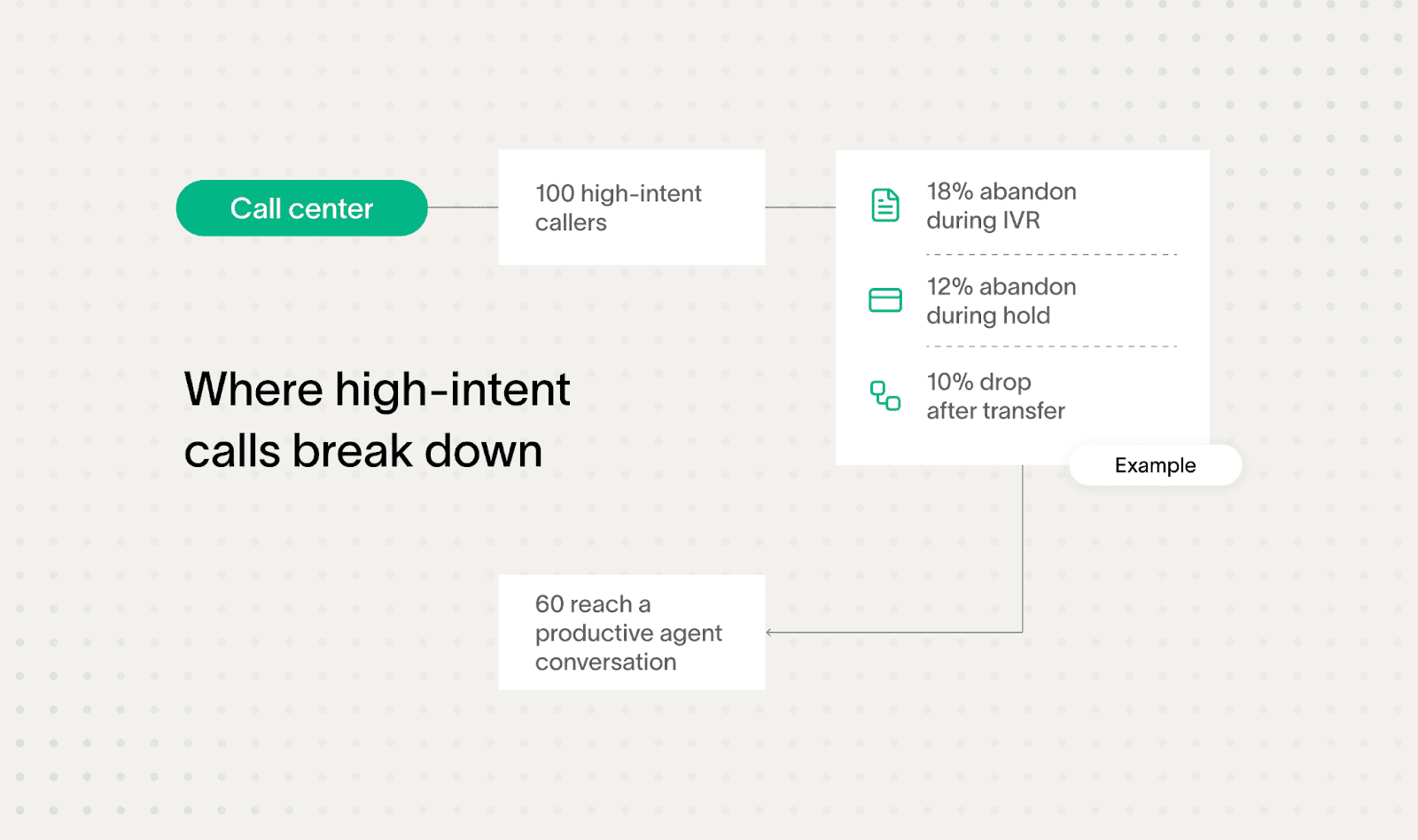
Strada’s AI phone agents answer instantly, identify intent, and begin structured quote intake or servicing flows in real time. For high-intent inquiries such as auto or homeowners quotes, it collects underwriting-relevant information, validates data, and passes a clean, structured record into your CRM or AMS.
The business impact is straightforward:
Lower abandonment rate
Higher completed quote applications
Reduced handle time for live agents
Improved first call resolution
In insurance environments where a five-point lift in quote completion can translate into millions in annual written premium, improving conversion rates with automation is not marginal optimization. It is material.
Outbound: systematic follow-up that increases conversion rates
Most insurance organizations lose revenue in follow-up. Unreturned quote requests, renewal reminders that go unanswered, lapsed policies that were once profitable. Agents cannot manually call every open opportunity at the right cadence.
Strada executes intelligent outbound campaigns for quote re-engagement, renewal reminders, payment follow-ups, and cross-sell outreach. Calls are contextual. Scripts are policy-aware. Outcomes are logged automatically.
This shifts follow-up from manual effort to systematized revenue recovery.
For CX leaders measured on retention and premium growth, this means:
Increased renewal confirmation rate
Recovered lapsed policyholders
Higher re-engagement on unbound quotes
Consistent follow-up without adding headcount
Improving conversion rates with automation at the voice layer ensures that no high-intent policyholder is lost to operational gaps.
How Strada improves conversion rates in complex insurance journeys
Insurance conversion is rarely a single click. It is a multi-step journey that includes underwriting questions, eligibility checks, policy explanations, compliance disclosures, and payment confirmation. Each step introduces friction.
Strada improves conversion rates by reducing cognitive load in these journeys while preserving compliance and accuracy.
Guided quote intake that reduces drop-off
Digital quote forms often exceed 20 fields and require product literacy that many consumers lack. Drop-off rates climb as forms get longer, particularly on mobile.
Strada conducts guided, conversational quote intake over the phone. It clarifies coverage types, explains deductibles, and dynamically adjusts follow-up questions based on prior responses. Instead of static forms, customers experience adaptive dialogue.
From a CX performance standpoint, this leads to:
Higher quote completion rate
Fewer incomplete submissions in CRM
Reduced rework for agents
Shorter time from inquiry to bind
For organizations asking how to improve conversion rates in high-friction lines like commercial auto or specialty programs, structured voice guidance is a measurable lever.
Intelligent handoff that protects agent productivity
Not every call should remain fully automated. High-complexity risks, large commercial accounts, or emotionally sensitive claims require human expertise.
Strada evaluates intent and complexity in real time, then transfers the call to the appropriate licensed agent with full conversation context attached. No repetition. No requalification.
This improves:
Agent efficiency
First call resolution
Customer satisfaction
Quote-to-bind conversion on complex accounts
Rather than replacing agents, Strada optimizes how and when they engage. That is how to increase conversion rates without eroding service quality.
Improving conversion rates with automation in renewals and retention
For enterprise carriers and MGAs, renewal retention often drives more profitability than new business growth. A one-point lift in retention can outperform aggressive acquisition spend.
Strada improves conversion rates in renewals by systematizing proactive outreach and reducing renewal friction.
Renewal confirmation before policy expiration
Many non-renewals occur not because of dissatisfaction, but because of inaction. Customers forget to confirm, miss a notice, or delay payment.
Strada proactively contacts policyholders before renewal deadlines, confirms intent, answers coverage questions, and routes confirmed renewals into billing workflows. If objections arise, they are logged and escalated appropriately.
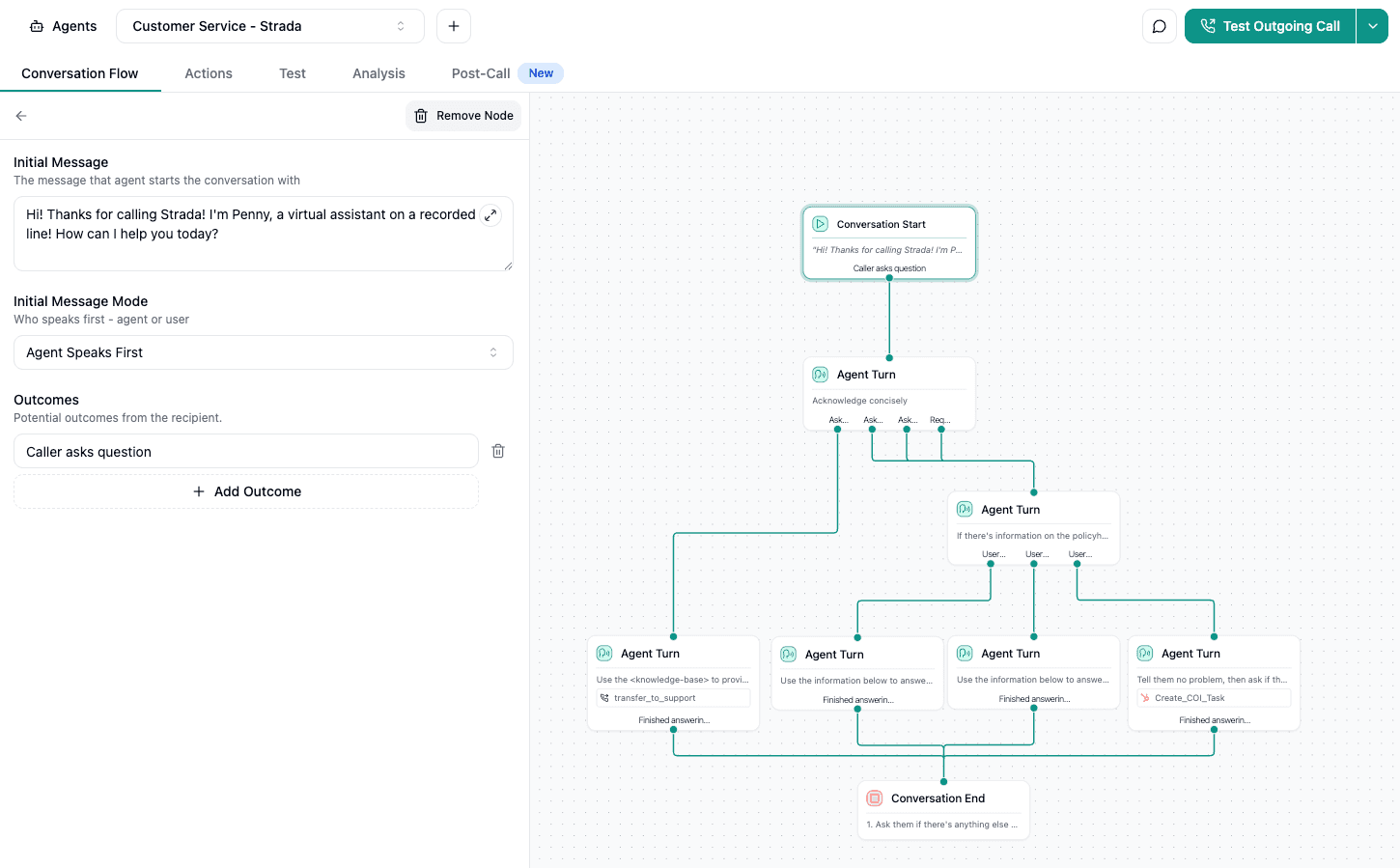
The measurable impact includes:
Higher renewal confirmation rate
Reduced lapse due to missed communication
Lower inbound renewal surge near expiration
Stabilized premium retention
For CX leaders accountable for retention rate and policy persistency, this is one of the most direct ways to increase conversion rates at scale.
Payment and billing follow-up without agent overload
Billing inquiries and missed payments create operational strain. They also represent preventable churn.
Strada handles payment reminders, installment confirmations, and billing FAQs through compliant, policy-aware scripts. Complex disputes can be escalated, but routine interactions are resolved automatically.
Operationally, this produces:
Lower call center volume
Reduced average handle time
Improved collection rate
Higher policy retention
Improving conversion rates with automation at this stage directly protects lifetime value.
Measuring conversion rates and business impact with Strada
Enterprise CX leaders do not adopt new systems without clear attribution. Strada is designed to tie voice activity directly to insurance performance metrics.
Rather than vanity metrics, the platform aligns to the indicators you already report to the executive team.
Core conversion metrics influenced by Strada
Metric | Operational driver | Business outcome |
Quote completion rate | Guided conversational intake | More qualified applications |
Quote-to-bind rate | Faster follow-up and contextual escalation | Higher written premium |
Renewal retention rate | Proactive voice confirmation | Increased persistency |
Call abandonment rate | Instant answer and intelligent routing | Reduced lost opportunities |
Average handle time | Structured data capture | Lower cost per policy |
Revenue per call | Cross-sell and upsell prompts | Higher policy value |
CSAT | Reduced friction and repetition | Stronger brand trust |
By connecting voice outcomes to CRM and AMS data, Strada enables direct reporting on how improving conversion rates affects premium growth and operating margin.
Voice-to-revenue attribution
Traditional analytics struggle to connect phone conversations to revenue. Strada logs structured outcomes for every call, including:
Quote initiated
Quote completed
Renewal confirmed
Payment secured
Escalated to licensed agent
Cross-sell opportunity identified
When integrated with your CRM, these outcomes can be tied to bound policies and premium amounts. That enables CX leaders to demonstrate how voice automation contributes to:
Incremental written premium
Reduced acquisition cost
Increased lifetime value
Improved agent productivity ratio
This level of attribution is essential for organizations seeking higher conversion rates without speculative investment.
A strategic framework for improving conversion rates with automation
Strada should not be deployed as a tactical add-on. The highest-performing insurance organizations treat Voice AI as part of a broader conversion architecture.
A simple framework aligns strategy to measurable impact.
1. Prioritize high-intent workflows
Focus first on journeys with clear revenue impact:
New quote intake
Unbound quote follow-up
Renewal confirmation
Lapsed policy reactivation
Cross-sell to existing policyholders
These workflows typically have defined success metrics and measurable financial upside. Improving conversion rates in these areas generates executive-level visibility quickly.
2. Align voice to CX-owned metrics
CX leaders are often accountable for:
CSAT and NPS
Service level agreements
Cost per contact
Retention rate
Escalation rate
Compliance adherence
Strada should be configured to reinforce these metrics. For example:
Use automated identity verification to reduce compliance risk.
Route vulnerable customer conversations to trained agents.
Capture structured data to reduce post-call administrative work.
Improving conversion rates is sustainable only when it supports the broader CX mandate.
3. Build continuous optimization loops
Conversion performance should not remain static. Strada provides analytics that reveal:
Drop-off points within conversations
Common objections during renewal calls
High-performing cross-sell scripts
Escalation triggers
By reviewing these insights monthly, CX leaders can refine scripts, adjust handoff logic, and identify new automation candidates.
This creates a flywheel effect. Each iteration contributes to higher conversion rates, lower operating cost, and improved customer satisfaction.
What differentiates Strada for enterprise insurance teams
The Voice AI market is crowded. Many platforms offer generic conversational tools. Strada is purpose-built for insurance.
Insurance-specific language and workflows
Insurance terminology is complex. Deductibles, endorsements, riders, underwriting questions, claims FNOL processes. Generic voice systems frequently misinterpret these details.
Strada’s models are trained on insurance conversations and designed to integrate with:
Agency Management Systems
Policy administration platforms
Claims systems
CRM environments
This reduces error rates, improves data accuracy, and protects compliance. For enterprise carriers, accuracy is not optional.
Enterprise-grade security and governance
Insurance organizations operate under strict regulatory oversight. Data privacy and auditability are critical.
Strada supports:
SOC 2 Type 2 standards
Structured call logs for audit trails
Role-based access controls
Clear data isolation between clients
This enables CX leaders to improve conversion rates without introducing governance risk.
Scalable without linear headcount growth
Managing 200 agents is operationally complex. Managing 500 is exponentially harder. Volume spikes during storm events or renewal cycles create unpredictable load.
Strada absorbs volume variability without proportional staffing increases. Routine calls are handled automatically, while agents focus on high-value cases.
The financial equation becomes clear:
Stable service levels during peak volume
Controlled cost per contact
Consistent follow-up on every opportunity
Improved agent focus on revenue-generating interactions
This is how to increase conversion rates while maintaining service quality at scale.
Conclusion
Insurance conversion is not a marketing problem. It is an operational design problem. Friction, latency, and inconsistent follow-up erode performance long before underwriting decisions are made.
Strada addresses these gaps directly. By automating high-intent voice interactions, structuring quote intake, systematizing renewals, and connecting call outcomes to revenue metrics, it enables enterprise insurance teams to achieve higher conversion rates without sacrificing compliance or service quality.
For CX leaders measured on retention, cost per policy, CSAT, and premium growth, Voice AI is no longer experimental. It is strategic infrastructure.
Request a Strada strategy session to evaluate where Voice AI can improve conversion rates across your insurance portfolio.
Frequently Asked Questions
How does voice automation directly impact quote-to-bind and renewal retention metrics we already report on?
The platform converts inbound and outbound calls into structured workflows tied to metrics like quote completion, renewal confirmation, and revenue per call. By logging outcomes and integrating with CRM or AMS systems, it connects voice activity to written premium and retention performance rather than vanity engagement metrics.
How can we reduce call abandonment and speed-to-answer issues without adding more agents?
Framer is a design tool that allows you to design websites on a freeform canvas, and then publish them as websites with a single click.
Why is follow-up such a persistent revenue gap in insurance, and how does automation address it?
Framer is a design tool that allows you to design websites on a freeform canvas, and then publish them as websites with a single click.
How does guided conversational intake improve performance in high-friction lines like commercial auto or specialty programs?
Framer is a design tool that allows you to design websites on a freeform canvas, and then publish them as websites with a single click.
When should calls remain automated versus transferred to a licensed agent?
Framer is a design tool that allows you to design websites on a freeform canvas, and then publish them as websites with a single click.
Table of Contents
Carriers, MGAs, and brokers scale revenue-driving phone calls with Strada's conversational AI platform.
Start scaling with voice AI agents today
Join innovative carriers and MGAs transforming their calls with Strada.
How Insurance Conversion Rates Improve at Scale | 2026 Updated

Amir Prodensky
CEO
Mar 2, 2026
8 min read
Proven tactics to convert insurance inquiries faster with Voice AI
Key takeaways:
Higher quote-to-bind and renewal retention rates are achieved by converting inbound and outbound calls into structured, measurable workflows tied directly to premium growth
Revenue leakage is reduced by systematizing outbound follow-up for unbound quotes, renewals, and lapsed policies, ensuring consistent engagement without adding headcount
Quote completion and speed to bind improve by guiding policyholders through conversational intake that reduces drop-off, rework, and cognitive load in complex insurance journeys
Agent productivity and complex account conversion increase through intelligent handoffs that route high-value interactions with full context and no repetition
Executive-level visibility into premium impact strengthens by tying structured voice outcomes directly to CRM and AMS data for clear revenue attribution
Enterprise insurance customer experience leaders do not struggle with traffic.
They struggle with friction. Every abandoned quote, every renewal that slips to a competitor, every inbound call that never reaches an agent shows up in your dashboard.
Strada was built to address that friction directly. Not with another point tool, but with an insurance-specific Voice AI platform designed to increase conversion rates across quote intake, renewals, claims servicing, and cross-sell journeys.
Strada drives higher conversion rates across the insurance call lifecycle
Strada increases conversion rates by turning inbound and outbound calls into structured, measurable insurance workflows. Instead of treating voice as a cost center, it converts it into a performance channel tied directly to quote bind rate, renewal retention, and policy growth.
For a VP or Director of Customer Experience managing 50 to 500 plus licensed agents, conversion is not abstract. It shows up in:
Quote-to-bind rate by product line
Renewal retention rate by segment
Call abandonment rate
Average speed to answer
First call resolution
Cost per bound policy
Revenue per call
Agent utilization and occupancy
CSAT and NPS
Strada impacts these metrics by handling high-volume, repeatable insurance interactions with precision and speed, freeing agents to focus on complex consultative conversations that materially affect retention and cross-sell.
Inbound: capturing intent before it leaks
When policyholders call for a quote, renewal, billing question, or claim status, speed determines outcome. Long IVR trees and hold times reduce conversion rates before an agent even says hello.
Here’s where intent quietly leaks out of the funnel.

Strada’s AI phone agents answer instantly, identify intent, and begin structured quote intake or servicing flows in real time. For high-intent inquiries such as auto or homeowners quotes, it collects underwriting-relevant information, validates data, and passes a clean, structured record into your CRM or AMS.
The business impact is straightforward:
Lower abandonment rate
Higher completed quote applications
Reduced handle time for live agents
Improved first call resolution
In insurance environments where a five-point lift in quote completion can translate into millions in annual written premium, improving conversion rates with automation is not marginal optimization. It is material.
Outbound: systematic follow-up that increases conversion rates
Most insurance organizations lose revenue in follow-up. Unreturned quote requests, renewal reminders that go unanswered, lapsed policies that were once profitable. Agents cannot manually call every open opportunity at the right cadence.
Strada executes intelligent outbound campaigns for quote re-engagement, renewal reminders, payment follow-ups, and cross-sell outreach. Calls are contextual. Scripts are policy-aware. Outcomes are logged automatically.
This shifts follow-up from manual effort to systematized revenue recovery.
For CX leaders measured on retention and premium growth, this means:
Increased renewal confirmation rate
Recovered lapsed policyholders
Higher re-engagement on unbound quotes
Consistent follow-up without adding headcount
Improving conversion rates with automation at the voice layer ensures that no high-intent policyholder is lost to operational gaps.
How Strada improves conversion rates in complex insurance journeys
Insurance conversion is rarely a single click. It is a multi-step journey that includes underwriting questions, eligibility checks, policy explanations, compliance disclosures, and payment confirmation. Each step introduces friction.
Strada improves conversion rates by reducing cognitive load in these journeys while preserving compliance and accuracy.
Guided quote intake that reduces drop-off
Digital quote forms often exceed 20 fields and require product literacy that many consumers lack. Drop-off rates climb as forms get longer, particularly on mobile.
Strada conducts guided, conversational quote intake over the phone. It clarifies coverage types, explains deductibles, and dynamically adjusts follow-up questions based on prior responses. Instead of static forms, customers experience adaptive dialogue.
From a CX performance standpoint, this leads to:
Higher quote completion rate
Fewer incomplete submissions in CRM
Reduced rework for agents
Shorter time from inquiry to bind
For organizations asking how to improve conversion rates in high-friction lines like commercial auto or specialty programs, structured voice guidance is a measurable lever.
Intelligent handoff that protects agent productivity
Not every call should remain fully automated. High-complexity risks, large commercial accounts, or emotionally sensitive claims require human expertise.
Strada evaluates intent and complexity in real time, then transfers the call to the appropriate licensed agent with full conversation context attached. No repetition. No requalification.
This improves:
Agent efficiency
First call resolution
Customer satisfaction
Quote-to-bind conversion on complex accounts
Rather than replacing agents, Strada optimizes how and when they engage. That is how to increase conversion rates without eroding service quality.
Improving conversion rates with automation in renewals and retention
For enterprise carriers and MGAs, renewal retention often drives more profitability than new business growth. A one-point lift in retention can outperform aggressive acquisition spend.
Strada improves conversion rates in renewals by systematizing proactive outreach and reducing renewal friction.
Renewal confirmation before policy expiration
Many non-renewals occur not because of dissatisfaction, but because of inaction. Customers forget to confirm, miss a notice, or delay payment.
Strada proactively contacts policyholders before renewal deadlines, confirms intent, answers coverage questions, and routes confirmed renewals into billing workflows. If objections arise, they are logged and escalated appropriately.

The measurable impact includes:
Higher renewal confirmation rate
Reduced lapse due to missed communication
Lower inbound renewal surge near expiration
Stabilized premium retention
For CX leaders accountable for retention rate and policy persistency, this is one of the most direct ways to increase conversion rates at scale.
Payment and billing follow-up without agent overload
Billing inquiries and missed payments create operational strain. They also represent preventable churn.
Strada handles payment reminders, installment confirmations, and billing FAQs through compliant, policy-aware scripts. Complex disputes can be escalated, but routine interactions are resolved automatically.
Operationally, this produces:
Lower call center volume
Reduced average handle time
Improved collection rate
Higher policy retention
Improving conversion rates with automation at this stage directly protects lifetime value.
Measuring conversion rates and business impact with Strada
Enterprise CX leaders do not adopt new systems without clear attribution. Strada is designed to tie voice activity directly to insurance performance metrics.
Rather than vanity metrics, the platform aligns to the indicators you already report to the executive team.
Core conversion metrics influenced by Strada
Metric | Operational driver | Business outcome |
Quote completion rate | Guided conversational intake | More qualified applications |
Quote-to-bind rate | Faster follow-up and contextual escalation | Higher written premium |
Renewal retention rate | Proactive voice confirmation | Increased persistency |
Call abandonment rate | Instant answer and intelligent routing | Reduced lost opportunities |
Average handle time | Structured data capture | Lower cost per policy |
Revenue per call | Cross-sell and upsell prompts | Higher policy value |
CSAT | Reduced friction and repetition | Stronger brand trust |
By connecting voice outcomes to CRM and AMS data, Strada enables direct reporting on how improving conversion rates affects premium growth and operating margin.
Voice-to-revenue attribution
Traditional analytics struggle to connect phone conversations to revenue. Strada logs structured outcomes for every call, including:
Quote initiated
Quote completed
Renewal confirmed
Payment secured
Escalated to licensed agent
Cross-sell opportunity identified
When integrated with your CRM, these outcomes can be tied to bound policies and premium amounts. That enables CX leaders to demonstrate how voice automation contributes to:
Incremental written premium
Reduced acquisition cost
Increased lifetime value
Improved agent productivity ratio
This level of attribution is essential for organizations seeking higher conversion rates without speculative investment.
A strategic framework for improving conversion rates with automation
Strada should not be deployed as a tactical add-on. The highest-performing insurance organizations treat Voice AI as part of a broader conversion architecture.
A simple framework aligns strategy to measurable impact.
1. Prioritize high-intent workflows
Focus first on journeys with clear revenue impact:
New quote intake
Unbound quote follow-up
Renewal confirmation
Lapsed policy reactivation
Cross-sell to existing policyholders
These workflows typically have defined success metrics and measurable financial upside. Improving conversion rates in these areas generates executive-level visibility quickly.
2. Align voice to CX-owned metrics
CX leaders are often accountable for:
CSAT and NPS
Service level agreements
Cost per contact
Retention rate
Escalation rate
Compliance adherence
Strada should be configured to reinforce these metrics. For example:
Use automated identity verification to reduce compliance risk.
Route vulnerable customer conversations to trained agents.
Capture structured data to reduce post-call administrative work.
Improving conversion rates is sustainable only when it supports the broader CX mandate.
3. Build continuous optimization loops
Conversion performance should not remain static. Strada provides analytics that reveal:
Drop-off points within conversations
Common objections during renewal calls
High-performing cross-sell scripts
Escalation triggers
By reviewing these insights monthly, CX leaders can refine scripts, adjust handoff logic, and identify new automation candidates.
This creates a flywheel effect. Each iteration contributes to higher conversion rates, lower operating cost, and improved customer satisfaction.
What differentiates Strada for enterprise insurance teams
The Voice AI market is crowded. Many platforms offer generic conversational tools. Strada is purpose-built for insurance.
Insurance-specific language and workflows
Insurance terminology is complex. Deductibles, endorsements, riders, underwriting questions, claims FNOL processes. Generic voice systems frequently misinterpret these details.
Strada’s models are trained on insurance conversations and designed to integrate with:
Agency Management Systems
Policy administration platforms
Claims systems
CRM environments
This reduces error rates, improves data accuracy, and protects compliance. For enterprise carriers, accuracy is not optional.
Enterprise-grade security and governance
Insurance organizations operate under strict regulatory oversight. Data privacy and auditability are critical.
Strada supports:
SOC 2 Type 2 standards
Structured call logs for audit trails
Role-based access controls
Clear data isolation between clients
This enables CX leaders to improve conversion rates without introducing governance risk.
Scalable without linear headcount growth
Managing 200 agents is operationally complex. Managing 500 is exponentially harder. Volume spikes during storm events or renewal cycles create unpredictable load.
Strada absorbs volume variability without proportional staffing increases. Routine calls are handled automatically, while agents focus on high-value cases.
The financial equation becomes clear:
Stable service levels during peak volume
Controlled cost per contact
Consistent follow-up on every opportunity
Improved agent focus on revenue-generating interactions
This is how to increase conversion rates while maintaining service quality at scale.
Conclusion
Insurance conversion is not a marketing problem. It is an operational design problem. Friction, latency, and inconsistent follow-up erode performance long before underwriting decisions are made.
Strada addresses these gaps directly. By automating high-intent voice interactions, structuring quote intake, systematizing renewals, and connecting call outcomes to revenue metrics, it enables enterprise insurance teams to achieve higher conversion rates without sacrificing compliance or service quality.
For CX leaders measured on retention, cost per policy, CSAT, and premium growth, Voice AI is no longer experimental. It is strategic infrastructure.
Request a Strada strategy session to evaluate where Voice AI can improve conversion rates across your insurance portfolio.
Frequently Asked Questions
How does voice automation directly impact quote-to-bind and renewal retention metrics we already report on?
The platform converts inbound and outbound calls into structured workflows tied to metrics like quote completion, renewal confirmation, and revenue per call. By logging outcomes and integrating with CRM or AMS systems, it connects voice activity to written premium and retention performance rather than vanity engagement metrics.
How can we reduce call abandonment and speed-to-answer issues without adding more agents?
Framer is a design tool that allows you to design websites on a freeform canvas, and then publish them as websites with a single click.
Why is follow-up such a persistent revenue gap in insurance, and how does automation address it?
Framer is a design tool that allows you to design websites on a freeform canvas, and then publish them as websites with a single click.
How does guided conversational intake improve performance in high-friction lines like commercial auto or specialty programs?
Framer is a design tool that allows you to design websites on a freeform canvas, and then publish them as websites with a single click.
When should calls remain automated versus transferred to a licensed agent?
Framer is a design tool that allows you to design websites on a freeform canvas, and then publish them as websites with a single click.
Table of Contents
Carriers, MGAs, and brokers scale revenue-driving phone calls with Strada's conversational AI platform.
Start scaling with voice AI agents today
Join innovative carriers and MGAs transforming their calls with Strada.
How Insurance Conversion Rates Improve at Scale | 2026 Updated

Amir Prodensky
CEO
Mar 2, 2026
8 min read
Proven tactics to convert insurance inquiries faster with Voice AI
Key takeaways:
Higher quote-to-bind and renewal retention rates are achieved by converting inbound and outbound calls into structured, measurable workflows tied directly to premium growth
Revenue leakage is reduced by systematizing outbound follow-up for unbound quotes, renewals, and lapsed policies, ensuring consistent engagement without adding headcount
Quote completion and speed to bind improve by guiding policyholders through conversational intake that reduces drop-off, rework, and cognitive load in complex insurance journeys
Agent productivity and complex account conversion increase through intelligent handoffs that route high-value interactions with full context and no repetition
Executive-level visibility into premium impact strengthens by tying structured voice outcomes directly to CRM and AMS data for clear revenue attribution
Enterprise insurance customer experience leaders do not struggle with traffic.
They struggle with friction. Every abandoned quote, every renewal that slips to a competitor, every inbound call that never reaches an agent shows up in your dashboard.
Strada was built to address that friction directly. Not with another point tool, but with an insurance-specific Voice AI platform designed to increase conversion rates across quote intake, renewals, claims servicing, and cross-sell journeys.
Strada drives higher conversion rates across the insurance call lifecycle
Strada increases conversion rates by turning inbound and outbound calls into structured, measurable insurance workflows. Instead of treating voice as a cost center, it converts it into a performance channel tied directly to quote bind rate, renewal retention, and policy growth.
For a VP or Director of Customer Experience managing 50 to 500 plus licensed agents, conversion is not abstract. It shows up in:
Quote-to-bind rate by product line
Renewal retention rate by segment
Call abandonment rate
Average speed to answer
First call resolution
Cost per bound policy
Revenue per call
Agent utilization and occupancy
CSAT and NPS
Strada impacts these metrics by handling high-volume, repeatable insurance interactions with precision and speed, freeing agents to focus on complex consultative conversations that materially affect retention and cross-sell.
Inbound: capturing intent before it leaks
When policyholders call for a quote, renewal, billing question, or claim status, speed determines outcome. Long IVR trees and hold times reduce conversion rates before an agent even says hello.
Here’s where intent quietly leaks out of the funnel.

Strada’s AI phone agents answer instantly, identify intent, and begin structured quote intake or servicing flows in real time. For high-intent inquiries such as auto or homeowners quotes, it collects underwriting-relevant information, validates data, and passes a clean, structured record into your CRM or AMS.
The business impact is straightforward:
Lower abandonment rate
Higher completed quote applications
Reduced handle time for live agents
Improved first call resolution
In insurance environments where a five-point lift in quote completion can translate into millions in annual written premium, improving conversion rates with automation is not marginal optimization. It is material.
Outbound: systematic follow-up that increases conversion rates
Most insurance organizations lose revenue in follow-up. Unreturned quote requests, renewal reminders that go unanswered, lapsed policies that were once profitable. Agents cannot manually call every open opportunity at the right cadence.
Strada executes intelligent outbound campaigns for quote re-engagement, renewal reminders, payment follow-ups, and cross-sell outreach. Calls are contextual. Scripts are policy-aware. Outcomes are logged automatically.
This shifts follow-up from manual effort to systematized revenue recovery.
For CX leaders measured on retention and premium growth, this means:
Increased renewal confirmation rate
Recovered lapsed policyholders
Higher re-engagement on unbound quotes
Consistent follow-up without adding headcount
Improving conversion rates with automation at the voice layer ensures that no high-intent policyholder is lost to operational gaps.
How Strada improves conversion rates in complex insurance journeys
Insurance conversion is rarely a single click. It is a multi-step journey that includes underwriting questions, eligibility checks, policy explanations, compliance disclosures, and payment confirmation. Each step introduces friction.
Strada improves conversion rates by reducing cognitive load in these journeys while preserving compliance and accuracy.
Guided quote intake that reduces drop-off
Digital quote forms often exceed 20 fields and require product literacy that many consumers lack. Drop-off rates climb as forms get longer, particularly on mobile.
Strada conducts guided, conversational quote intake over the phone. It clarifies coverage types, explains deductibles, and dynamically adjusts follow-up questions based on prior responses. Instead of static forms, customers experience adaptive dialogue.
From a CX performance standpoint, this leads to:
Higher quote completion rate
Fewer incomplete submissions in CRM
Reduced rework for agents
Shorter time from inquiry to bind
For organizations asking how to improve conversion rates in high-friction lines like commercial auto or specialty programs, structured voice guidance is a measurable lever.
Intelligent handoff that protects agent productivity
Not every call should remain fully automated. High-complexity risks, large commercial accounts, or emotionally sensitive claims require human expertise.
Strada evaluates intent and complexity in real time, then transfers the call to the appropriate licensed agent with full conversation context attached. No repetition. No requalification.
This improves:
Agent efficiency
First call resolution
Customer satisfaction
Quote-to-bind conversion on complex accounts
Rather than replacing agents, Strada optimizes how and when they engage. That is how to increase conversion rates without eroding service quality.
Improving conversion rates with automation in renewals and retention
For enterprise carriers and MGAs, renewal retention often drives more profitability than new business growth. A one-point lift in retention can outperform aggressive acquisition spend.
Strada improves conversion rates in renewals by systematizing proactive outreach and reducing renewal friction.
Renewal confirmation before policy expiration
Many non-renewals occur not because of dissatisfaction, but because of inaction. Customers forget to confirm, miss a notice, or delay payment.
Strada proactively contacts policyholders before renewal deadlines, confirms intent, answers coverage questions, and routes confirmed renewals into billing workflows. If objections arise, they are logged and escalated appropriately.

The measurable impact includes:
Higher renewal confirmation rate
Reduced lapse due to missed communication
Lower inbound renewal surge near expiration
Stabilized premium retention
For CX leaders accountable for retention rate and policy persistency, this is one of the most direct ways to increase conversion rates at scale.
Payment and billing follow-up without agent overload
Billing inquiries and missed payments create operational strain. They also represent preventable churn.
Strada handles payment reminders, installment confirmations, and billing FAQs through compliant, policy-aware scripts. Complex disputes can be escalated, but routine interactions are resolved automatically.
Operationally, this produces:
Lower call center volume
Reduced average handle time
Improved collection rate
Higher policy retention
Improving conversion rates with automation at this stage directly protects lifetime value.
Measuring conversion rates and business impact with Strada
Enterprise CX leaders do not adopt new systems without clear attribution. Strada is designed to tie voice activity directly to insurance performance metrics.
Rather than vanity metrics, the platform aligns to the indicators you already report to the executive team.
Core conversion metrics influenced by Strada
Metric | Operational driver | Business outcome |
Quote completion rate | Guided conversational intake | More qualified applications |
Quote-to-bind rate | Faster follow-up and contextual escalation | Higher written premium |
Renewal retention rate | Proactive voice confirmation | Increased persistency |
Call abandonment rate | Instant answer and intelligent routing | Reduced lost opportunities |
Average handle time | Structured data capture | Lower cost per policy |
Revenue per call | Cross-sell and upsell prompts | Higher policy value |
CSAT | Reduced friction and repetition | Stronger brand trust |
By connecting voice outcomes to CRM and AMS data, Strada enables direct reporting on how improving conversion rates affects premium growth and operating margin.
Voice-to-revenue attribution
Traditional analytics struggle to connect phone conversations to revenue. Strada logs structured outcomes for every call, including:
Quote initiated
Quote completed
Renewal confirmed
Payment secured
Escalated to licensed agent
Cross-sell opportunity identified
When integrated with your CRM, these outcomes can be tied to bound policies and premium amounts. That enables CX leaders to demonstrate how voice automation contributes to:
Incremental written premium
Reduced acquisition cost
Increased lifetime value
Improved agent productivity ratio
This level of attribution is essential for organizations seeking higher conversion rates without speculative investment.
A strategic framework for improving conversion rates with automation
Strada should not be deployed as a tactical add-on. The highest-performing insurance organizations treat Voice AI as part of a broader conversion architecture.
A simple framework aligns strategy to measurable impact.
1. Prioritize high-intent workflows
Focus first on journeys with clear revenue impact:
New quote intake
Unbound quote follow-up
Renewal confirmation
Lapsed policy reactivation
Cross-sell to existing policyholders
These workflows typically have defined success metrics and measurable financial upside. Improving conversion rates in these areas generates executive-level visibility quickly.
2. Align voice to CX-owned metrics
CX leaders are often accountable for:
CSAT and NPS
Service level agreements
Cost per contact
Retention rate
Escalation rate
Compliance adherence
Strada should be configured to reinforce these metrics. For example:
Use automated identity verification to reduce compliance risk.
Route vulnerable customer conversations to trained agents.
Capture structured data to reduce post-call administrative work.
Improving conversion rates is sustainable only when it supports the broader CX mandate.
3. Build continuous optimization loops
Conversion performance should not remain static. Strada provides analytics that reveal:
Drop-off points within conversations
Common objections during renewal calls
High-performing cross-sell scripts
Escalation triggers
By reviewing these insights monthly, CX leaders can refine scripts, adjust handoff logic, and identify new automation candidates.
This creates a flywheel effect. Each iteration contributes to higher conversion rates, lower operating cost, and improved customer satisfaction.
What differentiates Strada for enterprise insurance teams
The Voice AI market is crowded. Many platforms offer generic conversational tools. Strada is purpose-built for insurance.
Insurance-specific language and workflows
Insurance terminology is complex. Deductibles, endorsements, riders, underwriting questions, claims FNOL processes. Generic voice systems frequently misinterpret these details.
Strada’s models are trained on insurance conversations and designed to integrate with:
Agency Management Systems
Policy administration platforms
Claims systems
CRM environments
This reduces error rates, improves data accuracy, and protects compliance. For enterprise carriers, accuracy is not optional.
Enterprise-grade security and governance
Insurance organizations operate under strict regulatory oversight. Data privacy and auditability are critical.
Strada supports:
SOC 2 Type 2 standards
Structured call logs for audit trails
Role-based access controls
Clear data isolation between clients
This enables CX leaders to improve conversion rates without introducing governance risk.
Scalable without linear headcount growth
Managing 200 agents is operationally complex. Managing 500 is exponentially harder. Volume spikes during storm events or renewal cycles create unpredictable load.
Strada absorbs volume variability without proportional staffing increases. Routine calls are handled automatically, while agents focus on high-value cases.
The financial equation becomes clear:
Stable service levels during peak volume
Controlled cost per contact
Consistent follow-up on every opportunity
Improved agent focus on revenue-generating interactions
This is how to increase conversion rates while maintaining service quality at scale.
Conclusion
Insurance conversion is not a marketing problem. It is an operational design problem. Friction, latency, and inconsistent follow-up erode performance long before underwriting decisions are made.
Strada addresses these gaps directly. By automating high-intent voice interactions, structuring quote intake, systematizing renewals, and connecting call outcomes to revenue metrics, it enables enterprise insurance teams to achieve higher conversion rates without sacrificing compliance or service quality.
For CX leaders measured on retention, cost per policy, CSAT, and premium growth, Voice AI is no longer experimental. It is strategic infrastructure.
Request a Strada strategy session to evaluate where Voice AI can improve conversion rates across your insurance portfolio.
Frequently Asked Questions
How does voice automation directly impact quote-to-bind and renewal retention metrics we already report on?
The platform converts inbound and outbound calls into structured workflows tied to metrics like quote completion, renewal confirmation, and revenue per call. By logging outcomes and integrating with CRM or AMS systems, it connects voice activity to written premium and retention performance rather than vanity engagement metrics.
How can we reduce call abandonment and speed-to-answer issues without adding more agents?
Framer is a design tool that allows you to design websites on a freeform canvas, and then publish them as websites with a single click.
Why is follow-up such a persistent revenue gap in insurance, and how does automation address it?
Framer is a design tool that allows you to design websites on a freeform canvas, and then publish them as websites with a single click.
How does guided conversational intake improve performance in high-friction lines like commercial auto or specialty programs?
Framer is a design tool that allows you to design websites on a freeform canvas, and then publish them as websites with a single click.
When should calls remain automated versus transferred to a licensed agent?
Framer is a design tool that allows you to design websites on a freeform canvas, and then publish them as websites with a single click.
Table of Contents
Carriers, MGAs, and brokers scale revenue-driving phone calls with Strada's conversational AI platform.
Start scaling with voice AI agents today
Join innovative carriers and MGAs transforming their calls with Strada.
© 2026 Strada API, Inc.
