Blog

/

AI & Automation

How Call Transfers Impact Insurance CX in 2026

Amir Prodensky

CEO

Feb 16, 2026

6 min read

Reduce repeated transfers and route insurance callers right first time

Key takeaways:

  • Lower cost per interaction by eliminating unnecessary call transfers that inflate handle time, suppress FCR, and erode policyholder trust. 

  • Increase first call resolution by resolving intent upfront and routing directly to the properly licensed, skill-aligned resource. 

  • Protect compliance and reduce audit exposure by embedding license controls, authentication flows, and structured documentation into every escalation. 

  • Expand effective agent capacity without adding headcount by reclaiming minutes lost to transfer loops and repeated explanations. 

  • Strengthen retention and renewal performance by reducing repeated story-telling and delivering context-rich handoffs that reinforce policyholder confidence. 


Enterprise insurance contact centers are measured on precision. First call resolution. Average handle time. CSAT. NPS. Retention. Cost per policy serviced. Agent occupancy. Supervisor span.

Yet one metric quietly undermines all of them: unnecessary call transfers.

Strada exists to eliminate transfer loops in insurance contact centers. Not by adding another routing tool, but by redesigning how intent is understood, how context moves, and how handoffs happen across underwriting, claims, billing, policy servicing, and FNOL.

Strada redefines call transfers as a strategic CX lever

Strada reframes call transfers from an operational nuisance to a strategic driver of experience, cost control, and retention.

In most enterprise insurers, call transfers are treated as an inevitability of specialization. Claims go to claims. Billing to billing. Underwriting to underwriting. That structure makes sense on paper. In practice, it produces fragmented experiences, longer handle times, and measurable erosion of trust.

Here’s what a “simple transfer” actually creates behind the scenes.
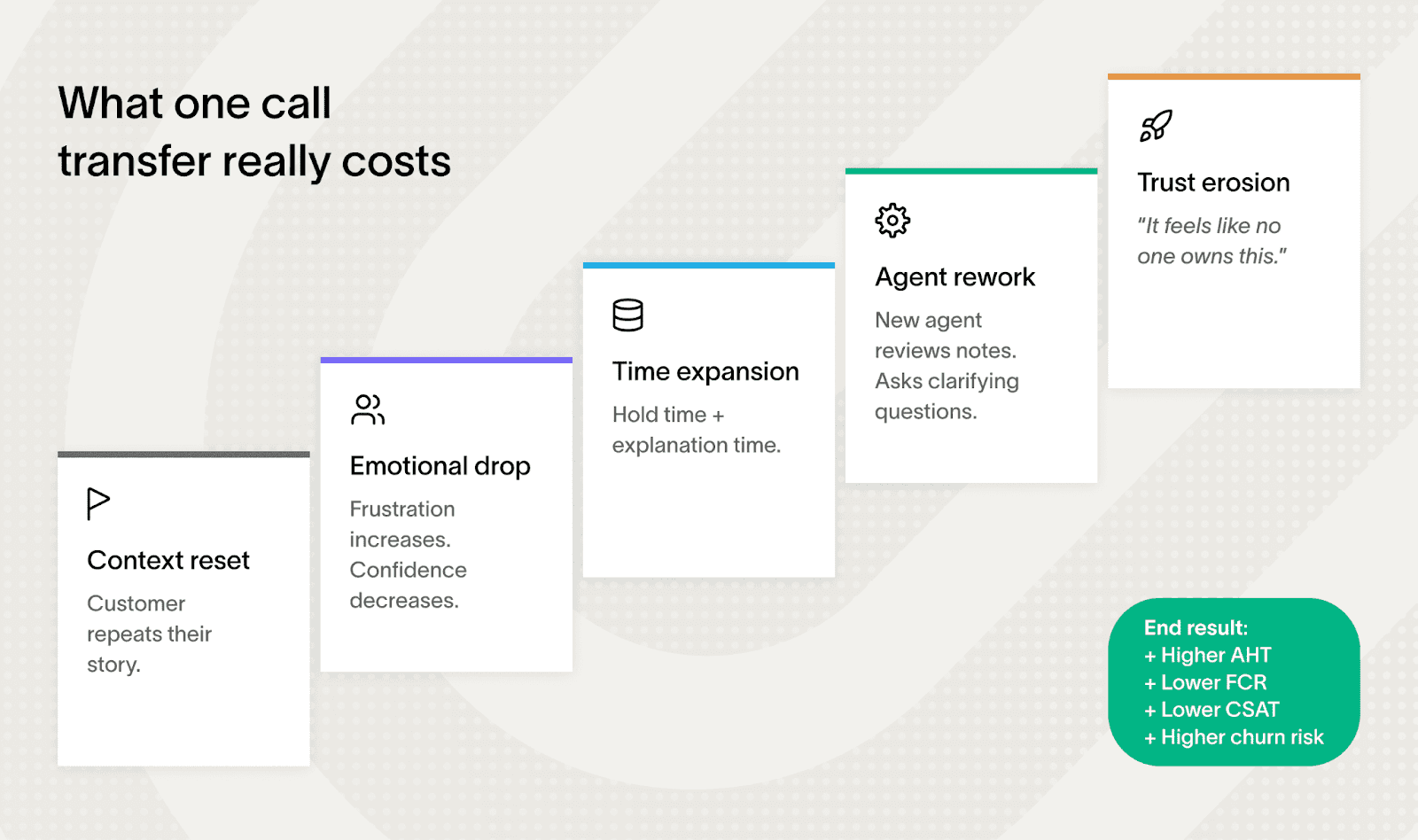
what one call transfer really costs

Strada’s approach to intelligent call transfers begins before a human agent is ever involved. Its insurance-trained Voice AI understands policy context, intent, and urgency in real time, then orchestrates routing decisions with full CRM and AMS awareness.

The result is not fewer transfers for their own sake. It is fewer unnecessary transfers, fewer insurance live call transfers that add no value, and fewer moments where a policyholder repeats their story.

The financial impact of transfer loops

For a CX leader managing 50 to 500 agents, transfer loops are not just frustrating. They are expensive.

Consider the downstream impact:

Metric

How transfers affect it

Executive impact

First call resolution (FCR)

Drops when calls bounce between teams

Lower policyholder satisfaction and renewal risk

Average handle time (AHT)

Increases with every handoff and re-explanation

Higher cost per interaction

CSAT / NPS

Declines when callers repeat policy details

Brand erosion in competitive lines

Agent occupancy

Inflated by internal routing inefficiency

Reduced effective capacity

Supervisor load

More escalations tied to routing failures

Higher management overhead

Strada reduces unnecessary live call transfers by resolving intent earlier, clarifying complexity before escalation, and routing directly to the most qualified licensed resource when escalation is required.

This is not tactical IVR optimization. It is structural CX redesign.

Strada reduces live call transfers through insurance-specific intelligence

Strada addresses live call transfers at the source: misaligned routing logic and fragmented context.

Traditional routing relies on DTMF menus, generic skill tags, or department-based queues. That model assumes the policyholder understands your internal structure. They do not. They describe their issue in natural language, often mixing billing, claims, and policy updates in a single call.

Strada’s AI phone call transfers are driven by intent detection trained specifically on insurance language. It distinguishes between:

  • FNOL vs. claim status follow-up

  • Endorsement requests vs. underwriting clarification

  • Renewal questions vs. payment disputes

  • Agent-of-record changes vs. simple contact updates

By resolving intent accurately up front, Strada significantly reduces insurance live call transfers caused by misclassification.

How Strada reduces transfers in a call center

When CX leaders ask how to reduce transfers in a call center, the strategic answer is not more queue rules. It is better intent orchestration.

Strada achieves this through three core mechanisms:

  1. Pre-transfer resolution filtering
    Many calls that traditionally escalate to licensed agents can be resolved via structured AI-led workflows. Policy document retrieval, payment confirmations, deductible explanations, and renewal reminders are handled without human handoff.

  2. Context-rich handoffs
    When escalation is required, Strada performs warm, intelligent call transfers. The receiving agent sees summarized policy data, prior interaction history, and issue classification before greeting the caller.

  3. Skill-aligned routing in real time
    Strada aligns call intent with license type, product line expertise, and availability. This prevents advanced call transfers from becoming lateral hops between equally unqualified queues.

The impact is measurable: fewer handoffs, higher FCR, and lower AHT without sacrificing compliance or empathy.

Intelligent call transfers that improve FCR and reduce AHT

Strada transforms intelligent call transfers from reactive routing into proactive experience management.

In most enterprise insurers, advanced call transfers are executed with limited context sharing. Even warm transfers often involve partial summaries and delayed CRM notes. The receiving agent spends the first 60 to 120 seconds reconstructing the conversation.

Strada eliminates that reconstruction tax.

Advanced call transfers with structured context

Strada’s intelligent call transfers deliver structured context across systems:

  • Policy number and product line

  • Claim stage and adjuster assignment

  • Payment status and delinquency flags

  • Prior call summaries

  • Compliance disclosures already completed

This changes the shape of the interaction. Instead of re-verifying basics, the agent moves directly to resolution.

For a CX executive, this affects measurable outcomes:

  • AHT decreases because repetition disappears

  • FCR increases because the right expertise is engaged immediately

  • QA scores improve due to standardized summaries

  • Agent satisfaction rises due to fewer frustrated policyholders

Advanced call transfers become a tool for experience precision, not an admission of routing failure.

AI phone call transfers that preserve human empathy

Strada does not replace licensed agents in complex scenarios. It ensures they engage at the right moment.

AI phone call transfers function as an escalation gate, not a replacement layer. The AI clarifies coverage type, verifies identity, gathers structured information, and confirms urgency before initiating a live connection.

This protects both sides of the interaction:

  • Policyholders feel heard before transfer

  • Agents begin with clarity

  • Supervisors see consistent documentation

Insurance live call transfers become purposeful, not reactive.

Governance, compliance, and risk control in call transfers

For enterprise insurers, call transfers are not just a CX issue. They are a compliance risk.

Misrouted calls can expose sensitive PHI, financial data, or claims details to unauthorized staff. In regulated lines, improper handoffs can trigger audit exposure.

Strada embeds compliance logic directly into its transfer orchestration.

Controlled Escalation Across Licensed Boundaries

Strada ensures that:

  • Calls involving underwriting decisions route only to appropriately licensed resources

  • Payment disputes follow authenticated verification flows before transfer

  • Claims discussions respect role-based access control

This reduces compliance drift that often occurs during manual advanced call transfers.

For CX leaders measured on both satisfaction and regulatory adherence, this alignment matters. Fewer unnecessary handoffs mean fewer uncontrolled data exposures.

Audit-ready documentation

Every intelligent call transfer executed through Strada generates structured documentation:

  • Intent classification

  • Timestamped escalation logic

  • Context summary delivered

  • Identity verification status

This strengthens QA review, simplifies audit readiness, and supports defensible routing practices.

In short, call transfers move from informal operational events to governed workflow steps.

The strategic impact of eliminating unnecessary call transfers

Strada’s value is not limited to operational efficiency. It reshapes enterprise insurance economics.

When live call transfers decline and intelligent routing improves, the cumulative impact appears across financial, workforce, and retention metrics.

Workforce leverage without headcount expansion

Reducing unnecessary insurance live call transfers effectively increases available capacity without hiring.

If each avoided transfer saves two to three minutes of agent time, across thousands of daily calls, the reclaimed hours are substantial. That reclaimed capacity can absorb seasonal spikes, catastrophe events, or renewal surges without proportional staffing increases.

For a VP of CX, this directly affects cost per interaction and cost per policy serviced.

Retention and policyholder trust

Transfers erode perceived competence. Every time a policyholder repeats their claim story or coverage details, confidence declines.

By reducing transfer loops and improving intelligent call transfers, Strada improves:

  • Renewal rates

  • Cross-policy retention

  • Escalation rates to supervisors

  • Complaint volumes

In competitive personal and commercial lines, trust is an economic asset.

A clearer view of performance

Strada’s analytics layer provides executive-level visibility into:

  • Transfer frequency by line of business

  • Transfer success rate

  • FCR before and after AI orchestration

  • AHT reduction tied to intelligent routing

  • CSAT variance correlated with transfer count

This allows CX leaders to move from anecdotal improvement to board-ready reporting.

Call transfers are not a minor routing issue. They are a structural determinant of cost, satisfaction, compliance exposure, and retention in enterprise insurance.

Strada eliminates unnecessary transfers by combining insurance-trained Voice AI, intelligent call transfers, structured context delivery, and governed escalation workflows. The result is higher FCR, lower AHT, improved CSAT, and measurable workforce leverage.

For CX executives responsible for large agent populations and complex policyholder journeys, reducing transfer loops is not tactical optimization. It is strategic modernization.

If you are evaluating how to reduce transfers in a call center while improving FCR and retention, schedule a strategic review with Strada.

Frequently Asked Questions

How would reducing unnecessary live call transfers materially impact my FCR and renewal metrics across multiple lines of business?

When calls move between teams, first call resolution declines and policyholders experience friction that can influence renewal risk. By resolving intent earlier and routing directly to the right licensed resource, fewer calls bounce across departments, which strengthens FCR and protects satisfaction. Over time, this reduces the erosion of trust that often shows up in retention and NPS metrics.

Why should I view call transfers as a strategic CX lever rather than just a routing inefficiency?

Framer is a design tool that allows you to design websites on a freeform canvas, and then publish them as websites with a single click.

How does insurance-specific intent detection reduce misrouted calls between claims, billing, and underwriting?

Framer is a design tool that allows you to design websites on a freeform canvas, and then publish them as websites with a single click.

How can Voice AI resolve certain policyholder needs without escalating to licensed agents?

Framer is a design tool that allows you to design websites on a freeform canvas, and then publish them as websites with a single click.

When escalation is necessary, how does context-rich handoff reduce AHT and repetition?

Framer is a design tool that allows you to design websites on a freeform canvas, and then publish them as websites with a single click.

Start scaling with voice AI agents today

Join innovative carriers and MGAs transforming their calls with Strada.

Blog

/

AI & Automation

How Call Transfers Impact Insurance CX in 2026

Amir Prodensky

CEO

Feb 16, 2026

6 min read

Reduce repeated transfers and route insurance callers right first time

Key takeaways:

  • Lower cost per interaction by eliminating unnecessary call transfers that inflate handle time, suppress FCR, and erode policyholder trust. 

  • Increase first call resolution by resolving intent upfront and routing directly to the properly licensed, skill-aligned resource. 

  • Protect compliance and reduce audit exposure by embedding license controls, authentication flows, and structured documentation into every escalation. 

  • Expand effective agent capacity without adding headcount by reclaiming minutes lost to transfer loops and repeated explanations. 

  • Strengthen retention and renewal performance by reducing repeated story-telling and delivering context-rich handoffs that reinforce policyholder confidence. 


Enterprise insurance contact centers are measured on precision. First call resolution. Average handle time. CSAT. NPS. Retention. Cost per policy serviced. Agent occupancy. Supervisor span.

Yet one metric quietly undermines all of them: unnecessary call transfers.

Strada exists to eliminate transfer loops in insurance contact centers. Not by adding another routing tool, but by redesigning how intent is understood, how context moves, and how handoffs happen across underwriting, claims, billing, policy servicing, and FNOL.

Strada redefines call transfers as a strategic CX lever

Strada reframes call transfers from an operational nuisance to a strategic driver of experience, cost control, and retention.

In most enterprise insurers, call transfers are treated as an inevitability of specialization. Claims go to claims. Billing to billing. Underwriting to underwriting. That structure makes sense on paper. In practice, it produces fragmented experiences, longer handle times, and measurable erosion of trust.

Here’s what a “simple transfer” actually creates behind the scenes.

what one call transfer really costs

Strada’s approach to intelligent call transfers begins before a human agent is ever involved. Its insurance-trained Voice AI understands policy context, intent, and urgency in real time, then orchestrates routing decisions with full CRM and AMS awareness.

The result is not fewer transfers for their own sake. It is fewer unnecessary transfers, fewer insurance live call transfers that add no value, and fewer moments where a policyholder repeats their story.

The financial impact of transfer loops

For a CX leader managing 50 to 500 agents, transfer loops are not just frustrating. They are expensive.

Consider the downstream impact:

Metric

How transfers affect it

Executive impact

First call resolution (FCR)

Drops when calls bounce between teams

Lower policyholder satisfaction and renewal risk

Average handle time (AHT)

Increases with every handoff and re-explanation

Higher cost per interaction

CSAT / NPS

Declines when callers repeat policy details

Brand erosion in competitive lines

Agent occupancy

Inflated by internal routing inefficiency

Reduced effective capacity

Supervisor load

More escalations tied to routing failures

Higher management overhead

Strada reduces unnecessary live call transfers by resolving intent earlier, clarifying complexity before escalation, and routing directly to the most qualified licensed resource when escalation is required.

This is not tactical IVR optimization. It is structural CX redesign.

Strada reduces live call transfers through insurance-specific intelligence

Strada addresses live call transfers at the source: misaligned routing logic and fragmented context.

Traditional routing relies on DTMF menus, generic skill tags, or department-based queues. That model assumes the policyholder understands your internal structure. They do not. They describe their issue in natural language, often mixing billing, claims, and policy updates in a single call.

Strada’s AI phone call transfers are driven by intent detection trained specifically on insurance language. It distinguishes between:

  • FNOL vs. claim status follow-up

  • Endorsement requests vs. underwriting clarification

  • Renewal questions vs. payment disputes

  • Agent-of-record changes vs. simple contact updates

By resolving intent accurately up front, Strada significantly reduces insurance live call transfers caused by misclassification.

How Strada reduces transfers in a call center

When CX leaders ask how to reduce transfers in a call center, the strategic answer is not more queue rules. It is better intent orchestration.

Strada achieves this through three core mechanisms:

  1. Pre-transfer resolution filtering
    Many calls that traditionally escalate to licensed agents can be resolved via structured AI-led workflows. Policy document retrieval, payment confirmations, deductible explanations, and renewal reminders are handled without human handoff.

  2. Context-rich handoffs
    When escalation is required, Strada performs warm, intelligent call transfers. The receiving agent sees summarized policy data, prior interaction history, and issue classification before greeting the caller.

  3. Skill-aligned routing in real time
    Strada aligns call intent with license type, product line expertise, and availability. This prevents advanced call transfers from becoming lateral hops between equally unqualified queues.

The impact is measurable: fewer handoffs, higher FCR, and lower AHT without sacrificing compliance or empathy.

Intelligent call transfers that improve FCR and reduce AHT

Strada transforms intelligent call transfers from reactive routing into proactive experience management.

In most enterprise insurers, advanced call transfers are executed with limited context sharing. Even warm transfers often involve partial summaries and delayed CRM notes. The receiving agent spends the first 60 to 120 seconds reconstructing the conversation.

Strada eliminates that reconstruction tax.

Advanced call transfers with structured context

Strada’s intelligent call transfers deliver structured context across systems:

  • Policy number and product line

  • Claim stage and adjuster assignment

  • Payment status and delinquency flags

  • Prior call summaries

  • Compliance disclosures already completed

This changes the shape of the interaction. Instead of re-verifying basics, the agent moves directly to resolution.

For a CX executive, this affects measurable outcomes:

  • AHT decreases because repetition disappears

  • FCR increases because the right expertise is engaged immediately

  • QA scores improve due to standardized summaries

  • Agent satisfaction rises due to fewer frustrated policyholders

Advanced call transfers become a tool for experience precision, not an admission of routing failure.

AI phone call transfers that preserve human empathy

Strada does not replace licensed agents in complex scenarios. It ensures they engage at the right moment.

AI phone call transfers function as an escalation gate, not a replacement layer. The AI clarifies coverage type, verifies identity, gathers structured information, and confirms urgency before initiating a live connection.

This protects both sides of the interaction:

  • Policyholders feel heard before transfer

  • Agents begin with clarity

  • Supervisors see consistent documentation

Insurance live call transfers become purposeful, not reactive.

Governance, compliance, and risk control in call transfers

For enterprise insurers, call transfers are not just a CX issue. They are a compliance risk.

Misrouted calls can expose sensitive PHI, financial data, or claims details to unauthorized staff. In regulated lines, improper handoffs can trigger audit exposure.

Strada embeds compliance logic directly into its transfer orchestration.

Controlled Escalation Across Licensed Boundaries

Strada ensures that:

  • Calls involving underwriting decisions route only to appropriately licensed resources

  • Payment disputes follow authenticated verification flows before transfer

  • Claims discussions respect role-based access control

This reduces compliance drift that often occurs during manual advanced call transfers.

For CX leaders measured on both satisfaction and regulatory adherence, this alignment matters. Fewer unnecessary handoffs mean fewer uncontrolled data exposures.

Audit-ready documentation

Every intelligent call transfer executed through Strada generates structured documentation:

  • Intent classification

  • Timestamped escalation logic

  • Context summary delivered

  • Identity verification status

This strengthens QA review, simplifies audit readiness, and supports defensible routing practices.

In short, call transfers move from informal operational events to governed workflow steps.

The strategic impact of eliminating unnecessary call transfers

Strada’s value is not limited to operational efficiency. It reshapes enterprise insurance economics.

When live call transfers decline and intelligent routing improves, the cumulative impact appears across financial, workforce, and retention metrics.

Workforce leverage without headcount expansion

Reducing unnecessary insurance live call transfers effectively increases available capacity without hiring.

If each avoided transfer saves two to three minutes of agent time, across thousands of daily calls, the reclaimed hours are substantial. That reclaimed capacity can absorb seasonal spikes, catastrophe events, or renewal surges without proportional staffing increases.

For a VP of CX, this directly affects cost per interaction and cost per policy serviced.

Retention and policyholder trust

Transfers erode perceived competence. Every time a policyholder repeats their claim story or coverage details, confidence declines.

By reducing transfer loops and improving intelligent call transfers, Strada improves:

  • Renewal rates

  • Cross-policy retention

  • Escalation rates to supervisors

  • Complaint volumes

In competitive personal and commercial lines, trust is an economic asset.

A clearer view of performance

Strada’s analytics layer provides executive-level visibility into:

  • Transfer frequency by line of business

  • Transfer success rate

  • FCR before and after AI orchestration

  • AHT reduction tied to intelligent routing

  • CSAT variance correlated with transfer count

This allows CX leaders to move from anecdotal improvement to board-ready reporting.

Call transfers are not a minor routing issue. They are a structural determinant of cost, satisfaction, compliance exposure, and retention in enterprise insurance.

Strada eliminates unnecessary transfers by combining insurance-trained Voice AI, intelligent call transfers, structured context delivery, and governed escalation workflows. The result is higher FCR, lower AHT, improved CSAT, and measurable workforce leverage.

For CX executives responsible for large agent populations and complex policyholder journeys, reducing transfer loops is not tactical optimization. It is strategic modernization.

If you are evaluating how to reduce transfers in a call center while improving FCR and retention, schedule a strategic review with Strada.

Frequently Asked Questions

How would reducing unnecessary live call transfers materially impact my FCR and renewal metrics across multiple lines of business?

When calls move between teams, first call resolution declines and policyholders experience friction that can influence renewal risk. By resolving intent earlier and routing directly to the right licensed resource, fewer calls bounce across departments, which strengthens FCR and protects satisfaction. Over time, this reduces the erosion of trust that often shows up in retention and NPS metrics.

Why should I view call transfers as a strategic CX lever rather than just a routing inefficiency?

Framer is a design tool that allows you to design websites on a freeform canvas, and then publish them as websites with a single click.

How does insurance-specific intent detection reduce misrouted calls between claims, billing, and underwriting?

Framer is a design tool that allows you to design websites on a freeform canvas, and then publish them as websites with a single click.

How can Voice AI resolve certain policyholder needs without escalating to licensed agents?

Framer is a design tool that allows you to design websites on a freeform canvas, and then publish them as websites with a single click.

When escalation is necessary, how does context-rich handoff reduce AHT and repetition?

Framer is a design tool that allows you to design websites on a freeform canvas, and then publish them as websites with a single click.

Start scaling with voice AI agents today

Join innovative carriers and MGAs transforming their calls with Strada.

Blog

/

AI & Automation

How Call Transfers Impact Insurance CX in 2026

Amir Prodensky

CEO

Feb 16, 2026

6 min read

Reduce repeated transfers and route insurance callers right first time

Key takeaways:

  • Lower cost per interaction by eliminating unnecessary call transfers that inflate handle time, suppress FCR, and erode policyholder trust. 

  • Increase first call resolution by resolving intent upfront and routing directly to the properly licensed, skill-aligned resource. 

  • Protect compliance and reduce audit exposure by embedding license controls, authentication flows, and structured documentation into every escalation. 

  • Expand effective agent capacity without adding headcount by reclaiming minutes lost to transfer loops and repeated explanations. 

  • Strengthen retention and renewal performance by reducing repeated story-telling and delivering context-rich handoffs that reinforce policyholder confidence. 


Enterprise insurance contact centers are measured on precision. First call resolution. Average handle time. CSAT. NPS. Retention. Cost per policy serviced. Agent occupancy. Supervisor span.

Yet one metric quietly undermines all of them: unnecessary call transfers.

Strada exists to eliminate transfer loops in insurance contact centers. Not by adding another routing tool, but by redesigning how intent is understood, how context moves, and how handoffs happen across underwriting, claims, billing, policy servicing, and FNOL.

Strada redefines call transfers as a strategic CX lever

Strada reframes call transfers from an operational nuisance to a strategic driver of experience, cost control, and retention.

In most enterprise insurers, call transfers are treated as an inevitability of specialization. Claims go to claims. Billing to billing. Underwriting to underwriting. That structure makes sense on paper. In practice, it produces fragmented experiences, longer handle times, and measurable erosion of trust.

Here’s what a “simple transfer” actually creates behind the scenes.

what one call transfer really costs

Strada’s approach to intelligent call transfers begins before a human agent is ever involved. Its insurance-trained Voice AI understands policy context, intent, and urgency in real time, then orchestrates routing decisions with full CRM and AMS awareness.

The result is not fewer transfers for their own sake. It is fewer unnecessary transfers, fewer insurance live call transfers that add no value, and fewer moments where a policyholder repeats their story.

The financial impact of transfer loops

For a CX leader managing 50 to 500 agents, transfer loops are not just frustrating. They are expensive.

Consider the downstream impact:

Metric

How transfers affect it

Executive impact

First call resolution (FCR)

Drops when calls bounce between teams

Lower policyholder satisfaction and renewal risk

Average handle time (AHT)

Increases with every handoff and re-explanation

Higher cost per interaction

CSAT / NPS

Declines when callers repeat policy details

Brand erosion in competitive lines

Agent occupancy

Inflated by internal routing inefficiency

Reduced effective capacity

Supervisor load

More escalations tied to routing failures

Higher management overhead

Strada reduces unnecessary live call transfers by resolving intent earlier, clarifying complexity before escalation, and routing directly to the most qualified licensed resource when escalation is required.

This is not tactical IVR optimization. It is structural CX redesign.

Strada reduces live call transfers through insurance-specific intelligence

Strada addresses live call transfers at the source: misaligned routing logic and fragmented context.

Traditional routing relies on DTMF menus, generic skill tags, or department-based queues. That model assumes the policyholder understands your internal structure. They do not. They describe their issue in natural language, often mixing billing, claims, and policy updates in a single call.

Strada’s AI phone call transfers are driven by intent detection trained specifically on insurance language. It distinguishes between:

  • FNOL vs. claim status follow-up

  • Endorsement requests vs. underwriting clarification

  • Renewal questions vs. payment disputes

  • Agent-of-record changes vs. simple contact updates

By resolving intent accurately up front, Strada significantly reduces insurance live call transfers caused by misclassification.

How Strada reduces transfers in a call center

When CX leaders ask how to reduce transfers in a call center, the strategic answer is not more queue rules. It is better intent orchestration.

Strada achieves this through three core mechanisms:

  1. Pre-transfer resolution filtering
    Many calls that traditionally escalate to licensed agents can be resolved via structured AI-led workflows. Policy document retrieval, payment confirmations, deductible explanations, and renewal reminders are handled without human handoff.

  2. Context-rich handoffs
    When escalation is required, Strada performs warm, intelligent call transfers. The receiving agent sees summarized policy data, prior interaction history, and issue classification before greeting the caller.

  3. Skill-aligned routing in real time
    Strada aligns call intent with license type, product line expertise, and availability. This prevents advanced call transfers from becoming lateral hops between equally unqualified queues.

The impact is measurable: fewer handoffs, higher FCR, and lower AHT without sacrificing compliance or empathy.

Intelligent call transfers that improve FCR and reduce AHT

Strada transforms intelligent call transfers from reactive routing into proactive experience management.

In most enterprise insurers, advanced call transfers are executed with limited context sharing. Even warm transfers often involve partial summaries and delayed CRM notes. The receiving agent spends the first 60 to 120 seconds reconstructing the conversation.

Strada eliminates that reconstruction tax.

Advanced call transfers with structured context

Strada’s intelligent call transfers deliver structured context across systems:

  • Policy number and product line

  • Claim stage and adjuster assignment

  • Payment status and delinquency flags

  • Prior call summaries

  • Compliance disclosures already completed

This changes the shape of the interaction. Instead of re-verifying basics, the agent moves directly to resolution.

For a CX executive, this affects measurable outcomes:

  • AHT decreases because repetition disappears

  • FCR increases because the right expertise is engaged immediately

  • QA scores improve due to standardized summaries

  • Agent satisfaction rises due to fewer frustrated policyholders

Advanced call transfers become a tool for experience precision, not an admission of routing failure.

AI phone call transfers that preserve human empathy

Strada does not replace licensed agents in complex scenarios. It ensures they engage at the right moment.

AI phone call transfers function as an escalation gate, not a replacement layer. The AI clarifies coverage type, verifies identity, gathers structured information, and confirms urgency before initiating a live connection.

This protects both sides of the interaction:

  • Policyholders feel heard before transfer

  • Agents begin with clarity

  • Supervisors see consistent documentation

Insurance live call transfers become purposeful, not reactive.

Governance, compliance, and risk control in call transfers

For enterprise insurers, call transfers are not just a CX issue. They are a compliance risk.

Misrouted calls can expose sensitive PHI, financial data, or claims details to unauthorized staff. In regulated lines, improper handoffs can trigger audit exposure.

Strada embeds compliance logic directly into its transfer orchestration.

Controlled Escalation Across Licensed Boundaries

Strada ensures that:

  • Calls involving underwriting decisions route only to appropriately licensed resources

  • Payment disputes follow authenticated verification flows before transfer

  • Claims discussions respect role-based access control

This reduces compliance drift that often occurs during manual advanced call transfers.

For CX leaders measured on both satisfaction and regulatory adherence, this alignment matters. Fewer unnecessary handoffs mean fewer uncontrolled data exposures.

Audit-ready documentation

Every intelligent call transfer executed through Strada generates structured documentation:

  • Intent classification

  • Timestamped escalation logic

  • Context summary delivered

  • Identity verification status

This strengthens QA review, simplifies audit readiness, and supports defensible routing practices.

In short, call transfers move from informal operational events to governed workflow steps.

The strategic impact of eliminating unnecessary call transfers

Strada’s value is not limited to operational efficiency. It reshapes enterprise insurance economics.

When live call transfers decline and intelligent routing improves, the cumulative impact appears across financial, workforce, and retention metrics.

Workforce leverage without headcount expansion

Reducing unnecessary insurance live call transfers effectively increases available capacity without hiring.

If each avoided transfer saves two to three minutes of agent time, across thousands of daily calls, the reclaimed hours are substantial. That reclaimed capacity can absorb seasonal spikes, catastrophe events, or renewal surges without proportional staffing increases.

For a VP of CX, this directly affects cost per interaction and cost per policy serviced.

Retention and policyholder trust

Transfers erode perceived competence. Every time a policyholder repeats their claim story or coverage details, confidence declines.

By reducing transfer loops and improving intelligent call transfers, Strada improves:

  • Renewal rates

  • Cross-policy retention

  • Escalation rates to supervisors

  • Complaint volumes

In competitive personal and commercial lines, trust is an economic asset.

A clearer view of performance

Strada’s analytics layer provides executive-level visibility into:

  • Transfer frequency by line of business

  • Transfer success rate

  • FCR before and after AI orchestration

  • AHT reduction tied to intelligent routing

  • CSAT variance correlated with transfer count

This allows CX leaders to move from anecdotal improvement to board-ready reporting.

Call transfers are not a minor routing issue. They are a structural determinant of cost, satisfaction, compliance exposure, and retention in enterprise insurance.

Strada eliminates unnecessary transfers by combining insurance-trained Voice AI, intelligent call transfers, structured context delivery, and governed escalation workflows. The result is higher FCR, lower AHT, improved CSAT, and measurable workforce leverage.

For CX executives responsible for large agent populations and complex policyholder journeys, reducing transfer loops is not tactical optimization. It is strategic modernization.

If you are evaluating how to reduce transfers in a call center while improving FCR and retention, schedule a strategic review with Strada.

Frequently Asked Questions

How would reducing unnecessary live call transfers materially impact my FCR and renewal metrics across multiple lines of business?

When calls move between teams, first call resolution declines and policyholders experience friction that can influence renewal risk. By resolving intent earlier and routing directly to the right licensed resource, fewer calls bounce across departments, which strengthens FCR and protects satisfaction. Over time, this reduces the erosion of trust that often shows up in retention and NPS metrics.

Why should I view call transfers as a strategic CX lever rather than just a routing inefficiency?

Framer is a design tool that allows you to design websites on a freeform canvas, and then publish them as websites with a single click.

How does insurance-specific intent detection reduce misrouted calls between claims, billing, and underwriting?

Framer is a design tool that allows you to design websites on a freeform canvas, and then publish them as websites with a single click.

How can Voice AI resolve certain policyholder needs without escalating to licensed agents?

Framer is a design tool that allows you to design websites on a freeform canvas, and then publish them as websites with a single click.

When escalation is necessary, how does context-rich handoff reduce AHT and repetition?

Framer is a design tool that allows you to design websites on a freeform canvas, and then publish them as websites with a single click.

Start scaling with voice AI agents today

Join innovative carriers and MGAs transforming their calls with Strada.