Blog

/

AI & Automation

How Call Flow Call Center Strategy Improves CX in 2026

Amir Prodensky

CEO

Mar 5, 2026

6 min read

Modern call flows help insurers scale CX without adding agents.

Key takeaways:

  • Reducing routine service interactions through Voice AI improves service levels and agent utilization while maintaining support capacity during high-volume events like claims spikes.

  • Capturing policyholder information before agent escalation shortens handle time and allows agents to focus on resolving issues instead of performing administrative verification.

  • Designing call flows around policyholder journeys reduces transfers and repeat calls by routing customers directly to the appropriate resolution path.

  • Integrating automated voice interactions with policy and claims systems eliminates repetitive data collection and ensures agents receive full interaction context during escalations.


Customer experience leaders in insurance manage a complex balancing act: service levels, policyholder satisfaction, regulatory compliance, and the productivity of teams often exceeding hundreds of agents. 

Call flow design sits at the center of that equation. When call routing, automation, and agent workflows are structured correctly, insurers see measurable improvements in first-contact resolution, handle time, and agent utilization. 

Why call flow strategy determines CX outcomes in insurance

For insurers, call flow is not just an operational design problem. It directly affects the metrics that CX executives are accountable for across service organizations.

A poorly structured call flow creates predictable problems:

  • Policyholders repeat information multiple times.

  • Calls transfer between underwriting, billing, and claims teams.

  • Agents spend time verifying policy details instead of resolving issues.

  • First notice of loss calls wait in queues during catastrophe spikes.

These issues increase average handle time, transfer rates, and repeat call volume, all of which increase service costs and erode customer trust.

A well-structured call flow does the opposite. It ensures that:

  • Callers reach the correct team immediately.

  • Authentication occurs automatically before an agent joins.

  • Policy and claim data are available during the interaction.

  • Routine requests resolve without agent involvement.

Here’s how the experience typically unfolds for policyholders and agents.
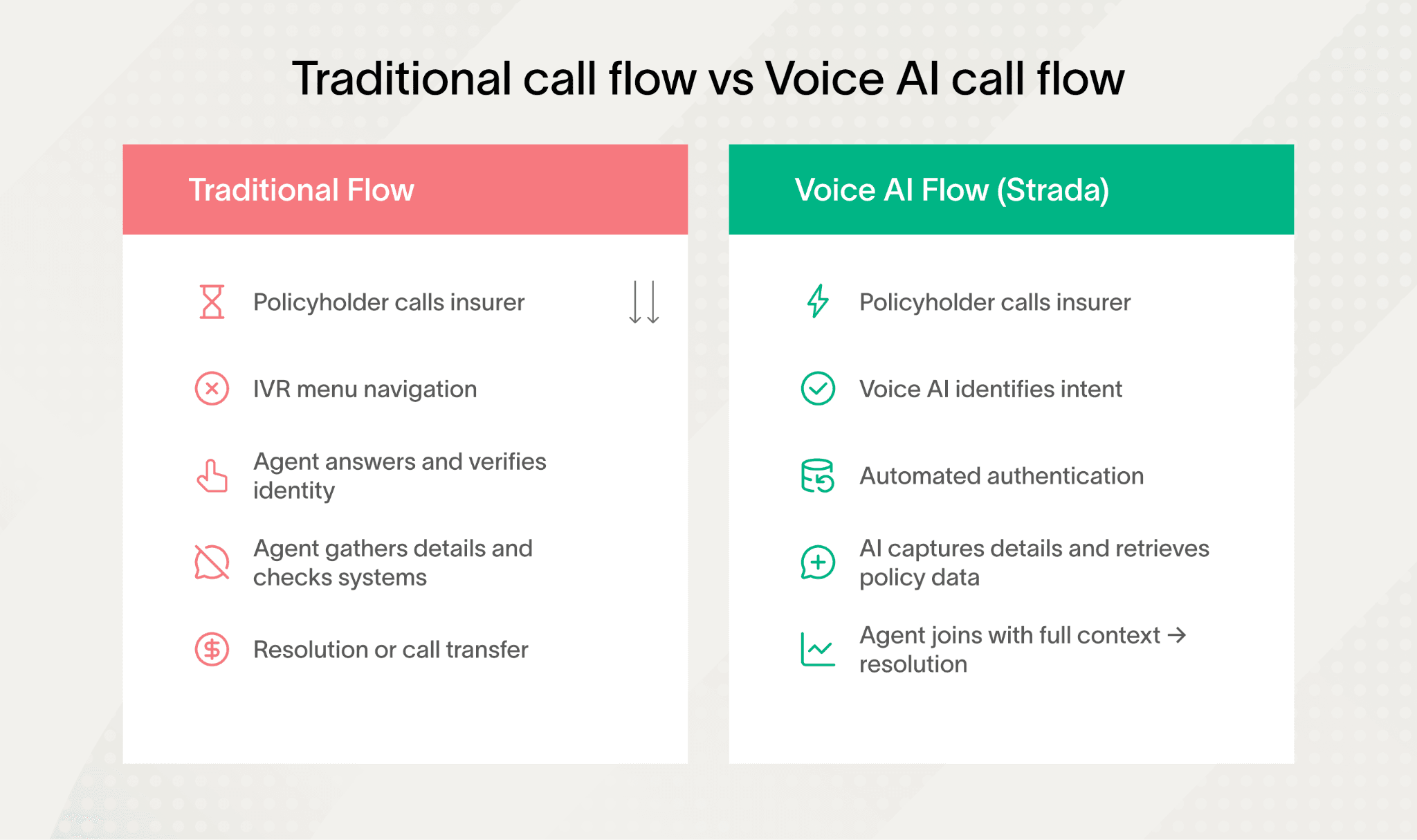
traditional call flow vs voice ai call flow

For enterprise carriers managing hundreds of service agents, a 15% reduction in AHT across a 300-agent contact center can reclaim thousands of labor hours annually while also improving service levels.

Modern Voice AI platforms like Strada are designed to orchestrate these flows across voice interactions. Rather than treating call flow as a static IVR diagram, the system dynamically routes, collects information, and completes policy servicing tasks before an agent becomes involved.

How Strada reframes call flow for insurance service operations

Traditional contact center technology focuses primarily on routing calls. Voice AI platforms change that model by enabling automation within the conversation itself.

Strada sits between the telephony platform and core insurance systems, orchestrating interactions in ways that directly impact service metrics.

Automating high-volume insurance service requests

Insurance contact centers experience predictable call patterns. Certain requests consistently represent the majority of inbound volume:

High-volume call type

Typical agent time

Automation opportunity

First notice of loss

7–12 minutes

Incident capture, claim creation

Billing questions

4–8 minutes

Payment status and balance

Policy document requests

3–5 minutes

Automated retrieval

Address or contact updates

3–4 minutes

Policy record updates

Renewal inquiries

5–9 minutes

Coverage explanation

In traditional workflows, each of these interactions requires an agent to manually collect information and update systems.

Strada automates the initial stages of these interactions by guiding the policyholder through a structured conversation that captures required data and interacts with backend systems.

For example, an automated FNOL flow typically follows this pattern:

  1. Authenticate the caller

  2. Capture incident details

  3. Create the claim record via system APIs

  4. Escalate to an adjuster if needed

For CX leaders, the result is measurable:

  • Reduced handle time

  • Improved first-contact resolution

  • Faster claim intake during high-volume events

Turning voice interactions into operational data

Another structural limitation of traditional call flows is that they generate limited insight into customer needs.

Many contact centers rely on post-call disposition codes to understand why customers call. These codes are often incomplete or inconsistently applied.

Strada captures interaction data throughout the conversation itself. This enables CX teams to analyze:

  • Policyholder intent

  • Escalation triggers

  • Service bottlenecks

  • Frequent policy servicing tasks

  • Sentiment trends across interactions

For example, a CX leader might identify that billing clarification calls spike during renewal cycles or that policy change requests often escalate due to missing documentation.

These insights allow CX teams to refine call flows proactively rather than reactively.

Operational metrics CX leaders improve with Voice AI call flows

Enterprise CX executives are measured on a set of operational and customer experience metrics. Call flow optimization directly affects these indicators.

The table below illustrates how Voice AI automation influences key contact center metrics.

CX metric

Why it matters

How Voice AI improves it

Average handle time

Drives staffing and service costs

Automates data collection and verification

First contact resolution

Measures service effectiveness

Resolves simple requests without transfers

Service level

Percentage of calls answered within SLA

Reduces agent workload

Call transfer rate

Indicator of poor routing

Routes calls with context and intent

Repeat call rate

Sign of unresolved issues

Captures full information during initial interaction

Agent utilization

Productivity of service teams

Removes routine requests from queues

Consider a typical example:

A regional insurer operating a 250-agent service center experiences an average handle time of 8 minutes and an annual inbound volume of 1.5 million calls.

Reducing handle time by 15% through automation can reduce annual service hours by more than 30,000 hours, equivalent to dozens of full-time agents.

These improvements allow CX leaders to:

  • Maintain service levels during seasonal spikes

  • Reduce overtime during catastrophe events

  • Redirect agents to higher-value customer interactions

Voice AI therefore becomes not just a technology upgrade but a capacity strategy for service organizations.

Designing insurance call flows around policyholder journeys

Effective call flows mirror the real journeys policyholders experience rather than internal departmental structures.

Insurance service organizations typically divide operations into functions such as underwriting, billing, and claims. However, policyholders contact insurers based on life events.

A driver reporting an accident does not think in terms of internal claims processes. They simply want help resolving a stressful situation quickly.

Mapping the highest-impact customer journeys

CX leaders typically begin by identifying the interactions that represent the largest share of inbound volume.

Common examples include:

Customer journey

Typical CX objective

Reporting a loss

Fast claim intake and reassurance

Understanding a renewal increase

Clear explanation of policy changes

Making a payment

Immediate confirmation

Updating policyholder information

Accurate record updates

Requesting documentation

Instant policy document delivery

Voice AI allows these journeys to be supported with structured conversational flows rather than rigid menu trees.

For example, instead of navigating a traditional IVR with multiple menu layers, a policyholder can state their intent naturally:

“I'm calling to report an accident.”

The system then immediately begins collecting information relevant to a claim rather than forcing the caller through multiple menu selections.

This approach reduces friction and shortens the path to resolution.

Aligning call flows with claims and policy systems

A critical factor in insurance call flows is integration with backend systems.

Voice automation is only valuable if it can perform real actions, such as:

  • Creating a claim

  • Updating policyholder contact information

  • Checking billing balances

  • Scheduling adjuster callbacks

Strada connects with policy administration systems, claims platforms, and agency management systems to enable these actions during the conversation itself.

When escalation to a human agent occurs, the system passes the collected information forward. From a CX perspective, this continuity improves both customer satisfaction and agent efficiency.

Scaling service operations without expanding headcount

Insurance contact centers face a recurring challenge: inbound volume grows faster than staffing budgets.

Where automation delivers the most value

The most effective automation targets interactions that meet three conditions:

  1. High inbound volume

  2. Structured information requirements

  3. Predictable resolution steps

In insurance service environments, these typically include:

  • FNOL intake

  • Payment verification

  • Policy document retrieval

  • Address updates

  • Coverage clarification

Automating these interactions creates a measurable capacity buffer within service operations.

Consider the following simplified impact model for a mid-size insurer.

Scenario

Annual calls

Agent hours required

No automation

1.2 million

~160,000 hours

20% automated

960,000 agent calls

~128,000 hours

Capacity gained

32,000 hours

Those reclaimed hours can be redirected toward:

  • complex claims support

  • proactive customer outreach

  • retention and renewal conversations

Supporting agents instead of replacing them

A common misconception about Voice AI is that it replaces human agents.

In practice, the most successful deployments use automation to support agents rather than eliminate them.

When Strada escalates a conversation to an agent, the agent receives the full context of the interaction. This allows them to:

  • begin the conversation immediately at the resolution stage

  • avoid repetitive verification steps

  • focus on empathy and problem solving

Agents spend less time performing administrative tasks and more time providing meaningful assistance to policyholders.

For CX leaders, this improves both agent satisfaction and customer experience outcomes.

Measuring the impact of Voice AI call flows

CX leaders track several metrics to evaluate whether service operations are improving.

The following metrics provide the clearest signal.

Metric

CX interpretation

Average handle time

Efficiency of service interactions

First contact resolution

Ability to resolve issues quickly

Abandonment rate

Accessibility of support

Transfer rate

Quality of routing decisions

Customer satisfaction

Policyholder perception of service

Voice AI platforms allow these metrics to be tracked alongside automation-specific indicators.

For example:

  • Automation containment rate

  • Escalation reasons

  • Policyholder intent distribution

  • Self-service completion rate

Combining these metrics enables CX leaders to evaluate the true impact of automation on service quality.

The goal is not simply to reduce call volume but to ensure that policyholders receive faster and more effective support.

When implemented correctly, Voice AI becomes a mechanism for continuous CX improvement.

Conclusion

Enterprise insurers cannot treat call flow design as a static IVR configuration. It is a strategic component of customer experience management that influences service costs, policyholder satisfaction, and agent productivity.

Voice AI platforms such as Strada transform call flows from simple routing diagrams into intelligent interaction systems that automate routine service requests, capture structured information, and integrate directly with insurance platforms.

For CX leaders managing hundreds of service agents, this shift creates measurable improvements in operational efficiency while allowing human agents to focus on the moments that matter most to policyholders.

If you want to understand how Voice AI could improve FNOL intake, policy servicing, and inbound claims interactions, request a Strada demo to see how automated call flows integrate with your policy and claims systems.

Frequently Asked Questions

How should a CX leader think about call flow design as a strategic lever rather than a contact center configuration task?

Call flow determines how quickly policyholders reach the right team and how much time agents spend resolving issues rather than gathering information. Voice AI turns call flows into dynamic interaction systems that automate authentication and data capture before an agent joins.

Why do poorly designed call flows increase operational costs in insurance contact centers?

Framer is a design tool that allows you to design websites on a freeform canvas, and then publish them as websites with a single click.

How can Voice AI automation reduce handle time without sacrificing policyholder experience?

Framer is a design tool that allows you to design websites on a freeform canvas, and then publish them as websites with a single click.

Why are First Notice of Loss (FNOL) interactions particularly well suited for automated call flows?

Framer is a design tool that allows you to design websites on a freeform canvas, and then publish them as websites with a single click.

How does Voice AI help CX teams understand why policyholders contact their service centers?

Framer is a design tool that allows you to design websites on a freeform canvas, and then publish them as websites with a single click.

Start scaling with voice AI agents today

Join innovative carriers and MGAs transforming their calls with Strada.

Blog

/

AI & Automation

How Call Flow Call Center Strategy Improves CX in 2026

Amir Prodensky

CEO

Mar 5, 2026

6 min read

Modern call flows help insurers scale CX without adding agents.

Key takeaways:

  • Reducing routine service interactions through Voice AI improves service levels and agent utilization while maintaining support capacity during high-volume events like claims spikes.

  • Capturing policyholder information before agent escalation shortens handle time and allows agents to focus on resolving issues instead of performing administrative verification.

  • Designing call flows around policyholder journeys reduces transfers and repeat calls by routing customers directly to the appropriate resolution path.

  • Integrating automated voice interactions with policy and claims systems eliminates repetitive data collection and ensures agents receive full interaction context during escalations.


Customer experience leaders in insurance manage a complex balancing act: service levels, policyholder satisfaction, regulatory compliance, and the productivity of teams often exceeding hundreds of agents. 

Call flow design sits at the center of that equation. When call routing, automation, and agent workflows are structured correctly, insurers see measurable improvements in first-contact resolution, handle time, and agent utilization. 

Why call flow strategy determines CX outcomes in insurance

For insurers, call flow is not just an operational design problem. It directly affects the metrics that CX executives are accountable for across service organizations.

A poorly structured call flow creates predictable problems:

  • Policyholders repeat information multiple times.

  • Calls transfer between underwriting, billing, and claims teams.

  • Agents spend time verifying policy details instead of resolving issues.

  • First notice of loss calls wait in queues during catastrophe spikes.

These issues increase average handle time, transfer rates, and repeat call volume, all of which increase service costs and erode customer trust.

A well-structured call flow does the opposite. It ensures that:

  • Callers reach the correct team immediately.

  • Authentication occurs automatically before an agent joins.

  • Policy and claim data are available during the interaction.

  • Routine requests resolve without agent involvement.

Here’s how the experience typically unfolds for policyholders and agents.

traditional call flow vs voice ai call flow

For enterprise carriers managing hundreds of service agents, a 15% reduction in AHT across a 300-agent contact center can reclaim thousands of labor hours annually while also improving service levels.

Modern Voice AI platforms like Strada are designed to orchestrate these flows across voice interactions. Rather than treating call flow as a static IVR diagram, the system dynamically routes, collects information, and completes policy servicing tasks before an agent becomes involved.

How Strada reframes call flow for insurance service operations

Traditional contact center technology focuses primarily on routing calls. Voice AI platforms change that model by enabling automation within the conversation itself.

Strada sits between the telephony platform and core insurance systems, orchestrating interactions in ways that directly impact service metrics.

Automating high-volume insurance service requests

Insurance contact centers experience predictable call patterns. Certain requests consistently represent the majority of inbound volume:

High-volume call type

Typical agent time

Automation opportunity

First notice of loss

7–12 minutes

Incident capture, claim creation

Billing questions

4–8 minutes

Payment status and balance

Policy document requests

3–5 minutes

Automated retrieval

Address or contact updates

3–4 minutes

Policy record updates

Renewal inquiries

5–9 minutes

Coverage explanation

In traditional workflows, each of these interactions requires an agent to manually collect information and update systems.

Strada automates the initial stages of these interactions by guiding the policyholder through a structured conversation that captures required data and interacts with backend systems.

For example, an automated FNOL flow typically follows this pattern:

  1. Authenticate the caller

  2. Capture incident details

  3. Create the claim record via system APIs

  4. Escalate to an adjuster if needed

For CX leaders, the result is measurable:

  • Reduced handle time

  • Improved first-contact resolution

  • Faster claim intake during high-volume events

Turning voice interactions into operational data

Another structural limitation of traditional call flows is that they generate limited insight into customer needs.

Many contact centers rely on post-call disposition codes to understand why customers call. These codes are often incomplete or inconsistently applied.

Strada captures interaction data throughout the conversation itself. This enables CX teams to analyze:

  • Policyholder intent

  • Escalation triggers

  • Service bottlenecks

  • Frequent policy servicing tasks

  • Sentiment trends across interactions

For example, a CX leader might identify that billing clarification calls spike during renewal cycles or that policy change requests often escalate due to missing documentation.

These insights allow CX teams to refine call flows proactively rather than reactively.

Operational metrics CX leaders improve with Voice AI call flows

Enterprise CX executives are measured on a set of operational and customer experience metrics. Call flow optimization directly affects these indicators.

The table below illustrates how Voice AI automation influences key contact center metrics.

CX metric

Why it matters

How Voice AI improves it

Average handle time

Drives staffing and service costs

Automates data collection and verification

First contact resolution

Measures service effectiveness

Resolves simple requests without transfers

Service level

Percentage of calls answered within SLA

Reduces agent workload

Call transfer rate

Indicator of poor routing

Routes calls with context and intent

Repeat call rate

Sign of unresolved issues

Captures full information during initial interaction

Agent utilization

Productivity of service teams

Removes routine requests from queues

Consider a typical example:

A regional insurer operating a 250-agent service center experiences an average handle time of 8 minutes and an annual inbound volume of 1.5 million calls.

Reducing handle time by 15% through automation can reduce annual service hours by more than 30,000 hours, equivalent to dozens of full-time agents.

These improvements allow CX leaders to:

  • Maintain service levels during seasonal spikes

  • Reduce overtime during catastrophe events

  • Redirect agents to higher-value customer interactions

Voice AI therefore becomes not just a technology upgrade but a capacity strategy for service organizations.

Designing insurance call flows around policyholder journeys

Effective call flows mirror the real journeys policyholders experience rather than internal departmental structures.

Insurance service organizations typically divide operations into functions such as underwriting, billing, and claims. However, policyholders contact insurers based on life events.

A driver reporting an accident does not think in terms of internal claims processes. They simply want help resolving a stressful situation quickly.

Mapping the highest-impact customer journeys

CX leaders typically begin by identifying the interactions that represent the largest share of inbound volume.

Common examples include:

Customer journey

Typical CX objective

Reporting a loss

Fast claim intake and reassurance

Understanding a renewal increase

Clear explanation of policy changes

Making a payment

Immediate confirmation

Updating policyholder information

Accurate record updates

Requesting documentation

Instant policy document delivery

Voice AI allows these journeys to be supported with structured conversational flows rather than rigid menu trees.

For example, instead of navigating a traditional IVR with multiple menu layers, a policyholder can state their intent naturally:

“I'm calling to report an accident.”

The system then immediately begins collecting information relevant to a claim rather than forcing the caller through multiple menu selections.

This approach reduces friction and shortens the path to resolution.

Aligning call flows with claims and policy systems

A critical factor in insurance call flows is integration with backend systems.

Voice automation is only valuable if it can perform real actions, such as:

  • Creating a claim

  • Updating policyholder contact information

  • Checking billing balances

  • Scheduling adjuster callbacks

Strada connects with policy administration systems, claims platforms, and agency management systems to enable these actions during the conversation itself.

When escalation to a human agent occurs, the system passes the collected information forward. From a CX perspective, this continuity improves both customer satisfaction and agent efficiency.

Scaling service operations without expanding headcount

Insurance contact centers face a recurring challenge: inbound volume grows faster than staffing budgets.

Where automation delivers the most value

The most effective automation targets interactions that meet three conditions:

  1. High inbound volume

  2. Structured information requirements

  3. Predictable resolution steps

In insurance service environments, these typically include:

  • FNOL intake

  • Payment verification

  • Policy document retrieval

  • Address updates

  • Coverage clarification

Automating these interactions creates a measurable capacity buffer within service operations.

Consider the following simplified impact model for a mid-size insurer.

Scenario

Annual calls

Agent hours required

No automation

1.2 million

~160,000 hours

20% automated

960,000 agent calls

~128,000 hours

Capacity gained

32,000 hours

Those reclaimed hours can be redirected toward:

  • complex claims support

  • proactive customer outreach

  • retention and renewal conversations

Supporting agents instead of replacing them

A common misconception about Voice AI is that it replaces human agents.

In practice, the most successful deployments use automation to support agents rather than eliminate them.

When Strada escalates a conversation to an agent, the agent receives the full context of the interaction. This allows them to:

  • begin the conversation immediately at the resolution stage

  • avoid repetitive verification steps

  • focus on empathy and problem solving

Agents spend less time performing administrative tasks and more time providing meaningful assistance to policyholders.

For CX leaders, this improves both agent satisfaction and customer experience outcomes.

Measuring the impact of Voice AI call flows

CX leaders track several metrics to evaluate whether service operations are improving.

The following metrics provide the clearest signal.

Metric

CX interpretation

Average handle time

Efficiency of service interactions

First contact resolution

Ability to resolve issues quickly

Abandonment rate

Accessibility of support

Transfer rate

Quality of routing decisions

Customer satisfaction

Policyholder perception of service

Voice AI platforms allow these metrics to be tracked alongside automation-specific indicators.

For example:

  • Automation containment rate

  • Escalation reasons

  • Policyholder intent distribution

  • Self-service completion rate

Combining these metrics enables CX leaders to evaluate the true impact of automation on service quality.

The goal is not simply to reduce call volume but to ensure that policyholders receive faster and more effective support.

When implemented correctly, Voice AI becomes a mechanism for continuous CX improvement.

Conclusion

Enterprise insurers cannot treat call flow design as a static IVR configuration. It is a strategic component of customer experience management that influences service costs, policyholder satisfaction, and agent productivity.

Voice AI platforms such as Strada transform call flows from simple routing diagrams into intelligent interaction systems that automate routine service requests, capture structured information, and integrate directly with insurance platforms.

For CX leaders managing hundreds of service agents, this shift creates measurable improvements in operational efficiency while allowing human agents to focus on the moments that matter most to policyholders.

If you want to understand how Voice AI could improve FNOL intake, policy servicing, and inbound claims interactions, request a Strada demo to see how automated call flows integrate with your policy and claims systems.

Frequently Asked Questions

How should a CX leader think about call flow design as a strategic lever rather than a contact center configuration task?

Call flow determines how quickly policyholders reach the right team and how much time agents spend resolving issues rather than gathering information. Voice AI turns call flows into dynamic interaction systems that automate authentication and data capture before an agent joins.

Why do poorly designed call flows increase operational costs in insurance contact centers?

Framer is a design tool that allows you to design websites on a freeform canvas, and then publish them as websites with a single click.

How can Voice AI automation reduce handle time without sacrificing policyholder experience?

Framer is a design tool that allows you to design websites on a freeform canvas, and then publish them as websites with a single click.

Why are First Notice of Loss (FNOL) interactions particularly well suited for automated call flows?

Framer is a design tool that allows you to design websites on a freeform canvas, and then publish them as websites with a single click.

How does Voice AI help CX teams understand why policyholders contact their service centers?

Framer is a design tool that allows you to design websites on a freeform canvas, and then publish them as websites with a single click.

Start scaling with voice AI agents today

Join innovative carriers and MGAs transforming their calls with Strada.

Blog

/

AI & Automation

How Call Flow Call Center Strategy Improves CX in 2026

Amir Prodensky

CEO

Mar 5, 2026

6 min read

Modern call flows help insurers scale CX without adding agents.

Key takeaways:

  • Reducing routine service interactions through Voice AI improves service levels and agent utilization while maintaining support capacity during high-volume events like claims spikes.

  • Capturing policyholder information before agent escalation shortens handle time and allows agents to focus on resolving issues instead of performing administrative verification.

  • Designing call flows around policyholder journeys reduces transfers and repeat calls by routing customers directly to the appropriate resolution path.

  • Integrating automated voice interactions with policy and claims systems eliminates repetitive data collection and ensures agents receive full interaction context during escalations.


Customer experience leaders in insurance manage a complex balancing act: service levels, policyholder satisfaction, regulatory compliance, and the productivity of teams often exceeding hundreds of agents. 

Call flow design sits at the center of that equation. When call routing, automation, and agent workflows are structured correctly, insurers see measurable improvements in first-contact resolution, handle time, and agent utilization. 

Why call flow strategy determines CX outcomes in insurance

For insurers, call flow is not just an operational design problem. It directly affects the metrics that CX executives are accountable for across service organizations.

A poorly structured call flow creates predictable problems:

  • Policyholders repeat information multiple times.

  • Calls transfer between underwriting, billing, and claims teams.

  • Agents spend time verifying policy details instead of resolving issues.

  • First notice of loss calls wait in queues during catastrophe spikes.

These issues increase average handle time, transfer rates, and repeat call volume, all of which increase service costs and erode customer trust.

A well-structured call flow does the opposite. It ensures that:

  • Callers reach the correct team immediately.

  • Authentication occurs automatically before an agent joins.

  • Policy and claim data are available during the interaction.

  • Routine requests resolve without agent involvement.

Here’s how the experience typically unfolds for policyholders and agents.

traditional call flow vs voice ai call flow

For enterprise carriers managing hundreds of service agents, a 15% reduction in AHT across a 300-agent contact center can reclaim thousands of labor hours annually while also improving service levels.

Modern Voice AI platforms like Strada are designed to orchestrate these flows across voice interactions. Rather than treating call flow as a static IVR diagram, the system dynamically routes, collects information, and completes policy servicing tasks before an agent becomes involved.

How Strada reframes call flow for insurance service operations

Traditional contact center technology focuses primarily on routing calls. Voice AI platforms change that model by enabling automation within the conversation itself.

Strada sits between the telephony platform and core insurance systems, orchestrating interactions in ways that directly impact service metrics.

Automating high-volume insurance service requests

Insurance contact centers experience predictable call patterns. Certain requests consistently represent the majority of inbound volume:

High-volume call type

Typical agent time

Automation opportunity

First notice of loss

7–12 minutes

Incident capture, claim creation

Billing questions

4–8 minutes

Payment status and balance

Policy document requests

3–5 minutes

Automated retrieval

Address or contact updates

3–4 minutes

Policy record updates

Renewal inquiries

5–9 minutes

Coverage explanation

In traditional workflows, each of these interactions requires an agent to manually collect information and update systems.

Strada automates the initial stages of these interactions by guiding the policyholder through a structured conversation that captures required data and interacts with backend systems.

For example, an automated FNOL flow typically follows this pattern:

  1. Authenticate the caller

  2. Capture incident details

  3. Create the claim record via system APIs

  4. Escalate to an adjuster if needed

For CX leaders, the result is measurable:

  • Reduced handle time

  • Improved first-contact resolution

  • Faster claim intake during high-volume events

Turning voice interactions into operational data

Another structural limitation of traditional call flows is that they generate limited insight into customer needs.

Many contact centers rely on post-call disposition codes to understand why customers call. These codes are often incomplete or inconsistently applied.

Strada captures interaction data throughout the conversation itself. This enables CX teams to analyze:

  • Policyholder intent

  • Escalation triggers

  • Service bottlenecks

  • Frequent policy servicing tasks

  • Sentiment trends across interactions

For example, a CX leader might identify that billing clarification calls spike during renewal cycles or that policy change requests often escalate due to missing documentation.

These insights allow CX teams to refine call flows proactively rather than reactively.

Operational metrics CX leaders improve with Voice AI call flows

Enterprise CX executives are measured on a set of operational and customer experience metrics. Call flow optimization directly affects these indicators.

The table below illustrates how Voice AI automation influences key contact center metrics.

CX metric

Why it matters

How Voice AI improves it

Average handle time

Drives staffing and service costs

Automates data collection and verification

First contact resolution

Measures service effectiveness

Resolves simple requests without transfers

Service level

Percentage of calls answered within SLA

Reduces agent workload

Call transfer rate

Indicator of poor routing

Routes calls with context and intent

Repeat call rate

Sign of unresolved issues

Captures full information during initial interaction

Agent utilization

Productivity of service teams

Removes routine requests from queues

Consider a typical example:

A regional insurer operating a 250-agent service center experiences an average handle time of 8 minutes and an annual inbound volume of 1.5 million calls.

Reducing handle time by 15% through automation can reduce annual service hours by more than 30,000 hours, equivalent to dozens of full-time agents.

These improvements allow CX leaders to:

  • Maintain service levels during seasonal spikes

  • Reduce overtime during catastrophe events

  • Redirect agents to higher-value customer interactions

Voice AI therefore becomes not just a technology upgrade but a capacity strategy for service organizations.

Designing insurance call flows around policyholder journeys

Effective call flows mirror the real journeys policyholders experience rather than internal departmental structures.

Insurance service organizations typically divide operations into functions such as underwriting, billing, and claims. However, policyholders contact insurers based on life events.

A driver reporting an accident does not think in terms of internal claims processes. They simply want help resolving a stressful situation quickly.

Mapping the highest-impact customer journeys

CX leaders typically begin by identifying the interactions that represent the largest share of inbound volume.

Common examples include:

Customer journey

Typical CX objective

Reporting a loss

Fast claim intake and reassurance

Understanding a renewal increase

Clear explanation of policy changes

Making a payment

Immediate confirmation

Updating policyholder information

Accurate record updates

Requesting documentation

Instant policy document delivery

Voice AI allows these journeys to be supported with structured conversational flows rather than rigid menu trees.

For example, instead of navigating a traditional IVR with multiple menu layers, a policyholder can state their intent naturally:

“I'm calling to report an accident.”

The system then immediately begins collecting information relevant to a claim rather than forcing the caller through multiple menu selections.

This approach reduces friction and shortens the path to resolution.

Aligning call flows with claims and policy systems

A critical factor in insurance call flows is integration with backend systems.

Voice automation is only valuable if it can perform real actions, such as:

  • Creating a claim

  • Updating policyholder contact information

  • Checking billing balances

  • Scheduling adjuster callbacks

Strada connects with policy administration systems, claims platforms, and agency management systems to enable these actions during the conversation itself.

When escalation to a human agent occurs, the system passes the collected information forward. From a CX perspective, this continuity improves both customer satisfaction and agent efficiency.

Scaling service operations without expanding headcount

Insurance contact centers face a recurring challenge: inbound volume grows faster than staffing budgets.

Where automation delivers the most value

The most effective automation targets interactions that meet three conditions:

  1. High inbound volume

  2. Structured information requirements

  3. Predictable resolution steps

In insurance service environments, these typically include:

  • FNOL intake

  • Payment verification

  • Policy document retrieval

  • Address updates

  • Coverage clarification

Automating these interactions creates a measurable capacity buffer within service operations.

Consider the following simplified impact model for a mid-size insurer.

Scenario

Annual calls

Agent hours required

No automation

1.2 million

~160,000 hours

20% automated

960,000 agent calls

~128,000 hours

Capacity gained

32,000 hours

Those reclaimed hours can be redirected toward:

  • complex claims support

  • proactive customer outreach

  • retention and renewal conversations

Supporting agents instead of replacing them

A common misconception about Voice AI is that it replaces human agents.

In practice, the most successful deployments use automation to support agents rather than eliminate them.

When Strada escalates a conversation to an agent, the agent receives the full context of the interaction. This allows them to:

  • begin the conversation immediately at the resolution stage

  • avoid repetitive verification steps

  • focus on empathy and problem solving

Agents spend less time performing administrative tasks and more time providing meaningful assistance to policyholders.

For CX leaders, this improves both agent satisfaction and customer experience outcomes.

Measuring the impact of Voice AI call flows

CX leaders track several metrics to evaluate whether service operations are improving.

The following metrics provide the clearest signal.

Metric

CX interpretation

Average handle time

Efficiency of service interactions

First contact resolution

Ability to resolve issues quickly

Abandonment rate

Accessibility of support

Transfer rate

Quality of routing decisions

Customer satisfaction

Policyholder perception of service

Voice AI platforms allow these metrics to be tracked alongside automation-specific indicators.

For example:

  • Automation containment rate

  • Escalation reasons

  • Policyholder intent distribution

  • Self-service completion rate

Combining these metrics enables CX leaders to evaluate the true impact of automation on service quality.

The goal is not simply to reduce call volume but to ensure that policyholders receive faster and more effective support.

When implemented correctly, Voice AI becomes a mechanism for continuous CX improvement.

Conclusion

Enterprise insurers cannot treat call flow design as a static IVR configuration. It is a strategic component of customer experience management that influences service costs, policyholder satisfaction, and agent productivity.

Voice AI platforms such as Strada transform call flows from simple routing diagrams into intelligent interaction systems that automate routine service requests, capture structured information, and integrate directly with insurance platforms.

For CX leaders managing hundreds of service agents, this shift creates measurable improvements in operational efficiency while allowing human agents to focus on the moments that matter most to policyholders.

If you want to understand how Voice AI could improve FNOL intake, policy servicing, and inbound claims interactions, request a Strada demo to see how automated call flows integrate with your policy and claims systems.

Frequently Asked Questions

How should a CX leader think about call flow design as a strategic lever rather than a contact center configuration task?

Call flow determines how quickly policyholders reach the right team and how much time agents spend resolving issues rather than gathering information. Voice AI turns call flows into dynamic interaction systems that automate authentication and data capture before an agent joins.

Why do poorly designed call flows increase operational costs in insurance contact centers?

Framer is a design tool that allows you to design websites on a freeform canvas, and then publish them as websites with a single click.

How can Voice AI automation reduce handle time without sacrificing policyholder experience?

Framer is a design tool that allows you to design websites on a freeform canvas, and then publish them as websites with a single click.

Why are First Notice of Loss (FNOL) interactions particularly well suited for automated call flows?

Framer is a design tool that allows you to design websites on a freeform canvas, and then publish them as websites with a single click.

How does Voice AI help CX teams understand why policyholders contact their service centers?

Framer is a design tool that allows you to design websites on a freeform canvas, and then publish them as websites with a single click.

Start scaling with voice AI agents today

Join innovative carriers and MGAs transforming their calls with Strada.