Introducing Strada Signals, our new report series on AI for insurance operations. Read our whitepaper →
Introducing Strada Signals, our new report series on AI for insurance operations.
Read our whitepaper →
Introducing Strada Signals, our new report series on AI for insurance operations. Read our whitepaper →
The Ultimate Guide to AI Operations for Insurance [2026 Updated]

Amir Prodensky
CEO
12 min read
A practical roadmap for turning AI into real operational results
A few years ago, I met an insurance team that said they were “experimenting with AI.”
They had a few chatbots and some automated email replies (impressive for the time), but nothing truly connected. Fast-forward to today, and things couldn’t be more different. The insurance industry isn’t testing AI anymore.
It’s powered by it.
New types of AI, like generative AI and smart machine learning, are taking insurers far beyond simple rule-based systems. These tools don’t just follow scripts. They can listen, understand intent, and take action on their own.
Leading this shift is Strada, an AI-powered platform that automates calls, handles renewals, and completes follow-up tasks seamlessly, helping insurance teams serve more customers without adding more staff.
These advances prove how powerful AI can be in transforming day-to-day operations. But here’s the catch: simply having AI tools isn’t enough. Real impact comes when insurers build a clear plan – one that fits their workflows, compliance rules, and the way their people actually work.
No matter if the goal is efficiency, personalization, better risk insights, or stronger customer experiences, AI needs to be woven into everyday processes.
This guide walks you through that step-by-step, with real examples, proven practices, and results from leading insurers.
But before we get into how to use AI effectively, let’s start with the basics: what AI operations in insurance really mean, and how they differ from older automation methods.
What are AI operations in insurance?
AI operations in insurance mean using artificial intelligence throughout the entire insurance process, not just as separate tools, but as smart helpers built into daily tasks.
Instead of only automating simple steps, AI now supports underwriting, claims handling, sales, policy management, fraud detection, and office work.
In the past, insurers used AI mainly for predictions, like setting prices, estimating losses, or spotting fraud. Now, with large language models and generative AI, new abilities have arrived, such as automatically creating documents, drafting emails, and chatting with customers.
And the biggest change comes with agentic AI – systems that don’t just suggest actions but take them on their own. These AI agents can gather information, make decisions instantly, start follow-up tasks, and connect different systems automatically, without needing a person to step in.
This is transforming insurance operations, especially in tricky areas like starting claims, following up on quotes, keeping customers for renewals, and helping with support.
But AI only delivers value when it’s fully built-in, not stuck in test phases.
Here’s a simple look at how AI operations flow through an insurance company, from first contact to final decision.
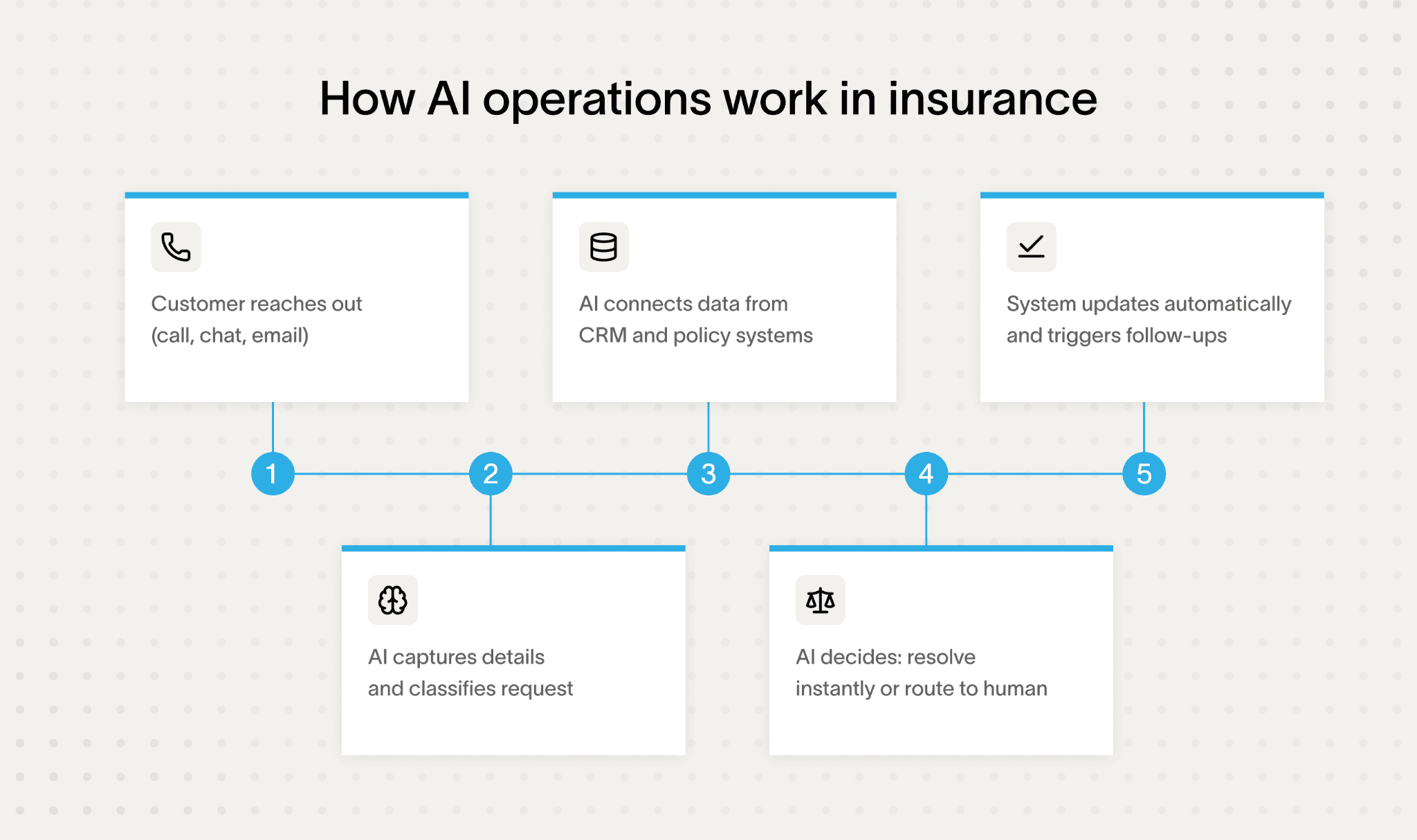
Insurance leaders are now using smart AI architectures that allow these systems to work together smoothly. For example, Strada uses conversational AI agents that understand insurance language and logic.
They can handle phone calls independently, gather first notice of loss (FNOL) info, recover lost sales opportunities, or flag risks by connecting with CRM and policy systems.
Here’s what that looks like in practice:
Take inbound calls → collect customer details and answer questions without wait times.
File FNOL automatically → record claim details, create files, and alert adjusters instantly.
Recover missed opportunities → follow up with prospects who didn’t complete quotes or renewals.
Flag potential risks → spot signs of churn, payment issues, or policy gaps in real time.
Sync data instantly → update CRM and policy systems the moment a call ends.
AI operations are becoming essential for insurers to stay competitive and efficient. With this clear view of AI operations, we can next look at key areas where AI is already making a real difference.
Where can AI add value in insurance today?
AI is making a big difference in insurance by speeding up work, improving accuracy, and handling more tasks without extra effort. That’s the real power of AI in insurance operations.
The key areas where AI helps the most include:
Area | What AI does | Business benefit | Example |
Claims | Detects fraud, estimates damage, routes cases | Cuts delays and boosts accuracy | Aviva’s 80+ AI models for faster claims |
Underwriting | Analyzes risk and predicts loss | Speeds up quotes, reduces errors | Smart scoring using ML and AI |
Sales | Identifies hot leads, drafts proposals | Improves conversion rates | Strada automated quote follow-ups |
Customer service | Handles chats and calls 24/7 | Improves satisfaction and response time | Strada AI agents for renewals and FNOL |
IT operations | Fixes bugs, tests systems | Saves developer time | GitHub Copilot for insurers |
And let’s talk details.
For claims, AI can quickly pull information from documents, detect fraud, estimate damage from photos, and send cases to the right people. For example, Aviva uses over 80 AI models to shorten investigation times a lot.
In underwriting, AI supports traditional methods by adding new risk insights and speeding up quote delivery. Sales teams benefit from AI by identifying the best leads, automating outreach, and helping agents write proposals and emails.
Customer service often uses AI assistants that provide friendly, round-the-clock support in many languages without wait times. IT teams use AI tools like GitHub Copilot to update code, run tests, set up environments, and spot system issues quickly.
Here’s what that looks like in action:
24/7 support → AI answers customer calls or chats instantly, anytime.
Multilingual help → conversations happen naturally in the customer’s preferred language.
Faster updates → IT teams use AI to write and test code in seconds.
Automatic fixes → system errors are detected and corrected before they cause downtime.
Quick setup → new environments or integrations are built automatically, with fewer manual steps.
Strada takes these tools further with AI phone agents made just for insurance. These agents handle calls about renewals, quotes, accident reports (FNOL), and policy services on their own. Unlike regular chatbots, Strada agents understand insurance terms and act instantly on what they hear.
Strada Workflows then turn these calls into actions.
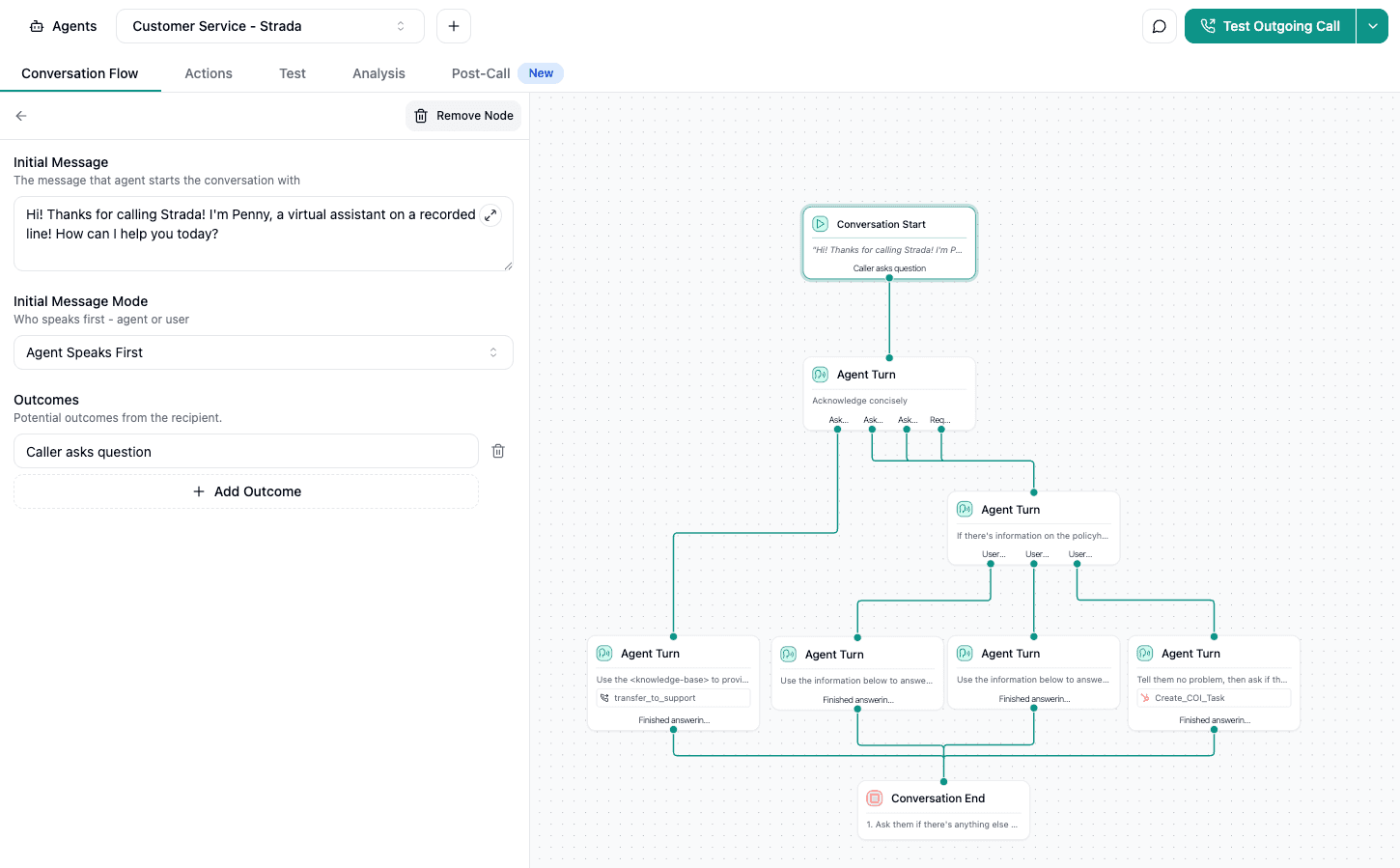
It helps update customer records, set reminders, start retention efforts, or send certificates automatically, without needing human help.
Seeing the impact is exciting, but how do you actually get started? Let’s walk through the first steps of building your own AI transformation.
How to start an AI transformation in insurance?
Starting AI in insurance needs clear goals from top leaders, focused on real results like faster claims, more policy sales, lower call center costs, or better customer retention.
It’s truly important to treat AI as a key business tool, not just a side project, and here’s how to start with it.
Pick one use case to pilot. Start simple. Choose a workflow that delivers quick results, like handling renewal calls or first notice of loss (FNOL). Strada already has pre-built voice AI templates for these, so setup takes minutes, not weeks.
Request a demo and define your workflow. Book a quick session with Strada’s team. They’ll help you map your current call process: what’s said, what happens next, and where data should go. This turns your real-world process into a Strada Workflow blueprint.
Connect your systems. Using Strada’s native integrations, link your CRM, AMS, and policy platforms. No engineering required – just authenticate and choose what data to sync (for example, updating a claim file or renewal status).
Set up smart triggers. Decide what happens after each call: create a task in Salesforce, send a payment reminder, issue a COI, or notify your retention team. Strada’s no-code rules make this part easy.
Test, launch, and learn. Run a small pilot for a week. Measure call completion rates, follow-up automation, and team feedback. Then scale to the next workflow.
With Strada, each call becomes a real business action (automated, accurate, and fast), so your team can focus on customers instead of manual busywork.
To make AI transformation easier to picture, here’s how the main building blocks stack up, each one supports the next.
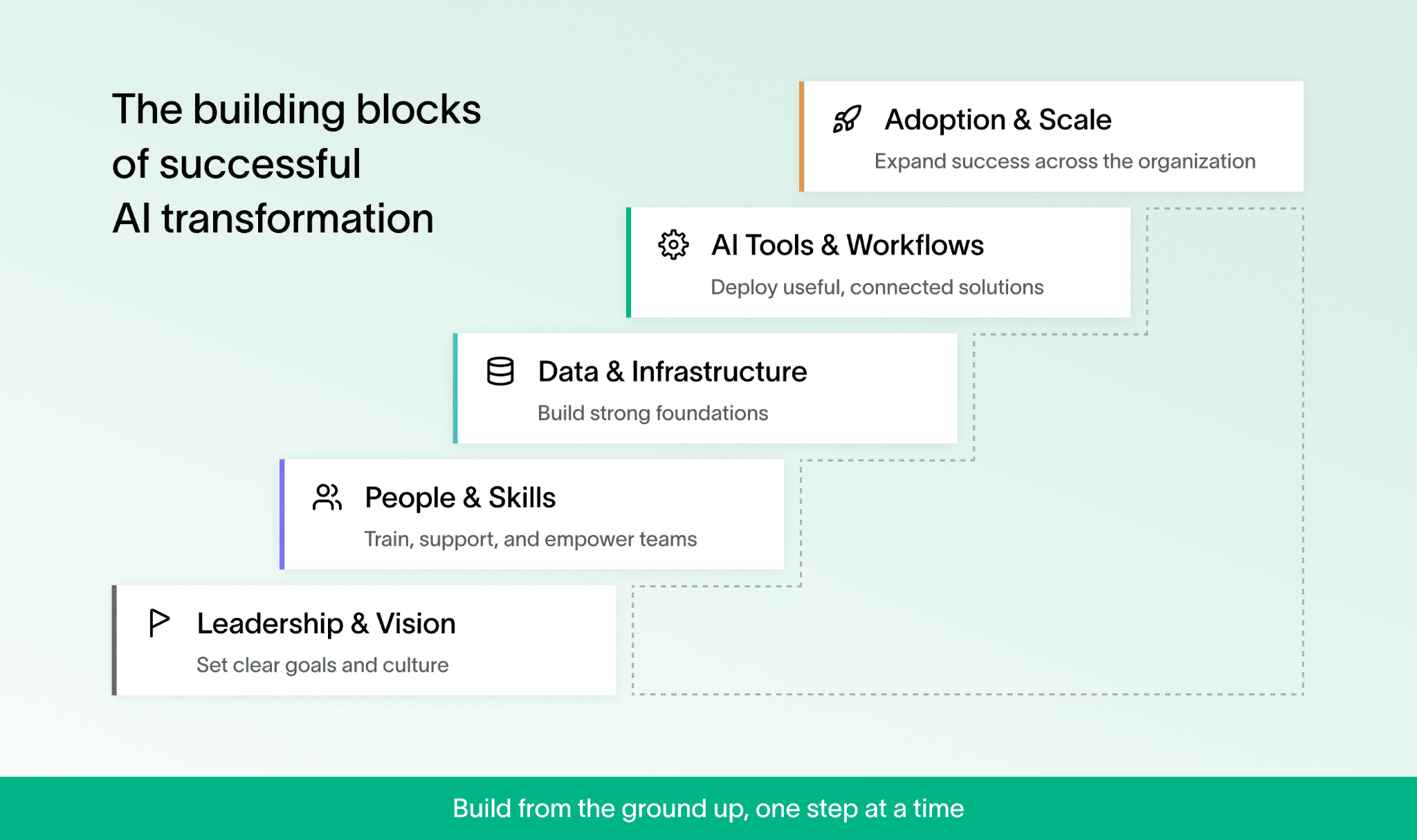
Once you’ve got your roadmap, it’s time to talk tools. You’ll need the right tech and infrastructure to make AI truly work at scale.
What technology and infrastructure support AI in insurance?
To use AI effectively in insurance, companies need a well-organized technology setup that supports everything from automating tasks to making smart decisions.
This setup usually has four main parts:
Customer engagement
Insurance companies interact with customers using tools that drive AI-powered insurance operations, like chatbots, voice assistants, and online portals. These tools handle tasks such as answering questions, managing claims, and processing renewals smoothly.
For example, platforms like Strada use AI to understand conversations and trigger actions automatically, making customer service faster and easier.
AI decision making
AI helps analyze data quickly to assess risks, detect fraud, and offer personalized insurance options. Using machine learning and smart AI systems, insurers can create flexible AI components that work together to handle complex tasks efficiently.
Here’s what that looks like in practice:
Risk assessment → AI reviews customer and market data to predict claim likelihood.
Fraud detection → flags unusual patterns or inconsistencies in claims before payout.
Personalized offers → suggests coverage and pricing based on each customer’s profile.
Faster underwriting → automatically gathers and reviews needed documents.
Continuous learning → improves accuracy over time as more data is processed.
Infrastructure
This is the technology foundation that runs AI tools. It includes cloud services that can grow or shrink as needed, technologies like containers and serverless computing for easy updates, and ways to connect new AI with older systems.
Using vendor-neutral designs, as recommended by experts like QuantumBlack, gives companies more freedom and avoids being tied to one provider.
Data platform
Good AI needs high-quality data. Data platforms collect information from different areas such as policy management, customer records, and claims. They also ensure the data is secure, accurate, and meets privacy rules.
Tools that help analyze and update old systems speed up the adoption of AI while keeping things reliable.
Strada makes this whole system better by being a central AI tool directly connected with sales, policy, and claims software. This integration turns customer conversations into automatic actions that save time, improve compliance, and produce clear business benefits.
By building on these four parts, insurers can get the most out of AI for insurance operations, automating work and making smarter decisions. But technology alone isn’t enough. Success depends on people, so let’s dive into how to drive adoption and manage change effectively.
How to maximize adoption and change management?
To get the most from AI in insurance, focus as much on your people and processes as on the technology itself. Spend equal time and resources on helping your team adjust to AI as you do on building the AI tools.
This ensures everyone feels supported, not threatened.
To make adoption smoother, here’s a quick guide you can use to plan your change management approach. Keep it practical and people-first.
Step | Action | Why it helps | Quick tip |
1. Lead by example | Leaders use AI first | Builds trust from the top | Share success stories |
2. Communicate early | Be open about goals and fears | Reduces uncertainty | Use town halls and demos |
3. Train everyone | Upskill your team regularly | Boosts confidence and comfort | Use short learning modules |
4. Celebrate wins | Highlight success stories | Keeps morale high | Reward teams publicly |
5. Ask for feedback | Listen to real experiences | Improves adoption speed | Run monthly feedback loops |
And let’s walk you through the details.
Start with strong leadership showing the way, open and clear communication, and setting simple, clear goals. This builds trust and confidence in the new AI tools.
Help your employees understand AI well, and encourage them to see it as a tool that helps them work better, not something that replaces their jobs. Use AI in daily tasks so staff can see how it cuts down repetitive work and speeds up results. This makes AI’s benefits real and clear.
Set up ways for people to give feedback on the AI tools. This helps you improve the tools based on real user experiences, making sure they are easy to use and truly helpful. Keep it simple:
Add a quick feedback button or form after AI interactions.
Ask teams for short weekly check-ins on what’s working or confusing.
Track common issues or requests to guide updates.
Share improvements openly so users see their input matters.
Avoid common mistakes like running separate pilot programs that don’t connect, ignoring how AI fits with insurance processes, or only focusing on how good the AI is without thinking about whether people will actually use it.
For example, Strada shows how AI can help acceptance by handling routine calls on its own. This takes busywork off agents’ desks, letting them focus on tough claims, keeping clients happy, or personalizing insurance offers.
This clear drop in daily hassles builds trust, speeds up adoption, and delivers real business results, making AI a welcomed part of insurance work.
Even with strong buy-in, challenges pop up. Here’s how to recognize and tackle the biggest risks before they slow you down.
What are the challenges and risks in AI operations for insurance?
Using AI in insurance comes with several challenges and risks that companies need to manage carefully.
One big issue is legacy technology: old systems that are hard to update can slow down AI projects and make automation difficult. At the same time, many insurance teams lack enough AI skills, so companies must invest in hiring and training people who can work with AI tools effectively.
Insurance companies also face strict rules around data privacy and fairness. They need to use AI in ways that are ethical, transparent, and comply with regulations to keep customer trust and avoid penalties.
Another challenge is resistance to change – some employees may be unsure or worried about adopting AI-driven processes, which can slow down progress.
As companies deploy more AI-driven tools for insurance operations, they must also manage growing complexity and security risks. Operational risks include cybersecurity threats that can compromise AI systems, model drift where AI predictions become less accurate over time, and dependency on specific vendors, which can limit flexibility.
To reduce these risks, companies can:
Use AI governance frameworks, like IBM AI Governance, to ensure ethical and legal use of AI
Combine building AI tools in-house with buying external solutions to get the best balance
Run clear change management programs with training to help employees adapt
Implement strong security measures and continuously monitor AI systems for issues
For example, Strada is a platform that helps manage these risks well. It offers top-level security certifications (like SOC 2 Type 2), keeps customer data separate and private, avoids reusing data to train AI models, and has dedicated teams to keep the system running smoothly.
Once you’ve navigated the bumps, it’s worth looking ahead. Let’s see where AI in insurance is heading next.
What’s next? The future of AI in insurance
AI tools in insurance are becoming smarter and more connected.
New AI systems, where multiple AI agents work together, help personalize services in real time, handle underwriting automatically, and make quick decisions that adjust as customer needs and market conditions change.
Insurers are building their own AI knowledge into these systems, turning AI into a key company asset. Customers expect highly personalized, smooth experiences on every channel.
AI needs to work well on its own but also team up with human agents to handle complex cases and provide compassionate support.
Also, using AI just a little won’t be enough anymore. Insurers must keep improving, adapt quickly, and use AI designed specifically for insurance to stay ahead. A big part of staying ahead will be integrating AI into insurance operations at every level, from underwriting to customer support.
Platforms like Strada show this future in action.
They automate not just phone calls but also emails, texts, and other ways customers reach out. Strada’s AI triggers actions automatically, linking systems, compliance, and customer interactions in one smooth process that improves business results.
And here are a few more trends to watch:
Agentic AI multi-agent systems → AI agents working together across departments for faster underwriting and claims triage.
Real-time personalization → AI offers tailored advice and policies, boosting customer satisfaction.
Multi-channel automation → Integrating voice, email, SMS, and digital channels for a seamless experience.
Embedded proprietary expertise → Using company-specific rules and models in AI for competitive edge.
Human-AI collaboration → AI supports human decisions on tough cases and helps deliver empathetic service.
The next wave of AI-powered insurance operations will rely on systems that learn, adapt, and act together.
So, the future sounds promising, but how do you know you’re on the right track today? Let’s talk about measuring success and ROI.
How to measure success and ROI in AI insurance projects?
To measure success and ROI in AI insurance projects, focus on key indicators that matter most to the business. Important metrics include cost savings, faster processing times, accuracy of tasks, customer satisfaction (NPS), and following compliance rules.
Use AI dashboards to monitor these metrics in real time and catch any issues quickly.

Besides these direct results, consider benefits like better employee productivity, faster innovation, and improved risk management.
Tools like Strada offer dashboards to track how well calls are handled, tasks are automated, connection rates, and effects on claims processing speed and customer retention.
These are great examples of AI-driven tools for insurance operations making results measurable and transparent. Combining AI insights with other operational data gives a full picture of financial and customer experience wins.
Don’t forget to test changes with A/B testing or small pilot projects to make sure improvements are real and useful before rolling out widely. Frameworks like McKinsey’s AI Value Framework or IBM Watson’s toolkit can help measure AI’s business impact clearly.
Here are some example targets:
Area | Metric | Target | How to track | Example result |
Claims | Processing time | ↓ 30% | CRM or claims system | From 10 days to 7 days |
Customer service | NPS improvement | +15 points | Monthly survey | 65 → 80 |
Operations | Task automation rate | 90%+ | Workflow dashboards | 9 of 10 calls fully automated |
Sales | Conversion rate | +20% | CRM analytics | 12% → 14.5% |
Compliance | Adherence rate | 100% | Audit logs | Zero missed checks |
Employee productivity | Time saved | +25% | Weekly team reports | 2 hours saved per day |
Using this clear and simple approach, insurers can see the true value of AI projects.
After seeing results, you’ll want to expand. Here’s how to move beyond small pilots and scale AI across your organization.
How to scale AI operations beyond pilots in insurance?
To scale AI in insurance beyond pilot projects, insurers need a clear, practical approach that combines technology, processes, and people.
Here’s what a typical AI growth journey looks like in insurance. You can use it as a roadmap to move from early pilots to full transformation.
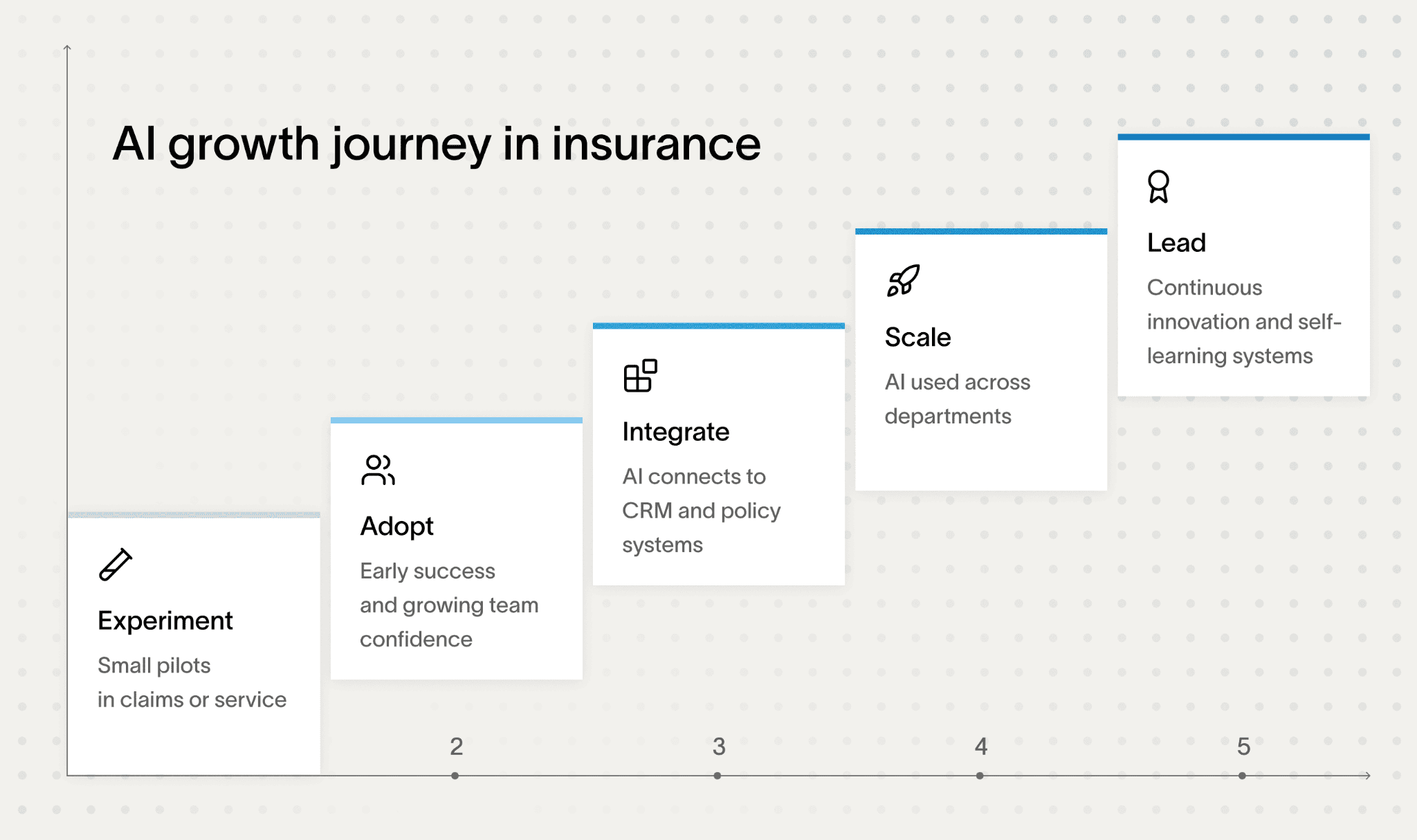
You might start by setting up an enterprise-wide AI Center of Excellence (CoE). This team creates consistent standards, tools, and best practices so all business areas work the same way.
This approach shows how AI in insurance operations can grow from one department to a company-wide system.
Next, build reusable AI parts like models, pipelines, and APIs. This saves time and avoids repeating work. Tools like Kubeflow and MLflow help manage AI projects from development to deployment.
Make it work smoothly:
Use one shared code base for models to ensure consistency.
Automate testing so updates don’t break existing workflows.
Track versions of models and data to reproduce results easily.
Document each reusable part clearly, so teams can plug and play.
Use an AI mesh architecture, which connects AI services across departments like underwriting, claims, and customer service. Middleware platforms such as MuleSoft or TIBCO make sure AI links smoothly with existing systems like policy management and CRM.
Apply DevOps and MLOps methods to automate continuous integration, testing, and delivery. Platforms like Kubeflow Pipelines or AWS SageMaker Pipelines help keep AI models running reliably and improve over time.
Operational governance is key: assign clear ownership of AI assets, set up automated retraining, and monitor performance regularly.
For example, Strada is a ready-to-use platform that scales thousands of AI-driven calls without heavy engineering work. It continuously evaluates and improves models.
Strada’s AI agents handle quote intake, first notice of loss, policy servicing, and follow-up tasks, turning successful pilots into broad business value.
Scaling AI sounds big, but it’s really about turning good habits into repeatable systems. Here’s a simple guide to help you do that.
Area | What to standardize | Why it matters | Example |
Data | Formats, pipelines, governance | Keeps models accurate | Shared schema across systems |
Models | Deployment and retraining | Prevents performance drops | Auto retrain every 30 days |
Tools | AI platforms and APIs | Avoids duplicate work | One platform for all pilots |
Metrics | ROI and adoption KPIs | Keeps focus on results | Common dashboard for all teams |
People | Roles and processes | Simplifies scaling | Central AI Center of Excellence |
Scaling means people, too. Let’s look at how to attract, grow, and keep the right AI talent to power your future.
How to build and retain AI talent within insurance organizations?
Getting and keeping skilled AI people is key to using AI well in insurance.
Start by hiring the right experts like AI engineers, data scientists, product managers, AI ethics specialists, and change leaders.
But hiring isn’t enough. Create clear career paths and mentorship programs so your AI team can grow and stay motivated. Partner with universities and AI labs to bring in fresh talent through internships and joint projects.
Use online learning platforms like Coursera, DataCamp, or Udacity to help your current employees learn new AI skills regularly. Build an internal AI community where teams can share ideas, solve problems together, and keep innovating.
When starting out with AI, work with experienced vendors who can guide your team and speed up results. For example, Strada offers on-site support to help insurers automate processes and embed AI best practices while training your staff.
Here’s a quick guide:
Hire specialized AI roles → AI engineers, data scientists, product owners, governance specialists, change managers
Offer career growth → Clear paths, mentoring, internal training
Work with academics → Internships, research collaborations
Keep learning → Online courses and nanodegrees
Build AI communities → Regular meetings and idea sharing
Use vendor help → Hands-on support from AI experts like Strada
Following these practical steps creates a steady flow of skilled AI talent, helping insurers grow their AI capabilities smoothly and successfully.
Of course, great talent needs great data. Let’s dig into how you can build a smarter data strategy to fuel AI success.
How to optimize data strategy for AI in insurance?
To make AI work well in insurance, start by focusing on the most important data.
This includes claims records, telematics, customer chats, and public data. Using the right data helps AI learn and make smart decisions.
Good data management is key. Keep track of where data comes from, tag it with useful details, and monitor how it changes over time. Tools like Collibra and Alation can help organize this.
Keep your data reliable:
Set clear ownership so every dataset has a responsible team.
Tag data with source, date, and usage notes for quick context.
Run regular quality checks to catch errors early.
Archive old or unused data to keep systems clean and fast.
Control access so only the right people can view or edit sensitive data.
Align data standards across teams to ensure consistency.
Create simple dashboards to track data freshness, accuracy, and use.
Clean and prepare your data by removing errors, labeling it properly, and adding examples. Sometimes, you can create fake but realistic data using tools like Mostly AI and Gretel.ai to fill gaps and reduce bias.
Set up systems for real-time data sharing using platforms like Apache Kafka, so AI can react fast and keep up with changing needs.
Find a balance between storing data in one place and spreading it out. This helps keep data safe but also flexible. Strada is an example of capturing conversations from calls and chats which can provide valuable insights.
This data should connect smoothly with your current systems to trigger automatic tasks, alerts, and updates, making processes faster and customers happier.
A clear data strategy turns messy information into useful insights, powering AI to make decisions and handle routine tasks. Using tools like Strada, insurers can go beyond theory and see real improvements in efficiency, accuracy, and customer experience.
You’ve now seen how everything connects, from data to people to strategy. Let’s wrap it all up with a quick look at what’s next for you.
How soon could you start your own AI transformation?
AI can change the insurance industry for the better, but only with a clear plan, the right tools, and a focus on people.
Success isn’t just about using AI. It needs strong leadership, teamwork, and technology that fits business needs. Insurers should focus on key areas like claims, underwriting, and customer service, where AI can improve results and save time.
And, if you’re ready to see how this works in real life, you don’t have to start from scratch. Platforms like Strada make it easy to bring AI into your everyday operations without big technical hurdles.
You can start small (maybe with AI-powered phone agents that handle claims or renewals), and expand as your team sees results.
Think of Strada as your hands-on partner that helps you connect people, data, and systems so AI actually makes your day-to-day smoother.
Want to see it in action?
You can book a Strada demo to explore how voice AI and automated workflows can transform your insurance operations, from faster renewals and FNOL handling to complete post-call automation.
See how leading carriers and brokers are already scaling results with Strada’s insurance-specific platform.
Frequently Asked Questions
How quickly can an insurance team start using AI operations?
Most teams can launch their first AI-powered workflow—like renewals or FNOL—within days using prebuilt templates and no-code setup. Full rollout typically happens over 4–8 weeks.
Do agents need technical skills to work with AI tools?
Framer is a design tool that allows you to design websites on a freeform canvas, and then publish them as websites with a single click.
What’s the easiest workflow to automate first?
Framer is a design tool that allows you to design websites on a freeform canvas, and then publish them as websites with a single click.
What are the biggest hidden costs of AI operations?
Framer is a design tool that allows you to design websites on a freeform canvas, and then publish them as websites with a single click.
What’s the biggest reason AI projects fail in insurance?
Framer is a design tool that allows you to design websites on a freeform canvas, and then publish them as websites with a single click.
Table of Contents
Carriers, MGAs, and brokers scale revenue-driving phone calls with Strada's conversational AI platform.
Start scaling with voice AI agents today
Join innovative carriers and MGAs transforming their calls with Strada.
The Ultimate Guide to AI Operations for Insurance [2026 Updated]
Amir Prodensky
CEO
12 min read
A practical roadmap for turning AI into real operational results
A few years ago, I met an insurance team that said they were “experimenting with AI.”
They had a few chatbots and some automated email replies (impressive for the time), but nothing truly connected. Fast-forward to today, and things couldn’t be more different. The insurance industry isn’t testing AI anymore.
It’s powered by it.
New types of AI, like generative AI and smart machine learning, are taking insurers far beyond simple rule-based systems. These tools don’t just follow scripts. They can listen, understand intent, and take action on their own.
Leading this shift is Strada, an AI-powered platform that automates calls, handles renewals, and completes follow-up tasks seamlessly, helping insurance teams serve more customers without adding more staff.
These advances prove how powerful AI can be in transforming day-to-day operations. But here’s the catch: simply having AI tools isn’t enough. Real impact comes when insurers build a clear plan – one that fits their workflows, compliance rules, and the way their people actually work.
No matter if the goal is efficiency, personalization, better risk insights, or stronger customer experiences, AI needs to be woven into everyday processes.
This guide walks you through that step-by-step, with real examples, proven practices, and results from leading insurers.
But before we get into how to use AI effectively, let’s start with the basics: what AI operations in insurance really mean, and how they differ from older automation methods.
What are AI operations in insurance?
AI operations in insurance mean using artificial intelligence throughout the entire insurance process, not just as separate tools, but as smart helpers built into daily tasks.
Instead of only automating simple steps, AI now supports underwriting, claims handling, sales, policy management, fraud detection, and office work.
In the past, insurers used AI mainly for predictions, like setting prices, estimating losses, or spotting fraud. Now, with large language models and generative AI, new abilities have arrived, such as automatically creating documents, drafting emails, and chatting with customers.
And the biggest change comes with agentic AI – systems that don’t just suggest actions but take them on their own. These AI agents can gather information, make decisions instantly, start follow-up tasks, and connect different systems automatically, without needing a person to step in.
This is transforming insurance operations, especially in tricky areas like starting claims, following up on quotes, keeping customers for renewals, and helping with support.
But AI only delivers value when it’s fully built-in, not stuck in test phases.
Here’s a simple look at how AI operations flow through an insurance company, from first contact to final decision.
Insurance leaders are now using smart AI architectures that allow these systems to work together smoothly. For example, Strada uses conversational AI agents that understand insurance language and logic.
They can handle phone calls independently, gather first notice of loss (FNOL) info, recover lost sales opportunities, or flag risks by connecting with CRM and policy systems.
Here’s what that looks like in practice:
Take inbound calls → collect customer details and answer questions without wait times.
File FNOL automatically → record claim details, create files, and alert adjusters instantly.
Recover missed opportunities → follow up with prospects who didn’t complete quotes or renewals.
Flag potential risks → spot signs of churn, payment issues, or policy gaps in real time.
Sync data instantly → update CRM and policy systems the moment a call ends.
AI operations are becoming essential for insurers to stay competitive and efficient. With this clear view of AI operations, we can next look at key areas where AI is already making a real difference.
Where can AI add value in insurance today?
AI is making a big difference in insurance by speeding up work, improving accuracy, and handling more tasks without extra effort. That’s the real power of AI in insurance operations.
The key areas where AI helps the most include:
Area | What AI does | Business benefit | Example |
Claims | Detects fraud, estimates damage, routes cases | Cuts delays and boosts accuracy | Aviva’s 80+ AI models for faster claims |
Underwriting | Analyzes risk and predicts loss | Speeds up quotes, reduces errors | Smart scoring using ML and AI |
Sales | Identifies hot leads, drafts proposals | Improves conversion rates | Strada automated quote follow-ups |
Customer service | Handles chats and calls 24/7 | Improves satisfaction and response time | Strada AI agents for renewals and FNOL |
IT operations | Fixes bugs, tests systems | Saves developer time | GitHub Copilot for insurers |
And let’s talk details.
For claims, AI can quickly pull information from documents, detect fraud, estimate damage from photos, and send cases to the right people. For example, Aviva uses over 80 AI models to shorten investigation times a lot.
In underwriting, AI supports traditional methods by adding new risk insights and speeding up quote delivery. Sales teams benefit from AI by identifying the best leads, automating outreach, and helping agents write proposals and emails.
Customer service often uses AI assistants that provide friendly, round-the-clock support in many languages without wait times. IT teams use AI tools like GitHub Copilot to update code, run tests, set up environments, and spot system issues quickly.
Here’s what that looks like in action:
24/7 support → AI answers customer calls or chats instantly, anytime.
Multilingual help → conversations happen naturally in the customer’s preferred language.
Faster updates → IT teams use AI to write and test code in seconds.
Automatic fixes → system errors are detected and corrected before they cause downtime.
Quick setup → new environments or integrations are built automatically, with fewer manual steps.
Strada takes these tools further with AI phone agents made just for insurance. These agents handle calls about renewals, quotes, accident reports (FNOL), and policy services on their own. Unlike regular chatbots, Strada agents understand insurance terms and act instantly on what they hear.
Strada Workflows then turn these calls into actions.
It helps update customer records, set reminders, start retention efforts, or send certificates automatically, without needing human help.
Seeing the impact is exciting, but how do you actually get started? Let’s walk through the first steps of building your own AI transformation.
How to start an AI transformation in insurance?
Starting AI in insurance needs clear goals from top leaders, focused on real results like faster claims, more policy sales, lower call center costs, or better customer retention.
It’s truly important to treat AI as a key business tool, not just a side project, and here’s how to start with it.
Pick one use case to pilot. Start simple. Choose a workflow that delivers quick results, like handling renewal calls or first notice of loss (FNOL). Strada already has pre-built voice AI templates for these, so setup takes minutes, not weeks.
Request a demo and define your workflow. Book a quick session with Strada’s team. They’ll help you map your current call process: what’s said, what happens next, and where data should go. This turns your real-world process into a Strada Workflow blueprint.
Connect your systems. Using Strada’s native integrations, link your CRM, AMS, and policy platforms. No engineering required – just authenticate and choose what data to sync (for example, updating a claim file or renewal status).
Set up smart triggers. Decide what happens after each call: create a task in Salesforce, send a payment reminder, issue a COI, or notify your retention team. Strada’s no-code rules make this part easy.
Test, launch, and learn. Run a small pilot for a week. Measure call completion rates, follow-up automation, and team feedback. Then scale to the next workflow.
With Strada, each call becomes a real business action (automated, accurate, and fast), so your team can focus on customers instead of manual busywork.
To make AI transformation easier to picture, here’s how the main building blocks stack up, each one supports the next.
Once you’ve got your roadmap, it’s time to talk tools. You’ll need the right tech and infrastructure to make AI truly work at scale.
What technology and infrastructure support AI in insurance?
To use AI effectively in insurance, companies need a well-organized technology setup that supports everything from automating tasks to making smart decisions.
This setup usually has four main parts:
Customer engagement
Insurance companies interact with customers using tools that drive AI-powered insurance operations, like chatbots, voice assistants, and online portals. These tools handle tasks such as answering questions, managing claims, and processing renewals smoothly.
For example, platforms like Strada use AI to understand conversations and trigger actions automatically, making customer service faster and easier.
AI decision making
AI helps analyze data quickly to assess risks, detect fraud, and offer personalized insurance options. Using machine learning and smart AI systems, insurers can create flexible AI components that work together to handle complex tasks efficiently.
Here’s what that looks like in practice:
Risk assessment → AI reviews customer and market data to predict claim likelihood.
Fraud detection → flags unusual patterns or inconsistencies in claims before payout.
Personalized offers → suggests coverage and pricing based on each customer’s profile.
Faster underwriting → automatically gathers and reviews needed documents.
Continuous learning → improves accuracy over time as more data is processed.
Infrastructure
This is the technology foundation that runs AI tools. It includes cloud services that can grow or shrink as needed, technologies like containers and serverless computing for easy updates, and ways to connect new AI with older systems.
Using vendor-neutral designs, as recommended by experts like QuantumBlack, gives companies more freedom and avoids being tied to one provider.
Data platform
Good AI needs high-quality data. Data platforms collect information from different areas such as policy management, customer records, and claims. They also ensure the data is secure, accurate, and meets privacy rules.
Tools that help analyze and update old systems speed up the adoption of AI while keeping things reliable.
Strada makes this whole system better by being a central AI tool directly connected with sales, policy, and claims software. This integration turns customer conversations into automatic actions that save time, improve compliance, and produce clear business benefits.
By building on these four parts, insurers can get the most out of AI for insurance operations, automating work and making smarter decisions. But technology alone isn’t enough. Success depends on people, so let’s dive into how to drive adoption and manage change effectively.
How to maximize adoption and change management?
To get the most from AI in insurance, focus as much on your people and processes as on the technology itself. Spend equal time and resources on helping your team adjust to AI as you do on building the AI tools.
This ensures everyone feels supported, not threatened.
To make adoption smoother, here’s a quick guide you can use to plan your change management approach. Keep it practical and people-first.
Step | Action | Why it helps | Quick tip |
1. Lead by example | Leaders use AI first | Builds trust from the top | Share success stories |
2. Communicate early | Be open about goals and fears | Reduces uncertainty | Use town halls and demos |
3. Train everyone | Upskill your team regularly | Boosts confidence and comfort | Use short learning modules |
4. Celebrate wins | Highlight success stories | Keeps morale high | Reward teams publicly |
5. Ask for feedback | Listen to real experiences | Improves adoption speed | Run monthly feedback loops |
And let’s walk you through the details.
Start with strong leadership showing the way, open and clear communication, and setting simple, clear goals. This builds trust and confidence in the new AI tools.
Help your employees understand AI well, and encourage them to see it as a tool that helps them work better, not something that replaces their jobs. Use AI in daily tasks so staff can see how it cuts down repetitive work and speeds up results. This makes AI’s benefits real and clear.
Set up ways for people to give feedback on the AI tools. This helps you improve the tools based on real user experiences, making sure they are easy to use and truly helpful. Keep it simple:
Add a quick feedback button or form after AI interactions.
Ask teams for short weekly check-ins on what’s working or confusing.
Track common issues or requests to guide updates.
Share improvements openly so users see their input matters.
Avoid common mistakes like running separate pilot programs that don’t connect, ignoring how AI fits with insurance processes, or only focusing on how good the AI is without thinking about whether people will actually use it.
For example, Strada shows how AI can help acceptance by handling routine calls on its own. This takes busywork off agents’ desks, letting them focus on tough claims, keeping clients happy, or personalizing insurance offers.
This clear drop in daily hassles builds trust, speeds up adoption, and delivers real business results, making AI a welcomed part of insurance work.
Even with strong buy-in, challenges pop up. Here’s how to recognize and tackle the biggest risks before they slow you down.
What are the challenges and risks in AI operations for insurance?
Using AI in insurance comes with several challenges and risks that companies need to manage carefully.
One big issue is legacy technology: old systems that are hard to update can slow down AI projects and make automation difficult. At the same time, many insurance teams lack enough AI skills, so companies must invest in hiring and training people who can work with AI tools effectively.
Insurance companies also face strict rules around data privacy and fairness. They need to use AI in ways that are ethical, transparent, and comply with regulations to keep customer trust and avoid penalties.
Another challenge is resistance to change – some employees may be unsure or worried about adopting AI-driven processes, which can slow down progress.
As companies deploy more AI-driven tools for insurance operations, they must also manage growing complexity and security risks. Operational risks include cybersecurity threats that can compromise AI systems, model drift where AI predictions become less accurate over time, and dependency on specific vendors, which can limit flexibility.
To reduce these risks, companies can:
Use AI governance frameworks, like IBM AI Governance, to ensure ethical and legal use of AI
Combine building AI tools in-house with buying external solutions to get the best balance
Run clear change management programs with training to help employees adapt
Implement strong security measures and continuously monitor AI systems for issues
For example, Strada is a platform that helps manage these risks well. It offers top-level security certifications (like SOC 2 Type 2), keeps customer data separate and private, avoids reusing data to train AI models, and has dedicated teams to keep the system running smoothly.
Once you’ve navigated the bumps, it’s worth looking ahead. Let’s see where AI in insurance is heading next.
What’s next? The future of AI in insurance
AI tools in insurance are becoming smarter and more connected.
New AI systems, where multiple AI agents work together, help personalize services in real time, handle underwriting automatically, and make quick decisions that adjust as customer needs and market conditions change.
Insurers are building their own AI knowledge into these systems, turning AI into a key company asset. Customers expect highly personalized, smooth experiences on every channel.
AI needs to work well on its own but also team up with human agents to handle complex cases and provide compassionate support.
Also, using AI just a little won’t be enough anymore. Insurers must keep improving, adapt quickly, and use AI designed specifically for insurance to stay ahead. A big part of staying ahead will be integrating AI into insurance operations at every level, from underwriting to customer support.
Platforms like Strada show this future in action.
They automate not just phone calls but also emails, texts, and other ways customers reach out. Strada’s AI triggers actions automatically, linking systems, compliance, and customer interactions in one smooth process that improves business results.
And here are a few more trends to watch:
Agentic AI multi-agent systems → AI agents working together across departments for faster underwriting and claims triage.
Real-time personalization → AI offers tailored advice and policies, boosting customer satisfaction.
Multi-channel automation → Integrating voice, email, SMS, and digital channels for a seamless experience.
Embedded proprietary expertise → Using company-specific rules and models in AI for competitive edge.
Human-AI collaboration → AI supports human decisions on tough cases and helps deliver empathetic service.
The next wave of AI-powered insurance operations will rely on systems that learn, adapt, and act together.
So, the future sounds promising, but how do you know you’re on the right track today? Let’s talk about measuring success and ROI.
How to measure success and ROI in AI insurance projects?
To measure success and ROI in AI insurance projects, focus on key indicators that matter most to the business. Important metrics include cost savings, faster processing times, accuracy of tasks, customer satisfaction (NPS), and following compliance rules.
Use AI dashboards to monitor these metrics in real time and catch any issues quickly.
Besides these direct results, consider benefits like better employee productivity, faster innovation, and improved risk management.
Tools like Strada offer dashboards to track how well calls are handled, tasks are automated, connection rates, and effects on claims processing speed and customer retention.
These are great examples of AI-driven tools for insurance operations making results measurable and transparent. Combining AI insights with other operational data gives a full picture of financial and customer experience wins.
Don’t forget to test changes with A/B testing or small pilot projects to make sure improvements are real and useful before rolling out widely. Frameworks like McKinsey’s AI Value Framework or IBM Watson’s toolkit can help measure AI’s business impact clearly.
Here are some example targets:
Area | Metric | Target | How to track | Example result |
Claims | Processing time | ↓ 30% | CRM or claims system | From 10 days to 7 days |
Customer service | NPS improvement | +15 points | Monthly survey | 65 → 80 |
Operations | Task automation rate | 90%+ | Workflow dashboards | 9 of 10 calls fully automated |
Sales | Conversion rate | +20% | CRM analytics | 12% → 14.5% |
Compliance | Adherence rate | 100% | Audit logs | Zero missed checks |
Employee productivity | Time saved | +25% | Weekly team reports | 2 hours saved per day |
Using this clear and simple approach, insurers can see the true value of AI projects.
After seeing results, you’ll want to expand. Here’s how to move beyond small pilots and scale AI across your organization.
How to scale AI operations beyond pilots in insurance?
To scale AI in insurance beyond pilot projects, insurers need a clear, practical approach that combines technology, processes, and people.
Here’s what a typical AI growth journey looks like in insurance. You can use it as a roadmap to move from early pilots to full transformation.
You might start by setting up an enterprise-wide AI Center of Excellence (CoE). This team creates consistent standards, tools, and best practices so all business areas work the same way.
This approach shows how AI in insurance operations can grow from one department to a company-wide system.
Next, build reusable AI parts like models, pipelines, and APIs. This saves time and avoids repeating work. Tools like Kubeflow and MLflow help manage AI projects from development to deployment.
Make it work smoothly:
Use one shared code base for models to ensure consistency.
Automate testing so updates don’t break existing workflows.
Track versions of models and data to reproduce results easily.
Document each reusable part clearly, so teams can plug and play.
Use an AI mesh architecture, which connects AI services across departments like underwriting, claims, and customer service. Middleware platforms such as MuleSoft or TIBCO make sure AI links smoothly with existing systems like policy management and CRM.
Apply DevOps and MLOps methods to automate continuous integration, testing, and delivery. Platforms like Kubeflow Pipelines or AWS SageMaker Pipelines help keep AI models running reliably and improve over time.
Operational governance is key: assign clear ownership of AI assets, set up automated retraining, and monitor performance regularly.
For example, Strada is a ready-to-use platform that scales thousands of AI-driven calls without heavy engineering work. It continuously evaluates and improves models.
Strada’s AI agents handle quote intake, first notice of loss, policy servicing, and follow-up tasks, turning successful pilots into broad business value.
Scaling AI sounds big, but it’s really about turning good habits into repeatable systems. Here’s a simple guide to help you do that.
Area | What to standardize | Why it matters | Example |
Data | Formats, pipelines, governance | Keeps models accurate | Shared schema across systems |
Models | Deployment and retraining | Prevents performance drops | Auto retrain every 30 days |
Tools | AI platforms and APIs | Avoids duplicate work | One platform for all pilots |
Metrics | ROI and adoption KPIs | Keeps focus on results | Common dashboard for all teams |
People | Roles and processes | Simplifies scaling | Central AI Center of Excellence |
Scaling means people, too. Let’s look at how to attract, grow, and keep the right AI talent to power your future.
How to build and retain AI talent within insurance organizations?
Getting and keeping skilled AI people is key to using AI well in insurance.
Start by hiring the right experts like AI engineers, data scientists, product managers, AI ethics specialists, and change leaders.
But hiring isn’t enough. Create clear career paths and mentorship programs so your AI team can grow and stay motivated. Partner with universities and AI labs to bring in fresh talent through internships and joint projects.
Use online learning platforms like Coursera, DataCamp, or Udacity to help your current employees learn new AI skills regularly. Build an internal AI community where teams can share ideas, solve problems together, and keep innovating.
When starting out with AI, work with experienced vendors who can guide your team and speed up results. For example, Strada offers on-site support to help insurers automate processes and embed AI best practices while training your staff.
Here’s a quick guide:
Hire specialized AI roles → AI engineers, data scientists, product owners, governance specialists, change managers
Offer career growth → Clear paths, mentoring, internal training
Work with academics → Internships, research collaborations
Keep learning → Online courses and nanodegrees
Build AI communities → Regular meetings and idea sharing
Use vendor help → Hands-on support from AI experts like Strada
Following these practical steps creates a steady flow of skilled AI talent, helping insurers grow their AI capabilities smoothly and successfully.
Of course, great talent needs great data. Let’s dig into how you can build a smarter data strategy to fuel AI success.
How to optimize data strategy for AI in insurance?
To make AI work well in insurance, start by focusing on the most important data.
This includes claims records, telematics, customer chats, and public data. Using the right data helps AI learn and make smart decisions.
Good data management is key. Keep track of where data comes from, tag it with useful details, and monitor how it changes over time. Tools like Collibra and Alation can help organize this.
Keep your data reliable:
Set clear ownership so every dataset has a responsible team.
Tag data with source, date, and usage notes for quick context.
Run regular quality checks to catch errors early.
Archive old or unused data to keep systems clean and fast.
Control access so only the right people can view or edit sensitive data.
Align data standards across teams to ensure consistency.
Create simple dashboards to track data freshness, accuracy, and use.
Clean and prepare your data by removing errors, labeling it properly, and adding examples. Sometimes, you can create fake but realistic data using tools like Mostly AI and Gretel.ai to fill gaps and reduce bias.
Set up systems for real-time data sharing using platforms like Apache Kafka, so AI can react fast and keep up with changing needs.
Find a balance between storing data in one place and spreading it out. This helps keep data safe but also flexible. Strada is an example of capturing conversations from calls and chats which can provide valuable insights.
This data should connect smoothly with your current systems to trigger automatic tasks, alerts, and updates, making processes faster and customers happier.
A clear data strategy turns messy information into useful insights, powering AI to make decisions and handle routine tasks. Using tools like Strada, insurers can go beyond theory and see real improvements in efficiency, accuracy, and customer experience.
You’ve now seen how everything connects, from data to people to strategy. Let’s wrap it all up with a quick look at what’s next for you.
How soon could you start your own AI transformation?
AI can change the insurance industry for the better, but only with a clear plan, the right tools, and a focus on people.
Success isn’t just about using AI. It needs strong leadership, teamwork, and technology that fits business needs. Insurers should focus on key areas like claims, underwriting, and customer service, where AI can improve results and save time.
And, if you’re ready to see how this works in real life, you don’t have to start from scratch. Platforms like Strada make it easy to bring AI into your everyday operations without big technical hurdles.
You can start small (maybe with AI-powered phone agents that handle claims or renewals), and expand as your team sees results.
Think of Strada as your hands-on partner that helps you connect people, data, and systems so AI actually makes your day-to-day smoother.
Want to see it in action?
You can book a Strada demo to explore how voice AI and automated workflows can transform your insurance operations, from faster renewals and FNOL handling to complete post-call automation.
See how leading carriers and brokers are already scaling results with Strada’s insurance-specific platform.
Frequently Asked Questions
How quickly can an insurance team start using AI operations?
Most teams can launch their first AI-powered workflow—like renewals or FNOL—within days using prebuilt templates and no-code setup. Full rollout typically happens over 4–8 weeks.
Do agents need technical skills to work with AI tools?
Framer is a design tool that allows you to design websites on a freeform canvas, and then publish them as websites with a single click.
What’s the easiest workflow to automate first?
Framer is a design tool that allows you to design websites on a freeform canvas, and then publish them as websites with a single click.
What are the biggest hidden costs of AI operations?
Framer is a design tool that allows you to design websites on a freeform canvas, and then publish them as websites with a single click.
What’s the biggest reason AI projects fail in insurance?
Framer is a design tool that allows you to design websites on a freeform canvas, and then publish them as websites with a single click.
Table of Contents
Carriers, MGAs, and brokers scale revenue-driving phone calls with Strada's conversational AI platform.
Start scaling with voice AI agents today
Join innovative carriers and MGAs transforming their calls with Strada.
The Ultimate Guide to AI Operations for Insurance [2026 Updated]
Amir Prodensky
CEO
12 min read
A practical roadmap for turning AI into real operational results
A few years ago, I met an insurance team that said they were “experimenting with AI.”
They had a few chatbots and some automated email replies (impressive for the time), but nothing truly connected. Fast-forward to today, and things couldn’t be more different. The insurance industry isn’t testing AI anymore.
It’s powered by it.
New types of AI, like generative AI and smart machine learning, are taking insurers far beyond simple rule-based systems. These tools don’t just follow scripts. They can listen, understand intent, and take action on their own.
Leading this shift is Strada, an AI-powered platform that automates calls, handles renewals, and completes follow-up tasks seamlessly, helping insurance teams serve more customers without adding more staff.
These advances prove how powerful AI can be in transforming day-to-day operations. But here’s the catch: simply having AI tools isn’t enough. Real impact comes when insurers build a clear plan – one that fits their workflows, compliance rules, and the way their people actually work.
No matter if the goal is efficiency, personalization, better risk insights, or stronger customer experiences, AI needs to be woven into everyday processes.
This guide walks you through that step-by-step, with real examples, proven practices, and results from leading insurers.
But before we get into how to use AI effectively, let’s start with the basics: what AI operations in insurance really mean, and how they differ from older automation methods.
What are AI operations in insurance?
AI operations in insurance mean using artificial intelligence throughout the entire insurance process, not just as separate tools, but as smart helpers built into daily tasks.
Instead of only automating simple steps, AI now supports underwriting, claims handling, sales, policy management, fraud detection, and office work.
In the past, insurers used AI mainly for predictions, like setting prices, estimating losses, or spotting fraud. Now, with large language models and generative AI, new abilities have arrived, such as automatically creating documents, drafting emails, and chatting with customers.
And the biggest change comes with agentic AI – systems that don’t just suggest actions but take them on their own. These AI agents can gather information, make decisions instantly, start follow-up tasks, and connect different systems automatically, without needing a person to step in.
This is transforming insurance operations, especially in tricky areas like starting claims, following up on quotes, keeping customers for renewals, and helping with support.
But AI only delivers value when it’s fully built-in, not stuck in test phases.
Here’s a simple look at how AI operations flow through an insurance company, from first contact to final decision.
Insurance leaders are now using smart AI architectures that allow these systems to work together smoothly. For example, Strada uses conversational AI agents that understand insurance language and logic.
They can handle phone calls independently, gather first notice of loss (FNOL) info, recover lost sales opportunities, or flag risks by connecting with CRM and policy systems.
Here’s what that looks like in practice:
Take inbound calls → collect customer details and answer questions without wait times.
File FNOL automatically → record claim details, create files, and alert adjusters instantly.
Recover missed opportunities → follow up with prospects who didn’t complete quotes or renewals.
Flag potential risks → spot signs of churn, payment issues, or policy gaps in real time.
Sync data instantly → update CRM and policy systems the moment a call ends.
AI operations are becoming essential for insurers to stay competitive and efficient. With this clear view of AI operations, we can next look at key areas where AI is already making a real difference.
Where can AI add value in insurance today?
AI is making a big difference in insurance by speeding up work, improving accuracy, and handling more tasks without extra effort. That’s the real power of AI in insurance operations.
The key areas where AI helps the most include:
Area | What AI does | Business benefit | Example |
Claims | Detects fraud, estimates damage, routes cases | Cuts delays and boosts accuracy | Aviva’s 80+ AI models for faster claims |
Underwriting | Analyzes risk and predicts loss | Speeds up quotes, reduces errors | Smart scoring using ML and AI |
Sales | Identifies hot leads, drafts proposals | Improves conversion rates | Strada automated quote follow-ups |
Customer service | Handles chats and calls 24/7 | Improves satisfaction and response time | Strada AI agents for renewals and FNOL |
IT operations | Fixes bugs, tests systems | Saves developer time | GitHub Copilot for insurers |
And let’s talk details.
For claims, AI can quickly pull information from documents, detect fraud, estimate damage from photos, and send cases to the right people. For example, Aviva uses over 80 AI models to shorten investigation times a lot.
In underwriting, AI supports traditional methods by adding new risk insights and speeding up quote delivery. Sales teams benefit from AI by identifying the best leads, automating outreach, and helping agents write proposals and emails.
Customer service often uses AI assistants that provide friendly, round-the-clock support in many languages without wait times. IT teams use AI tools like GitHub Copilot to update code, run tests, set up environments, and spot system issues quickly.
Here’s what that looks like in action:
24/7 support → AI answers customer calls or chats instantly, anytime.
Multilingual help → conversations happen naturally in the customer’s preferred language.
Faster updates → IT teams use AI to write and test code in seconds.
Automatic fixes → system errors are detected and corrected before they cause downtime.
Quick setup → new environments or integrations are built automatically, with fewer manual steps.
Strada takes these tools further with AI phone agents made just for insurance. These agents handle calls about renewals, quotes, accident reports (FNOL), and policy services on their own. Unlike regular chatbots, Strada agents understand insurance terms and act instantly on what they hear.
Strada Workflows then turn these calls into actions.
It helps update customer records, set reminders, start retention efforts, or send certificates automatically, without needing human help.
Seeing the impact is exciting, but how do you actually get started? Let’s walk through the first steps of building your own AI transformation.
How to start an AI transformation in insurance?
Starting AI in insurance needs clear goals from top leaders, focused on real results like faster claims, more policy sales, lower call center costs, or better customer retention.
It’s truly important to treat AI as a key business tool, not just a side project, and here’s how to start with it.
Pick one use case to pilot. Start simple. Choose a workflow that delivers quick results, like handling renewal calls or first notice of loss (FNOL). Strada already has pre-built voice AI templates for these, so setup takes minutes, not weeks.
Request a demo and define your workflow. Book a quick session with Strada’s team. They’ll help you map your current call process: what’s said, what happens next, and where data should go. This turns your real-world process into a Strada Workflow blueprint.
Connect your systems. Using Strada’s native integrations, link your CRM, AMS, and policy platforms. No engineering required – just authenticate and choose what data to sync (for example, updating a claim file or renewal status).
Set up smart triggers. Decide what happens after each call: create a task in Salesforce, send a payment reminder, issue a COI, or notify your retention team. Strada’s no-code rules make this part easy.
Test, launch, and learn. Run a small pilot for a week. Measure call completion rates, follow-up automation, and team feedback. Then scale to the next workflow.
With Strada, each call becomes a real business action (automated, accurate, and fast), so your team can focus on customers instead of manual busywork.
To make AI transformation easier to picture, here’s how the main building blocks stack up, each one supports the next.
Once you’ve got your roadmap, it’s time to talk tools. You’ll need the right tech and infrastructure to make AI truly work at scale.
What technology and infrastructure support AI in insurance?
To use AI effectively in insurance, companies need a well-organized technology setup that supports everything from automating tasks to making smart decisions.
This setup usually has four main parts:
Customer engagement
Insurance companies interact with customers using tools that drive AI-powered insurance operations, like chatbots, voice assistants, and online portals. These tools handle tasks such as answering questions, managing claims, and processing renewals smoothly.
For example, platforms like Strada use AI to understand conversations and trigger actions automatically, making customer service faster and easier.
AI decision making
AI helps analyze data quickly to assess risks, detect fraud, and offer personalized insurance options. Using machine learning and smart AI systems, insurers can create flexible AI components that work together to handle complex tasks efficiently.
Here’s what that looks like in practice:
Risk assessment → AI reviews customer and market data to predict claim likelihood.
Fraud detection → flags unusual patterns or inconsistencies in claims before payout.
Personalized offers → suggests coverage and pricing based on each customer’s profile.
Faster underwriting → automatically gathers and reviews needed documents.
Continuous learning → improves accuracy over time as more data is processed.
Infrastructure
This is the technology foundation that runs AI tools. It includes cloud services that can grow or shrink as needed, technologies like containers and serverless computing for easy updates, and ways to connect new AI with older systems.
Using vendor-neutral designs, as recommended by experts like QuantumBlack, gives companies more freedom and avoids being tied to one provider.
Data platform
Good AI needs high-quality data. Data platforms collect information from different areas such as policy management, customer records, and claims. They also ensure the data is secure, accurate, and meets privacy rules.
Tools that help analyze and update old systems speed up the adoption of AI while keeping things reliable.
Strada makes this whole system better by being a central AI tool directly connected with sales, policy, and claims software. This integration turns customer conversations into automatic actions that save time, improve compliance, and produce clear business benefits.
By building on these four parts, insurers can get the most out of AI for insurance operations, automating work and making smarter decisions. But technology alone isn’t enough. Success depends on people, so let’s dive into how to drive adoption and manage change effectively.
How to maximize adoption and change management?
To get the most from AI in insurance, focus as much on your people and processes as on the technology itself. Spend equal time and resources on helping your team adjust to AI as you do on building the AI tools.
This ensures everyone feels supported, not threatened.
To make adoption smoother, here’s a quick guide you can use to plan your change management approach. Keep it practical and people-first.
Step | Action | Why it helps | Quick tip |
1. Lead by example | Leaders use AI first | Builds trust from the top | Share success stories |
2. Communicate early | Be open about goals and fears | Reduces uncertainty | Use town halls and demos |
3. Train everyone | Upskill your team regularly | Boosts confidence and comfort | Use short learning modules |
4. Celebrate wins | Highlight success stories | Keeps morale high | Reward teams publicly |
5. Ask for feedback | Listen to real experiences | Improves adoption speed | Run monthly feedback loops |
And let’s walk you through the details.
Start with strong leadership showing the way, open and clear communication, and setting simple, clear goals. This builds trust and confidence in the new AI tools.
Help your employees understand AI well, and encourage them to see it as a tool that helps them work better, not something that replaces their jobs. Use AI in daily tasks so staff can see how it cuts down repetitive work and speeds up results. This makes AI’s benefits real and clear.
Set up ways for people to give feedback on the AI tools. This helps you improve the tools based on real user experiences, making sure they are easy to use and truly helpful. Keep it simple:
Add a quick feedback button or form after AI interactions.
Ask teams for short weekly check-ins on what’s working or confusing.
Track common issues or requests to guide updates.
Share improvements openly so users see their input matters.
Avoid common mistakes like running separate pilot programs that don’t connect, ignoring how AI fits with insurance processes, or only focusing on how good the AI is without thinking about whether people will actually use it.
For example, Strada shows how AI can help acceptance by handling routine calls on its own. This takes busywork off agents’ desks, letting them focus on tough claims, keeping clients happy, or personalizing insurance offers.
This clear drop in daily hassles builds trust, speeds up adoption, and delivers real business results, making AI a welcomed part of insurance work.
Even with strong buy-in, challenges pop up. Here’s how to recognize and tackle the biggest risks before they slow you down.
What are the challenges and risks in AI operations for insurance?
Using AI in insurance comes with several challenges and risks that companies need to manage carefully.
One big issue is legacy technology: old systems that are hard to update can slow down AI projects and make automation difficult. At the same time, many insurance teams lack enough AI skills, so companies must invest in hiring and training people who can work with AI tools effectively.
Insurance companies also face strict rules around data privacy and fairness. They need to use AI in ways that are ethical, transparent, and comply with regulations to keep customer trust and avoid penalties.
Another challenge is resistance to change – some employees may be unsure or worried about adopting AI-driven processes, which can slow down progress.
As companies deploy more AI-driven tools for insurance operations, they must also manage growing complexity and security risks. Operational risks include cybersecurity threats that can compromise AI systems, model drift where AI predictions become less accurate over time, and dependency on specific vendors, which can limit flexibility.
To reduce these risks, companies can:
Use AI governance frameworks, like IBM AI Governance, to ensure ethical and legal use of AI
Combine building AI tools in-house with buying external solutions to get the best balance
Run clear change management programs with training to help employees adapt
Implement strong security measures and continuously monitor AI systems for issues
For example, Strada is a platform that helps manage these risks well. It offers top-level security certifications (like SOC 2 Type 2), keeps customer data separate and private, avoids reusing data to train AI models, and has dedicated teams to keep the system running smoothly.
Once you’ve navigated the bumps, it’s worth looking ahead. Let’s see where AI in insurance is heading next.
What’s next? The future of AI in insurance
AI tools in insurance are becoming smarter and more connected.
New AI systems, where multiple AI agents work together, help personalize services in real time, handle underwriting automatically, and make quick decisions that adjust as customer needs and market conditions change.
Insurers are building their own AI knowledge into these systems, turning AI into a key company asset. Customers expect highly personalized, smooth experiences on every channel.
AI needs to work well on its own but also team up with human agents to handle complex cases and provide compassionate support.
Also, using AI just a little won’t be enough anymore. Insurers must keep improving, adapt quickly, and use AI designed specifically for insurance to stay ahead. A big part of staying ahead will be integrating AI into insurance operations at every level, from underwriting to customer support.
Platforms like Strada show this future in action.
They automate not just phone calls but also emails, texts, and other ways customers reach out. Strada’s AI triggers actions automatically, linking systems, compliance, and customer interactions in one smooth process that improves business results.
And here are a few more trends to watch:
Agentic AI multi-agent systems → AI agents working together across departments for faster underwriting and claims triage.
Real-time personalization → AI offers tailored advice and policies, boosting customer satisfaction.
Multi-channel automation → Integrating voice, email, SMS, and digital channels for a seamless experience.
Embedded proprietary expertise → Using company-specific rules and models in AI for competitive edge.
Human-AI collaboration → AI supports human decisions on tough cases and helps deliver empathetic service.
The next wave of AI-powered insurance operations will rely on systems that learn, adapt, and act together.
So, the future sounds promising, but how do you know you’re on the right track today? Let’s talk about measuring success and ROI.
How to measure success and ROI in AI insurance projects?
To measure success and ROI in AI insurance projects, focus on key indicators that matter most to the business. Important metrics include cost savings, faster processing times, accuracy of tasks, customer satisfaction (NPS), and following compliance rules.
Use AI dashboards to monitor these metrics in real time and catch any issues quickly.
Besides these direct results, consider benefits like better employee productivity, faster innovation, and improved risk management.
Tools like Strada offer dashboards to track how well calls are handled, tasks are automated, connection rates, and effects on claims processing speed and customer retention.
These are great examples of AI-driven tools for insurance operations making results measurable and transparent. Combining AI insights with other operational data gives a full picture of financial and customer experience wins.
Don’t forget to test changes with A/B testing or small pilot projects to make sure improvements are real and useful before rolling out widely. Frameworks like McKinsey’s AI Value Framework or IBM Watson’s toolkit can help measure AI’s business impact clearly.
Here are some example targets:
Area | Metric | Target | How to track | Example result |
Claims | Processing time | ↓ 30% | CRM or claims system | From 10 days to 7 days |
Customer service | NPS improvement | +15 points | Monthly survey | 65 → 80 |
Operations | Task automation rate | 90%+ | Workflow dashboards | 9 of 10 calls fully automated |
Sales | Conversion rate | +20% | CRM analytics | 12% → 14.5% |
Compliance | Adherence rate | 100% | Audit logs | Zero missed checks |
Employee productivity | Time saved | +25% | Weekly team reports | 2 hours saved per day |
Using this clear and simple approach, insurers can see the true value of AI projects.
After seeing results, you’ll want to expand. Here’s how to move beyond small pilots and scale AI across your organization.
How to scale AI operations beyond pilots in insurance?
To scale AI in insurance beyond pilot projects, insurers need a clear, practical approach that combines technology, processes, and people.
Here’s what a typical AI growth journey looks like in insurance. You can use it as a roadmap to move from early pilots to full transformation.
You might start by setting up an enterprise-wide AI Center of Excellence (CoE). This team creates consistent standards, tools, and best practices so all business areas work the same way.
This approach shows how AI in insurance operations can grow from one department to a company-wide system.
Next, build reusable AI parts like models, pipelines, and APIs. This saves time and avoids repeating work. Tools like Kubeflow and MLflow help manage AI projects from development to deployment.
Make it work smoothly:
Use one shared code base for models to ensure consistency.
Automate testing so updates don’t break existing workflows.
Track versions of models and data to reproduce results easily.
Document each reusable part clearly, so teams can plug and play.
Use an AI mesh architecture, which connects AI services across departments like underwriting, claims, and customer service. Middleware platforms such as MuleSoft or TIBCO make sure AI links smoothly with existing systems like policy management and CRM.
Apply DevOps and MLOps methods to automate continuous integration, testing, and delivery. Platforms like Kubeflow Pipelines or AWS SageMaker Pipelines help keep AI models running reliably and improve over time.
Operational governance is key: assign clear ownership of AI assets, set up automated retraining, and monitor performance regularly.
For example, Strada is a ready-to-use platform that scales thousands of AI-driven calls without heavy engineering work. It continuously evaluates and improves models.
Strada’s AI agents handle quote intake, first notice of loss, policy servicing, and follow-up tasks, turning successful pilots into broad business value.
Scaling AI sounds big, but it’s really about turning good habits into repeatable systems. Here’s a simple guide to help you do that.
Area | What to standardize | Why it matters | Example |
Data | Formats, pipelines, governance | Keeps models accurate | Shared schema across systems |
Models | Deployment and retraining | Prevents performance drops | Auto retrain every 30 days |
Tools | AI platforms and APIs | Avoids duplicate work | One platform for all pilots |
Metrics | ROI and adoption KPIs | Keeps focus on results | Common dashboard for all teams |
People | Roles and processes | Simplifies scaling | Central AI Center of Excellence |
Scaling means people, too. Let’s look at how to attract, grow, and keep the right AI talent to power your future.
How to build and retain AI talent within insurance organizations?
Getting and keeping skilled AI people is key to using AI well in insurance.
Start by hiring the right experts like AI engineers, data scientists, product managers, AI ethics specialists, and change leaders.
But hiring isn’t enough. Create clear career paths and mentorship programs so your AI team can grow and stay motivated. Partner with universities and AI labs to bring in fresh talent through internships and joint projects.
Use online learning platforms like Coursera, DataCamp, or Udacity to help your current employees learn new AI skills regularly. Build an internal AI community where teams can share ideas, solve problems together, and keep innovating.
When starting out with AI, work with experienced vendors who can guide your team and speed up results. For example, Strada offers on-site support to help insurers automate processes and embed AI best practices while training your staff.
Here’s a quick guide:
Hire specialized AI roles → AI engineers, data scientists, product owners, governance specialists, change managers
Offer career growth → Clear paths, mentoring, internal training
Work with academics → Internships, research collaborations
Keep learning → Online courses and nanodegrees
Build AI communities → Regular meetings and idea sharing
Use vendor help → Hands-on support from AI experts like Strada
Following these practical steps creates a steady flow of skilled AI talent, helping insurers grow their AI capabilities smoothly and successfully.
Of course, great talent needs great data. Let’s dig into how you can build a smarter data strategy to fuel AI success.
How to optimize data strategy for AI in insurance?
To make AI work well in insurance, start by focusing on the most important data.
This includes claims records, telematics, customer chats, and public data. Using the right data helps AI learn and make smart decisions.
Good data management is key. Keep track of where data comes from, tag it with useful details, and monitor how it changes over time. Tools like Collibra and Alation can help organize this.
Keep your data reliable:
Set clear ownership so every dataset has a responsible team.
Tag data with source, date, and usage notes for quick context.
Run regular quality checks to catch errors early.
Archive old or unused data to keep systems clean and fast.
Control access so only the right people can view or edit sensitive data.
Align data standards across teams to ensure consistency.
Create simple dashboards to track data freshness, accuracy, and use.
Clean and prepare your data by removing errors, labeling it properly, and adding examples. Sometimes, you can create fake but realistic data using tools like Mostly AI and Gretel.ai to fill gaps and reduce bias.
Set up systems for real-time data sharing using platforms like Apache Kafka, so AI can react fast and keep up with changing needs.
Find a balance between storing data in one place and spreading it out. This helps keep data safe but also flexible. Strada is an example of capturing conversations from calls and chats which can provide valuable insights.
This data should connect smoothly with your current systems to trigger automatic tasks, alerts, and updates, making processes faster and customers happier.
A clear data strategy turns messy information into useful insights, powering AI to make decisions and handle routine tasks. Using tools like Strada, insurers can go beyond theory and see real improvements in efficiency, accuracy, and customer experience.
You’ve now seen how everything connects, from data to people to strategy. Let’s wrap it all up with a quick look at what’s next for you.
How soon could you start your own AI transformation?
AI can change the insurance industry for the better, but only with a clear plan, the right tools, and a focus on people.
Success isn’t just about using AI. It needs strong leadership, teamwork, and technology that fits business needs. Insurers should focus on key areas like claims, underwriting, and customer service, where AI can improve results and save time.
And, if you’re ready to see how this works in real life, you don’t have to start from scratch. Platforms like Strada make it easy to bring AI into your everyday operations without big technical hurdles.
You can start small (maybe with AI-powered phone agents that handle claims or renewals), and expand as your team sees results.
Think of Strada as your hands-on partner that helps you connect people, data, and systems so AI actually makes your day-to-day smoother.
Want to see it in action?
You can book a Strada demo to explore how voice AI and automated workflows can transform your insurance operations, from faster renewals and FNOL handling to complete post-call automation.
See how leading carriers and brokers are already scaling results with Strada’s insurance-specific platform.
Frequently Asked Questions
How quickly can an insurance team start using AI operations?
Most teams can launch their first AI-powered workflow—like renewals or FNOL—within days using prebuilt templates and no-code setup. Full rollout typically happens over 4–8 weeks.
Do agents need technical skills to work with AI tools?
Framer is a design tool that allows you to design websites on a freeform canvas, and then publish them as websites with a single click.
What’s the easiest workflow to automate first?
Framer is a design tool that allows you to design websites on a freeform canvas, and then publish them as websites with a single click.
What are the biggest hidden costs of AI operations?
Framer is a design tool that allows you to design websites on a freeform canvas, and then publish them as websites with a single click.
What’s the biggest reason AI projects fail in insurance?
Framer is a design tool that allows you to design websites on a freeform canvas, and then publish them as websites with a single click.
Table of Contents
Carriers, MGAs, and brokers scale revenue-driving phone calls with Strada's conversational AI platform.
Start scaling with voice AI agents today
Join innovative carriers and MGAs transforming their calls with Strada.

Agentic AI for insurance operations
© 2026 Strada API, Inc.
Agentic AI for insurance operations
© 2026 Strada API, Inc.
Agentic AI for insurance operations
© 2026 Strada API, Inc.