Clearcover selects Strada to automate its customer-facing operations

Watch their story →

Blog

/

AI & Automation

Agent Feedback at Scale: Automating QA to Improve Call Center Quality

Amir Prodensky

CEO

Apr 2, 2026

7 min read

Consistency, compliance, and performance in one system

Key takeaways:

  • Improving call center quality starts with fixing QA. Most teams rely on limited QA sampling and inconsistent coaching, making it impossible to link agent behavior to outcomes like CSAT and first call resolution.

  • Reducing average handle time depends on identifying root causes within conversations, such as unclear explanations or poor call structure, rather than enforcing time-based targets.

  • Scaling agent performance across large teams requires consistent, data-driven feedback on 100% of interactions, eliminating subjectivity and uneven coaching.

Enterprise insurance CX leaders are under pressure to improve call quality while controlling cost per interaction, but QA processes remain manual, partial, and inconsistent.

Yet most feedback systems still rely on partial data and inconsistent coaching. Strada automates QA across 100% of interactions, turning every call into structured, actionable insight.

The result is a continuous AI agent feedback loop that directly impacts CSAT, first call resolution, and agent retention.

Strada turns QA into a continuous, automated system

Traditional QA reviews only a small sample of calls, making feedback incomplete and inconsistent. Strada automates QA across every interaction, creating a continuous system for measuring and improving call quality.
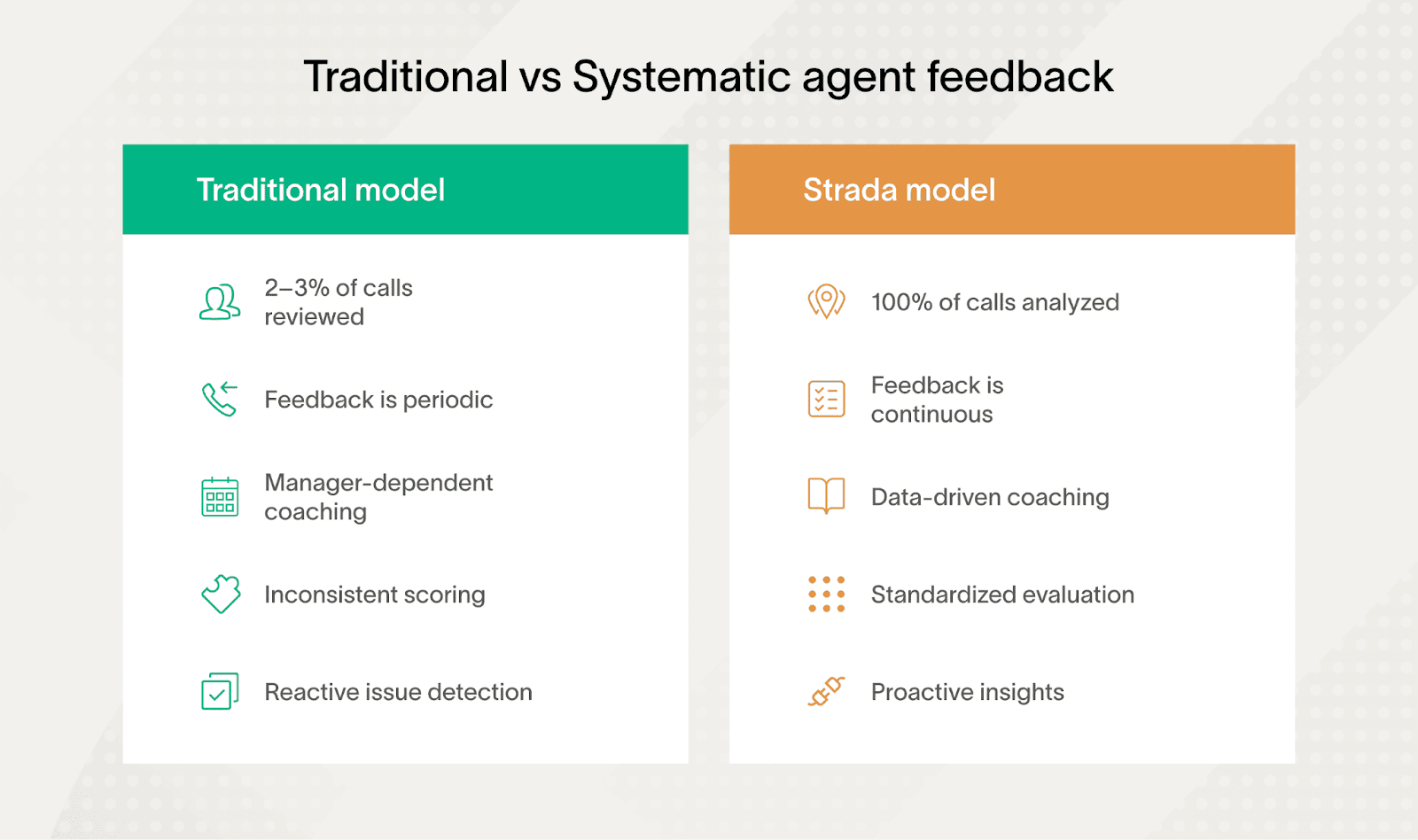
Strada turns QA into a continuous, automated system

In most insurance contact centers, fewer than 3% of calls are reviewed manually. 

Strada eliminates that constraint by analyzing 100% of voice interactions across FNOL, policy servicing, billing, and claims inquiries. For CX leaders managing 50–500+ agents, this directly affects the metrics they are accountable for:

Metric

Traditional feedback limitation

Strada impact

CSAT

Based on limited QA sampling

Driven by full interaction visibility

AHT

Diagnosed after trends emerge

Reduced through real-time behavior insights

FCR

Hard to link to agent behavior

Directly tied to conversational patterns

Compliance

Reactive audits

Proactive detection across all calls

This is where QA becomes operational infrastructure, not just a management activity.

From manual QA to an automated QA loop

The most important shift is structural. Strada converts feedback into an AI agent feedback loop that continuously improves both agent performance and customer outcomes.

Every call is automatically analyzed, scored, and tied to outcomes, creating a continuous QA loop that improves quality over time.

This loop ensures that feedback is not just delivered but validated against real-world impact, such as reduced repeat calls or improved claims resolution times.

Strada operationalizes agent feedback into measurable outcomes

Most organizations struggle to connect feedback to business results. Strada is designed specifically to bridge that gap.

Instead of generic scoring, Strada links call center agent feedback directly to operational KPIs that CX leaders own.

Connecting QA insights to core CX metrics

Strada connects QA signals directly to call quality metrics like CSAT, AHT, and FCR:

Behavior signal

Operational impact

Clear FNOL intake

Higher first call resolution

Empathy in claims calls

Increased CSAT

Accurate policy explanation

Reduced repeat calls

Proper escalation handling

Lower compliance risk

Call structure adherence

Reduced AHT

For example, reducing AHT is often approached as a time management issue. Strada reveals that in many cases, AHT is driven by:

  • Re-explaining policy details due to unclear initial communication

  • Inefficient call structure during claims intake

  • Missed opportunities to resolve issues in a single interaction

By identifying these patterns, feedback for customer service agent teams becomes targeted and outcome-driven.

Typical performance improvements observed

Across enterprise insurance environments, Strada-driven feedback systems typically correlate with:

Metric

Improvement range

Average Handle Time

15–25% reduction

First Call Resolution

10–20% increase

CSAT

8–15% increase

Agent Attrition

10–20% reduction

QA Coverage

From ~2% to 100%

These improvements are not theoretical. They are the result of aligning feedback with the actual drivers of customer experience.

Turning feedback into actionable manager insight

Strada does not replace managers. It makes them more effective by focusing their attention where it matters most.

Instead of reviewing random calls, managers receive prioritized insights such as:

  • Which agents are struggling with FNOL accuracy

  • Where escalation handling is breaking down

  • Which behaviors correlate with repeat calls

  • Which agents are improving after coaching

This enables managers to spend less time searching for issues and more time addressing them.

As a result, simple feedback AI agent systems evolve into strategic tools that guide manager decision-making at scale.

Strada embeds QA directly into insurance workflows

One of the biggest limitations of traditional QA is that it happens after the call, disconnected from the interaction itself.

Strada integrates feedback into the actual work environment of insurance agents.

Real-time and contextual feedback

Strada delivers insights tied to specific interaction types, such as:

  • FNOL calls

  • Policy changes

  • Billing disputes

  • Claims status inquiries

This ensures that call center agent feedback is not generic but contextual to the exact scenario the agent is handling.

For example:

  • During FNOL, feedback focuses on completeness and accuracy of intake

  • During claims calls, emphasis shifts to empathy and expectation setting

  • During policy servicing, clarity and compliance take priority

This contextual approach increases the relevance and adoption of feedback.

Reducing cognitive load for agents

Agents in insurance environments already manage complex systems and regulatory requirements. Adding more dashboards or reports reduces effectiveness.

Strada simplifies feedback delivery by:

  • Highlighting only the most critical behaviors

  • Providing concise, actionable insights

  • Aligning feedback with daily workflows

This is what defines a simple feedback AI agent. It reduces noise and increases clarity, allowing agents to focus on improvement without being overwhelmed.

Supporting compliance and audit requirements

Insurance CX leaders are also responsible for regulatory compliance. Feedback systems must support auditability and consistency.

Strada embeds compliance into the feedback model by:

  • Tracking adherence to required disclosures

  • Monitoring escalation protocols

  • Creating audit trails for every interaction

This ensures that feedback for customer service agent teams is aligned not only with performance but also with regulatory expectations.

Strada scales QA and coaching without increasing overhead

Scaling coaching across large teams is one of the hardest challenges for CX leaders. Traditional models rely heavily on manager capacity, which does not scale linearly with team size.

Strada enables professional development feedback AI agent systems that scale without increasing managerial overhead.

Personalized development at scale

Instead of generic training programs, Strada identifies individual skill gaps based on actual interactions.

Each agent receives feedback tailored to their performance patterns, such as:

  • Improving clarity in policy explanations

  • Strengthening empathy during claims calls

  • Reducing unnecessary call extensions

  • Handling objections more effectively

This transforms professional development from broad training initiatives into targeted, behavior-based improvement.

Manager leverage and coaching efficiency

Managers become more effective because they are no longer responsible for identifying issues manually.

Strada provides:

  • Ranked coaching priorities by agent

  • Trend analysis across teams

  • Visibility into coaching effectiveness

This allows one manager to effectively support a larger team without sacrificing quality.

Strada redefines how CX leaders measure and act on agent feedback

For CX executives, the ultimate question is not whether feedback exists, but whether it drives outcomes.

Strada provides a framework for measuring the effectiveness of agent feedback at a system level.

From activity metrics to outcome metrics

Traditional systems track activity:

  • Number of QA reviews

  • Coaching sessions completed

  • Feedback delivered

Strada shifts focus to outcomes:

  • Did CSAT improve after coaching?

  • Did AHT decrease for targeted behaviors?

  • Did FCR increase for specific interaction types?

This allows leaders to evaluate whether feedback is actually working.

A structured approach to feedback evaluation

Strada enables a structured evaluation model based on key dimensions:

Dimension

What it measures

Completeness

Was the customer issue fully resolved?

Tone

Was the interaction appropriate and empathetic?

Accuracy

Was policy information correct?

Efficiency

Was the issue resolved without unnecessary steps?

Compliance

Were regulatory requirements met?

This framework ensures that feedback is comprehensive and aligned with both customer experience and operational goals.

Continuous optimization through data

Because Strada operates on a full dataset of interactions, it continuously refines its feedback models.

This allows CX leaders to:

  • Identify emerging trends before they impact metrics

  • Adjust coaching strategies proactively

  • Align feedback with evolving business priorities

The result is a feedback system that improves over time rather than remaining static.

Conclusion

QA is no longer a secondary function in the contact center. It is the foundation of call center quality, efficiency, and compliance.

Strada transforms QA from a manual, partial process into an automated system covering every interaction. By analyzing every interaction, embedding insights into workflows, and connecting behaviors to outcomes, it enables CX leaders to manage performance with precision.

The shift is clear: from manual QA sampling to automated, continuous quality improvement.

If you want to understand how Strada can operationalize agent feedback across your contact center, request a tailored walkthrough based on your current CX metrics and workflows.

Frequently Asked Questions

How does Strada change the way agent feedback impacts CSAT and retention in an insurance contact center?

It connects specific agent behaviors like empathy and clarity directly to outcomes such as CSAT and repeat calls, making feedback a lever for measurable improvements rather than general coaching.

Why is reviewing only a small percentage of calls a risk for insurance CX operations?

Framer is a design tool that allows you to design websites on a freeform canvas, and then publish them as websites with a single click.

How does Strada ensure consistency in call center agent feedback across large teams?

Framer is a design tool that allows you to design websites on a freeform canvas, and then publish them as websites with a single click.

What should CX leaders expect when tying feedback to metrics like AHT and FCR?

Framer is a design tool that allows you to design websites on a freeform canvas, and then publish them as websites with a single click.

How does embedding feedback into workflows improve agent performance in insurance scenarios like FNOL?

Framer is a design tool that allows you to design websites on a freeform canvas, and then publish them as websites with a single click.

Start scaling with voice AI agents today

Join innovative carriers and MGAs transforming their calls with Strada.

Blog

/

AI & Automation

Agent Feedback at Scale: Automating QA to Improve Call Center Quality

Amir Prodensky

CEO

Apr 2, 2026

7 min read

Consistency, compliance, and performance in one system

Key takeaways:

  • Improving call center quality starts with fixing QA. Most teams rely on limited QA sampling and inconsistent coaching, making it impossible to link agent behavior to outcomes like CSAT and first call resolution.

  • Reducing average handle time depends on identifying root causes within conversations, such as unclear explanations or poor call structure, rather than enforcing time-based targets.

  • Scaling agent performance across large teams requires consistent, data-driven feedback on 100% of interactions, eliminating subjectivity and uneven coaching.

Enterprise insurance CX leaders are under pressure to improve call quality while controlling cost per interaction, but QA processes remain manual, partial, and inconsistent.

Yet most feedback systems still rely on partial data and inconsistent coaching. Strada automates QA across 100% of interactions, turning every call into structured, actionable insight.

The result is a continuous AI agent feedback loop that directly impacts CSAT, first call resolution, and agent retention.

Strada turns QA into a continuous, automated system

Traditional QA reviews only a small sample of calls, making feedback incomplete and inconsistent. Strada automates QA across every interaction, creating a continuous system for measuring and improving call quality.

Strada turns QA into a continuous, automated system

In most insurance contact centers, fewer than 3% of calls are reviewed manually. 

Strada eliminates that constraint by analyzing 100% of voice interactions across FNOL, policy servicing, billing, and claims inquiries. For CX leaders managing 50–500+ agents, this directly affects the metrics they are accountable for:

Metric

Traditional feedback limitation

Strada impact

CSAT

Based on limited QA sampling

Driven by full interaction visibility

AHT

Diagnosed after trends emerge

Reduced through real-time behavior insights

FCR

Hard to link to agent behavior

Directly tied to conversational patterns

Compliance

Reactive audits

Proactive detection across all calls

This is where QA becomes operational infrastructure, not just a management activity.

From manual QA to an automated QA loop

The most important shift is structural. Strada converts feedback into an AI agent feedback loop that continuously improves both agent performance and customer outcomes.

Every call is automatically analyzed, scored, and tied to outcomes, creating a continuous QA loop that improves quality over time.

This loop ensures that feedback is not just delivered but validated against real-world impact, such as reduced repeat calls or improved claims resolution times.

Strada operationalizes agent feedback into measurable outcomes

Most organizations struggle to connect feedback to business results. Strada is designed specifically to bridge that gap.

Instead of generic scoring, Strada links call center agent feedback directly to operational KPIs that CX leaders own.

Connecting QA insights to core CX metrics

Strada connects QA signals directly to call quality metrics like CSAT, AHT, and FCR:

Behavior signal

Operational impact

Clear FNOL intake

Higher first call resolution

Empathy in claims calls

Increased CSAT

Accurate policy explanation

Reduced repeat calls

Proper escalation handling

Lower compliance risk

Call structure adherence

Reduced AHT

For example, reducing AHT is often approached as a time management issue. Strada reveals that in many cases, AHT is driven by:

  • Re-explaining policy details due to unclear initial communication

  • Inefficient call structure during claims intake

  • Missed opportunities to resolve issues in a single interaction

By identifying these patterns, feedback for customer service agent teams becomes targeted and outcome-driven.

Typical performance improvements observed

Across enterprise insurance environments, Strada-driven feedback systems typically correlate with:

Metric

Improvement range

Average Handle Time

15–25% reduction

First Call Resolution

10–20% increase

CSAT

8–15% increase

Agent Attrition

10–20% reduction

QA Coverage

From ~2% to 100%

These improvements are not theoretical. They are the result of aligning feedback with the actual drivers of customer experience.

Turning feedback into actionable manager insight

Strada does not replace managers. It makes them more effective by focusing their attention where it matters most.

Instead of reviewing random calls, managers receive prioritized insights such as:

  • Which agents are struggling with FNOL accuracy

  • Where escalation handling is breaking down

  • Which behaviors correlate with repeat calls

  • Which agents are improving after coaching

This enables managers to spend less time searching for issues and more time addressing them.

As a result, simple feedback AI agent systems evolve into strategic tools that guide manager decision-making at scale.

Strada embeds QA directly into insurance workflows

One of the biggest limitations of traditional QA is that it happens after the call, disconnected from the interaction itself.

Strada integrates feedback into the actual work environment of insurance agents.

Real-time and contextual feedback

Strada delivers insights tied to specific interaction types, such as:

  • FNOL calls

  • Policy changes

  • Billing disputes

  • Claims status inquiries

This ensures that call center agent feedback is not generic but contextual to the exact scenario the agent is handling.

For example:

  • During FNOL, feedback focuses on completeness and accuracy of intake

  • During claims calls, emphasis shifts to empathy and expectation setting

  • During policy servicing, clarity and compliance take priority

This contextual approach increases the relevance and adoption of feedback.

Reducing cognitive load for agents

Agents in insurance environments already manage complex systems and regulatory requirements. Adding more dashboards or reports reduces effectiveness.

Strada simplifies feedback delivery by:

  • Highlighting only the most critical behaviors

  • Providing concise, actionable insights

  • Aligning feedback with daily workflows

This is what defines a simple feedback AI agent. It reduces noise and increases clarity, allowing agents to focus on improvement without being overwhelmed.

Supporting compliance and audit requirements

Insurance CX leaders are also responsible for regulatory compliance. Feedback systems must support auditability and consistency.

Strada embeds compliance into the feedback model by:

  • Tracking adherence to required disclosures

  • Monitoring escalation protocols

  • Creating audit trails for every interaction

This ensures that feedback for customer service agent teams is aligned not only with performance but also with regulatory expectations.

Strada scales QA and coaching without increasing overhead

Scaling coaching across large teams is one of the hardest challenges for CX leaders. Traditional models rely heavily on manager capacity, which does not scale linearly with team size.

Strada enables professional development feedback AI agent systems that scale without increasing managerial overhead.

Personalized development at scale

Instead of generic training programs, Strada identifies individual skill gaps based on actual interactions.

Each agent receives feedback tailored to their performance patterns, such as:

  • Improving clarity in policy explanations

  • Strengthening empathy during claims calls

  • Reducing unnecessary call extensions

  • Handling objections more effectively

This transforms professional development from broad training initiatives into targeted, behavior-based improvement.

Manager leverage and coaching efficiency

Managers become more effective because they are no longer responsible for identifying issues manually.

Strada provides:

  • Ranked coaching priorities by agent

  • Trend analysis across teams

  • Visibility into coaching effectiveness

This allows one manager to effectively support a larger team without sacrificing quality.

Strada redefines how CX leaders measure and act on agent feedback

For CX executives, the ultimate question is not whether feedback exists, but whether it drives outcomes.

Strada provides a framework for measuring the effectiveness of agent feedback at a system level.

From activity metrics to outcome metrics

Traditional systems track activity:

  • Number of QA reviews

  • Coaching sessions completed

  • Feedback delivered

Strada shifts focus to outcomes:

  • Did CSAT improve after coaching?

  • Did AHT decrease for targeted behaviors?

  • Did FCR increase for specific interaction types?

This allows leaders to evaluate whether feedback is actually working.

A structured approach to feedback evaluation

Strada enables a structured evaluation model based on key dimensions:

Dimension

What it measures

Completeness

Was the customer issue fully resolved?

Tone

Was the interaction appropriate and empathetic?

Accuracy

Was policy information correct?

Efficiency

Was the issue resolved without unnecessary steps?

Compliance

Were regulatory requirements met?

This framework ensures that feedback is comprehensive and aligned with both customer experience and operational goals.

Continuous optimization through data

Because Strada operates on a full dataset of interactions, it continuously refines its feedback models.

This allows CX leaders to:

  • Identify emerging trends before they impact metrics

  • Adjust coaching strategies proactively

  • Align feedback with evolving business priorities

The result is a feedback system that improves over time rather than remaining static.

Conclusion

QA is no longer a secondary function in the contact center. It is the foundation of call center quality, efficiency, and compliance.

Strada transforms QA from a manual, partial process into an automated system covering every interaction. By analyzing every interaction, embedding insights into workflows, and connecting behaviors to outcomes, it enables CX leaders to manage performance with precision.

The shift is clear: from manual QA sampling to automated, continuous quality improvement.

If you want to understand how Strada can operationalize agent feedback across your contact center, request a tailored walkthrough based on your current CX metrics and workflows.

Frequently Asked Questions

How does Strada change the way agent feedback impacts CSAT and retention in an insurance contact center?

It connects specific agent behaviors like empathy and clarity directly to outcomes such as CSAT and repeat calls, making feedback a lever for measurable improvements rather than general coaching.

Why is reviewing only a small percentage of calls a risk for insurance CX operations?

Framer is a design tool that allows you to design websites on a freeform canvas, and then publish them as websites with a single click.

How does Strada ensure consistency in call center agent feedback across large teams?

Framer is a design tool that allows you to design websites on a freeform canvas, and then publish them as websites with a single click.

What should CX leaders expect when tying feedback to metrics like AHT and FCR?

Framer is a design tool that allows you to design websites on a freeform canvas, and then publish them as websites with a single click.

How does embedding feedback into workflows improve agent performance in insurance scenarios like FNOL?

Framer is a design tool that allows you to design websites on a freeform canvas, and then publish them as websites with a single click.

Start scaling with voice AI agents today

Join innovative carriers and MGAs transforming their calls with Strada.

Blog

/

AI & Automation

Agent Feedback at Scale: Automating QA to Improve Call Center Quality

Amir Prodensky

CEO

Apr 2, 2026

7 min read

Consistency, compliance, and performance in one system

Key takeaways:

  • Improving call center quality starts with fixing QA. Most teams rely on limited QA sampling and inconsistent coaching, making it impossible to link agent behavior to outcomes like CSAT and first call resolution.

  • Reducing average handle time depends on identifying root causes within conversations, such as unclear explanations or poor call structure, rather than enforcing time-based targets.

  • Scaling agent performance across large teams requires consistent, data-driven feedback on 100% of interactions, eliminating subjectivity and uneven coaching.

Enterprise insurance CX leaders are under pressure to improve call quality while controlling cost per interaction, but QA processes remain manual, partial, and inconsistent.

Yet most feedback systems still rely on partial data and inconsistent coaching. Strada automates QA across 100% of interactions, turning every call into structured, actionable insight.

The result is a continuous AI agent feedback loop that directly impacts CSAT, first call resolution, and agent retention.

Strada turns QA into a continuous, automated system

Traditional QA reviews only a small sample of calls, making feedback incomplete and inconsistent. Strada automates QA across every interaction, creating a continuous system for measuring and improving call quality.

Strada turns QA into a continuous, automated system

In most insurance contact centers, fewer than 3% of calls are reviewed manually. 

Strada eliminates that constraint by analyzing 100% of voice interactions across FNOL, policy servicing, billing, and claims inquiries. For CX leaders managing 50–500+ agents, this directly affects the metrics they are accountable for:

Metric

Traditional feedback limitation

Strada impact

CSAT

Based on limited QA sampling

Driven by full interaction visibility

AHT

Diagnosed after trends emerge

Reduced through real-time behavior insights

FCR

Hard to link to agent behavior

Directly tied to conversational patterns

Compliance

Reactive audits

Proactive detection across all calls

This is where QA becomes operational infrastructure, not just a management activity.

From manual QA to an automated QA loop

The most important shift is structural. Strada converts feedback into an AI agent feedback loop that continuously improves both agent performance and customer outcomes.

Every call is automatically analyzed, scored, and tied to outcomes, creating a continuous QA loop that improves quality over time.

This loop ensures that feedback is not just delivered but validated against real-world impact, such as reduced repeat calls or improved claims resolution times.

Strada operationalizes agent feedback into measurable outcomes

Most organizations struggle to connect feedback to business results. Strada is designed specifically to bridge that gap.

Instead of generic scoring, Strada links call center agent feedback directly to operational KPIs that CX leaders own.

Connecting QA insights to core CX metrics

Strada connects QA signals directly to call quality metrics like CSAT, AHT, and FCR:

Behavior signal

Operational impact

Clear FNOL intake

Higher first call resolution

Empathy in claims calls

Increased CSAT

Accurate policy explanation

Reduced repeat calls

Proper escalation handling

Lower compliance risk

Call structure adherence

Reduced AHT

For example, reducing AHT is often approached as a time management issue. Strada reveals that in many cases, AHT is driven by:

  • Re-explaining policy details due to unclear initial communication

  • Inefficient call structure during claims intake

  • Missed opportunities to resolve issues in a single interaction

By identifying these patterns, feedback for customer service agent teams becomes targeted and outcome-driven.

Typical performance improvements observed

Across enterprise insurance environments, Strada-driven feedback systems typically correlate with:

Metric

Improvement range

Average Handle Time

15–25% reduction

First Call Resolution

10–20% increase

CSAT

8–15% increase

Agent Attrition

10–20% reduction

QA Coverage

From ~2% to 100%

These improvements are not theoretical. They are the result of aligning feedback with the actual drivers of customer experience.

Turning feedback into actionable manager insight

Strada does not replace managers. It makes them more effective by focusing their attention where it matters most.

Instead of reviewing random calls, managers receive prioritized insights such as:

  • Which agents are struggling with FNOL accuracy

  • Where escalation handling is breaking down

  • Which behaviors correlate with repeat calls

  • Which agents are improving after coaching

This enables managers to spend less time searching for issues and more time addressing them.

As a result, simple feedback AI agent systems evolve into strategic tools that guide manager decision-making at scale.

Strada embeds QA directly into insurance workflows

One of the biggest limitations of traditional QA is that it happens after the call, disconnected from the interaction itself.

Strada integrates feedback into the actual work environment of insurance agents.

Real-time and contextual feedback

Strada delivers insights tied to specific interaction types, such as:

  • FNOL calls

  • Policy changes

  • Billing disputes

  • Claims status inquiries

This ensures that call center agent feedback is not generic but contextual to the exact scenario the agent is handling.

For example:

  • During FNOL, feedback focuses on completeness and accuracy of intake

  • During claims calls, emphasis shifts to empathy and expectation setting

  • During policy servicing, clarity and compliance take priority

This contextual approach increases the relevance and adoption of feedback.

Reducing cognitive load for agents

Agents in insurance environments already manage complex systems and regulatory requirements. Adding more dashboards or reports reduces effectiveness.

Strada simplifies feedback delivery by:

  • Highlighting only the most critical behaviors

  • Providing concise, actionable insights

  • Aligning feedback with daily workflows

This is what defines a simple feedback AI agent. It reduces noise and increases clarity, allowing agents to focus on improvement without being overwhelmed.

Supporting compliance and audit requirements

Insurance CX leaders are also responsible for regulatory compliance. Feedback systems must support auditability and consistency.

Strada embeds compliance into the feedback model by:

  • Tracking adherence to required disclosures

  • Monitoring escalation protocols

  • Creating audit trails for every interaction

This ensures that feedback for customer service agent teams is aligned not only with performance but also with regulatory expectations.

Strada scales QA and coaching without increasing overhead

Scaling coaching across large teams is one of the hardest challenges for CX leaders. Traditional models rely heavily on manager capacity, which does not scale linearly with team size.

Strada enables professional development feedback AI agent systems that scale without increasing managerial overhead.

Personalized development at scale

Instead of generic training programs, Strada identifies individual skill gaps based on actual interactions.

Each agent receives feedback tailored to their performance patterns, such as:

  • Improving clarity in policy explanations

  • Strengthening empathy during claims calls

  • Reducing unnecessary call extensions

  • Handling objections more effectively

This transforms professional development from broad training initiatives into targeted, behavior-based improvement.

Manager leverage and coaching efficiency

Managers become more effective because they are no longer responsible for identifying issues manually.

Strada provides:

  • Ranked coaching priorities by agent

  • Trend analysis across teams

  • Visibility into coaching effectiveness

This allows one manager to effectively support a larger team without sacrificing quality.

Strada redefines how CX leaders measure and act on agent feedback

For CX executives, the ultimate question is not whether feedback exists, but whether it drives outcomes.

Strada provides a framework for measuring the effectiveness of agent feedback at a system level.

From activity metrics to outcome metrics

Traditional systems track activity:

  • Number of QA reviews

  • Coaching sessions completed

  • Feedback delivered

Strada shifts focus to outcomes:

  • Did CSAT improve after coaching?

  • Did AHT decrease for targeted behaviors?

  • Did FCR increase for specific interaction types?

This allows leaders to evaluate whether feedback is actually working.

A structured approach to feedback evaluation

Strada enables a structured evaluation model based on key dimensions:

Dimension

What it measures

Completeness

Was the customer issue fully resolved?

Tone

Was the interaction appropriate and empathetic?

Accuracy

Was policy information correct?

Efficiency

Was the issue resolved without unnecessary steps?

Compliance

Were regulatory requirements met?

This framework ensures that feedback is comprehensive and aligned with both customer experience and operational goals.

Continuous optimization through data

Because Strada operates on a full dataset of interactions, it continuously refines its feedback models.

This allows CX leaders to:

  • Identify emerging trends before they impact metrics

  • Adjust coaching strategies proactively

  • Align feedback with evolving business priorities

The result is a feedback system that improves over time rather than remaining static.

Conclusion

QA is no longer a secondary function in the contact center. It is the foundation of call center quality, efficiency, and compliance.

Strada transforms QA from a manual, partial process into an automated system covering every interaction. By analyzing every interaction, embedding insights into workflows, and connecting behaviors to outcomes, it enables CX leaders to manage performance with precision.

The shift is clear: from manual QA sampling to automated, continuous quality improvement.

If you want to understand how Strada can operationalize agent feedback across your contact center, request a tailored walkthrough based on your current CX metrics and workflows.

Frequently Asked Questions

How does Strada change the way agent feedback impacts CSAT and retention in an insurance contact center?

It connects specific agent behaviors like empathy and clarity directly to outcomes such as CSAT and repeat calls, making feedback a lever for measurable improvements rather than general coaching.

Why is reviewing only a small percentage of calls a risk for insurance CX operations?

Framer is a design tool that allows you to design websites on a freeform canvas, and then publish them as websites with a single click.

How does Strada ensure consistency in call center agent feedback across large teams?

Framer is a design tool that allows you to design websites on a freeform canvas, and then publish them as websites with a single click.

What should CX leaders expect when tying feedback to metrics like AHT and FCR?

Framer is a design tool that allows you to design websites on a freeform canvas, and then publish them as websites with a single click.

How does embedding feedback into workflows improve agent performance in insurance scenarios like FNOL?

Framer is a design tool that allows you to design websites on a freeform canvas, and then publish them as websites with a single click.

Start scaling with voice AI agents today

Join innovative carriers and MGAs transforming their calls with Strada.